
How-To | Data Enrichment – Make Informed Decisions (#EpoqPXD22)
In this slot, the speakers will present various solutions for data management.

Successful online shops generate vast amounts of data. Data mining uses self-learning algorithms to utilize this data and convert it into useful knowledge. These algorithms identify patterns that companies can use to learn a lot about their customers. Find out here what data mining is, how it works, and how you can use it to your advantage.

Here'swhatyou can expect to find in this blog article:
Data mining definition and distinction from big data
Key benefits of data mining in e-commerce
Examples of data mining applications in online retail
These data mining methods exist
Classification based on characteristics
Grouping through cluster analysis and segmentation
Discover dependencies through association rules and sequences
CRISP-DM: A standardized workflow
1. Task definition: Business understanding
2. Selection of relevant data sets: Data understanding
3. Preparing data: Data preparation
4. Selection and application of data mining methods: Modeling
5. Evaluation and interpretation of results: Evaluation
6. Application of results: Deployment
Conclusion: Use data mining to find out what your customer data reveals
Data mining describes the attempt to find patterns in data and make them usable. These patterns or empirical correlations should be identified as automatically as possible using algorithms. This method is typically used to analyze large amounts of data.
That is why it is sometimes equated with big data. However, big data primarily refers to the processing of large data sets and how technology makes this possible. Data mining, on the other hand, is a tool for making big data usable. It is even applied to huge databases to obtain structured data. Data mining searches the big data pool for usable information, thereby creating knowledge that would be virtually impossible to identify in large data sets without such assistance.
Data mining can enable accurate predictions regarding buyer behavior in e-commerce , thereby contributing to greater success. The technology makes it possible to draw conclusions about the purchasing behavior of prospects and customers from past purchases. The insights gained in this way can be used in almost all areas of online retail: from acquiring new customers to perfectly addressing existing customers to efficient after-sales measures.
Stay up to date on personalization: Sign up for the Epoq newsletter. Register now!
This makes it increasingly easy to target buyers or leads as if they were well known to the company as individuals —moving away from the customer target group and toward the specific needs, desires, and problems of each individual. This makes communication much more targeted and successful. This is also made possible by the many customer interactions in e-commerce and well-structured product data in online shops. This is because they enable algorithms to become increasingly accurate in their patterns and the forecasts derived from them.
Many companies already use data mining to extract valuable information from their data. The method provides important assistance in the following use cases, for example:
Patterns can be recognized in various ways. The technology determines different approaches depending on the objective.
In classification, objects are assigned to classes based on similarities or patterns. Specific implementations include neural networks, Bayesian classification, and decision trees. To explain this using a simple example for two classes: Customer is interested in new campaign "yes" or "no." Based on collected campaign data from the past, a model is learned that calculates the affinity as a probability for all customers. This method is repeated for several campaigns so that the best campaign can ultimately be played out for each customer.
Grouping and segmenting data sets helps to divide large amounts of data into smaller, homogeneous groups based on common or at least similar characteristics. The particular challenge for analysts here is that algorithms find these groups without prior knowledge, and additional analysis is necessary so that humans can also recognize the similarities. Furthermore, the similarities are not always usable.
Stay up to date on personalization: Sign up for the Epoq newsletter. Register now!
Recurring sequences and association rules are designed to reveal connections. The aim is to identify and exploit frequent combinations. They are used in e-commerce to identify and display patterns in customer behavior, e.g., IF (page load time > 2 seconds) THEN (customer abandons visit).
A uniform standard for data mining processes was created back in 2000: the CRISP-DM model (Cross Industry Standard Process for Data Mining) is designed to enable companies from all industries to obtain more accurate results more quickly and use them across sectors. To this end, this standardized process is divided into six phases. Depending on the task at hand, the focus is usually directed to a greater or lesser extent to the respective stages. Their sequence is also not strict, and it is quite common to switch between the individual phases.
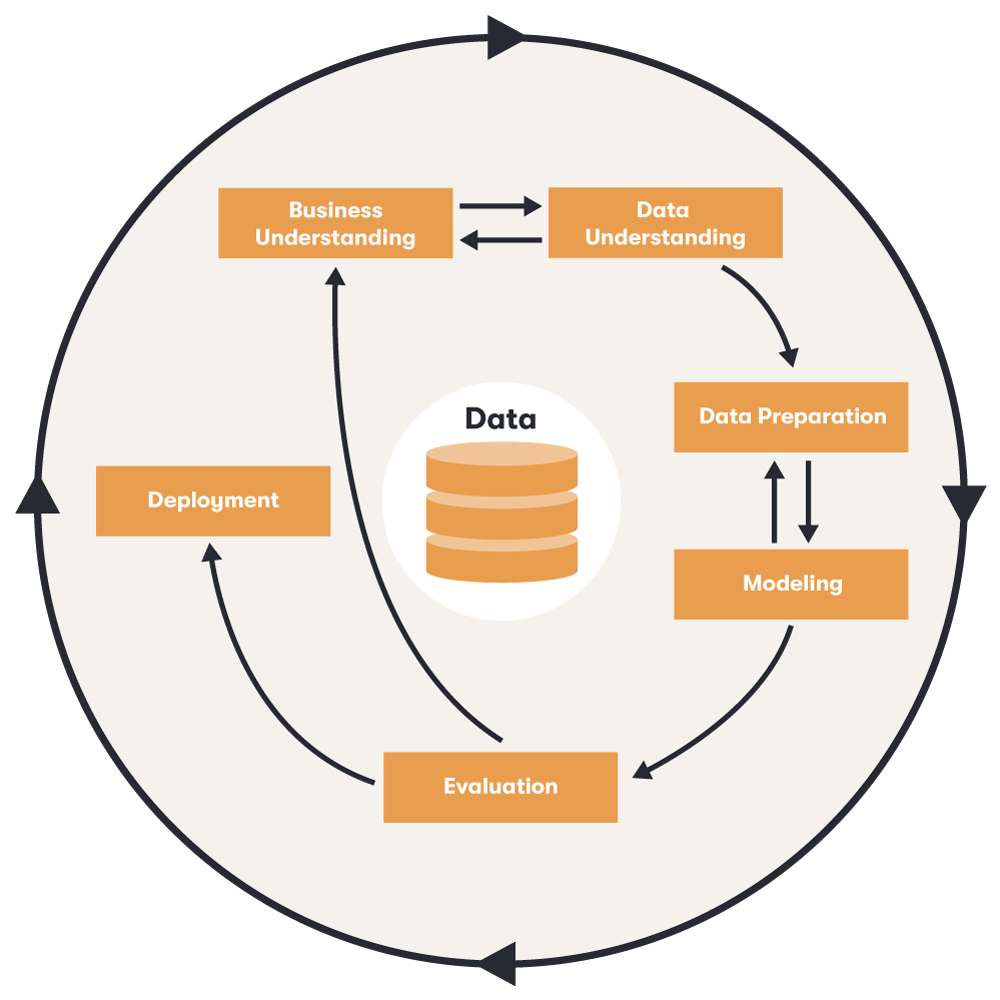
The CRISP-DM model according to Shearer shows the cross-industry standard process for data mining (source: own representation based on Shearer¹)
The aim of this stage is to describe the problem precisely in order to formulate specific requirements for data analysis. This important first step helps to define measures and check the process for target achievement.
In this phase , data is collected, described, and checked. An analyst therefore attempts to find suitable databases and understand them and their characteristics. They must analyze whether the data basis is sufficient to achieve the corporate goals formulated in the first step.
The data is now selected and cleaned. Both steps are necessary in order to obtain meaningful results. In addition, statisticians transform the data so that it can be presented in a meaningful way and used for modeling.
Analysts then select a suitable modeling technique and check again whether the data structure meets the modeling requirements. They create a test model and use it to check the quality and accuracy.
The test model is evaluated in terms of results and process before the company implements it. If the objectives of the data mining project are not achieved, the project manager decides which phase the project team will return to. If the model proves itself, it is implemented.
The insights gained are organized and processed so that the company can utilize the new knowledge.
Data mining enables you to tap into a wealth of knowledge that you would otherwise not have access to. This technology allows you to analyze your customer data and use it to find out how to increase customer acquisition and retention. However, it is important to take a targeted approach in order to draw reliable conclusions from the data.
Data mining is the process of automatically identifying patterns or correlations in large data sets and making them usable—usually with the help of special algorithms.
Big data primarily refers to the processing of large amounts of data and the technologies that make this possible. Data mining, on the other hand, is an analysis tool that is applied to such extensive data in order to discover patterns and usable information. It helps to extract knowledge from data that would be virtually impossible to identify without automated processes.
Data mining is used, for example, in forecasts of customer lifetime value, the optimization of cross-selling and upselling, customer segmentation, campaign optimization, and price optimization.
The most important methods include classification, cluster analysis, and association rules. They assign data to classes, group similar objects, or recognize connections and patterns in processes.
CRISP-DM (Cross Industry Standard Process for Data Mining) is a cross-industry model with six phases that standardizes data mining processes and structures them in a customizable way.
Want to learn how to unlock the full potential of your data?
Check out our webinar recording on this topic!

You are currently viewing placeholder content from HubSpot Embedded Content. To access the actual content, click the button below. Please note that doing so will result in data being shared with third-party providers.
More InformationYou are currently viewing placeholder content from HubSpot. To access the actual content, click the button below. Please note that doing so will result in data being shared with third-party providers.
More InformationYou are currently viewing placeholder content from HubSpot Meetings. To access the actual content, click the button below. Please note that doing so will result in data being shared with third-party providers.
More Information