
85% higher click-through rate in newsletters thanks to personalized category-based recommendations at babymarkt.de
babymarkt.de increased its click-through rate by 85% through personalized, category-specific newsletters.

Who hasn't experienced this themselves: when you don't urgently need anything in particular, you browse through a website while shopping online, add everything you like to your shopping cart, and as soon as the "Submit order" button comes into view, you back out and disappear again without buying anything. If you recognize yourself in this behavior, you're in good company. Studies have found that this happens more often in e-commerce than you might think: almost 70% of shopping carts in online stores are abandoned. This is normal behavior for store visitors, but it's frustrating for store operators, as it means losing sales that were almost certain.
Here's what you can expect to find in this blog article:
The most common reasons for shopping cart abandonment
What to consider when sending shopping cart abandonment emails
Requirements for sending shopping cart abandonment emails
Content of the shopping cart abandonment email
When to send the shopping cart abandonment email
The indecision described above is one of the most common reasons for abandoning a shopping cart, but it is by no means the only one. On the contrary, there are many different reasons for abandoning a shopping cart, and these do not always lie with the customer. Problems with the shop can also lead to abandonment. We have therefore compiled an overview of the most common reasons for abandonment:
There are various optimization strategies depending on the reason for abandonment. Some of them attempt to prevent shopping cart abandonment in general (e.g., clear communication of additional costs and simple checkout), while others aim to convince the visitor of the contents of their shopping cart after the fact. One of the most commonly used and effective strategies here is the shopping cart abandonment email. This involves sending an email to the customer some time after they have left the site to remind them of the abandoned shopping cart. When planning these customer emails, three points in particular should be taken into account: the requirements for sending the emails, the content, and the time of dispatch.
Stay up to date on personalization: Sign up for the Epoq newsletter: Register now!
As with all customer emails, there are legal requirements for shopping cart abandonment emails that must be clarified before they are sent. However, technical requirements must also be taken into account when dealing with shopping cart abandonment emails. Therefore, the first step is to check whether the following points are in place in the shop and email delivery system:
Are you already using cart abandonment emails to bring visitors back to your online store? What has been your experience with this type of email so far? We'd love to hear about it!
When determining the content, it is particularly important that the recipient does not feel observed, which could create a negative feeling. This works best with humor and creativity. This way, the email leaves a positive, lasting impression, even if the customer does not convert.
When designing the content, there are eight points to consider that make an abandoned cart email a successful optimization tool:
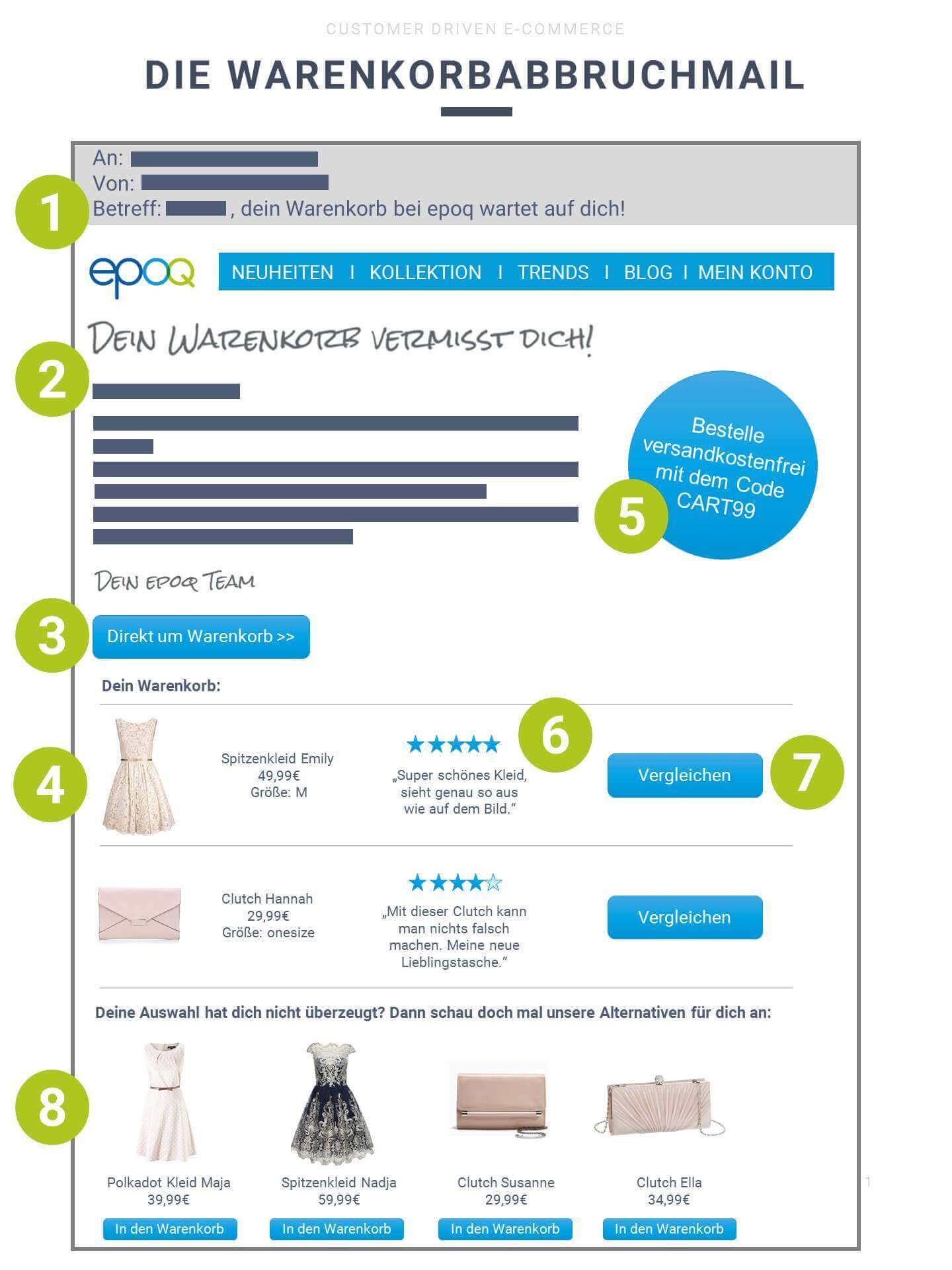
Eight elements of a shopping cart abandonment email
However, the perfect shopping cart abandonment email does not have to include all eight of the elements described above. Quite the contrary. Even simple text emails without a lot of bells and whistles can have a big impact. The ideal mix of content therefore depends mainly on the store and its customers.
Stay up to date on personalization: Sign up for the Epoq newsletter: Register now!
Finding the right time to send an email is not easy, even for weekly customer newsletters. With abandoned cart emails, there is the additional difficulty that there should not be too much time between leaving the store and sending the email, so that the customer does not forget about the shopping cart or has already made a purchase at another online store. At the same time, however, you should also avoid annoying the customer by sending the email too early.
According to Sales Cycle, the time with the best conversion rate is 20 minutes after leaving the shop. This makes perfect sense for a fashion shop. For a furniture shop, on the other hand, it is advisable to give the customer a little more time and only send the email after a few days, as such purchases require more time to decide. The frequency with which a customer receives abandoned cart emails must also be considered so that they do not feel pressured.
Finally, as with all other emails, the same rule applies: test, test, test. Different layouts, sending times, or incentives appeal to customers in different ways and thus generate different levels of success. A/B testing helps to test the different settings against each other.
A high shopping cart abandonment rate of almost 70% makes it necessary for shop operators to focus on this issue. Optimization strategies can be implemented proactively or retrospectively. One of the most effective tools for retrospective conversion is the shopping cart abandonment email. In order to convince the customer of the contents of the shopping cart and a purchase, additional content such as recommendations, reviews, and coupons can be integrated in addition to the actual shopping cart. The timing of the email must also be chosen so that the customer is ready to complete the purchase: not too soon after abandonment, so that they feel tracked, but also not too late, so that they have already purchased the items from another store.
Overall, the shopping cart abandonment email should be seen by the customer as a helpful tool and not just a sales tool. This can be achieved by leaving the customer with a positive feeling so that they are happy to come back.
Would you also like to send shopping cart abandonment emails? Then simply contact us or get more insights into our personalized email service.
Discover how babymarkt.de increased the click-through rate in its category-specific newsletter by 85%.
Read the case study now!

You are currently viewing placeholder content from HubSpot Embedded Content. To access the actual content, click the button below. Please note that doing so will result in data being shared with third-party providers.
More InformationYou are currently viewing placeholder content from HubSpot. To access the actual content, click the button below. Please note that doing so will result in data being shared with third-party providers.
More InformationYou are currently viewing placeholder content from HubSpot Meetings. To access the actual content, click the button below. Please note that doing so will result in data being shared with third-party providers.
More Information