Boost your click-through rate with trigger mail: Here's how it works
Find out how you can maximize the click rate in your online store with Trigger Mail!

As a shop owner, there is hardly any channel as important as your newsletter for connecting with your customers and building customer trust. But it's only worthwhile if you tailor it to your target audience. The click-through rate is an important metric that you can use to gauge the success of your emails. It tells you which readers you were able to convince to click on further content. That's why it's an indicator of how well an email is received by your target audience. Here you can find out how to calculate the click-through rate for newsletters, when your click-through rate is good, and how you can further optimize it.

Here's what you can expect to find in this blog article:
What is the click-through rate for newsletters?
Click-to-open rate vs. click-through rate
The click-to-open rate as an effective click rate
Difference between total click-through rate and unique click-through rate
How is the effective click-through rate of newsletters calculated?
Average effective click-through rate for newsletters
Tips for improving the click-through rate of your newsletters
#1 Segment your recipient list
#2 Use trigger-based workflows
#3 Personalize your approach and content
#4 Optimize for mobile devices
#5 Stick to a single CTA
#6 Choose the right images
#7 Give your most compelling arguments enough space
#8 Be creative and find new ways
Conclusion: Keep an eye on the click-through rate of your newsletters
Frequently asked questions about newsletter click-through rates
The click-to-open rate for newsletters indicates how many of the readers who opened a particular email clicked on the links it contained. It uses the open rate and compares it to the number of recipients who used a link to, for example, take advantage of offers or access content. This metric therefore tells you how well the newsletter content meets the expectations of your recipients.
Closely related is the CTR (click-through rate). This KPI indicates how many recipients of your newsletter clicked on a link in it. The difference between click rate and CTR is that CTR considers clicks independently of the open rate.
Both are helpful metrics in email marketing that enable you to draw various conclusions and point out potential in different areas. If you want to optimize your newsletter so that it interests recipients and encourages them to interact, the click-through rate is much more meaningful. The CTR, on the other hand, is more important for the overall success of your emails.
Comparing the click-to-open rate (effective click rate) to the open rate has a significant advantage: it allows you to compare metrics from different newsletters much more effectively than CTR. After all, CTR fluctuates depending on the open rate and delivery rate: if deliverability is poor, for example, the CTR will drop, but not necessarily the click rate. This is because the effective click-through rate is adjusted for these fluctuations, as the open rate serves as a fixed point. It is a relative click-through rate that you can use to optimize your newsletter content.
Stay up to date on personalization: Sign up for the Epoq newsletter. Register now!
While a good open rate indicates that the newsletter has piqued the interest of your recipients, a good click-through rate is a sign that the content is compelling.
The unique click rate indicates how many recipients clicked on a link. In contrast to the total click rate, this tells you how many recipients of your newsletter you were able to entice to click. The click-through rate itself indicates how often all recipients clicked on a link. This makes the unique click-through rate the more accurate click-through rate for your newsletter if you want to exclude very active recipients from the equation.
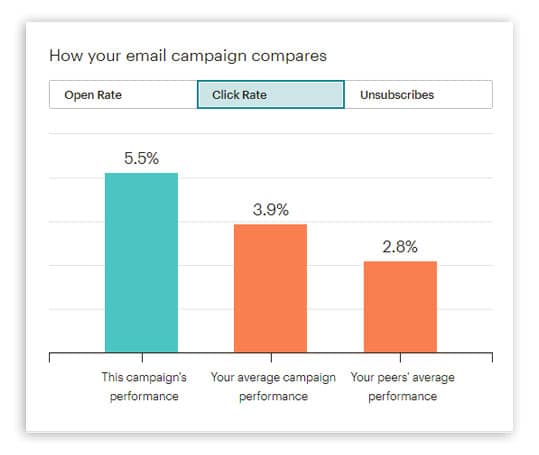
Email marketing tools can be used to analyze the click rate (in this case, the click-through rate) in comparison to average values, for example.
(Source: Mailchimp screenshot)
To calculate the click-to-open rate of your newsletter, take the number of users who clicked on a link in your email and divide it by the total number of users who opened your newsletter. Then multiply the result by 100 to get a percentage.
Example: If 2,000 recipients open the newsletter and 50 of them click on a link, the click-through rate is 2.5 percent.
The click-to-open rate of a newsletter averages just over ten percent. By comparison, the CTR is just over two percent. However, the rate in your industry can vary significantly. The education industry , for example, enjoys an average click-to-open rate of almost 16 percent. In wellness and fitness, on the other hand, it is only around six percent.
The click-through rate of your mailings depends on how well a newsletter is received by your recipients. That's why it's always worth focusing on optimizing this metric.
With the scattergun approach, you will reach individual customers much less effectively than if you make an effort to send emails tailored to your target group. Countless characteristics of your buyers help you to offer relevant content for each of them. This has a positive effect on open and click rates and ultimately increases the conversion rate. You also reduce the unsubscribe rate and increase the overall satisfaction of your customers. Even though segmentation is more time-consuming, it pays off.
You can also turn this around and use segmentation to send emails only to recipients on your list who are likely to be interested in the content. Read the case study to find out how Ex Libris used this tactic to automatically match newly released books with potentially interested customers, resulting in a 10x increase in email sales in their online store.
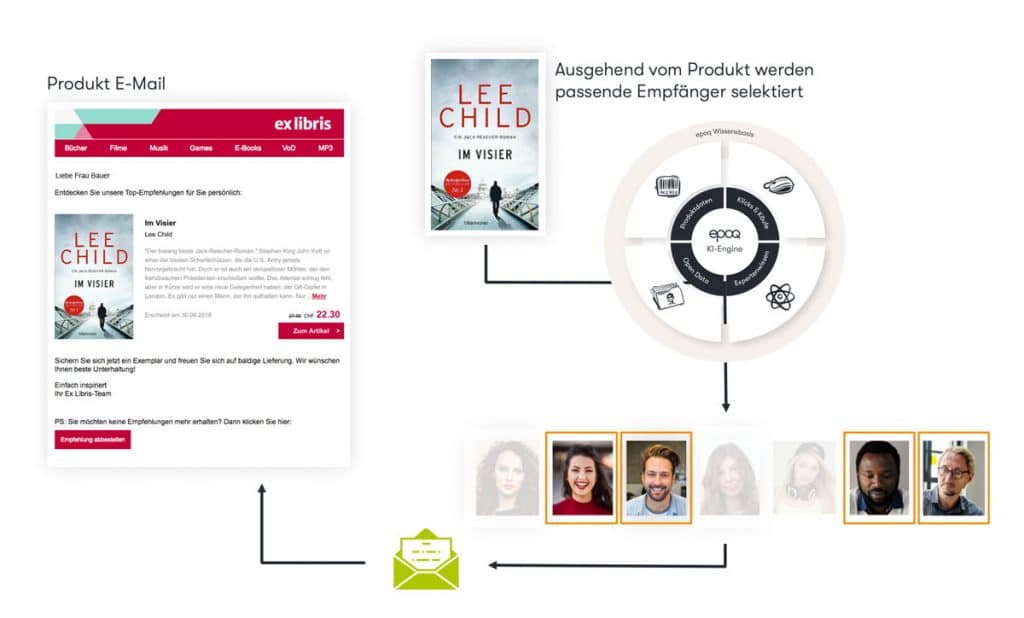
Based on the product, Ex Libris selects suitable recipients, who are the only ones to receive an email about the new product release.
With emails that reach your recipients at just the right moment, you can increase customer satisfaction, make compelling cross-selling offers, or win back customers. But it's impossible to manually send an email to everyone whenever a relevant event or date occurs. The solution to this is trigger-based workflows that are automatically triggered by certain events. This allows you to surprise customers with personalized birthday emails, welcome new newsletter recipients with a voucher, or specifically target existing customers.
Personalized messaging in emails has become almost standard practice. It’s one of the easiest tips to implement for your e-commerce newsletter. But it’s even better to send personalized content as well. You can do this, for example, by featuring personalized product recommendations that align with each recipient’s personal interests and individual preferences. This ensures your emails are more relevant to each customer, making them more valuable. Users open them more often and perceive it as a service when, for example, they learn in the email that a favorite product they viewed is currently on sale in their size. This way, you strengthen customer loyalty—not to mention that relevance is always good for the conversion rate.
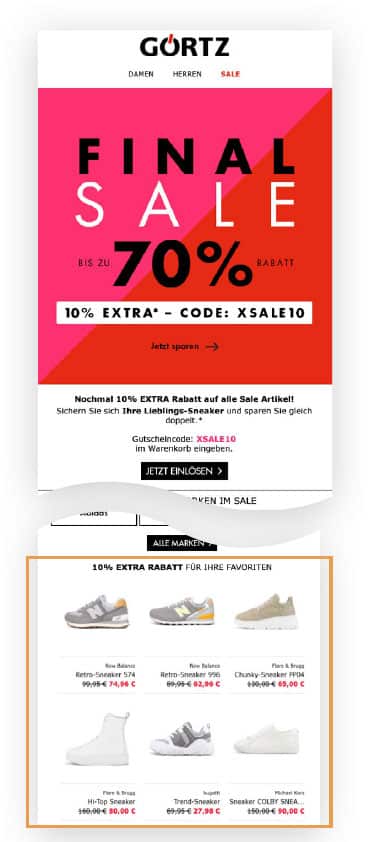
Personalized emails ensure relevance and can lead to increased click-through rates for newsletters.
(Source: Screenshot of email from goertz.de)
One of the most important email marketing tips is that you should always optimize emails for viewing and reading on mobile devices. Otherwise, you'll be wasting valuable potential. A recipient who is interested in your newsletter and opens it will be frustrated if they cannot read it properly on the go. They will not click on your offers and, in the worst case, may even unsubscribe from your mailing list. With the growing number of emails being accessed on smartphones, you can no longer afford to ignore this and should adapt your design accordingly.
A good call-to-action often makes a difference of several percentage points in click-through and conversion rates. However, constantly changing it reduces the recognition value of your newsletter and distracts your readers unnecessarily. Therefore , useA/B testing to find the CTA that your recipients respond to best and use it consistently. You will see that this has a positive effect on click-through rates and your sales.
The importance of visual elements in newsletters is often underestimated. However, you can appeal to customers on an emotional level more effectively with images than with text. That's why choosing the right images is crucial for success. Choose them carefully and avoid meaningless photos wherever possible.
Not only do you need to formulate your arguments and offers, but you also need to make sure there is enough white space. Many of your recipients do not read your emails thoroughly, but scan them for content that is relevant to them. White space allows you to draw attention to the right information.
Stay up to date on personalization: Sign up for the Epoq newsletter. Register now!
Whether you want to improve your newsletter open rate, click-through rate, or conversion rate, try new approaches and surprise your customers in a positive way. You are competing with dozens of other emails for your readers' attention. Only by being creative and daring to try new things can you win them over.
The click-through rate is a helpful metric that allows you to evaluate how well the content meets your readers' expectations of your emails. After all, this is what determines who clicks after opening your newsletter. However, even with good newsletters, the click-through rate is usually rather low. So use our tips to increase it further.
Source: ¹ Campaign Monitor
The click-through rate, also known as the click-to-open rate (CTOR), shows how many recipients clicked on a link after opening the newsletter. It measures clicks in relation to opened emails and provides information about how well the content motivates recipients to take action.
The click-through rate refers to clicks after opening the email, while the CTR refers to all recipients—regardless of whether they opened the email.
Because it evaluates clicks in relation to opens, thus avoiding distorting influences from delivery or open rates. This makes it easier to compare and optimize newsletters.
If you divide the number of recipients who clicked on a link after opening the email by the number of openings and multiply the result by 100, you get the click-through rate as a percentage.
On average, the click-to-open rate is just over 10%. However, it can vary greatly depending on the industry—from around 6% in the wellness and fitness sector to almost 16% in the education sector.
Learn how to increase your click-through rate with Trigger Mail.
Watch our webinar recording on this topic.

You are currently viewing placeholder content from HubSpot Embedded Content. To access the actual content, click the button below. Please note that doing so will result in data being shared with third-party providers.
More InformationYou are currently viewing placeholder content from HubSpot. To access the actual content, click the button below. Please note that doing so will result in data being shared with third-party providers.
More InformationYou are currently viewing placeholder content from HubSpot Meetings. To access the actual content, click the button below. Please note that doing so will result in data being shared with third-party providers.
More Information