
Boost your click-through rate with trigger mail: Here's how it works
Find out how you can maximize the click rate in your online store with Trigger Mail!

Email marketing is a powerful tool for connecting with store customers and encouraging them to return to your store. But how do you know if your email marketing is successful? In this blog article, we reveal which metrics are crucial in email marketing and how you can use them to monitor the achievement of your goals and measure your success.

Here's what you can expect to find in this blog article:
What are key figures and why are they important?
What goals can you pursue with email marketing?
Which metrics should you keep an eye on?
Delivery rate: Are your emails arriving?
Open rate: Are your emails being opened?
Click rate: Are your recipients interacting with the email content?
Conversion rate: Is the desired action being taken?
Additional metrics for successful email marketing
Conclusion: Know your key figures, measure target achievement, and increase email marketing success
Frequently asked questions about key figures in email marketing
Key performance indicators (KPIs) are used to show the performance of certain measures—for example, the performance of email marketing. They are important for tracking and evaluating measures. You can then derive and implement optimization options. It is important that the figures are interpreted correctly so that you can ultimately draw the right conclusions from them.
Overall, the key figures help you to see whether your set goals are being achieved. They give you an insight into what content is interesting for your recipients and where there may still be weaknesses. From this, you can gain valuable insights to make future newsletters and email campaigns even more effective.
Stay up to date on personalization: Sign up for the Epoq newsletter. Register now!
Since there are many criteria for successful emails, you should consider in advance what goal you want to achieve with your email marketing. You can then determine which metrics you should keep an eye on depending on your defined goal in order to identify trends. However, there are some basic email marketing metrics that you should be aware of in any case. We have compiled these for you in this article.
The goal you want to achieve with email marketing can vary greatly. For example, you can measure the increase in traffic based on the number of sessions on your website or in your online shop, determine the number of products or services sold, or measure the strengthening of customer loyalty based on the repurchase rate.
However, apart from your overall goal, you should definitely keep the following basic goals in mind and optimize your email marketing accordingly:
For each of these goals, you can use specific metrics to measure your success.
The following metrics are important for monitoring the achievement of the four email marketing goals mentioned above:
The delivery rate indicates the percentage of emails sent that successfully reach your recipients. This describes the first hurdle—that your sent emails actually end up in your customers' inboxes. According to Mailjet, this email marketing metric should be in the range of 95 to 100%.
Once the email has been successfully delivered, the next hurdle is getting it opened. The open rate describes the proportion of delivered emails that have been opened at least once. A distinction can be made between single opens (unique open rate) and multiple opens (total open rate). While the unique open rate counts only one opening per recipient, the total open rate includes all openings of the email (including multiple openings by individual recipients).
Since this metric allows you to determine whether your recipients open your email or whether it ends up unread in the trash, you gain valuable information about whether your content is interesting and whether the subject line is appealing.
According to OMT, the open rate should be between 20 and 25%.² However, this value can depend on various factors, such as the industry, the subject line, the sender's address, the time of sending, or the frequency of sending.
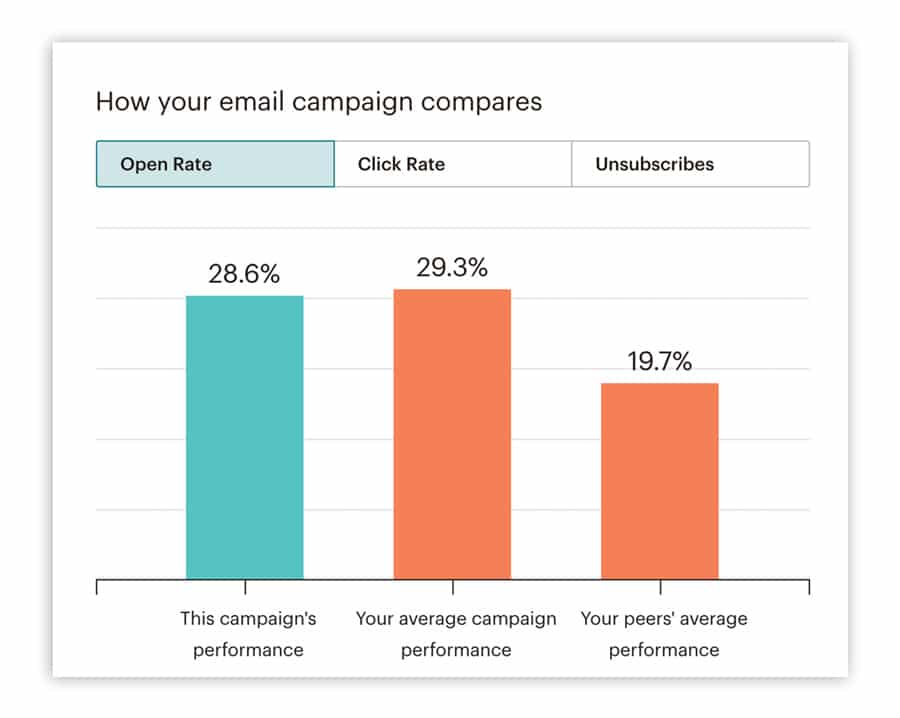
Example of the evaluation of the open rate compared to average values and those of similar users (source: Mailchimp screenshot)
To optimize your open rate, you can start with these points. For example, choose an appealing subject line that grabs attention. Many recipients decide whether to open an email based on the subject line. Address your recipients directly by name in the subject line or ask questions that pique their curiosity. Wordplay or emojis can also attract attention. Be sure to avoid spam-heavy words or characters, such as "free," "limited offer," or "you've won." You can find many more email spam words in this blog article from HubSpot.
The design of the pre-header (preview text of the email in the form of a short description) can also influence the open rate. You should also design this in an appealing way and motivate your recipients to read on and open the email with an inviting call to action.

Subject line and pre-header of a newsletter as an example (source: Mailchimp screenshot)
By choosing a trustworthy sender address and not using a noreply address, you can also increase your open rate.
Furthermore, the time of dispatch can play a decisive role. Here, you can follow best practices or simply test for yourself which dispatch time has the best effect on your recipients. Various email dispatch tools can also calculate the dispatch time automatically.
You can find out more about optimizing open rates in this guest article: Improving newsletter open rates through subject line testing and send time optimization.
The click-through rate describes the number of recipients who clicked on one or more links in your email after opening it. This metric helps you determine the performance of individual emails and provides insights into how many recipients interacted with your content. This, in turn, shows whether your content is interesting to your readers and whether your customer approach is convincing. According to Mailjet, a click-through rate between 3% and 7% is considered normal.³
Here, either all clicks or each recipient can be counted only once. In the second case, this is referred to as the unique click rate.
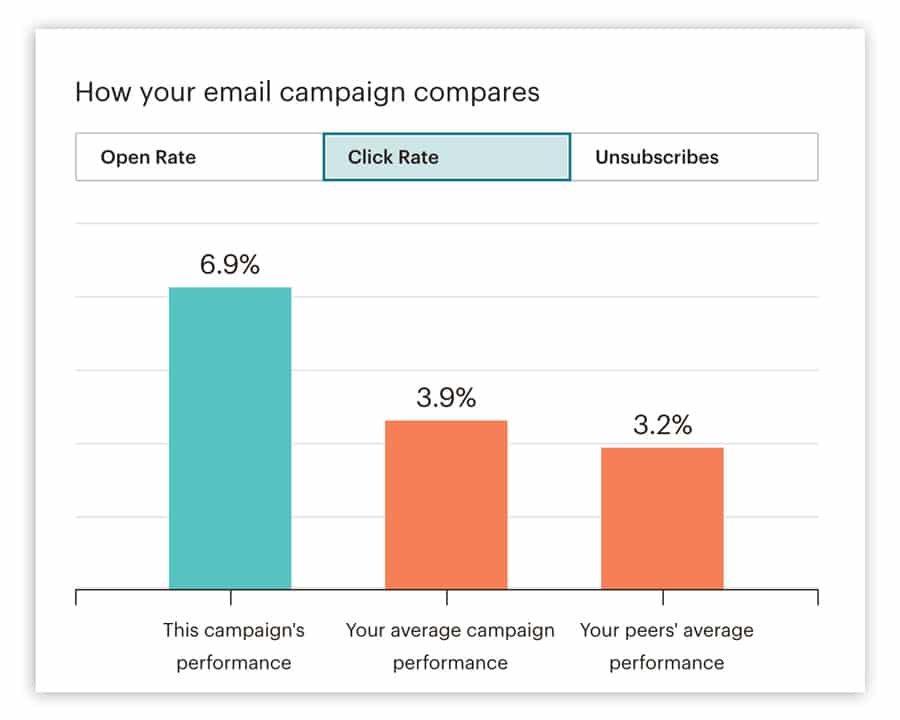
Example of click-through rate evaluation compared to average values and those of similar users (source: Mailchimp screenshot)
To increase the click-through rate, you can, for example, use email personalization and send emails that contain relevant content based on each user’s interests.
Stay up to date on personalization: Sign up for the Epoq newsletter. Register now!
You can also address your readers personally by name. The use of storytelling can also lead to higher click-through rates by generating emotions and building trust. The presentation of links and CTAs is also crucial in getting your recipients to interact with the content. Descriptive CTAs with clear calls to action and color-coded links or buttons can also increase the click-through rate. Make it clear to your recipients where they should click and what they can expect behind the link. In addition, the mobile view is also very important and should not be neglected.
Various email marketing tools allow you to view key figures directly in the form of reports and provide detailed analyses of your sent emails. If you would like to know more about how the individual key figures are calculated, you can find the formulas for calculating some key figures as well as calculation examples in an article by Christoph Hemmann on omt.de.
The conversion rate email marketing metric goes one step further. It refers to recipients who clicked on a link and then performed a specific (desired) target action. These actions can vary greatly, such as filling out a form, registering for an event, subscribing to a newsletter, downloading informational material, or purchasing a product. To measure conversions, tracking URLs for email links, such as Google Analytics' UTM parameters, are helpful. This allows you to track which email generated how many conversions.
Since the target action or the recipient's action takes place on the website or in the online shop, it is important to consider the influencing factors there. For example, the page layout, the registration or download process, or usability can be decisive for a conversion.
In addition to the metrics presented here, there are many other email marketing metrics that are worth keeping an eye on. We would like to briefly outline some of them below.
Note: The metrics listed above are only a selection of important KPIs. Of course, there are other metrics that can provide you with information about the success of your email marketing.
As with any marketing activity, you should know and understand the most important metrics in email marketing and keep a close eye on them. If you also draw the right conclusions from them, you can take appropriate optimization measures. It is important to note that, depending on the defined goal, different metrics may be more relevant than others. However, a basic understanding of the key metrics presented in this article is helpful in any case and can already help you increase your email marketing success in the long term.
KPIs are key performance indicators that show the performance of your email campaigns and help you track and evaluate them. This allows you to see whether your goals are being achieved, which content is interesting, and where there is room for improvement. As a result, you can design future emails more effectively.
With email marketing, you can pursue various goals, such as more website traffic, higher sales figures, or stronger customer loyalty. Basic goals such as delivery, opening, interaction, and ultimately the desired target action are important here.
The delivery rate, open rate, click-through rate, and conversion rate are important. They show you whether your emails are arriving, being opened, whether recipients are interacting with the content, and whether they are performing the desired action.
An appealing and personal subject line, a motivating preheader, and a trustworthy sender address increase the open rate. In addition, the time of sending plays an important role and can be optimized through testing or tools.
Personalized content, personal salutations, and emotional storytelling increase interest. Clear, eye-catching calls to action and an optimized mobile view also help recipients interact with your emails more easily.
Want to learn how to increase your click-through rate with trigger emails?
Watch our webinar recording!

You are currently viewing placeholder content from HubSpot Embedded Content. To access the actual content, click the button below. Please note that doing so will result in data being shared with third-party providers.
More InformationYou are currently viewing placeholder content from HubSpot. To access the actual content, click the button below. Please note that doing so will result in data being shared with third-party providers.
More InformationYou are currently viewing placeholder content from HubSpot Meetings. To access the actual content, click the button below. Please note that doing so will result in data being shared with third-party providers.
More Information