
- Increase Traffic
Improving newsletter open rates through subject line testing and send time optimization
You send out a newsletter with attractive offers, appealing images, and the perfect call to action. It's just a shame that some of your customers never get to see any of this because they don't even open the newsletter. Opening is the door to the newsletter. The open rate indicates the percentage of your customers who walk through the door. To increase the open rate of your newsletters, you should optimize two door openers: the subject line and the sending time. The best way to find the optimal subject line and best sending time is through testing. We'll show you how.

Here's what you can expect to find in this blog article:
Newsletter open rate – optimization options
Choosing the right testing method to increase your newsletter open rate
Subject line optimization
Sending time optimization
General tips for testing in email marketing
Conclusion: Utilize testing opportunities and increase the open rate of your newsletters.
Choosing the right testing method to increase your newsletter open rate
There are various testing methods in email marketing. "Classic" A/B testing is also common here, preferably as sample testing. Two or more variants of the variable to be tested (e.g., the subject line) are sent to one test group each, and after a certain period of time, the rest of the distribution list receives the variant with the best performance (in the case of a subject line test, the variant with the highest open rate). There are also multivariate tests in which several elements are tested in parallel, for example, the subject line and header image. In particularly advanced multivariate tests, email content is adapted to the test results in real time during the course of the campaign, so that a customer may already receive optimized content when they open the newsletter later. For this article, however, we will limit ourselves to A/B tests and show you how you can use them to increase the open rate of your newsletters.
Subject line optimization
The subject line is the first thing your customer sees from your newsletter in their inbox. Based on the subject line, they decide whether the content of the newsletter could be relevant to them. The information that makes sense to convey in a subject line can vary from business model to business model. The following elements are found in many subject lines:
- Personalized greeting: Mentioning your customer's name in the subject line can be an effective eye-catcher. Test whether a personalized greeting has an impact on the open rate of your newsletters. If communication guidelines allow, test both first-name and last-name greetings.
- Contents: What is the newsletter actually about? Briefly describe the content and test different descriptions. For example, if you are promoting new items from your online store, you could test the following alternatives against each other:
- Mention of specific products
- Mention of specific brands
- Mention of specific product categories
- general reference to new products without specifics
You may also have individual information about your customers that you can include to increase the open rate of your newsletters. For example, do they have favorite brands or products? Use this information and send personalized emails.
Stay up to date on personalization: Sign up for the Epoq newsletter. Register now!
- Argument: How does your newsletter benefit your customers? What are your arguments in favor of your cause? Test different arguments, e.g.
- Price ("10% discount")
- Practical benefits ("Less effort")
- Emotional benefit ("Impress")
- Shortage ("Only until")
- Social proof ("95% customer satisfaction")
- Context ("Ready for summer")
- Keyword: Back up your arguments with keywords such as "free," "exclusive," "almost sold out," "top seller," etc., and test different keywords for different arguments.
- Highlighting: Highlights such as capital letters or emojis attract your customer's attention. But be careful: too many "gimmicks" in the subject line can also appear unprofessional and sometimes even trigger spam filters. Here, too, the rule is: just try out what works and what doesn't.
- Order: First the personal greeting and then the argument? The emoji at the beginning or at the end? The order of the elements in the subject line can have a major impact on the open rate of your newsletters.
In addition to the subject line, your customers will also see the sender and, in some clients, the pre-header in their inbox. You can also test these variables. However, they have less impact on the newsletter open rate than the subject line.
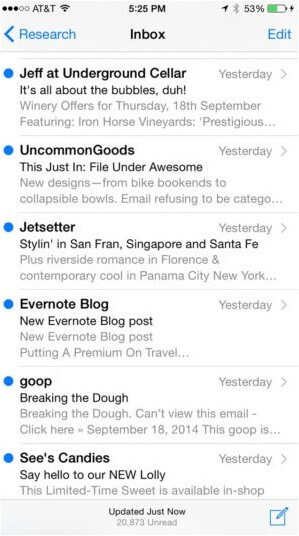
Examples of different subject lines (Image: artegic)
shipping time optimization
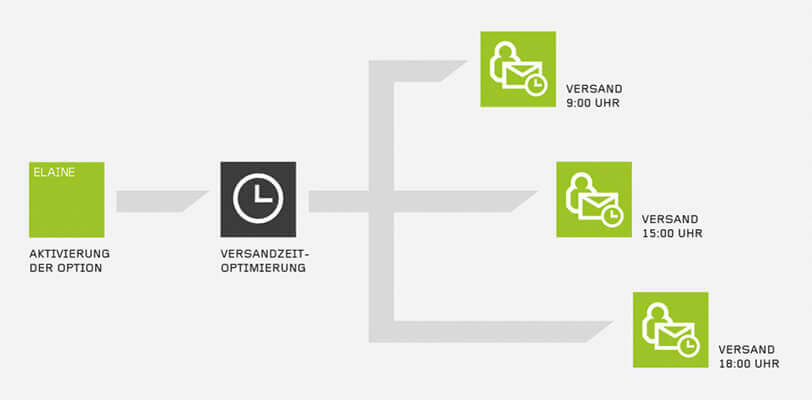
You've optimized the subject line perfectly through testing, but your newsletter still gets lost in the inbox because it always reaches your customers at the wrong time? In addition to the subject line, the time of dispatch is the second key factor for a high newsletter open rate. The right time to send is when your customers are most likely to be reading their emails and have the time and leisure to interact with your newsletter. Test different days and times and compare the open rates to determine the right time or times to send your newsletters.
If you don't want to test manually: Most email marketing technologies now offer functions for optimizing sending times, even on an individual basis. This means that an individual, optimal sending time is determined for each of your customers.
General tips for testing in email marketing
Finally, here are a few brief general tips for testing in email marketing:
- Ensure proper segmentation. Just because one subject line variant achieves a higher newsletter open rate than another for the entire distribution list, this does not necessarily apply to every segment.
- Set thresholds above which a test result is considered significant enough for you. An improvement of 0.1 percent is probably not significant, but an improvement of 5 percent is more likely to be significant.
- In addition, involve different people to develop ideas for test variants. The more input, the larger the pool of ideas.
- Test not only newsletters but also transactional emails and whatever else you send out.
You can find more tips and tricks for effective testing in email marketing in the artegic checklist "20 tips for successful testing in email marketing."
Conclusion: Utilize testing opportunities and increase the open rate of your newsletters.
The open rate is one of the key factors in optimizing your success in email marketing. You can improve it by optimizing the subject lines of your newsletters and by optimizing the time of dispatch. Test which subject lines work best with your customers and on which days and at what times the probability of opening the newsletter is highest.

Sebastian Pieper
Head of Marketing at artegic | Epoq Guest authorYou are currently viewing placeholder content from HubSpot Embedded Content. To access the actual content, click the button below. Please note that doing so will result in data being shared with third-party providers.
More InformationYou are currently viewing placeholder content from HubSpot. To access the actual content, click the button below. Please note that doing so will result in data being shared with third-party providers.
More InformationYou are currently viewing placeholder content from HubSpot Meetings. To access the actual content, click the button below. Please note that doing so will result in data being shared with third-party providers.
More Information