Back to overview
  • Reduce Return Rate

More personal, faster, closer: How conversational commerce is transforming digital shopping

  • Published August 6, 2025
  • Sarah Birk
  • Reading time: 15 min.

Conversational commerce is one of the most important drivers in digital commerce. It is gaining importance not only through the spread of chatbots, but above all through rapid advances in artificial intelligence—especially in powerful large language models. These technologies significantly enhance previously rigid systems and generic responses. More and more customers expect fast, personalized, and simple interactions – 24/7 and on all relevant channels. With intelligent, dialogue-based solutions, you can improve the shopping experience through greater proximity, trust, and efficiency. Conversational commerce is thus changing not only purchasing behavior, but also the way companies communicate with their target groups. In this article, we show why conversational commerce is so much more than simple chatbots today and what potential lies in the new, truly intelligent dialogue solutions.

Consulting situation in a perfume store as a pictorial representation of personal, digital customer dialogue in conversational commerce.

Definition: What is conversational commerce?

Chris Messina coined the term "conversational commerce" in 2015. What's more, the former Google developer advocate has been instrumental in driving this innovative approach forward.

Conversational commerce refers to direct, dialogue-based communication between companies and customers, e.g., via chatbots, messengers, or shopping assistants. Chatbots and similar applications are not new in themselves, but technological change—especially AI-based systems such as large language models (e.g., ChatGPT, Gemini)— is transforming simple, pre-programmed responses into genuine conversations that respond individually to users and can serve multiple customers simultaneously.

This development significantly increases the relevance of conversational commerce, as user behavior and expectations are also changing: users increasingly want to communicate in natural language and receive fast, personalized solutions.

This form of communication supports the purchasing process, making it easier, more accessible, and more personalized —for both sides. Customers ask questions, seek personal advice, or make direct purchases via the channel that is most convenient for them. Companies can thus engage in direct dialogue, build trust, and accompany their customers every step of the way through the purchasing process.

For example, you can offer them digital purchasing advice that helps them find what they are looking for quickly and efficiently.


The importance of conversational commerce for online retail

A 2021 report by McKinsey emphasizes the importance of conversational commerce. It states that 71% of consumers expect personalized interactions —and 76% are frustrated when this is not the case. In addition, 40% of fast-growing companies would increase their sales through personalization measures.

Although these figures do not explicitly refer to conversational commerce, they clearly show the overall relevance of personalization in digital commerce, which is precisely where conversational commerce comes in. Dialogue-based applications such as chatbots are particularly efficient at implementing personalized experiences.

Around 60% of users confirm that personalized recommendations from chatbots have a positive influence on their purchasing decisions, especially when these are used specifically in e-commerce or on websites. This increases brand loyalty and conversion rates. In addition, current figures show that 83% of consumers are more loyal to brands when companies actively use chatbots.

The following key figures also show how strongly conversational commerce can support online retail:

  • 58% of consumers particularly appreciate the round-the-clock availability of virtual assistants.⁴ This is a clear advantage over traditional service hours.
  • Chatbots successfully resolve 71% of customer inquiries, which significantly increases satisfaction.⁵
  • In many cases, chatbots lead to an average conversion increase of 23% —in e-commerce, values of up to 70% are possible.
  • At the same time, up to 80% of standard inquiries can be processed automatically, reducing the support workload by up to 30%.⁶

The combination of personalization and interaction is crucial, and conversational commerce brings both together. Smart, context-sensitive communication not only informs customers, but also provides them with targeted advice and ultimately motivates them to make a purchase—efficiently, individually, and scalably.


Stay up to date on personalization: Sign up for the Epoq newsletter. Register now!


Goals and benefits of conversational commerce

The wider the range of products and services offered on the internet, the more important customer service becomes. By engaging with potential customers early on and providing them with personalized support, you simplify and optimize their experience with your brand and your store, even on their preferred channel. After all, customers want to interact and shop where they enjoy spending time and regularly visit—whether on social media, in messenger apps, or directly in your online store. This shortens the process and allows you to identify and address requests or problems immediately, often in real time.

Genuine dialogue builds trust

Conversational commerce focuses on genuine dialogue between companies and customers. Instead of automated, one-way communication, a personal conversation takes place, which builds trust and personalizes the shopping experience.

Customers feel welcomed, taken seriously, and individually cared for. Their questions, wishes, and any uncertainties are brought into focus and actively addressed. The focus is on providing advice—not on making a quick sale. When customers feel that their concerns are heard and understood, they are more satisfied with the entire shopping experience.

Satisfied customers are happy to return. Those who feel well advised stay loyal—a win-win situation for both sides.

The most important advantages at a glance

Conversational commerce offers numerous advantages—here are the most important ones at a glance:

  • Round-the-clock availability: Customers can ask questions or receive support at any time, even outside business hours.
  • Targeted and automated advice: Intelligent systems can be used to provide answers, recommendations, and information automatically. Tailored precisely to the situation at hand.
  • Making the purchase decision easier: Those who quickly obtain the right information find it easier to make their purchase decision and feel more confident about it.
  • Increase in conversion rate: Fewer abandoned purchases because questions are answered immediately and uncertainties are addressed directly.
  • Reduction in the return rate: Providing accurate advice before the purchase leads to accurate expectations of the product and results in fewer returns.
  • Improved customer experience: Personalized, fast dialogue ensures a pleasant shopping experience and leaves a valuable, positive impression.
  • Stronger customer loyalty: Individual communication creates closeness, trust, and recognition value. Customers feel understood and are happy to make repeat purchases.

Internal processes also benefit significantly, especially with AI-supported solutions in conversational commerce. Automated processes accelerate problem solving, reduce the workload on customer service, and lower operating costs in the long term.

Example: Employees can use chatbots or voice commands to check inventory levels without having to switch between systems. Assistants can also access internal knowledge to efficiently answer recurring questions and relieve teams of day-to-day tasks.

Channels and APIs: Prerequisites for conversational commerce

You have various options if you want to integrate conversational commerce into your processes. The key question is: Where is your target audience located, and through which channels do your potential customers communicate? Once you know this, you can specifically target the appropriate communication channels—such as messaging services or your own online store—and connect them with the necessary technical interfaces (APIs) to enable seamless, dialogue-based experiences.

Conversational commerce via messenger and social networks

Many providers, such as API service providers like Sinch or platforms like Meta, enable dialogue-based shopping experiences via messenger and social networks. With the help of APIs (application programming interfaces), you can connect systems such as chatbots, CRM, or shop systems with channels such as WhatsApp, Facebook Messenger, or Instagram, enabling centralized control and management of communication.

A well-known example is the WhatsApp Business API: It enables automated communication directly in the messenger, for example for support, ordering processes, or personalized recommendations.

Providers such as Sinch also support cross-channel interactions, e.g., via SMS, RCS, or various meta services. This allows you to efficiently integrate your existing systems and create seamless, AI-supported customer dialogues across multiple channels.

Conversational commerce directly in the online store

In addition, many shop systems now also offer direct integration options for conversational commerce, for example via their own APIs or via app stores and extensions within the shop platform.

With Shopify, Magento, Salesforce Commerce Cloud, or Shopware, you can integrate chatbots, product advice, and messaging functions directly into your store. This allows you to start conversations exactly where purchasing interest or advice is needed— for example, in the product listing, in the shopping cart, or during checkout. With Shopify, dialog-based features can be implemented via native extensions or third-party apps, for example. This allows you to seamlessly integrate flexible solutions into your existing commerce infrastructure.

The key here is to tailor communication to the users' preferred places of interaction. Whether directly in the online shop or on social media and messaging channels such as WhatsApp, Facebook, or Instagram, conversational commerce becomes truly user-centric and reaches customers exactly where their interest and needs arise.

Technology: How conversational commerce works

How can intelligent, smooth dialogues with customers be guaranteed? The answer lies in the interaction of various modern technologies —above all, artificial intelligence (AI). AI is a collective term that encompasses various specialized technologies that together form the technical basis for conversational commerce.

An overview:

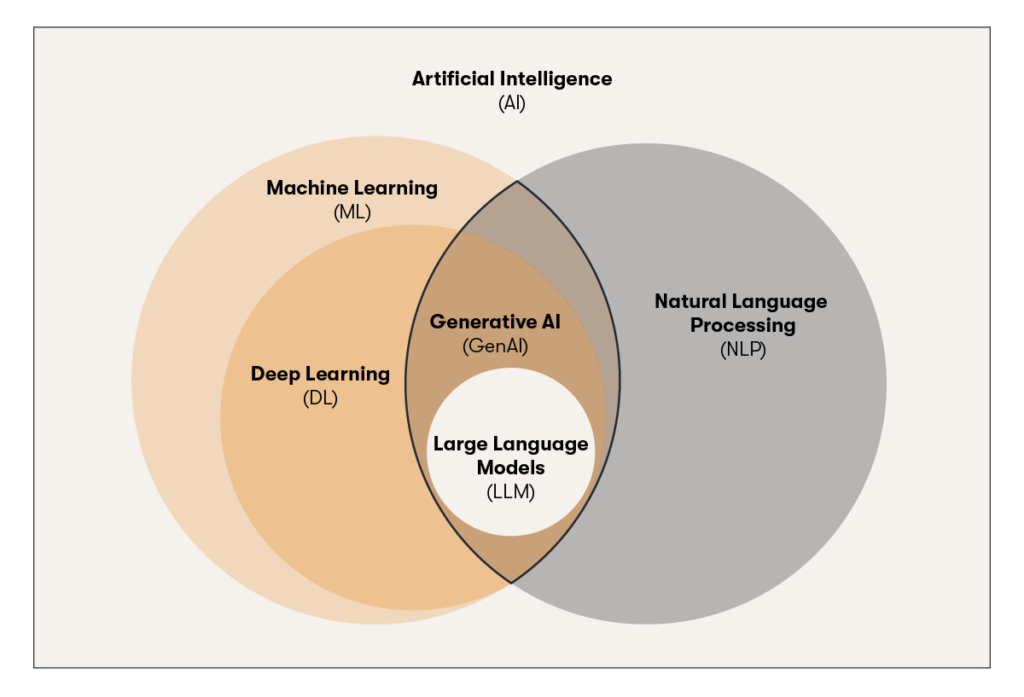
  • Artificial intelligence (AI) generally describes systems that perform tasks that typically require human intelligence, such as understanding language or making decisions.
  • Machine learning (ML) is a subfield of AI. Here, systems learn independently from data in order to continuously improve their performance.
  • Deep learning (DL) is a specialized method within machine learning. Based on artificial neural networks, it recognizes particularly complex relationships. Deep learning is the basis for many modern speech and image processing systems.
  • Natural Language Processing (NLP) is also part of AI and enables computers to understand, interpret, and respond to human language, whether spoken or written.
  • Large language models (LLMs) are particularly powerful AI models within the field of NLP. They are based on extensive language data and can generate highly complex, context-related texts or answer questions.
  • Generative AI (GenAI) is an umbrella term for AI systems that can independently generate new content such as text, images, or recommendations. LLMs are an example of generative AI in the field of language.

The potential of these technologies is particularly evident in conversational commerce: NLP enables systems to understand natural language in text or speech form. LLMs such as GPT models enable particularly natural, flexible, and context-sensitive dialogues. Based on this, generative AI can even make product recommendations or handle complex customer inquiries independently. And thanks to machine learning, these systems are continuously improving through interactions, feedback, and user data.

The following graphic illustrates the relationships between the technologies mentioned. It shows how the various areas of AI interlock.

Interrelationships between key AI technologies that serve as the basis for conversational commerce (source: own illustration)

Another important aspect is semantics. Only when systems not only recognize keywords but also understand the actual meaning behind a customer query can a truly helpful, natural dialogue emerge. This ability is particularly crucial for support or purchasing advice. After all, nothing frustrates customers more than inappropriate or generic responses.

Application: AI Shopping Assistant as a possible use case

Conversational commerce can support the digital shopping process in many ways—depending on which channels your customers prefer and how they like to communicate. An AI shopping assistant is a particularly innovative and central example of this application, providing customers with targeted guidance and support during their shopping experience.

What is the AI Shopping Assistant?

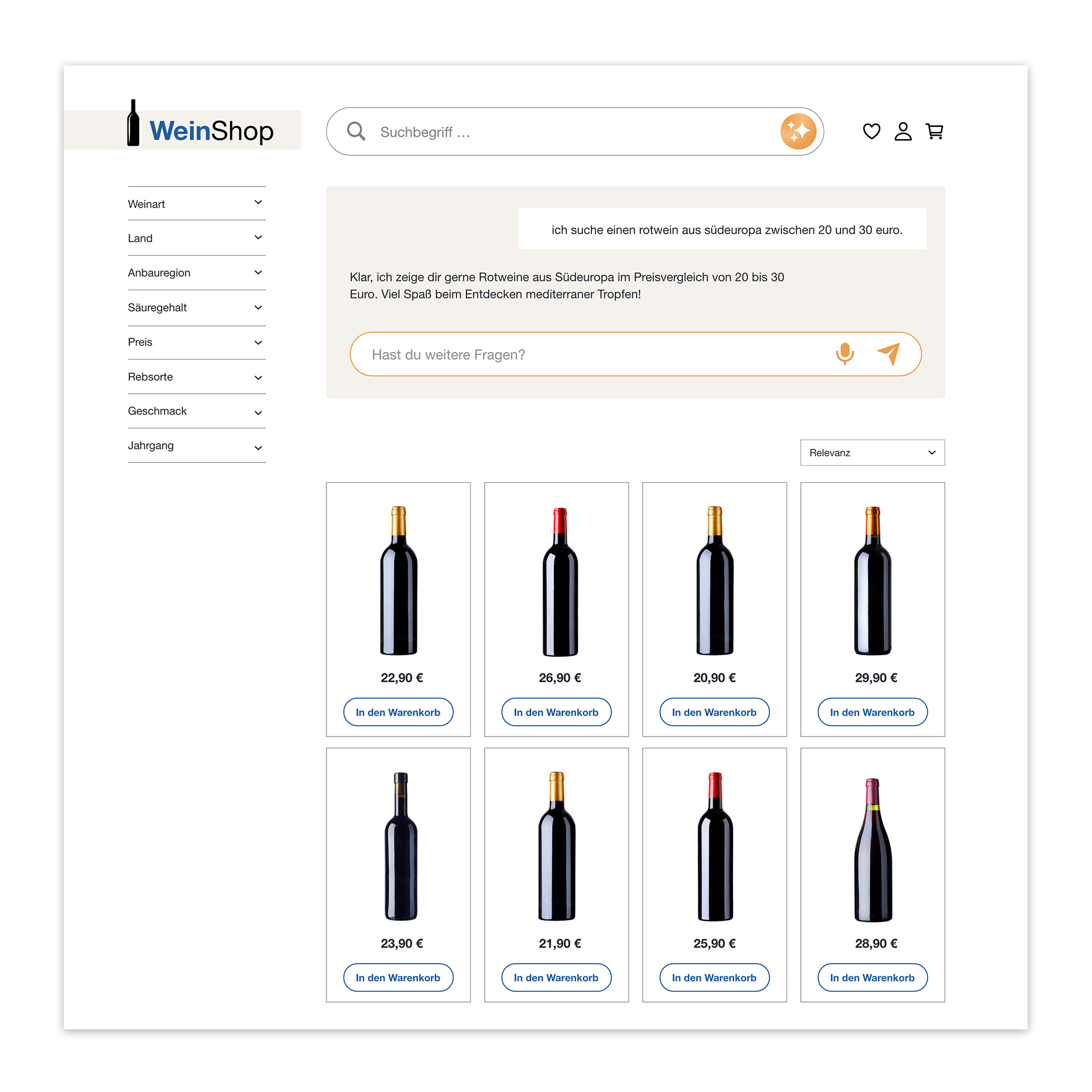
An AI shopping assistant is an AI-powered application. It proactively accompanies shoppers and helps them search for products, find suitable items, and make confident purchasing decisions. The AI shopping assistant thus functions like a digital sales consultant: it asks questions, makes suggestions, and guides shoppers through the purchasing process—directly in the chat window—via text or voice.

It can also be understood as a modern advancement of guided selling. Whereas structured processes, in which users had to answer questions or make selections step by step, were previously the norm, the AI Shopping Assistant relies on natural, flexible dialogue. It responds dynamically to individual requests and adapts to the respective situation.

To profitably combine personalization, convenience, and efficiency, you can use such AI assistants as chatbots on your website, in messaging apps, or as voice assistants. Used correctly, virtual shopping assistants can Customer satisfaction and loyalty and significantly increase sales.

The AI Shopping Assistant also understands complex queries with multiple criteria and formulates appropriate recommendations. (Source: Own representation)

What makes the AI Shopping Assistant special?

The key advantage of an AI shopping assistant lies in its ability to conduct personal, context-related conversations —similar to a good sales pitch in a brick-and-mortar store. This is made possible by combining customer data, such as click and purchase behavior, with advanced technologies such as large language models (LLMs).

LLMs enable digital assistants to conduct natural, flexible dialogues that adapt individually to the situation, preferences, and behavior of each customer. This results in a genuine exchange rather than a rigid sequence of questions—one that is understandable, dynamic, and in real time.

The result: customers receive personalized product recommendations, targeted assistance with their selection, and a completely seamless shopping experience. This not only increases convenience, but also satisfaction, trust, and ultimately willingness to buy.

Important! As helpful as AI and data-based technologies are, it is important to keep legal requirements in mind when innovating. GDPR compliance is particularly crucial when handling personal data. Every company must ensure that user data is processed in accordance with data protection regulations and that all systems used operate transparently and traceably. This is the only way to strengthen customer trust in the long term.

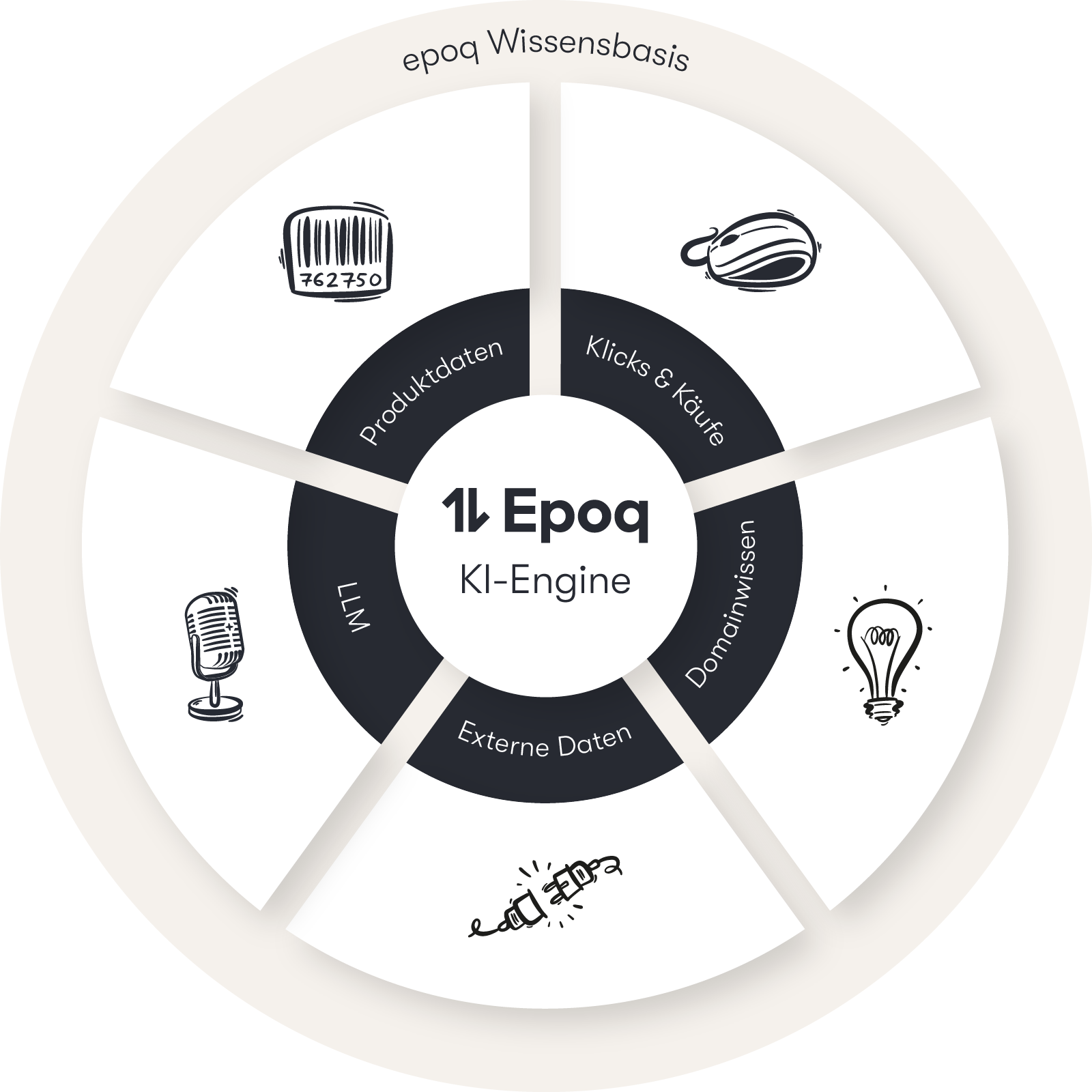
Clicks and purchases, domain knowledge, external data, LLM, and product data are brought together in a shared knowledge base
and form the basis for AI-supported conversational commerce. (Source: Own representation)

What other possible applications are there?

In addition to the AI shopping assistant, conversational commerce offers other applications to support customers in the digital shopping process. The possibilities range from quick responses in chat to voice control while shopping.

For example, it is possible to order products using voice commands with Alexa. If you say, "Alexa, buy laundry detergent," you will immediately receive suitable suggestions, either based on previous purchases or selected recommendations such as an Amazon's Choice product. Alexa will tell you the price, name, and delivery time right away. For recurring orders, the system prefers to use familiar products.

Another example is completing a purchase via a messenger service. Instead of receiving updates on their order by email, customers receive them directly via WhatsApp or Facebook Messenger. Information on the shipping status or delivery time is thus sent directly to where it can be seen quickly. Queries can also be conveniently clarified in the chat, without having to go through service hotlines or customer accounts.

Use cases and touchpoints along the customer journey

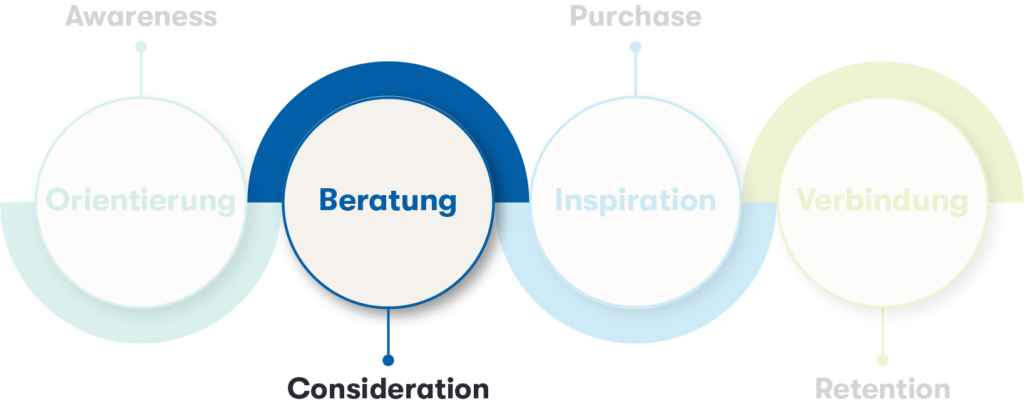
Conversational commerce makes it possible digital shopping experience more human – from orientation to purchase and beyond. Especially in the Consideration phase does this type of digital technical advice plays a central role: it removes uncertainties, provides targeted support for decision-making, and helps to reduce the return rate.

During the consideration phase, potential customers actively compare different products in order to prepare for a purchase decision
, which is why individual advice is crucial. (Source: Own representation)


However, a wide range of applications for conversational commerce can also be identified at other touchpoints—from initial contact to after-sales service. Along the customer journey, the possible applications can be classified as follows:

Awareness

In the awareness phase, conversational commerce solutions support product searches, for example, and help provide initial information or spark the interest of potential customers through targeted, personalized communication.

Consideration

As soon as the purchase intention becomes concrete, these systems come into play in the consideration phase: Here, they offer targeted product advice, suggest suitable personalized offers, or enable appointment bookings and pre-orders to simplify the decision-making process.

Purchase

During the purchase phase, chatbots, shopping assistants, and similar tools ensure a smooth process by guiding customers through the ordering process , assisting them with completing their purchase , or proactively providing shipping and delivery information . They can also increase the value of the shopping cart and address additional customer needs through targeted product recommendations and cross-selling offers.

Retention

The use of conversational commerce does not end after the purchase – in the retention phase, intelligent dialogue systems strengthen customer loyalty by providing fast customer service and support, helping with returns and complaints, gathering feedback, or initiating targeted measures for customer satisfaction and reactivation.

Conversational commerce accompanies shop customers at every touchpoint along the entire journey —efficiently, personally, and exactly where they expect it.

The following table clearly summarizes the use cases described above along the customer journey.

phase Examples of use
Awareness Product search
Marketing & initial contact
Consideration Product advice
Personalized offers & upselling
Appointment bookings & pre-orders
Purchase Order process & purchase completion
Shipping & delivery information
Recommendations & cross-selling
Retention Customer service & support
Returns & complaints
Feedback & customer satisfaction
Marketing & reactivation

Where is conversational commerce headed?

Conversational commerce is developing steadily and rapidly. This makes it all the more important to stay up to date so you don't miss out on innovative technologies and possible uses. These developments show where the journey is headed:

  • Omnichannel dialogues: Customers expect a consistent experience, regardless of which channel they are using. That is why it is becoming increasingly important to enable seamless communication across multiple touchpoints, where no information is lost and the context is preserved.
  • Voice commerce: Customers no longer want to just type, they also want to be able to search and shop conveniently, hands-free, and intuitively using voice commands. This not only makes it easier to use, but also increases accessibility.
  • Hyper-personalization through AI: Demands for relevance and individuality are increasing. Artificial intelligence enables you to analyze user behavior in real time and provide offers and content that are precisely tailored to their interests, preferences, and needs.

While various developments show where the trend is heading, mobile commerce has long since become a basic requirement. Conversational interfaces must therefore be designed for mobile shopping environments. Since most customers shop on the go, spontaneous, context-related purchases via smartphone have long been part of everyday life. Those who are not present here are wasting valuable potential.


Stay up to date on personalization: Sign up for the Epoq newsletter. Register now!


A glimpse into the future: Agentic Commerce

While conversational commerce has already established itself in many companies—often through classic solutions such as live chats or rule-based chatbots—it is continuously gaining importance due to the increasing use of intelligent AI-based systems. At the same time, agentic commerce is emerging as a possible next stage in its evolution. This refers to AI systems that not only respond to inputs but also act independently on behalf of the user —for example, by comparing offers, weighing decisions, or making recommendations without the need for direct interaction.

Interactive dialogue as we know it today is taking a back seat. Instead, AI agents are proactively taking on tasks—increasingly on behalf of their users.

According to Gartner, agent-based AI is one of the most important technology trends of 2025. Companies could use it to build a kind of virtual workforce that complements human teams, reduces their workload, and makes processes more efficient.⁷

But as promising as that sounds, the move toward autonomous AI systems also raises new questions: When can we trust AI enough to allow it to make decisions on its own? How can we ensure that these decisions are made in the interests of users? And what guidelines are needed to clearly regulate responsibility and control?

Agentic commerce is still in the future at present – but it offers exciting prospects for the further development of digital commerce.

Conclusion: Conversational commerce as the key to a modern shopping experience

Digital commerce is becoming increasingly dialogue-oriented. Conversational commerce is not a new concept, but it is gaining in importance thanks to technological advances in AI and large language models (LLMs). Intelligent, dialogue-based applications such as chatbots, voice assistants, and AI-powered shopping assistants make digital commerce more personal, direct, and efficient. This allows you to offer your customers personalized advice, fast support, and intuitive purchasing processes—right where they already interact. This not only improves your service, but also builds genuine closeness and trust with your target group. You present yourself as a modern brand that has recognized what matters: an outstanding customer experience and long-term customer loyalty. By investing in conversational commerce today, you secure the loyalty and satisfaction of your customers tomorrow.

Sources: ¹ McKinsey, ² LocaliQ, ³ Leadoo, ⁴ Nordlight Research, ⁵ Glassix, ⁶ invesp, ⁷ Gartner

Frequently asked questions about conversational commerce

Want to learn more about conversational commerce?

Then download our e-book on the topic now!


Sarah, Junior Content Marketing Manager at epoq
Sarah Birk
Online Marketing Manager - Content & SEO
Sarah works as Online Marketing Manager – Content & SEO at Epoq and is responsible for the content area. Her responsibilities range from content planning and conception to analysis and optimization of various content formats, taking important SEO aspects into account.