
Boost your click-through rate with trigger mail: Here's how it works
Find out how you can maximize the click rate in your online store with Trigger Mail!

Email marketing is essential for any successful online retailer. The email funnel plays a major role in effectively implementing this type of marketing. In the following article, you will learn everything about the definition of the email funnel and the advantages it offers. We will also show you how to use it correctly for your e-commerce business to convert shop visitors into buyers and increase your sales.

Here'swhatyou can expect to find in this blog article:
What is an email funnel?
Benefits for your email marketing
Practical application
How to create a funnel for successful email marketing
Reliable email marketing tools to support you
Conclusion: Use the funnel to convert shop visitors into buyers and existing customers.
Frequently asked questions about email funnels in e-commerce
Before we look at how to use the email funnel correctly for your e-commerce business, it is first important to understand what it actually is. The email funnel is part of the sales funnel. And that's exactly what the email funnel is – a kind of funnel model that accompanies your potential customers throughout their entire customer journey.
This model represents all the steps your customers take from receiving the email to completing the purchase and beyond. The funnel consists of five phases: awareness, interest, conviction, purchase, and customer loyalty. First, the customer is made aware of your brand. The next step is to arouse the potential buyer's interest in a particular product. The prospective customer must then be persuaded to buy the product, which leads to the fourth phase, the purchase.
However, this does not complete the email funnel, because after the purchase, it is important to constantly provide your customers with the right information in order to retain them for your brand in the long term and generate repeat purchases.
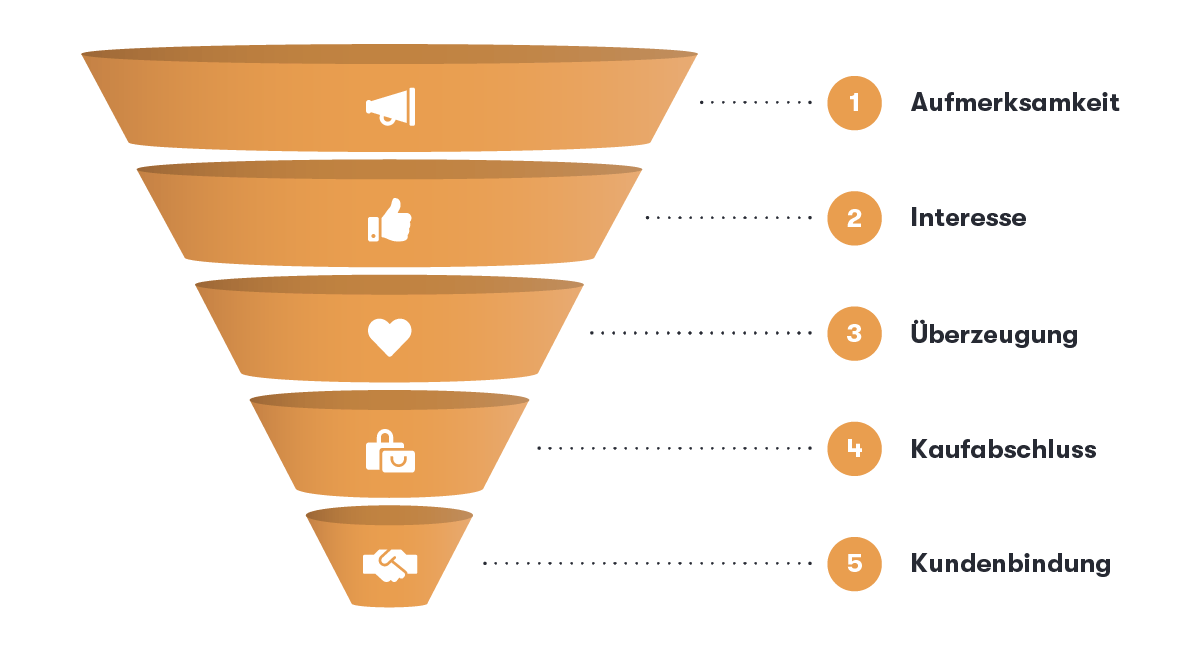
The email funnel is a type of funnel model consisting of five phases. (Source: Own representation)
Personalization and building trust are playing an increasingly important role in e-commerce. Standard newsletters and emails that are not tailored to the needs of the customer usually do not lead to much success or even a purchase. That's why it's all the more important to provide your customers with the right information at every stage of their customer journey.
The email funnel helps you, as an online retailer, to optimize your email marketing, convert prospects into buyers, and generate repeat customers. Modern tools give you the ability to send customer emails not only at specific times, but also based on different triggers.
Email automation plays an important role here. It ensures that your emails and content tailored to each stage of the customer journey reach every subscriber at exactly the right time. Email personalization also allows you to offer your customers a better user experience.
Stay up to date on personalization: Sign up for the Epoq newsletter. Register now!
You can think of the email funnel as a kind of plan that you, as an e-commerce retailer, can use to attract new customers and encourage existing customers to make repeat purchases.
You have now learned about the five phases of the email funnel, but how could these be implemented in practice? To help you better understand the funnel model, here is a small example:
In order to successfully use the email funnel for your e-commerce business, it is important to make some preparations beforehand.
To ensure that your email marketing and funnel are successful, you should choose a reliable tool. When making your selection, make sure that it offers the features you need for your project. We have compiled a list of tools that you can use to implement your email marketing professionally:
Haphazard marketing is rarely crowned with success. That's why it's essential to create a roadmap for your campaigns. The email funnel helps you harness the potential of email marketing and continuously optimize it. By applying the funnel model, you can effectively reach prospects, accompany them throughout their customer journey, and generate more sales in your e-commerce business.
An email funnel is a funnel model that supports you as an online retailer in implementing your email marketing. The goal is to convert prospects into customers and accompany them throughout their entire customer journey.
The email funnel consists of five phases: attention, interest, persuasion, purchase, and customer loyalty.
The funnel is essential for running personalized and automated email campaigns. It allows you to optimize your email marketing in a targeted manner, thereby ensuring more sales.
A lead magnet is an incentive you create for potential customers to encourage them to sign up for your newsletter.
When mapping the customer journey, you put yourself in the shoes of your potential customers and try to understand their entire journey, from their initial contact with your brand and products to the purchase and long-term customer loyalty.
Learn how to increase your click-through rate with trigger emails in our webinar recording.
Watch now!

You are currently viewing placeholder content from HubSpot Embedded Content. To access the actual content, click the button below. Please note that doing so will result in data being shared with third-party providers.
More InformationYou are currently viewing placeholder content from HubSpot. To access the actual content, click the button below. Please note that doing so will result in data being shared with third-party providers.
More InformationYou are currently viewing placeholder content from HubSpot Meetings. To access the actual content, click the button below. Please note that doing so will result in data being shared with third-party providers.
More Information