
E-book – Personalization in E-commerce
In this e-book, you will learn why personalization is important in e-commerce and what the term personalization actually means.

Dynamic pricing has become a familiar buzzword in e-commerce, but it tends to have negative connotations. That's why we want to use this blog article to explain exactly what dynamic pricing is, what its advantages and disadvantages are, how it can be used, and what role personalization plays in it. This will ultimately clarify the significance of dynamic pricing for e-commerce. Enjoy reading!

Here's whatyou can expect to find in this blog article:
How dynamic pricing is defined
Advantages and disadvantages of dynamic pricing
Example of dynamic pricing at TUI in emails
Setup in the email delivery system
Process after email dispatch
Dynamic prices in combination with personalization
Personalization in the context of dynamic pricing
Calculation of dynamic prices
Display of dynamic prices
Conclusion: Dynamic pricing can optimize the customer experience
Dynamic pricing (also known as dynamic price adjustment or dynamic price management) defines prices that are automatically changed within a relatively short period of time based on market conditions and pricing strategies (in contrast to static prices, which rarely change). For example, prices in e-commerce are dynamically adjusted when a particular offer has expired or a certain purchase volume has been reached in B2B.
One major advantage of dynamic pricing is definitely the customer experience. For example, when an online shopper automatically sees the sale price for a product displayed in real time on their wish list, this has a positive effect on the customer experience. The same applies to B2B buyers, for example. Once they have reached a certain purchase volume, they are happy to see their purchase price automatically reduced. As long as dynamic prices are not unfair to the customer and are transparent, they have a positive influence, even adding value for customers, and thus represent an advantage in e-commerce.
Stay up to date on personalization: Sign up for the Epoq newsletter.Sign up now!
The disadvantage of dynamic pricing arises from the definition of possible influencing factors. For example, if a different price is charged for MacBook users than for PC users, or if a price difference is made between mobile and desktop users, this can lead to very negative sentiment among customers, as they consider this dynamic pricing to be unfair. This price change usually has a negative impact on the customer and thus also on the company's brand. It is precisely for this reason that dynamic pricing has gained a rather negative image.
➔ Whether dynamic pricing is an advantage or a disadvantage depends on the factors that influence dynamic pricing.
In the travel industry, it is common for prices to change constantly. This applies to flights, hotels, and rental cars. It usually depends on occupancy rates. If these are low, discounts are offered and prices fall. If occupancy rates rise again, prices increase. This means that prices can change by the minute. It is therefore important that prices are kept up to date both on the website and in emails so that there are no discrepancies. With emails in particular, several hours or even days can pass between sending and opening, which can lead to confusion when the website is opened. That is why TUI uses dynamic pricing in its email marketing.
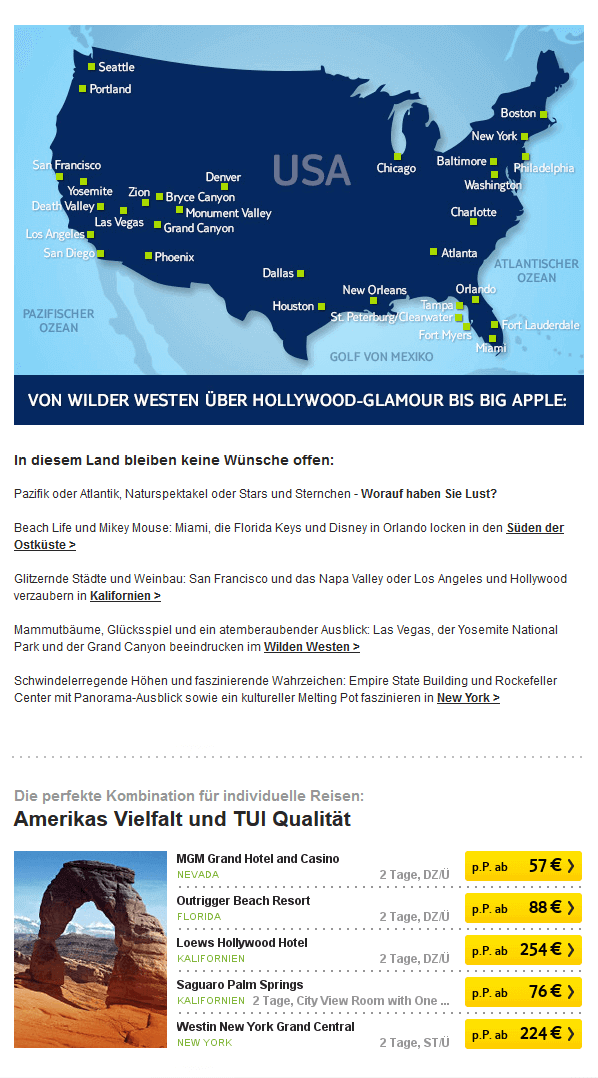
TUI newsletter with dynamic price adjustment
The TUI newsletter consists of several offers for a wide variety of trips. For each offer, a placeholder is created in the email template, where the price will later be inserted. As soon as the recipient opens the newsletter, the current prices are displayed in a matter of milliseconds. The prices are calculated by TUI and transferred to a knowledge base. The dynamic price display then takes place in real time via personalization software.
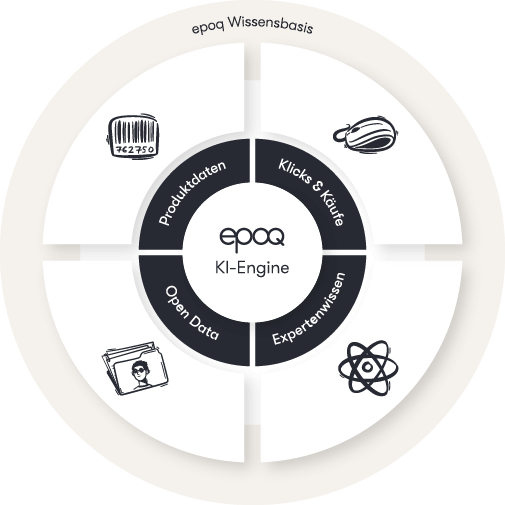
The calculated prices are transferred to the knowledge base via the product catalog.
If the email recipient clicks on one of the travel offers, the current price is transmitted in real time from the knowledge base. Since both the website and the email delivery system are connected to the knowledge base, the prices in the newsletter correspond to those on the website. What is special about this is that the prices are not frozen so that they correspond to the status of the first opening each time the newsletter is opened. They are replayed via the knowledge base each time the newsletter is opened and are thus always kept up to date. If an offer is now fully booked, the text "already booked" appears in the email. In this case, a fallback strategy could also be implemented to display alternatives. Dynamic pricing in the travel industry is therefore efficient and recipient-friendly, enabling TUI to inspire its customers with constantly updated offers.
In addition, it would also be possible to combine dynamic pricing with personalization. This would involve displaying relevant recommendations and sending a personalized email with current prices. The advantage of this would be that customers would receive individual offers for their favorite travel destinations and the price would be displayed as it is on the day the email is opened. A customer with an affinity for Italy would receive offers with dynamic prices for Italy. This would further increase the click rate and thus the traffic in the online shop.
Personalization is about addressing customers individually and ensuring they have a positive customer experience. Dynamic pricing can help achieve this if it is calculated to the customer's advantage.
Dynamic pricing uses an algorithm that calculates the appropriate price for recipients based on a database. Artificial intelligence methods (machine learning) can be used here, which are constantly evolving. In addition, company-specific rules can also influence prices. Every company therefore has the opportunity to influence dynamic pricing in a negative or positive way. However, it should be noted that personalization always has the overarching goal of optimizing the customer experience and creating positive shopping experiences throughout the customer journey. Unfair pricing and personalization therefore do not go hand in hand. If you want to learn more about calculating dynamic prices, you can read the article by Stephan Lamprecht in e-tailment magazine.
Stay up to date on personalization: Sign up for the Epoq newsletter.Sign up now!
The personalization software is responsible for displaying dynamic prices, e.g., in combination with relevant product recommendations depending on the customer or, in the B2B sector, depending on the purchase quantity. However, the calculation of dynamic prices depends on the online shop itself; the personalization software merely accesses the prices that are fed into the knowledge base via the product catalog and displays them in connection with personalized measures in the online shop.
When used correctly, dynamic pricing can be a blessing. Your customers won't get any nasty surprises, but rather excellent service. However, if you want to increase your profits at any cost, this can quickly have a negative impact on your image and long-term success. Overall, however, it can be said that, especially in industries with strong price fluctuations, such as the travel industry, there is potential in dynamic price adjustment that should be exploited to create a better customer experience in e-commerce while simultaneously increasing KPIs.
Gather more insights on the topic of personalization:
Request the e-book now!

You are currently viewing placeholder content from HubSpot Embedded Content. To access the actual content, click the button below. Please note that doing so will result in data being shared with third-party providers.
More InformationYou are currently viewing placeholder content from HubSpot. To access the actual content, click the button below. Please note that doing so will result in data being shared with third-party providers.
More InformationYou are currently viewing placeholder content from HubSpot Meetings. To access the actual content, click the button below. Please note that doing so will result in data being shared with third-party providers.
More Information