
4.23% higher click-through rate on product overview pages thanks to self-learning ranking at A-Z Gartenhaus
A-Z Gartenhaus increased the click-through rate on product overview pages by more than 4% using a self-learning ranking system.

Generate more sales with optimally designed product categories – online category management makes it possible. This is not a temporary marketing measure, but a long-term, strategic approach. In this article, you will learn what product group management entails, what its goals are, and what an optimal category management process looks like. You will also learn about the interfaces with online marketing.

Here'swhatyou can expect to find in this blog article:
Category management – a definition
Cooperation between retailers and manufacturers
Tasks of a category manager
Why category management is also important in e-commerce
The category management process in 8 steps
Basis: Strategic coordination
1. Definition of the category from the consumer's perspective
2. Category significance
3. Category evaluation
4. Category goals
5. Strategy development
6. Tactics for your category management
7. Implementation of the action plan
8. Review
Numerous interfaces between category management and online marketing
Product assignment using keyword and clickstream analyses
Easy category access thanks to optimal website structure
Development potential based on conversion rate and shopping cart value
Jointly coordinated measures
Conclusion: Online category management offers significant growth potential
Category management refers to the management of product groups. Products are structured according to specific product groups. The focus here is on consumers and their needs. For them, shopping becomes more efficient thanks to an optimal product selection. What is even more important in the eyes of customers is that the store knows and fulfills their consumer needs.
Category management has been standard practice in brick-and-mortar retail for decades: instead of similar products, complementary products are placed in close proximity to each other. For example, in a supermarket you will find different types of pasta next to the pasta sauces, or in a sports store you will find clothing, shoes, and backpacks for hiking in the same aisle.
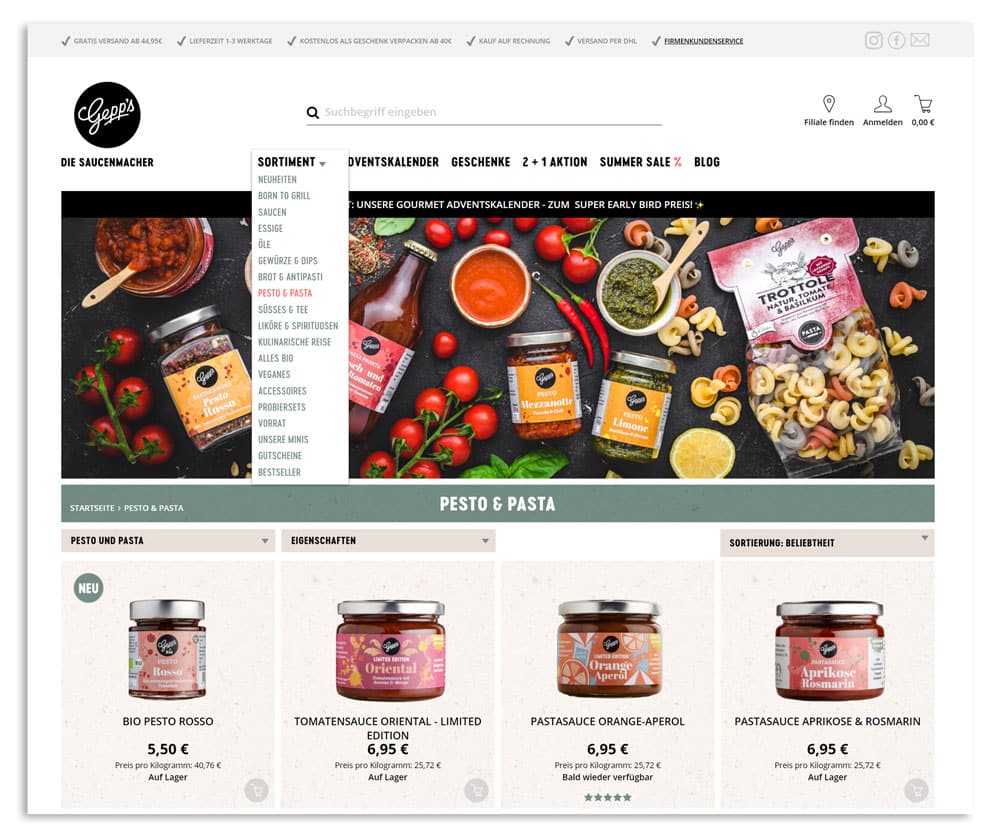
It also makes sense to present complementary products such as pesto and pasta together in your online shop, as is the case with Gepp's, for example.
(Source: Screenshot from gepps.de)
The category management process is based on cooperation between retailers and manufacturers who want to achieve a triple win situation within the limits of antitrust law: satisfied customers, higher profits for retailers, and thus more sales for manufacturers. Product groups or service categories are regarded as strategic business units.
Stay up to date on personalization: Sign up for the Epoq newsletter.Sign up now!
It is about a holistic approach that involves various departments within companies. Retailers and manufacturers contribute to successful category management with their respective expertise: retailers control the product groups among themselves, while manufacturers provide detailed knowledge of the product categories. Both sides are interested in finding the best possible solution for customers.
Product group management is generally handled by a category manager. This person is responsible for various tasks, such as
Product group management is a strategic approach designed for the long term. The aim is to achieve better customer orientation, which is reflected in higher customer satisfaction. This generates additional sales and improves the brand image. At the same time, this approach provides a competitive advantage, as potential buyers recognize the technical expertise of a retailer for certain product groups and trust them.
Category management is still a relatively new phenomenon in e-commerce, but it has a lot of potential for development. Similar to brick-and-mortar retail, you can serve the consumer needs of your target groups with your online shop by creating appropriately structured product groups (product categories) and an optimal user experience —this will increase customer satisfaction and boost your sales.
An 8-step process has been established worldwide for product group management, which you can also apply to online category management. This process enables you to take a systematic and structured approach. You should therefore go through the individual steps again and again in order to identify and implement optimization and growth potential.
Data and facts, especially from online marketing, serve as the basis for decisions at the various stages. Close coordination with the various departments is therefore essential.
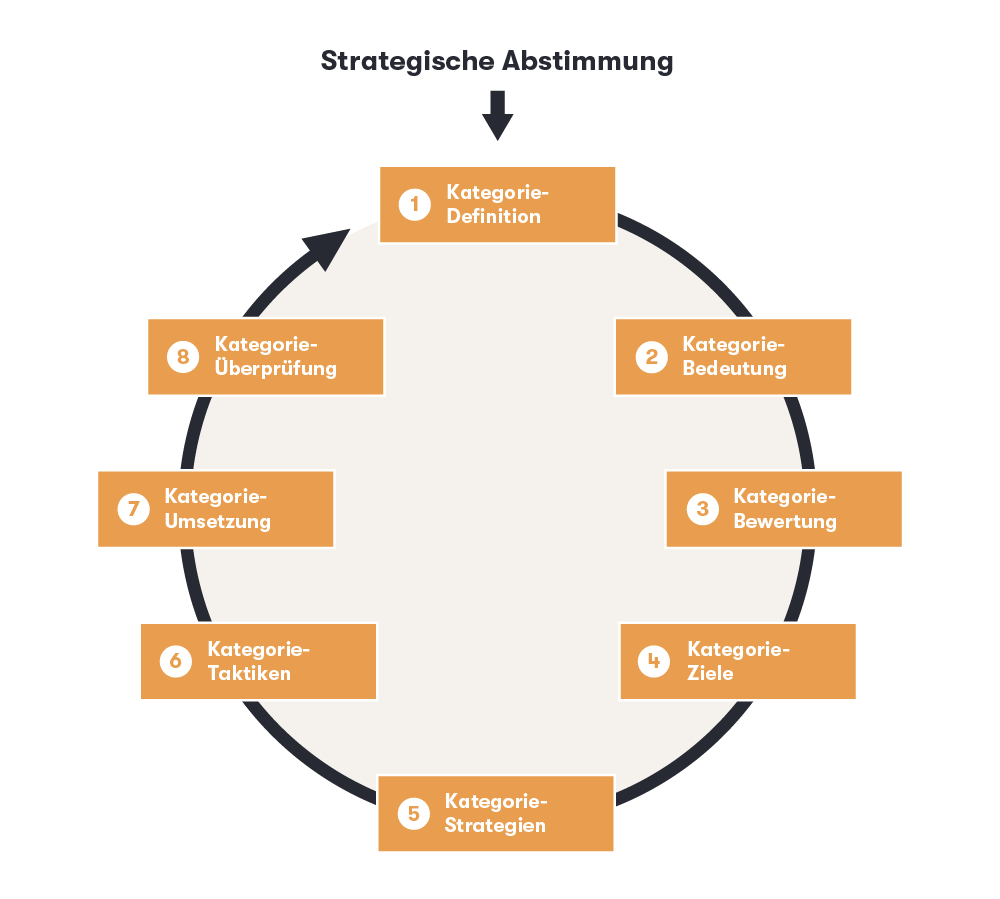
The category management process with its eight steps enables a systematic and structured approach. (Source: Own representation)
Before the actual process begins, you should discuss strategies, goals, and wishes with the manufacturers for your future product groups. This will help you avoid potential conflicts in the future.
This stage is about understanding your customers' purchasing decision-making process. Which products or services do they choose together and why? To do this, you analyze quantitative and qualitative data, for example from market research.
Here you can specify how important the selected product category is in your shop's overall portfolio.
Once you have defined a product group, you can analyze the performance of this category. Based on sales figures and various key performance indicators relating to purchasing behavior, you can assess where there is potential for development—especially in comparison to competitors.
To check the success of your product category, you work with retailers to set specific and measurable goals. These goals relate in particular to consumers, finances, the market, and performance. For example, you may want to reach certain target groups and achieve sales of XY euros, or you may want a product category to become one of the top three in your online shop.
Now it's time to develop strategies to help you achieve the goals you defined earlier. Marketing strategies relate to the conversion rate, average shopping cart value, or profit. More efficient processes, on the other hand, are the focus of procurement strategies.
To put your strategies into practice, you and your team define a concrete action plan covering the product range, placement and visibility in the online shop, pricing, and your communication and advertising measures.
You have defined goals, strategies, and measures—now it's time to implement your plan. To ensure that category management is a success, you assign responsibilities and set deadlines.
You regularly review the performance of your product group to identify potential for growth and improvement and implement accordingly. The aim is to make your product range as efficient as possible.
Online category management overlaps with online marketing in many ways. Both areas can benefit from each other's expertise by exchanging data and jointly implementing measures for successful product group management in online shops.
Online marketing already collects a wealth of data for its communication and advertising activities and conducts various studies, such as keyword or clickstream analyses and UX tests. This makes it easier for you to assign your products to individual categories, identify gaps in your product range, and add suitable products to the respective product groups. This framework also offers you opportunities to identify potential for cross-selling or upselling strategies.
Category managers can also use data from online marketing to identify the paths that lead potential customers to product selection and optimize the website structure accordingly: Are shop visitors searching for specific products or brands? If so, they should be able to select these paths using appropriate filter attributes in the onsite search.
In some cases, thematic landing pages, personalized product recommendations, or a brand store can also serve as alternative category entry points. The goal is to offer visitors to your store an outstanding customer experience through an optimal website structure. For example, category management can be used to structure products related to "barbecuing," such as barbecue aprons, spices, charcoal, etc., as a product group. This can then be used to design a themed page for the barbecue season, where products and content for the next barbecue party are provided.
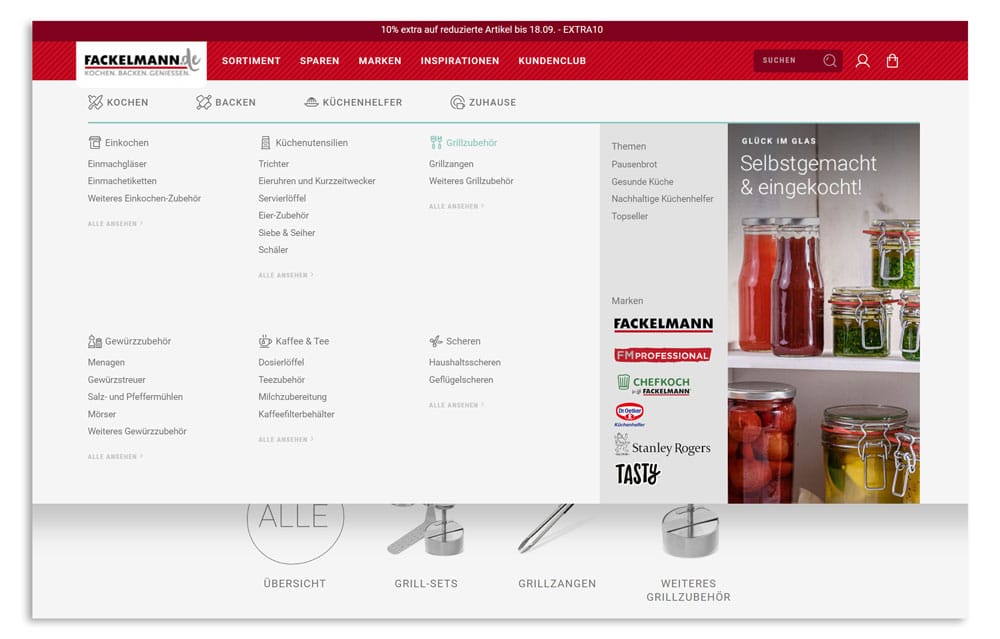
Fackelmann offers customers several entry points via the menu: categories, topics, brands, and a topics page.
(Source: Screenshot from fackelmann.de)
With the help of online marketing analyses—website traffic, conversion rate, bounce rate, or average shopping cart value—category management can identify development potential for the respective segments. For example, improved user guidance in your online shop can lead to greater success.
Stay up to date on personalization: Sign up for the Epoq newsletter.Sign up now!
Online category management determines the marketing focus of a product group. However, you should coordinate specific advertising and communication measures with online marketing in order to optimally place product offerings for the respective target groups. The prioritization of certain products and product groups in the recommendation system should also be decided jointly.
Secure competitive advantages, strengthen customer loyalty to your shop, and generate higher sales—you can achieve all this with strategically thought-out online category management. A long-term approach breaks down traditional corporate structures and offers enormous growth potential for your shop. Take advantage of the benefits and work with manufacturers to find the best possible solution for your customers.
The term "online category management" refers to the management of product groups in an online shop. The category manager does not classify products based on their similarities, but rather because they complement each other. The decisive factor here is the perspective of consumers and their needs. Retailers and manufacturers work closely together in this area to find the optimal solution for their customers.
Successful category management—whether in brick-and-mortar retail or e-commerce—ensures greater customer satisfaction. This in turn leads to higher sales for retailers, which also benefits manufacturers. It is a huge competitive advantage when a store can distinguish itself through greater product range expertise.
The category management process is a standardized and systematic approach to establishing and managing product groups. It comprises eight steps, starting with the definition of a product category, through performance evaluation, to goals, tactics for successful implementation, and review.
Category management can use a wealth of data from online marketing to build product groups, such as keyword and clickstream analyses, as well as key figures on traffic, conversion rates, and bounce rates. Here, too, the focus is on an optimal user experience.
In addition to analysis tools used in online marketing, there are numerous other tools that support online category management. These include, for example, the recommendation system, which enables personalized product recommendations to be displayed in real time. At the same time, this and other services such as intelligent onsite search and product filters benefit from optimal product group management, as product data and good category management form the basis for the display of personalized content.
Discover how Gartenhaus increases the click-through rate on product overview pages by more than 4%.
Read the case study now!

You are currently viewing placeholder content from HubSpot Embedded Content. To access the actual content, click the button below. Please note that doing so will result in data being shared with third-party providers.
More InformationYou are currently viewing placeholder content from HubSpot. To access the actual content, click the button below. Please note that doing so will result in data being shared with third-party providers.
More InformationYou are currently viewing placeholder content from HubSpot Meetings. To access the actual content, click the button below. Please note that doing so will result in data being shared with third-party providers.
More Information