
E-book – Personalization in E-commerce
In this e-book, you will learn why personalization is important in e-commerce and what the term personalization actually means.

When asked why B2B companies make their purchases online, the most frequently cited reason in a survey of experts conducted by ibi research is "It's more convenient or faster."¹ To ensure that your customers feel the same way when shopping online, this blog article will show you the differences between B2B and B2C customers and what is important in B2B e-commerce in order to best meet your customers' requirements.

Here's what you can expect to find in this blog article:
B2C and B2B customers in comparison
1. Like to browse vs. Often shop under time pressure
2. Usually make single purchases vs. often make repeat purchases
3. Buy at the same prices vs. buy at individual prices and from an individual range
4. Are not tied to one store vs. aim for a consistent supplier relationship
How to meet your customers' requirements in B2B e-commerce
Quick entry into the purchasing process
Focus on relevant product categories
Consideration of concluded framework agreements
Build customer loyalty by creating trust and loyalty
Conclusion: Meet your customers' requirements in B2B e-commerce
The demands of buyers in B2B e-commerce for good usability, fast response times, and personalization should not be underestimated. After all, in their private lives, they are consumers just like you and me and have become accustomed to the advantages of B2C shops.
Nevertheless, there are different motives, framework conditions, and goals when it comes to online shopping, meaning that the purchasing behavior of B2B customers differs from that of B2C buyers. In the following table, we have compared four characteristics of the purchasing behavior of both customer groups.
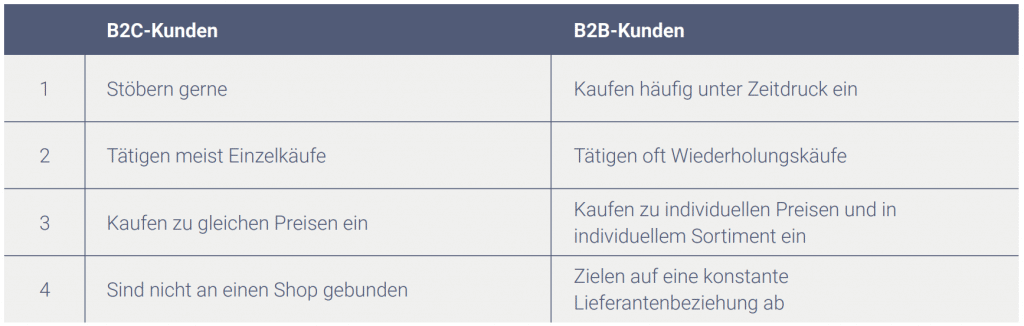
Comparison of purchasing behavior characteristics of B2C and B2B customers
In B2C, online shopping often becomes a hobby, so people enjoy spending a lot of time doing it. Customers are happy to take their time. Your B2B customers, on the other hand, (usually) don't have time to browse your online shop comfortably on the sofa with a cup of tea. Deadlines have to be met, production depends on items, and there is other work to be done.
End customers usually purchase products on a one-time basis. B2B customers, on the other hand, often need the same products at regular intervals.
In the B2B sector, there are often many individual contractual arrangements that influence prices. As a result, different customers/companies may receive different product ranges. Regional availability can also play a major role. You should reflect these aspects in your online shop.
Personally, I always enjoy discovering new and exciting online shops. This keeps the range varied and guarantees that browsing is fun.
However, once B2B buyers have found a reliable dealer, they are reluctant to switch to another one. Switching involves much greater effort and costs. It is therefore in the interests of both parties to build a satisfactory, long-term relationship.
Now you know what customers expect from B2B retailers. We will now show you how you can meet these expectations with targeted measures.
Since B2B customers usually don't have time to browse around an online store for long, the ordering process should be quick and efficient. The following aspects will help you achieve this:
A search function with type-ahead and product suggestions with images helps your shop customers quickly find suitable products. The ability to search by item numbers also contributes to a quick start to the shopping process. By playing out the order in the type-ahead search based on personal customer preferences and individual click and purchase behavior, you can make it even easier to get started. Individual suggestions at the category, product, and content level that match customer preferences ensure a smooth start and fast results in B2B e-commerce.
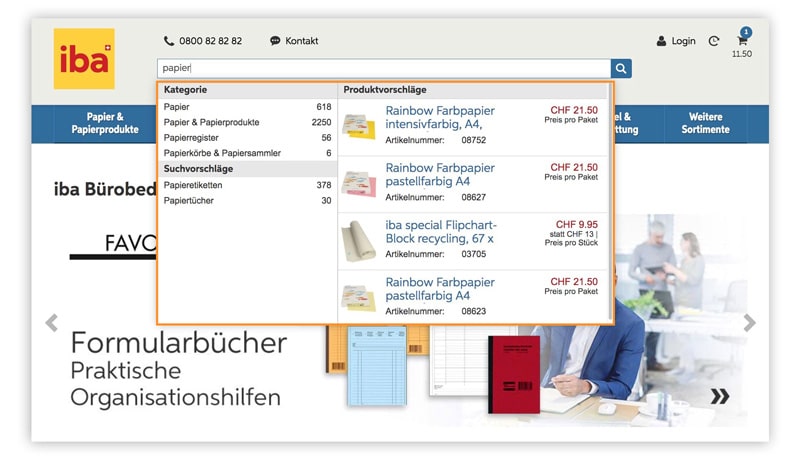
Example of an ecommerce search engine with product suggestions in the iba online shop (source: screenshot from iba.ch)
When a customer is on a product overview page, dynamic faceted navigation in the search results list offers a good way to narrow down products according to desired criteria. The number and selection of filters are based on the search term. In addition, it is possible to adjust the order of the filters to reflect personal customer preferences and individual click and purchase behavior in order to further support product research.
Expert advice from brick-and-mortar stores can be transferred to digital commerce with the help of an AI shopping assistant. The assistant offers dialogue-based advice to identify the customer's needs and help them select products. Customers can, of course, ask questions, filter, or sort in the chat, while the assistant understands the context and displays suitable products directly in the results list. By taking individual preferences and behavior patterns into account, B2B customers receive personalized and efficient advice that makes the purchase decision easier.
Relevant recommendations on the product detail page can show customers additional items that go well with the selected product and which the customer might not have discovered in the product range themselves. This could be a mounting bracket when purchasing a bathtub, for example. This way, B2B customers get everything they need for installation, for example. By showing B2B buyers suitable accessories that also match their personal preferences, the ordering process in B2B e-commerce can be accelerated.
To make it easier for your customers to reorder frequently purchased products, you can assist them by displaying relevant products or categories on various shop pages.
In the form of recommendation widgets, you can display preferred categories/products or recently purchased products directly on the home page, making it easier for your B2B buyers to reorder these items.
Delivery times and availability are crucial when choosing products, especially when B2B buyers are dependent on specific deadlines. By displaying actual delivery times in the product tiles after a real-time query (also possible for prices and availability), you can ensure that your shop customers receive all the information they need at a glance.
Note: Price accuracy is particularly important when prices are linked to the metal market, for example. This means they must be updated in real time. However, it is not only the market that can influence prices, but also
All these influences must alsobe individually reflected online for each customer. This means that prices must be available and displayed in real time on the product detail page, in the search preview, and in the recommendations. Customer-specific prices are the second most relevant factor for shoppers, directly behind the search function.
It is also a good idea to place recommendation widgets on product detail pages. By placing them there, you suitable alternatives By taking personal customer preferences into account, you can guide your customers directly to the next product. If the customer is not 100% satisfied with a product that is displayed, you save them from having to search again.
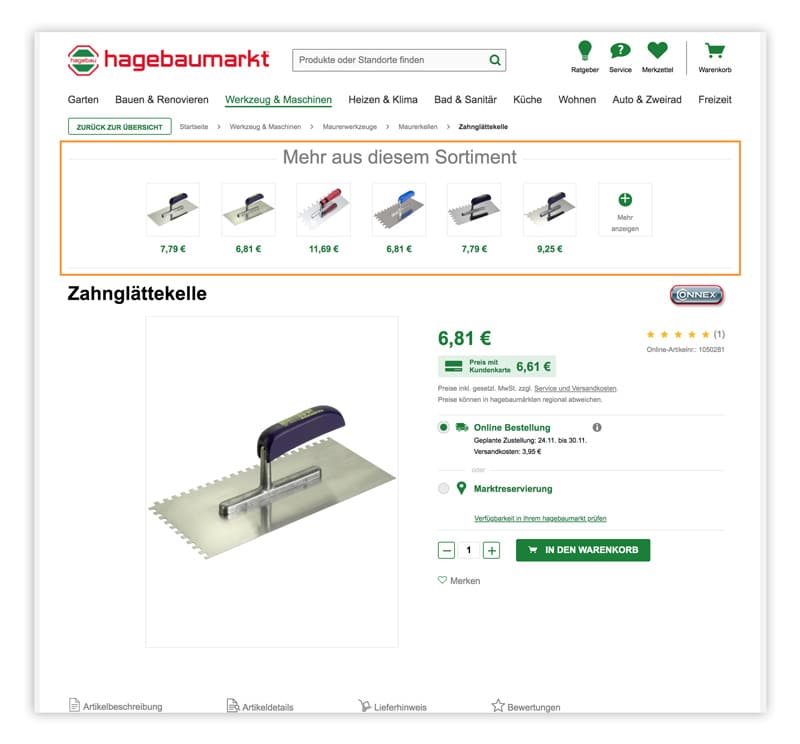
Alternative recommendations in the B2B online shop hagebaumarkt as an example (source: screenshot from hagebau.de)
As already mentioned in relation to prices, there are many individual contractual arrangements in B2B e-commerce. As a result, different customers/companies may receive different product ranges. This should also be reflected in the online shop. Of course, regional availability must also be taken into account.
Display individual prices to your shop customers on the product overview pages (triggered by the search function or navigation). You should also take customer-specific prices into account on theme pages, brand pages, or special landing pages.
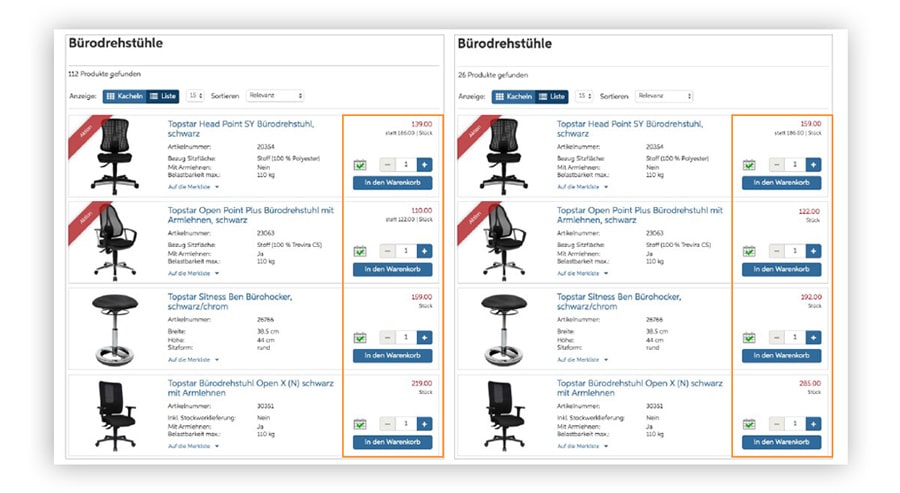
Example of customer-specific prices in the iba online shop (source: screenshot from iba.ch)
The same applies to individual product ranges. Here, too, you should tailor product visibility to specific customers, for example by hiding certain brands, items, etc. Make sure that the products displayed on all product overview pages correspond to the individual product range.
Do you offer your shop customers a customized product range? Tell us how you implement this in your online shop and share your experiences with us!
Stay up to date on personalization: Sign up for the Epoq newsletter. Register now!
Even though customers in B2B e-commerce tend to make rational decisions and the framework conditions are predetermined, there is still an emotional influence in the decision-making process. B2B customers also buy from retailers who make them feel secure. Branding and customer service are very important in this regard. Since the customer journey does not end with the purchase, you should maintain contact with your customers even after the purchase and offer them incentives to visit your online shop again, so that a constant supplier relationship is established. With the help of the following after-sales measures, you can shape and maintain the relationship with your customers and retain them for your shop in the long term.
Emails are a great way to stay in touch with customers. For example, you can send out emails about special offers or newsletters focused on specific categories. Relevant product and content recommendations provide customers with added value and encourage them to return to your store. The relevance of these recommendations is crucial, and they should also align with individual prices and product ranges. By calculating the recommendations only when the email is opened, you can ensure that all relevant information is taken into account. By using email personalization, you can increase traffic to your online store.

Example of a personalized email from the online store BTI (source: screenshot of an email from BTI)
The demands of B2B buyers have increased significantly in recent years. It is particularly important for buyers to feel secure and confident, and to be able to complete the purchasing process as smoothly and quickly as possible. Many B2C online shops can serve as a model for this. However, you also need to offer a number of extras, such as individual prices or customized product ranges. By meeting the requirements of your B2B customers, you will not only make your buyers happy, but also ensure optimized KPIs.
Sources:
¹ 2018 ibi research "Online purchasing behavior in B2B e-commerce" –Fast and convenient shopping and product availability are the most important reasons for shopping online
² 2018 ibi research "Online purchasing behavior in B2B e-commerce" –A search function and individual prices are important features for buyers – shopping without registration tends not to be
Would you like to further deepen your knowledge of B2B customer requirements?
Then read our e-book on this topic now!

You are currently viewing placeholder content from HubSpot Embedded Content. To access the actual content, click the button below. Please note that doing so will result in data being shared with third-party providers.
More InformationYou are currently viewing placeholder content from HubSpot. To access the actual content, click the button below. Please note that doing so will result in data being shared with third-party providers.
More InformationYou are currently viewing placeholder content from HubSpot Meetings. To access the actual content, click the button below. Please note that doing so will result in data being shared with third-party providers.
More Information