
E-book – Personalization in E-commerce
In this e-book, you will learn why personalization is important in e-commerce and what the term personalization actually means.

Every shop visitor explores an online shop in their own individual way. However, customers with similar or identical characteristics and behaviors can be grouped into buyer types. As a shop operator, it is important to know the different buyer types in your own shop and to respond to their individual needs so that every customer can find what they are looking for in your online shop. In this article, we will first show you what buyer types are, why it makes sense to use customer segments, what types can be distinguished, and how buyer types can be assigned to the customer journey phases. Find out now how buyer types can increase the success of your online shop.

Here's what you can expect to find in this blog article:
Types of buyers in online shops – what lies behind them
Consumers with similar characteristics
Personas as the basis for buyer types
Classification into buyer types – Why it is beneficial
Optimizing your online store
Addressing customer needs in a targeted manner
Different types of buyers in online shops – what they are
Customer segmentation according to TargetingMantra
Classification of types into hunters, seekers, and gatherers according to Bernhard/Mühling
Buyer types and customer journey phases – how they are connected
Buyer types in the different customer journey phases
Hybrid forms and fluid transitions
Conclusion: Buyer types contribute to the success of your online store
The path through the online shop differs depending on the customer. While some online shoppers navigate directly to the desired product, other users like to be inspired by the range on offer first and use their time in the online shop more as a kind of "window shopping." The individual shopping path of each buyer type depends, among other things, on the product they are looking for, their shopping intention, their personal preferences and requirements, and their level of knowledge. Every shop needs to be prepared for individual buyer types so that they can find what they are looking for – regardless of which phase of the customer journey they are in. But what exactly are buyer types?
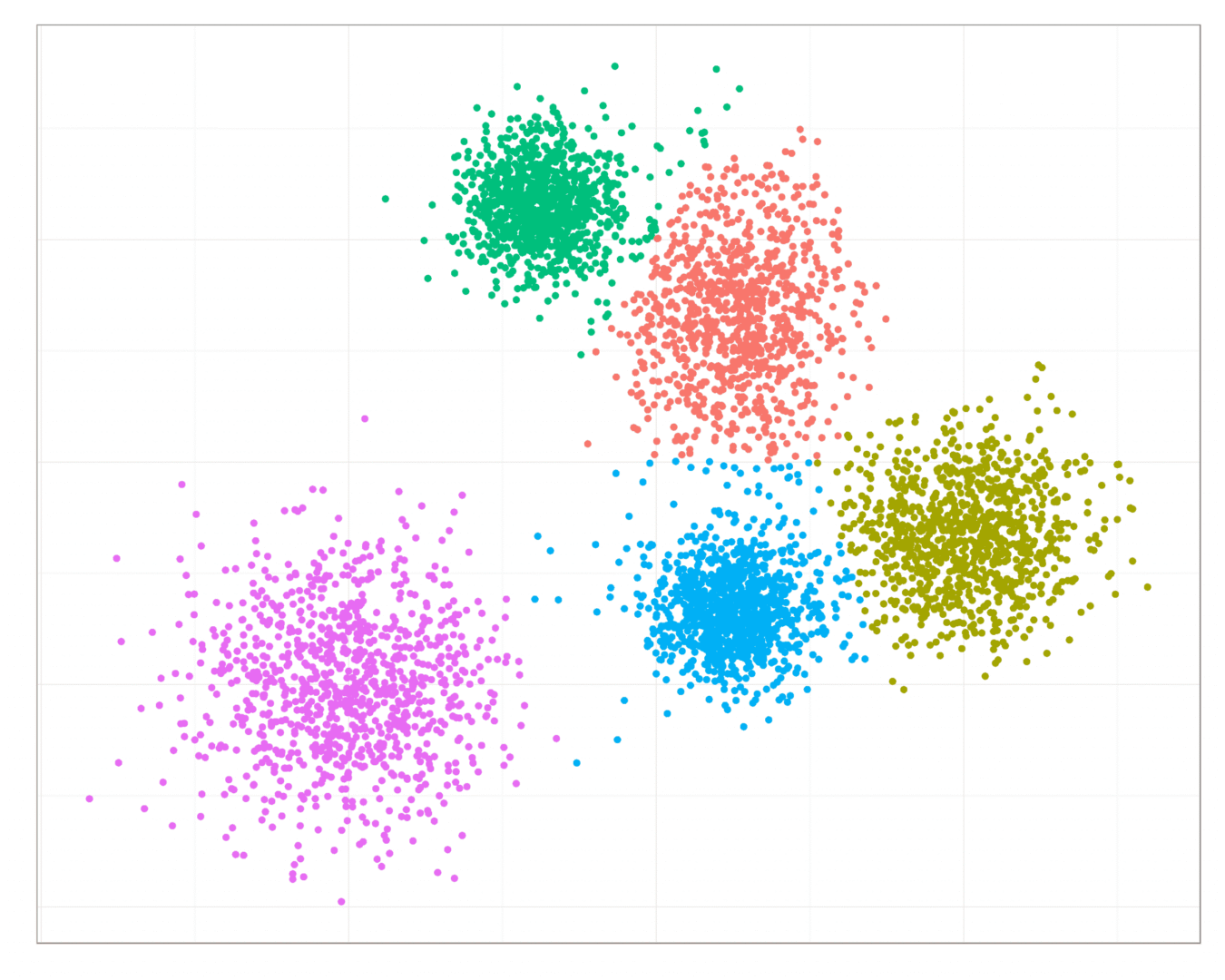
The buyer type approach describes the grouping of several consumers who have similar or identical characteristics. Consumers are described using various characteristics and grouped together with similar individuals to form a specific type. It is therefore a matter of segmenting customer groups in order to target them specifically. The following graphic shows how such segmentation can be visualized in two dimensions.
Before you start targeting customers, you first need to consider what your target group looks like. Personas can be developed for this purpose. These represent individuals in a target group and characterize them according to their characteristics. This concept serves to put yourself in the shoes of potential customers in order to identify their behaviors, goals, desires, and preferences. This creates as detailed a picture as possible of the ideal customer, to whom all measures can be specifically targeted. However, since the behavior of a persona can vary depending on the situation and intention, and a company can also define different personas, the customer segmentation model helps to highlight buyer types that can further concretize a persona.
Stay up to date on personalization: Sign up for the Epoq newsletter. Register now!
Segmenting customer groups is not always easy and can be time-consuming. It is particularly important to focus (more) on those customer types that are relevant to your business and fit your target group. You should therefore focus on the types of buyers that your online shop is actually designed for. By focusing on your target group, the various measures you take will be particularly effective. For example, it is not necessarily useful for high-priced shops to focus on the "bargain hunter" customer type.
So why is the work worthwhile?
By tailoring your entire online shop to the different types, you can optimize it in various ways: The identified needs help you to target your buyer types, for example in the form of text or the appropriate choice of images. Furthermore, you can use the knowledge you have gained about the types in your shop to improve usability, optimize category structures, or make design adjustments.
Buyer types help you to form a concrete picture of your users and their needs. The more you know about your customers as a shop operator and the better you understand their different needs, the more specifically you can respond to them, which will lead to greater success for your online shop. For this reason, it helps to group users with similar behavior and comparable starting situations into buyer types. This allows you to address as many customer needs as possible in a targeted manner.
It is possible to distinguish between numerous different types of buyers. To give you an initial overview, we would like to introduce you to a few different approaches below.
The marketing agency TargetingMantra, for example, distinguishes between four different types of buyers in online shops. These include
The above-mentioned buyer types are presented in detail and very clearly in an infographic by TargetingMantra.
In an article, the consulting firm ec4u also presents five different buyer types—specifically, the product fan, the browser, the research expert, the bargain hunter, and the one-time shopper —and provides insight into how they can be helped in online shops. Here, initial parallels can already be drawn with other customer segmentation models. For example, the product fan is similar to the Busy Twins, the browser can be compared to the Wish Lister, and the bargain hunter has similarities with the Hesitant Twins.
The book "Responsible AI in E-Commerce"¹presents another way of classifying customer types. It distinguishes between three types : hunters, seekers, and gatherers.
When entering the shop, the hunter has a clear idea of what he is looking for. Their journey through the online shop is purposeful, and they do not allow themselves to be distracted by what is happening around them. They leave the shop as soon as they have found and purchased the right product. If they are unable to find the product they want within a short period of time, they also leave the shop. This customer group also includes bargain hunters, who are particularly interested in low-priced offers.
The searcher does not yet know in detail which product they want to buy. Although they have a rough idea and an internal framework in mind, they would like to receive advice on their selection and compare different products. Once a searcher has decided to buy a particular item, they will also be interested in recommendations for suitable additional items.
Collectors develop their purchasing ideas while browsing through the product range and drawing inspiration from the variety of products on offer. Collectors also like to make impulse purchases without having a specific need for a product and would often like to buy more than their budget ultimately allows. This can lead to shopping carts being left behind.
This type of customer segmentation also shows that the different buyer types in the various approaches often have things in common. For example, the hunter in this approach is similar to the research expert in ec4u. The seeker overlaps with the hesitant twins in TargetingMantra, and the collector is comparable to the browser and wish lister in the two approaches already presented.
In order to ultimately target your buyer types, it helps to also consider the customer journey phase that a user is in. Furthermore, the associated needs of the potential customer play a decisive role. Taking into account the customer journey phase and the respective needs, buyer types can be further specified based on these criteria.
When looking at the individual phases of the customer journey, different types of buyers can be identified. These buyers also have different needs depending on the phase. The following four types, which are based on the approaches mentioned above, can be distinguished:
The following graphic provides an overview of the various phases of the customer journey and the needs associated with each phase.
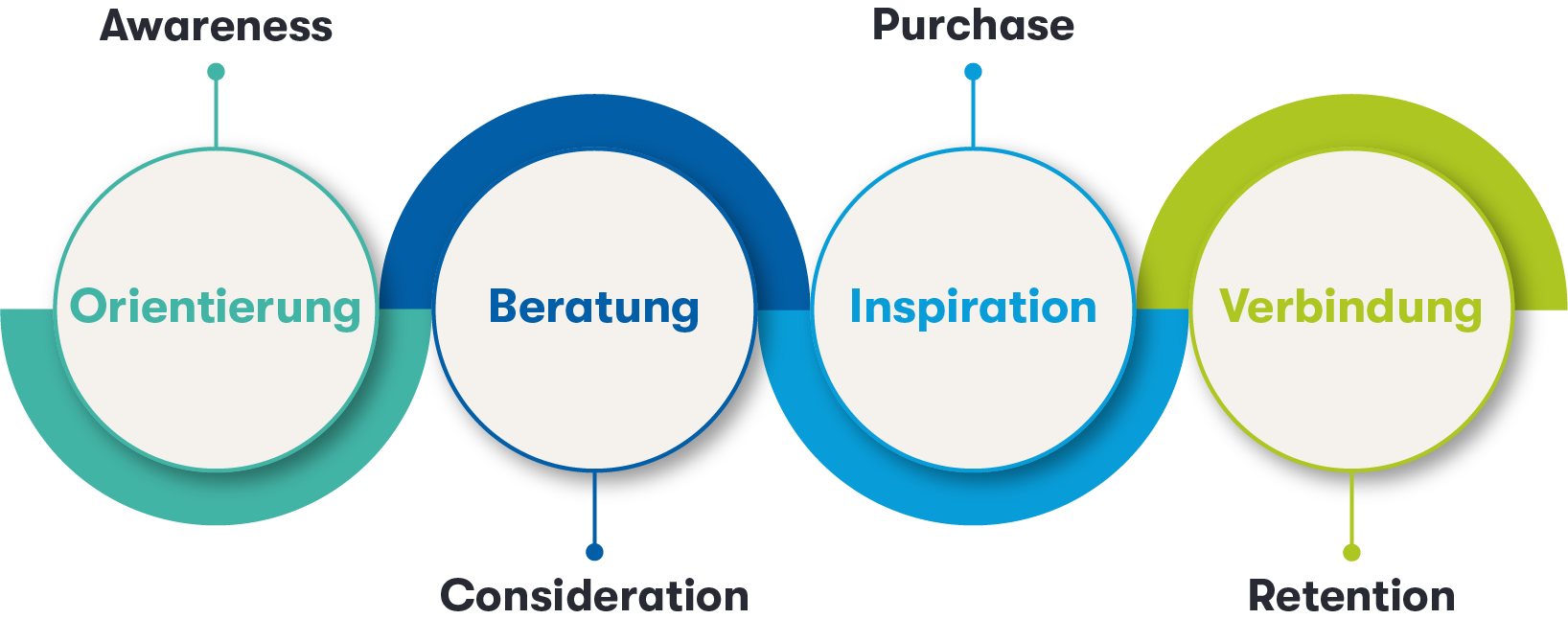
Online customer journey: Customers have different needs depending on the phase they are currently in.
However, the customer's journey does not end with the purchase. As a shop operator, it is therefore important for you to continue to take action after the purchase. By continuing to provide your customers with content after the purchase, you can build a connection with them, strengthen trust, and retain users in the long term. You can find out what options are available for this in the blog article After the purchase is before the purchase: Successful after-sales measures for strong customer loyalty.
Stay up to date on personalization: Sign up for the Epoq newsletter. Register now!
When distinguishing between buyer types, there is one thing you must not forget: not every online shopper can necessarily be assigned to one of these specific customer types, and the types rarely occur in their pure form. Some users may fall between two different buyer types or cannot be explicitly assigned to one of the types presented. So there are always gradations or hybrid forms. However, it makes sense to consider different buyer types. By being prepared for them, you can create a pleasant shopping experience for your customers.
The four buyer types presented—the expert, the discerning, the undecided, and the browser—can be used as a basis for targeted marketing in addition to general shop optimization. Personalizing the customer journey touchpoints plays an important role here. You can find out how to succeed with one-to-one marketing along the customer journey in our article on this topic.
Some users already have a specific product in mind when they visit an online store. Others do not yet have an explicit purchase intention and want to be inspired by the range on offer first. Both types of users must be catered for in the online store and receive information and support tailored to their needs throughout the customer journey so that they enjoy a unique shopping experience. Identifying buyer types helps you tailor your online store to the exact target group and design your approach in a targeted manner. By optimizing your online store in this way, you are contributing to its success.
Sources: ¹Bernhard, Michael and Mühling, Thorsten (2020). Responsible AI in e-commerce. A brief introduction to artificial intelligence methods in web shop personalization.
Buyer personas describe groups of customers with similar behavior, similar needs, or comparable purchasing intentions. They help online store owners target different users more effectively and guide them more effectively through the store.
If you know the main types of buyers, you can better tailor your content, navigation, product recommendations, advice, and messaging to meet customer expectations. This improves the customer experience and can increase the conversion rate.
Among other things, the article describes hunters, seekers, and gatherers. It also assigns buyer types—such as experts, discerning buyers, the undecided, and browsers—to the respective stages of the customer journey.
The hunter knows exactly what he wants and searches with a specific goal in mind. The seeker has a general idea and needs help making a choice. The collector lets himself be inspired and often doesn't come up with a purchase idea until he starts browsing.
Depending on the stage of the customer journey, customers have different needs. During product research, they need guidance; during product selection, they need advice; and when they’re ready to buy, they need inspiration.
An online store can provide targeted support to different types of shoppers through clear navigation, smart search, filters, product guides, personalized recommendations, and inspiring content. It is important that each measure is tailored to the needs of the individual user.
Particularly relevant are buyer types that align with the store’s target audience and business model. For example, a high-end store should prioritize different needs than a store that relies heavily on discounts and bargains.
Learn how to use personalization profitably in e-commerce:
View the e-book now!

You are currently viewing placeholder content from HubSpot Embedded Content. To access the actual content, click the button below. Please note that doing so will result in data being shared with third-party providers.
More InformationYou are currently viewing placeholder content from HubSpot. To access the actual content, click the button below. Please note that doing so will result in data being shared with third-party providers.
More InformationYou are currently viewing placeholder content from HubSpot Meetings. To access the actual content, click the button below. Please note that doing so will result in data being shared with third-party providers.
More Information