
Reduce bounce rates – with ecommerce search engine
In a web demo, we will show you how you can reduce the bounce rate in your online shop using various live examples.

No one wants to lose potential customers who have already found their way to the online store. If only because measures such as SEO, SEA, and the like are quite resource-intensive. That's why it's important to look at the bounce rate for pages in your online store in order to identify potential for optimization. In this guide, you'll learn exactly what a bounce rate is, how you can evaluate it, and what options are available to you to improve it.

Here's what you can expect to find in this blog article:
What is a bounce rate in an online shop?
Reasons for high bounce rates in online shops
Product filtering not possible
Advertisement and landing page do not match
Search results are not optimal
Product information is not available
Trust symbols are not available
The bounce rate is a percentage value that iscalculated from two components:
The formula for calculating the bounce rate is therefore as follows:
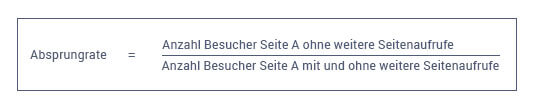
The bounce rate is therefore based only on sessions that start on page A. So if you want to calculate the bounce rate for page A, you need to look at all sessions that started on page A.
An example: Page A is accessed 735 times as the entry page in one month, and 657 website visitors left page A without viewing any other pages. The bounce rate is therefore 89.39%.
Stay up to date on personalization: Sign up for the Epoq newsletter:Sign up now!
Simply looking at the percentage value is not enough to accurately assess the bounce rate.
If, for example, you operate a website that provides information about the opening hours of your brick-and-mortar store, the bounce rate for this page may well be high. This is not necessarily a bad sign, as website visitors find exactly what they are looking for on the page and then leave it again. In this case, the bounce rate is high, but it is not an indicator of a need for optimization, i.e., a high bounce rate can also be positive.
Let's assume you are a blogger for an online shop with the goal of directing potential customers to specific product detail pages via blog articles. After publishing a blog article, you notice that it has a high bounce rate. You might assume that the website visitor got the information they needed and then left the site. However, this is not the case here, because the goal was to redirect them to a product detail page. Accordingly, the high bounce rate in relation to the set goal is an indicator of a need for optimization.
A study by Customedialabs, which examined average bounce rates for different types of websites, arrived at the following percentage ranges by website type:
But if you want to know exactly how to evaluate your bounce rate, you need to put the respective page into context as described above. Only then will you get a valid result.
As the study has shown, the bounce rate for online shops can be as high as 45% on average. Below, we describe possible reasons for a high bounce rate in your online shop and give you tips on how you can reduce it:
An online shopper uses a Google search query to find a category page on your online shop that offers various T-shirts, for example. Your online shopper starts looking for the right T-shirt. If they can't find the right model right away, the search can tire your online shopper and they will leave.
Tip: Well-structuredfaceted navigation can help your online shoppers narrow down products based on various characteristics. This allows them to quickly and easily find the right item and prevents them from leaving your site immediately.
Your online shopper has seen a Google ad for discounted iMacs. They click on the ad and are taken to a landing page for discounted laptops from various PC brands. The landing page does not offer the relevance promised by the ad. The online shopper therefore quickly leaves the page.
Tip: Ensure consistency between the advertisement and the landing page. In this case, it would have been helpful if the landing page had only displayed discounted iMacs.
Search result sets can be indexed by Google provided certain requirements are met, such as individual/descriptive URLs for the search result set and the ability to define metadata. If someone searches for a specific product, e.g., "Mac Book Air 15-inch," and arrives at your online shop with search results for various 15-inch laptop brands, then there is a high probability of a high bounce rate.
Tip: Usean ecommerce search engine function that allows you to optimize your results precisely. We recommend reading our blog article on this topic: "Results management: How you can optimize your results even more precisely."
Stay up to date on personalization: Sign up for the Epoq newsletter:Sign up now!
An online shopper is checking out the latest news on their Facebook account. They see an ad for a ski helmet, which they need for their upcoming winter vacation. They click on the link and are taken to the product details page because they want more information about the product. Unfortunately, they can't find much information about the helmet and leave the page.
Tip: Take your time with your product detail pages. Read our blog article: How to use the product detail page as a conversion lever and find out what optimization options you have.
An online shopper finds a necklace in the higher price segment via Google Shopping. The price-performance ratio is optimal in online shop X. Nevertheless, the online shopper decides to buy from online shop Y, even though the price is higher. The reason for this is a lack of trust. Especially in higher price segments, people do not want to take the risk of being cheated.
Tip: Add trust symbols to your product detail page to alleviate any uncertainty among your online shoppers and keep the ordering process moving, such as the Trusted Shops seal of approval.
The bounce rate is an important KPI for optimizing landing pages and guiding visitors to conversion. It is important to evaluate the bounce rate correctly. Depending on the context of the page, a high bounce rate can also be positive. That's why you should constantly keep an eye on the bounce rate of your landing pages so you don't lose potential customers.
Sources:Google Analytics Help,Sistrix
The bounce rate describes the percentage of visitors who land on a page and leave the store without viewing any other pages. It is also called the bounce rate.
No. A high bounce rate must be evaluated in context. If a page provides all the information a user is looking for, it may not be a problem. However, if the goal is a redirect or a conversion, a high bounce rate indicates a need for optimization.
Common reasons include inappropriate landing pages, a lack of filtering options, inaccurate search results, inadequate product information, a lack of trust-building elements, or a poor match between the ad and the landing page.
If an ad promises something different from what the landing page offers, it leads to disappointment. Users leave the page more quickly because their expectations aren't met.
Smart search delivers more precise results, takes search intent into account, and reduces the number of zero results or irrelevant results. As a result, users are more likely to stay on the store's website and find the right products faster.
Priority is given to important entry pages with high traffic, such as category pages, search results pages, product detail pages, landing pages, and blog posts that link to the product lineup.
Want to reduce the bounce rate in your online shop with the help of ecommerce search engine?
Then schedule a web demo now!

You are currently viewing placeholder content from HubSpot Embedded Content. To access the actual content, click the button below. Please note that doing so will result in data being shared with third-party providers.
More InformationYou are currently viewing placeholder content from HubSpot. To access the actual content, click the button below. Please note that doing so will result in data being shared with third-party providers.
More InformationYou are currently viewing placeholder content from HubSpot Meetings. To access the actual content, click the button below. Please note that doing so will result in data being shared with third-party providers.
More Information