
- Artificial Intelligence
- Increase Shopping Cart Value
Various recommendation systems in e-commerce
Recommendation systems are standard in most online shops. But if you take a closer look at the recommendations displayed, you will see that there are big differences between them. These differences arise from the personalization methods used. Depending on how the recommendation system works, different areas of focus are set for personalization. In this article, you will learn about the different types of recommendation systems available and when it makes sense to use which system for your online shop.

Here's what you can expect to find in this blog article:
Relevant recommendations through personalization
Personalization requires dialogue
Dialogue-based AI
Various possibilities for dialogue
Classic recommendation systems (static)
Collaborative recommendation systems
Content-based recommendation systems
Context-sensitive recommendation systems (dynamic)
Multiple recommendation contexts
Individual recommendation contexts
Choosing the right recommendation system
Recommendation strategy and type of personalization depend on context
Expert knowledge as a prerequisite
Conclusion: Targeted combination of different recommendation systems
Relevant recommendations through personalization
Recommendations attract a high level of attention and have a significant impact when they are relevant to the customer viewing them. You can achieve this relevance by ensuring that the recommendations presented take into account the individual preferences of your customers —in other words, through personalization. It should be noted that the type of personalization varies depending on the recommendation system and strategy used.
Personalization requires dialogue
Personalization is a very complex term and can be used at various touchpoints and implemented using different systems. In this blog article, we look at personalization in the form of relevant recommendations via recommendation systems.
Personalization means presenting shop customers with results (in our case, product recommendations) that come as close as possible to their wishes and expectations. To do this, you first need data on the user's click and purchase behavior. This data can be collected through a dialogue with the shop customer, which is created through the user's interactions in the online shop.
The data on the click and purchase behavior of shop customers is combined with product data and expert knowledge in a knowledge base. In this database, all data is processed and evaluated using artificial intelligence methods. This means that the data (click and purchase behavior, etc.) can first be processed into information using targeted analyses by experts (data mining) and then finally into knowledge using algorithms (reinforcement learning). This knowledge is ultimately used to provide shop customers with relevant recommendations.
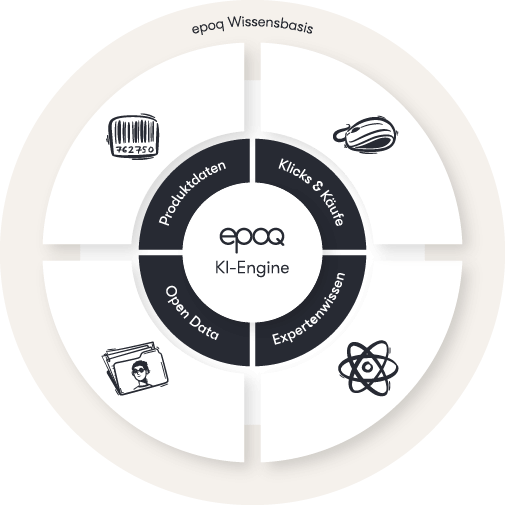
Product data, the click and purchase behavior of shop customers, and expert knowledge all flow into the knowledge base.
Dialogue-based AI
In order to deliver the desired results to the customer, an algorithm must first be able to figure out what the shop customer intends to do. We use the term "dialogue-based AI" for such processes. The so-called response engine, which uses sensors to record and analyze the click and purchase behavior of shop customers, plays a decisive role here. It takes on the task of identifying the customer's goals and interests from the dialogue with them in the online shop.
Various possibilities for dialogue
There are many ways to conduct such a dialogue.
We distinguish between dialogue in the form of
- Reactions: While a shop customer is browsing an online shop, numerous reactions can occur. Based on a user's reactions to the content presented (e.g., clicks, product selection, purchases), you can find out what they want. In the next step, the content to be presented can be customized accordingly for each customer.
- Language: When we think of "dialogue," we naturally think of language. But language-based dialogue between humans and machines also has its pitfalls, as every Alexa user knows from personal experience. Verbal input from a shop customer comes about, for example, through the entry of search terms. This means that dialogue in the form of language can be used for a personalized search system. A product search can be understood as a personalized search system that is triggered by verbal input.
In the following, we will focus primarily on the reactions of shop customers, which are of great importance for generating relevant recommendations.
This raises the question: How can shop operators use dialogue with their customers to display suitable recommendations in their online shops? Various recommendation systems can be used for this purpose. We will discuss some of them in more detail below.
Stay up to date on personalization: Sign up for the Epoq newsletter. Register now!
Classic recommendation systems (static)
A recommendation system is required to generate recommendations. In e-commerce, a distinction is made between different recommendation systems. These are primarily differentiated according to the methods and data basis they use to determine the number of recommendations. For example, there are two classic variants: the content-based and the collaborative system. In addition, recommendation systems can also incorporate other aspects such as demographic data, time series, or context. Let's first take a look at the two "classic" recommendation systems.
Collaborative recommendation systems
The collaborative recommendation system refers to shop customers with similar click and purchase behavior. This means that this system analyzes the click and purchase behavior of different customers for similarities and calculates suitable recommendations based on this. Recommendations generated by a system of this type could be presented with a headline such as "Customers who were interested in this product were also interested in the following products." If shop customers with similar behavior show a high level of interest in a particular product, for example, the system will recommend it to others. Algorithms that deliver product lists according to this approach are also known as collaborative filtering algorithms.
This method, which is used by Amazon among others, is the method of choice when little or no personalization information is available about a customer or the product catalog is rather sparse in terms of product features. Collaborative filtering, even in its modified form, remains one of the cornerstones of personalized recommendation contexts today.
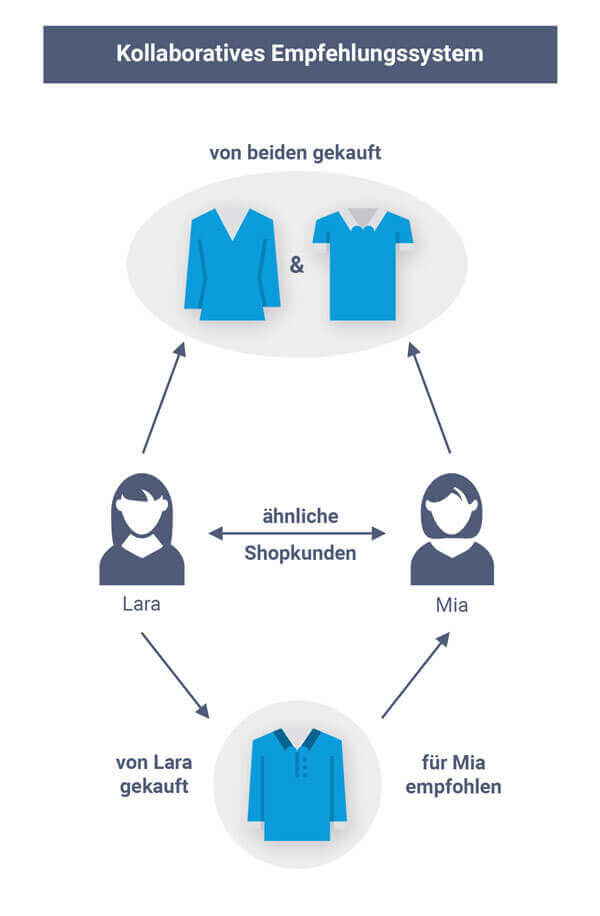
Collaborative recommendation systems calculate recommendations based on similar store customers.
advantage
The advantage of this recommendation system is that it can reveal relationships between users and items that are not explicitly apparent from the product characteristics. In addition, collaborative filtering allows you to show shop customers products that differ from their previous preferences but could also be of interest to them. This allows you to create a surprise effect.
disadvantage
However, one disadvantage of collaborative recommendation systems is the so-called "cold start problem," which occurs primarily with new users and products. Recommendation systems of this type require a large number of shop customers with their respective click and purchase behavior. However, if there is a lack of responses regarding new customers or products, it is difficult to find similar items.
Content-based recommendation systems
The content-based recommendation system does not work on the basis of users with similar click and purchase behavior, but uses similarities between products as a basis. In addition to product attributes, the click and purchase behavior of individual shop customers also plays a decisive role here. Content-based recommendation systems therefore recommend items that are similar to products with which a shop customer has already interacted (e.g., viewed, purchased, or searched for). To calculate recommendations of this type, content analysis is required to determine the similarity between objects. A possible headline for recommendations of this type could be, for example: "Similar products from your favorite brand."
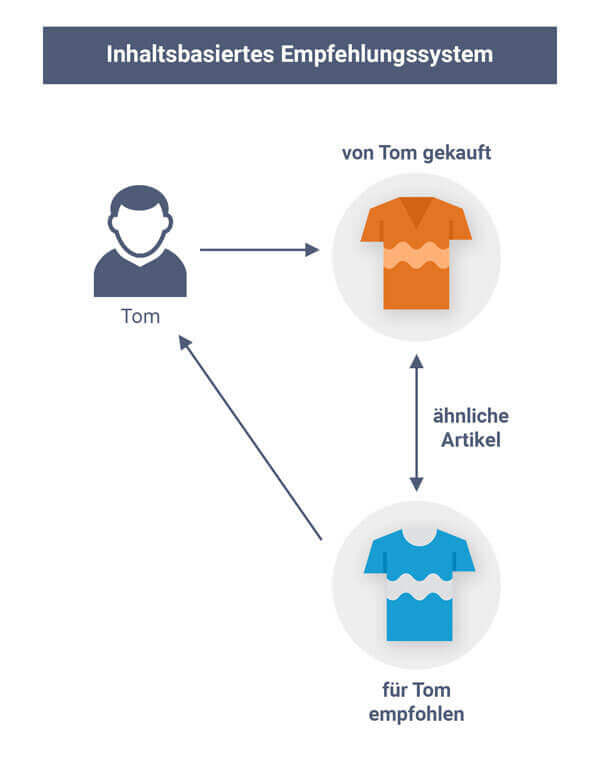
Content-based recommendation systems calculate recommendations based on similar articles.
advantage
The content-based recommendation system has both advantages and disadvantages. One significant advantage over collaborative recommendation systems, for example, is that content-based recommendation systems can also recommend items for which there have been no clicks or purchases to date. This counteracts the so-called "cold start problem," which occurs primarily with new products.
disadvantage
One disadvantage of this recommendation system is that it can lead to overspecialization. Surprising items are not recommended if the product recommendations are based solely on the preferences of the individual customer.
If we recall the example mentioned above, "Similar products from your favorite brand," another problem with these recommendation systems becomes apparent. The customer may prefer to see products in their favorite color. This highlights another aspect that should not be overlooked: context. So, you would actually have to present a customer with a variety of recommendations in a variety of recommendation contexts and hope that one or the other recommendation context piques the customer's interest.
Context-sensitive recommendation systems (dynamic)
Developments in personalization show that it is not just a matter of providing shop customers with the content they want. Users increasingly expect content to be presented in the "right" context, i.e., the context they expect. This poses a challenge for personalization services.
In order to present customers with relevant recommendations in the right recommendation context, dynamic information is required in addition to static information (such as product similarities), as contexts change dynamically. So-called context-sensitive recommendation systems process this information. The context is another input for the recommendation system, which conveys what the customer is currently doing and where recommendations are displayed to them. The dynamic context-sensitive information and its interrelationships significantly increase the quality of the recommendations.
Multiple recommendation contexts
In order to be able to present customers with suitable recommendations in the right recommendation context, you would actually have to present them with a large number of recommendations in a large number of recommendation contexts. To enable shop operators to present their customers with a large number of different recommendation contexts, it would be advantageous if the online shop were to undergo fundamental changes in its structure and design. Users are accustomed to this type of structure from video-on-demand platforms such as Netflix or YouTube, for example.
Multiple recommendation contexts on a shop page
This principle of multiple contexts can also be implemented in e-commerce by shop operators displaying individual recommendations in various recommendation contexts (e.g., items from the customer's favorite brand, favorite style, favorite color, favorite category, etc.) in a personal stream and thus on a shop page for each customer.
Multiple recommendation contexts for entertainment and customer loyalty
This means that the context in which a customer sees the various recommendations in their personal stream is as follows: The customer has already made a purchase and is now in the customer loyalty phase with a need for entertainment. Since they have already gone through several phases of the customer journey, a wide variety of interactions have already taken place at the individual touchpoints on their journey through the online shop. Knowledge about their individual preferences has therefore already been gained from the shop customer's behavior.
This makes it possible to display a variety of recommendations in multiple recommendation contexts in their personal stream, tailored to their individual preferences. The stream also includes interactive elements and offers a mix of inspiration, interaction, and service that provides entertainment. As a result, customers are happy to return to the online store on their own, which increases customer loyalty and the repurchase rate.
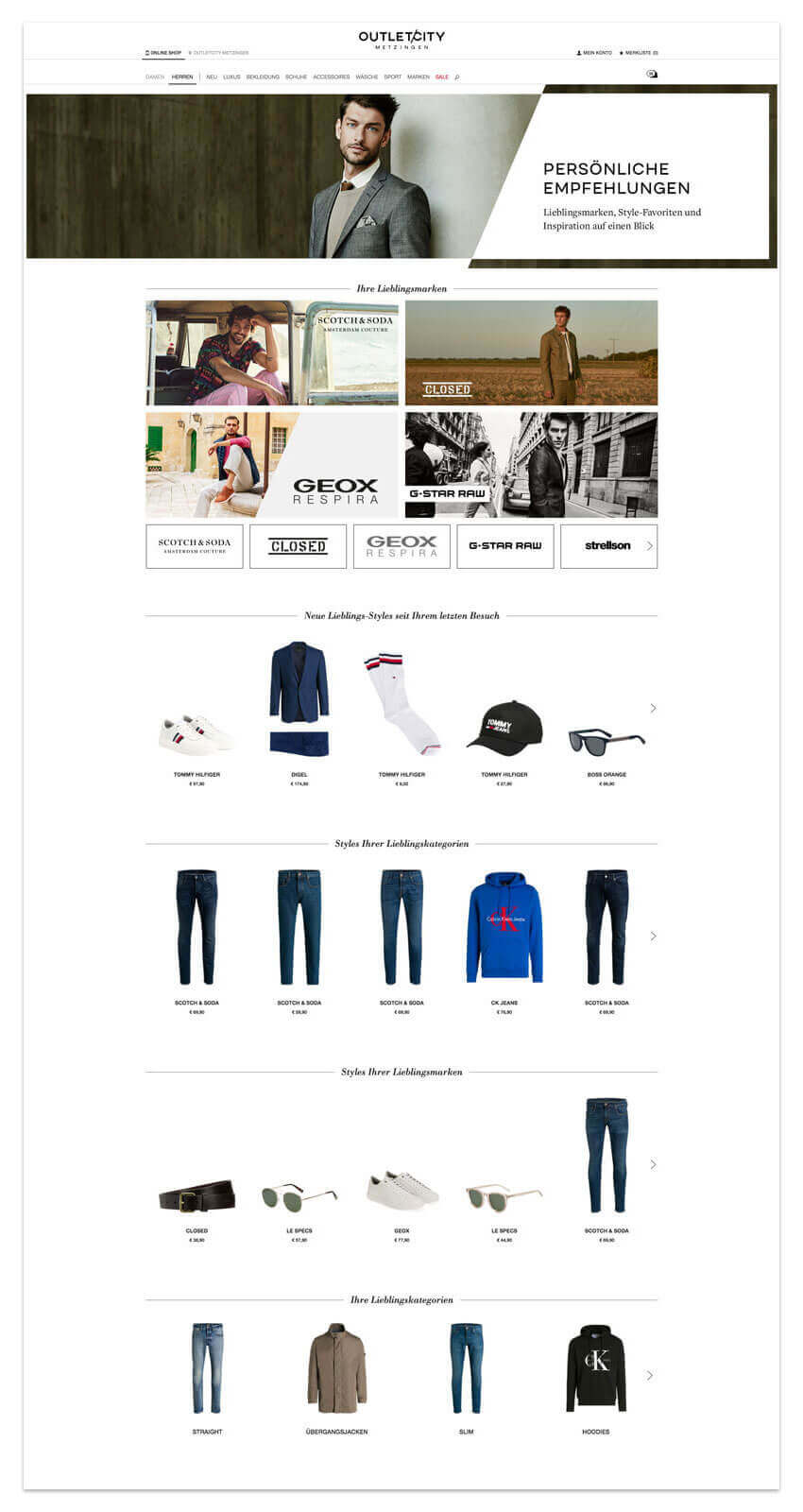
Recommendations in various recommendation contexts on a shop page (source: screenshot from outletcity.com)
Individual recommendation contexts
In practice, however, online shops often only have the space to display individual recommendation contexts. It is therefore particularly important to ask yourself what the customer's needs are in the respective context and which recommendation strategy can best meet these needs. To illustrate how crucial context is for displaying suitable recommendations, let's consider the following two scenarios:
Context 1: Product detail page
A shop customer views a product (in our example, a pot) on a product detail page. Here, the context indicates that the shop customer is currently looking for information and probably wants to buy a pot. To best support the shop customer in this context and help them find the right product, you can display recommendations in the form of similar products in a recommendation widget below the product information.
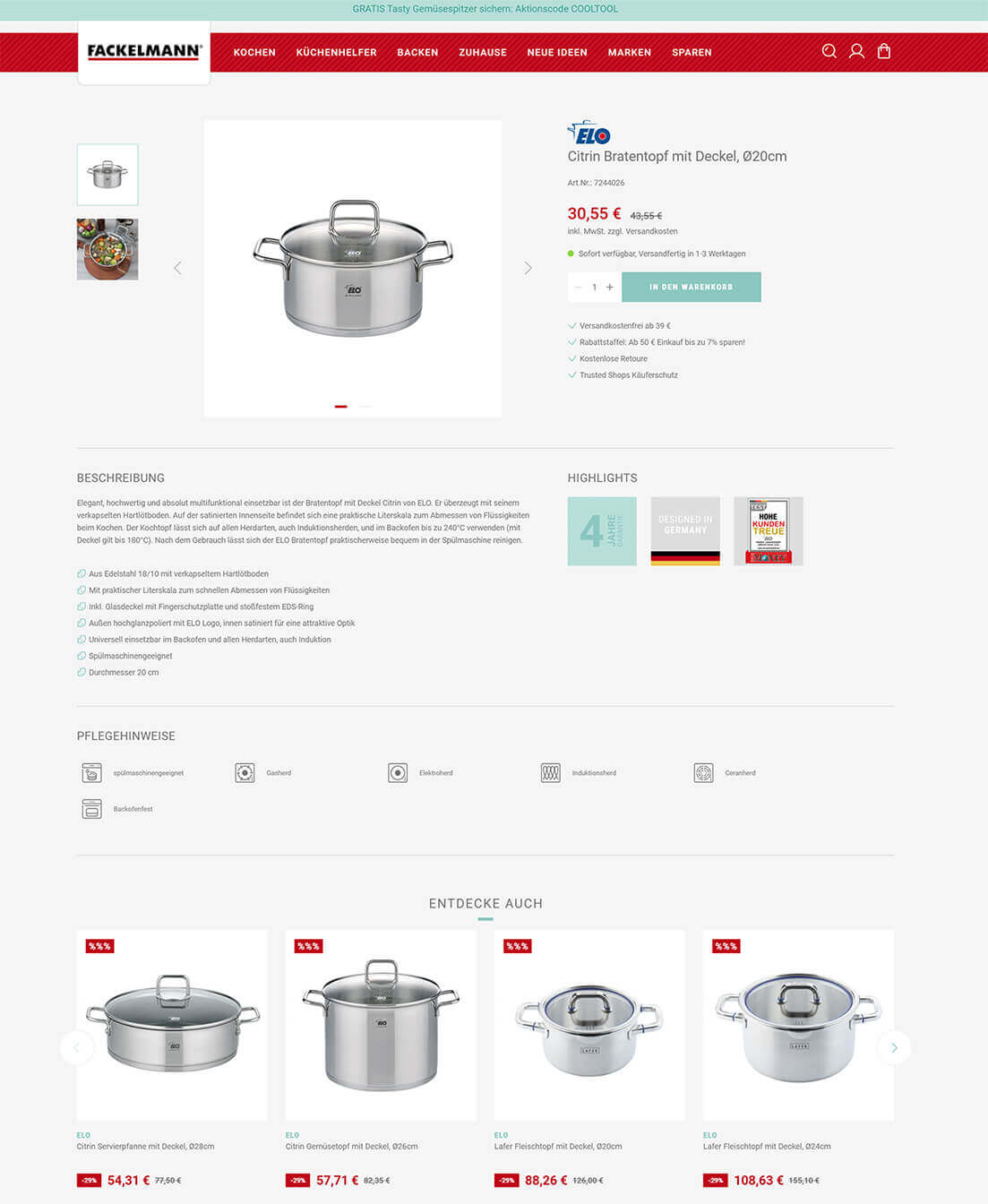
Recommendation of similar products on the product detail page (source: screenshot from fackelmann.de)
Context 2: Shopping cart layer
Another situation is when a shop customer adds a product, in our example a bicycle, to their shopping cart and a cart layer with recommendations opens. Here we have a completely different context: the customer is already one step further and is about to complete the purchase. They are in the process of buying a bicycle and have already added it to their shopping cart. In this context, you should not display similar products under any circumstances, so as not to unsettle the customer in their decision. To prevent the shop customer from changing their mind at this stage, you should instead present them with products that are often purchased together with the product in their shopping cart. These so-called cross-selling recommendations inspire your customers and increase the value of their shopping cart.
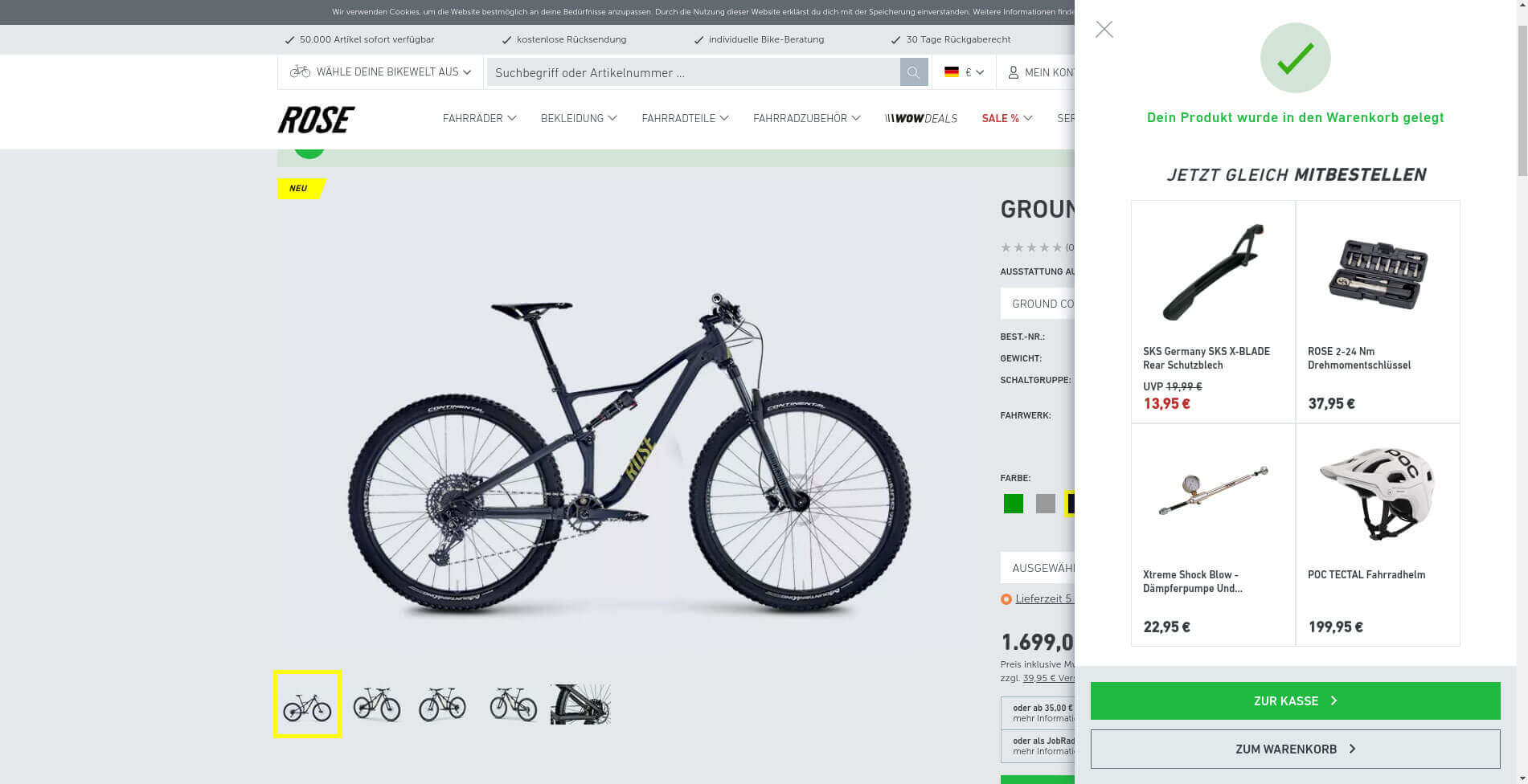
Cross-selling recommendations in the shopping cart layer (source: screenshot from rosebikes.de)
This clearly shows how important it is to consider the respective context and thus the situation in which a shop customer currently finds themselves when displaying recommendations.
Compromises for individual recommendation contexts
So if, for example, only one or two recommendation contexts can be presented on a product detail page, you have to choose the best possible compromise. An example of this would be: "Similar products you may also like." It is important to take the term "similar" seriously, as this significantly increases the quality of the recommendations. "Similar" here means products with similar characteristics to the product viewed in detail by the shop customer, rated according to the customer's personal preferences.
Example: If a customer shows a particular interest in black items, other black items are considered very similar. Without this information about customer behavior, the product color would not have played a major role in the recommendations.
Stay up to date on personalization: Sign up for the Epoq newsletter. Register now!
Hybrid recommendation systems
Depending on the context, it may be necessary to intelligently mix or modulate the recommendations generated in this way with recommendations generated by collaborative filtering. When different recommendation systems and components are combined, this is referred to as hybrid recommendation systems. These ensure better results and remedy the weaknesses of individual systems. By combining content-based and collaborative recommendation systems, it is possible, for example, to minimize the cold start problem of the collaborative system. This allows relevant recommendations to be generated more quickly for shop customers and improves the quality of the recommendations.
This means that truly relevant recommendations cannot be generated using a universal algorithm, but rather require the dynamic interconnection of a whole series of intelligent basic algorithms. This requires, on the one hand, a modular software system that makes these basic algorithms compatible with each other and, on the other hand, experts who are able to configure and parameterize such dynamic architectures.
Choosing the right recommendation system
We have now seen that there are very different recommendation systems that work with different methods and use different data bases. Finally, the question arises as to which is the "right" system for generating suitable recommendations.
Recommendation strategy and personalization type are context-dependent
There is no simple, blanket answer to this question. Which recommendation system is the right one depends on various factors. The development of e-commerce shows that originally static structures are becoming increasingly dynamic, and in addition to product or content selection, the context in which the selection is presented is becoming increasingly important. Depending on the phase of the customer journey a customer is currently in and the context in which they see recommendations, a different recommendation strategy, type of personalization, and thus the use of different recommendation systems makes sense.
Expert knowledge as a prerequisite
In order to dynamically display personalized recommendations in the appropriate context, software architecture is required that can dynamically interconnect a wide variety of algorithms depending on the context. However, configuring these architectures requires expert knowledge above all else. This is because experts can identify the requirements of the individual touchpoints and then select the appropriate recommendation system and type of personalization depending on the context. This allows recommendations to be generated that are individually tailored to the context and preferences of the shop customers.
Conclusion: Targeted combination of different recommendation systems
There are various recommendation systems, each with its own advantages and disadvantages. The development of e-commerce shows that dynamic structures are becoming increasingly important and shop customers expect product recommendations in a suitable context. To keep pace with this development, different recommendation system methods can be combined in a targeted manner depending on the context. Since these hybrid systems are very complex, expert knowledge is crucial for success. This allows dynamic architectures to be designed and personalized product recommendations to be generated that are tailored not only to preferences, but also to the individual customer journey phase and the context in which the respective shop customer finds themselves. This customization in the online shop makes all the difference and determines how good the recommendations presented are, which in turn has a positive effect on the value of the shopping cart.
Frequently Asked Questions About Recommendation Systems
Recommendation systems are technologies that suggest relevant products or content to online shoppers. They use data such as click behavior, purchase history, product information, and the current context within the online store to provide recommendations that are as relevant as possible.
Personalization ensures that recommendations align with a customer's individual interests, preferences, and needs. The more relevant the recommended products are, the more likely they are to be noticed, clicked on, and purchased.
Collaborative filtering systems are based on the behavior of similar users, such as the clicks or purchases of other customers. Content-based systems, on the other hand, recommend products that have similar characteristics to items that have already been viewed or purchased.
Context determines which recommendation makes sense in a given situation. On a product detail page, similar products can be helpful, whereas in the shopping cart, complementary cross-selling products should be recommended.
Hybrid recommendation systems combine multiple recommendation methods, such as collaborative and content-based approaches. This helps offset the weaknesses of individual systems and generate more relevant recommendations for different shopping scenarios.
The best recommendation system depends on the product lineup, the available data, the stage of the customer journey, and the specific touchpoint. In practice, it often makes sense to use a combination of different methods so that recommendations can be dynamically adapted to the context.
Recommendation systems can draw customers' attention to suitable complementary products, alternatives, or product bundles. As a result, users discover more relevant items and are more likely to add additional products to their shopping cart.

Michael Bernhard
Co-founderYou are currently viewing placeholder content from HubSpot Embedded Content. To access the actual content, click the button below. Please note that doing so will result in data being shared with third-party providers.
More InformationYou are currently viewing placeholder content from HubSpot. To access the actual content, click the button below. Please note that doing so will result in data being shared with third-party providers.
More InformationYou are currently viewing placeholder content from HubSpot Meetings. To access the actual content, click the button below. Please note that doing so will result in data being shared with third-party providers.
More Information