
E-book – Personalization in E-commerce
In this e-book, you will learn why personalization is important in e-commerce and what the term personalization actually means.

The better the digital customer experience, the more loyal your customers will be. It therefore determines whether your customer will buy from you again in the future or switch to another online store. That is why customer experience has become increasingly important in companies, leading to the emergence of customer experience management. This is intended to support the optimization of the customer experience through various measures. Personalization is one of the most important measures for building customer loyalty in e-commerce and responding to customers individually. In this blog article, you will learn everything you need to know about the digital customer experience. Enjoy reading!

Here'swhatyou can expect to find in this blog article:
How the term "digital customer experience" is defined
The importance of customer experience for companies
Perception gaps regarding customer experience
Consequences of negative customer experience for companies
Customer experience management puts customers first
Customer journey mapping as part of CXM
Developing a digital customer experience strategy
Personalization as the most important measure for an excellent customer experience
Conclusion: Customer experience influences customer loyalty.
Frequently Asked Questions About the Digital Customer Experience
The digital customer experience defines a customer's shopping experience in e-commerce. Specifically, this refers to the sum of all experiences that the customer has with an online store: before, during, and after the purchase. These can be both positive and negative. For example, if a customer is used to other online shops having a faceted navigation on a product overview page that narrows down the products, they will expect this in every online shop. If this is not the case, it will result in a negative shopping experience.
Stay up to date on personalization: Sign up for the Epoq newsletter:Sign up now!
Customers therefore have certain expectations when they visit an online store, and these expectations should be met or even exceeded. If expectations are not met and the customer has a negative experience as a result, it is unlikely that they will shop with you again and become a loyal customer. The digital customer experience therefore determines whether the customer will buy from you in the future or switch to another online store.¹
Companies have recognized the importance of customer experience. In fact, 93% say that a good customer experience is one of their top strategic priorities.² So it's no surprise that there are now dedicated employees and entire departments dealing with this issue.
Due to the hype surrounding customer experience, more and more companies are beginning to implement optimization measures in this area. It is therefore understandable that, according to a study, 69% of marketers surveyed now believe that they provide their customers with an excellent customer experience. However, the situation is quite different from the customers' perspective. Only 22% feel that retailers understand them.³ The perception of companies thus differs greatly from that of customers. The reason for this is often that companies neither focus on the customer nor take the customer's perspective.
It is therefore not surprising that many customers have already had a negative shopping experience. However, this can have far-reaching consequences for companies. According to studies, 63% of customers who have a bad experience leave the site. 17% even share their bad experience on social media or on the site itself.⁴ In times of referral marketing and word-of-mouth marketing, such behavior can be fatal and lead to a slump in sales.
Customer experience management (CEM or CXM) focuses on the customer and their shopping experience and creates measures and processes to systematically improve the customer experience in order to increase customer satisfaction and loyalty. 75% of respondents to a study stated that an important reason for using customer experience management is improved competitive differentiation.⁴ This is essential for many companies, especially in today's highly competitive online shop landscape.
Stay up to date on personalization: Sign up for the Epoq newsletter: Register now!
Customer journey mapping helps you identify all touchpoints between customers and your online store, thereby improving the customer experience and turning your online store into the point of decision. Customer journey mapping focuses on the user flow of a customer in the online store. This is examined from different perspectives in order to identify the relevant touchpoints. In doing so, you put yourself in the shoes of the target group, evaluate the various touchpoints, and visualize the customer journey. You can find more information about the procedure in our blog article: Customer journey mapping for identifying touchpoints in e-commerce.
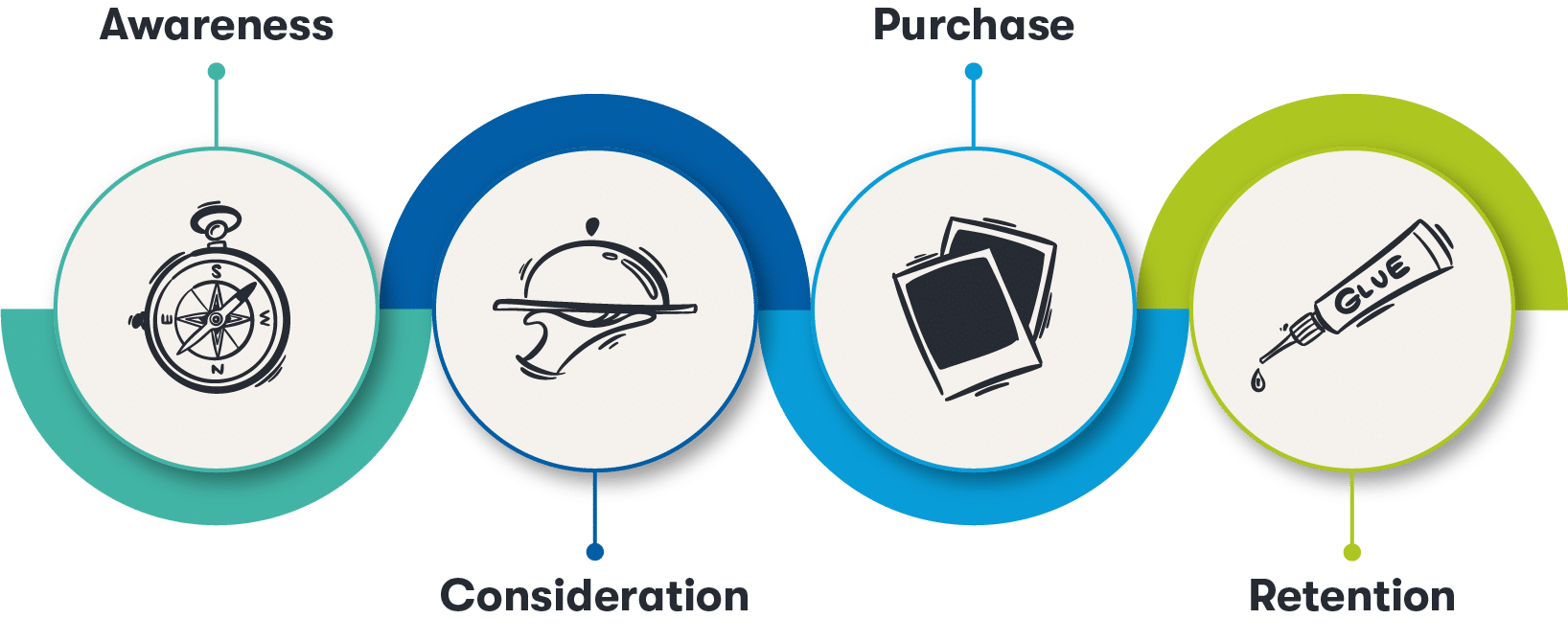
Customer journey phases in which the digital customer experience can be optimized
During customer journey mapping, you identify the touchpoints in your online shop that lead to a negative customer experience. Now it's time to turn these weak points into positive shopping experiences. You can do this by developing a digital customer experience strategy, which you can incorporate into an action plan. The order in which you address the weak points depends on their impact on your online store. You should prioritize and sort the weak points, as you cannot address them all at once. Next, you need to find the right solution for the weak points and also include this in the action plan.
One weak point could be, for example, the search function in the online shop, which returns no results or incorrect results. The problem needs to be evaluated in detail. Important product attributes may be missing from the product catalog, or the necessary personalization may be lacking to respond accurately to the search query.
Once you're done, you'll have developed your customer experience strategy for creating positive shopping experiences along the digital customer journey and you'll be ready to get started.
Personalization is the top priority in all possible measures. It plays a decisive role and holistically supports the digital customer experience by generating individualized communication and personalized content at touchpoints along the customer journey. This allows shop operators to demonstrate that they understand and respond to customer needs, which is reflected positively in customer loyalty.⁵
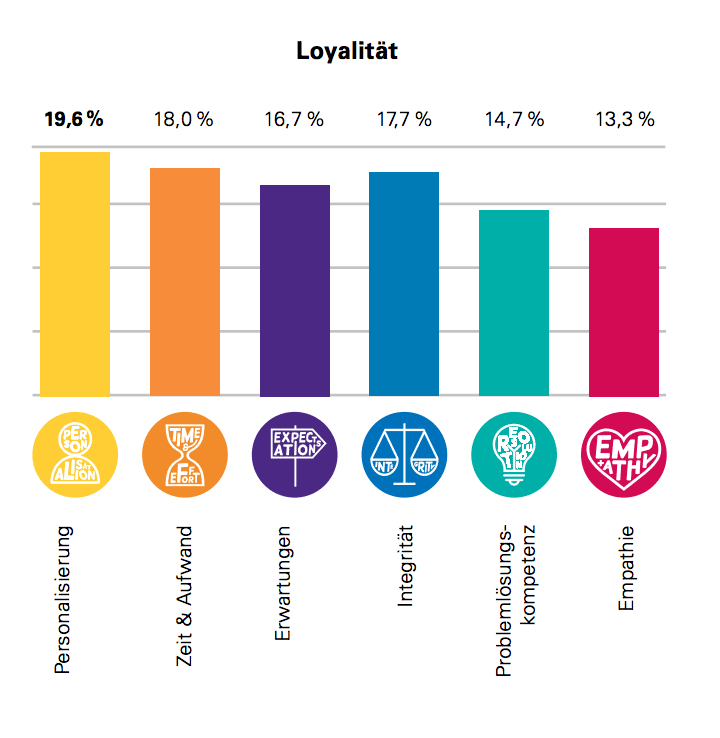
Impact of personalization on customer loyalty (Source: KPMG 2019)
If you want to delve deeper into personalization along the customer journey, we recommend the following blog article: Digital customer journey: How to make your customers' journey unforgettable.
Rising customer expectations when shopping have meant that the digital customer experience has become increasingly important. This has led to the development of customer experience management, which aims to eliminate weaknesses and increase customer loyalty. Proximity to the customer and a personalized approach are essential in this regard. That is why personalization plays a particularly important role in the customer experience, enabling companies to differentiate themselves from the competition through customer satisfaction and loyalty.
Sources:¹KPMG 2019,²IBM Commerce 2015,³IBM and Econsultancy 2015,⁴IBM Commerce 2015,⁵KPMG 2019
The digital customer experience (CX) encompasses all the impressions and experiences a customer has when interacting with an online store, from the initial search through the purchase process to after-sales service.
The most important factors are: website loading speed, intuitive navigation, quality of search results, relevance of product recommendations, a simple checkout process, and personalized communication across all channels.
User experience refers to the user's experience with a single digital product. Customer experience is the broader term and encompasses all of a customer's interactions with a brand, including emails, social media, customer service, and after-sales support.
Personalization is what sets a generic shopping experience apart from a truly relevant one. When customers see exactly the products, content, and offers that match their interests, satisfaction increases measurably—and so do loyalty and revenue.
Key metrics include: Net Promoter Score (NPS), Customer Satisfaction Score (CSAT), repurchase rate, bounce rate, conversion rate, and customer lifetime value. Regular customer surveys and usability tests help identify areas for improvement.
Customer service is a subset of the customer experience; it involves providing direct assistance with issues such as returns or complaints. The customer experience describes the overall experience across all touchpoints, including an intuitive checkout process and fast delivery.
Omnichannel means that customers can switch seamlessly between different channels—online store, app, brick-and-mortar store, social media—while enjoying a consistent experience. Brands with a strong omnichannel strategy achieve significantly higher customer retention rates.
Learn how to use personalization profitably in e-commerce:
Request your e-book now!

You are currently viewing placeholder content from HubSpot Embedded Content. To access the actual content, click the button below. Please note that doing so will result in data being shared with third-party providers.
More InformationYou are currently viewing placeholder content from HubSpot. To access the actual content, click the button below. Please note that doing so will result in data being shared with third-party providers.
More InformationYou are currently viewing placeholder content from HubSpot Meetings. To access the actual content, click the button below. Please note that doing so will result in data being shared with third-party providers.
More Information