Back to overview
  • Reduce Return Rate

Guided Selling Software 2.0: The new era of digital purchasing advice

  • Updated September 23, 2025 ● Published June 8, 2018
  • Sarah Birk
  • Reading time: 13 min.

E-commerce is constantly evolving. The same applies to customers' expectations of competent, personal advice in online retail. In recent years, classic guided selling software has proven that structured assistance with product selection increases conversion rates and reduces returns. However, rigid decision trees and visual filters are not always sufficient. What is needed is a new form of digital assistance – interactive, dialogue-oriented, and intuitive. The concept of AI conversational commerce and AI shopping assistants offers exactly that: customers chat with artificial intelligence via voice or text instead of navigating through predefined click paths. In this article, learn what lies behind the term guided selling software and how the new generation of intelligent assistants is leveraging and further developing its strengths.

The picture shows a woman taking another person by the hand and leading them through the streets.

What is guided selling software?

Guided selling software is a software program that allows you to assist your customers in selecting items and guide them to the right product in e-commerce. This makes it easier for them to choose the product they want. Overall, this leads to the right purchase decision, which is reflected in lower return costs for your company.

An online consulting tool helps your customers determine their needs when they are not familiar with the features of a product. The guided selling software asks specific questions and provides possible answers via visually prepared filters. The customer can easily answer these questions and thereby convey to the consultant which product meets their expectations.

The guided selling software then displays the products that best suit your customer first in the results list. The instant result function immediately changes the results list as soon as the customer answers another question. Since the products presented are tailored to their specifications, they feel more confident and more inclined to make a purchase.

How does guided selling software work?

Traditional guided selling is based on a fixed decision tree: customers answer a series of predetermined questions and are guided step by step to the right product selection.

Modern, AI-supported variants go one step further. They not only take into account the user's answers, but also their clicking and purchasing behavior, which is incorporated into a store-specific knowledge base and made available for consultation. On this basis, the results list is adapted to personal preferences in real time. For example, in terms of brands, models, or product types.

What makes it special is that the AI model learns with every interaction. This means that recommendations are continuously improved, making advice increasingly accurate and relevant.

What are the advantages of guided selling software?

It often happens that a customer has a need but cannot specify it precisely. For example, in the case of complex products that require explanation. In such cases, it can be difficult to select the right product, as different requirements apply depending on the intended use.

The more uncertain the customer is, the less likely they are to make the purchase. If they do buy despite their uncertainty, there is a good chance that the customer will not be satisfied with the product and will return it. This is where guided selling software can be effective, because it:

  • advises the customer so that they ultimately know what they need and what they want.
  • creates awareness for the right product. This makes the customer more likely to make a purchase and also more likely to be satisfied when they receive the goods.

We reveal more about how you can effectively avoid returns in our blog article Avoiding returns: The role of personalization in e-commerce consulting.


Stay up to date on personalization: Sign up for the Epoq newsletter. Register now!


2 cases for successful use of guided selling software

Lufthansa and Ex Libris have implemented different shopping assistants. Despite their differences, they have both achieved the same result: the shopping experience is now more enjoyable and easier, enabling customers to buy the right products.

Targeted baggage selection: Miles & More's conversion rate increases thanks to guided selling

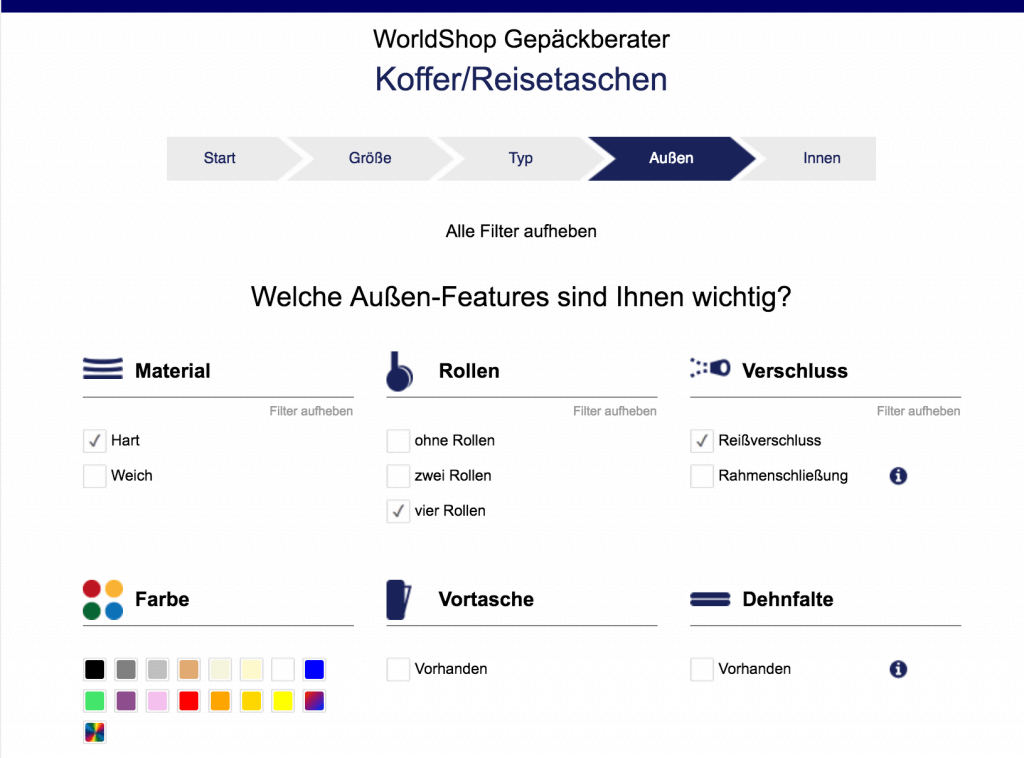
For travelers, finding the right suitcase is essential. If it is larger than necessary, you will be carrying unnecessary volume. If it is too small, you will have problems fitting everything you need for your trip. To avoid these problems, Miles & More, a subsidiary of Lufthansa, has integrated a luggage advisor. With the wide variety of luggage that Miles & More sells, it is easy to lose track. But with the Baggage Advisor, no customer should have any difficulty finding the right suitcase to suit their needs and requirements.

The luggage advisor will ask you detailed questions about your needs. For example, they will ask about the material, the number of wheels, or the closure.

Excerpt from Lufthansa's baggage advisor for selecting external features (source: screenshot of the baggage advisor on worldshop.eu)


Stay up to date on personalization: Sign up for the Epoq newsletter. Register now!


Miles & More made sure that customers weren't shown a page with zero results. Instead, they added a reasoning feature to the offers they showed. This feature shows which features the customer is looking for do and don't apply to each product. This way, customers can see at a glance which products meet their needs and wants.

“With the support of Epoq's Guided Selling Software, we were able to significantly increase conversion in the luggage sector. In conjunction with the Recommendation Engine, it has become an indispensable part of worldshop.eu for us.”

– Thomas Hilus | Digital Marketing Manager | Miles & More GmbH

Spot-on gift ideas: Ex Libris uses guided selling for greater relevance

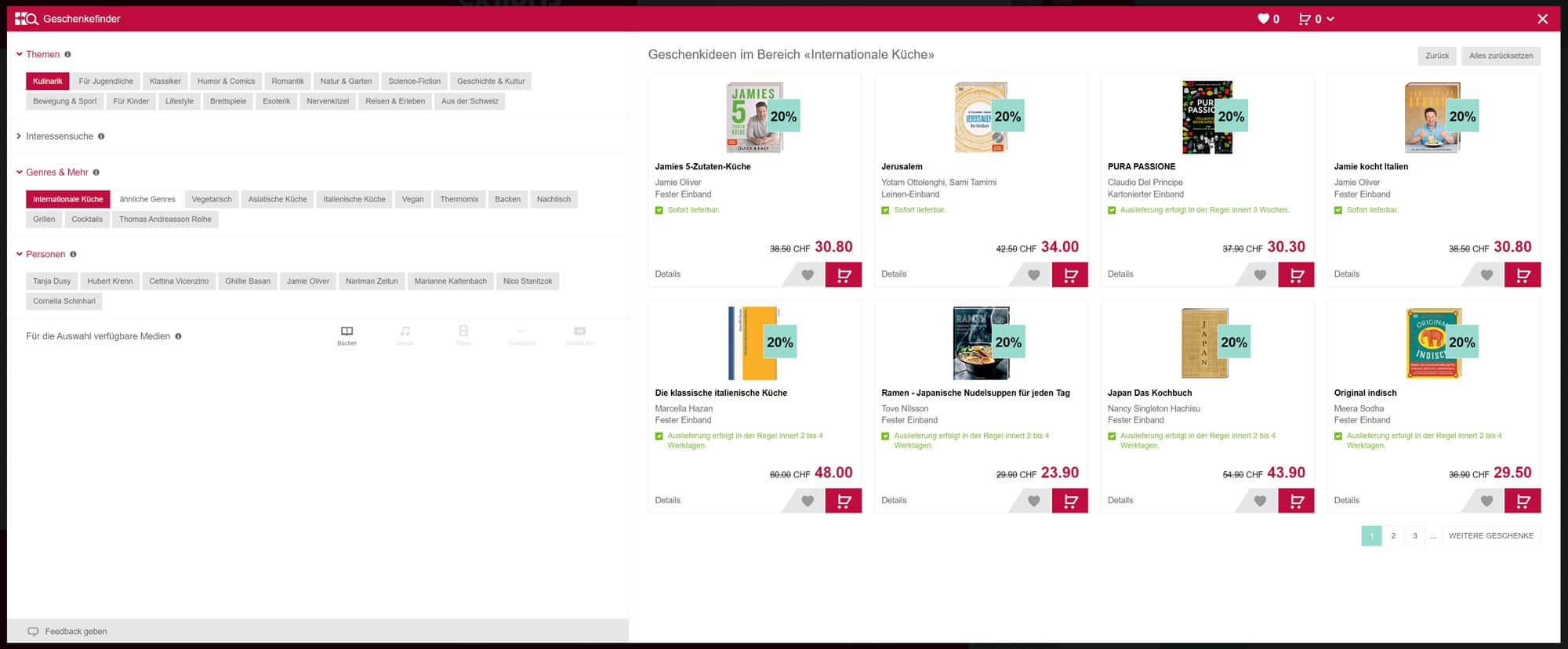
Ex Libris relies on its gift finder as a prime example of self-explanatory products. This interactive tool uses keyword tags instead of explanation-intensive advice. Users simply select topics or areas of interest, such as favorite authors, music genres, or product types (books, movies, games). The system combines these tags to generate suitable recommendations and presents the results in real time.

Screenshot of the Ex Libris gift finder as an example of guided selling software.

Excerpt from Ex Libris' gift finder for selecting suitable gift ideas by tags (source: screenshot from exlibris.ch)

These examples show how much potential structured online counseling has. But with today's technology, even more is possible.

From guided selling software to AI shopping assistants: the next level of digital consulting

Guided selling is a success story in digital consulting. However, with increasing expectations for real-time, interactive, and contextual service, there is a need for a new level of service: today's customers expect more than structured but rigid advice. Instead of navigating through predetermined click paths, they want to engage in dialogue —have terms explained, chat, ask specific questions, and be able to respond immediately.

Traditional guided selling software reaches its limits here. The AI Shopping Assistant builds on its strengths and takes digital consulting into a new generation— more flexible, more personalized, and more dialogue-oriented.

What is the new AI Shopping Assistant?

An AI Shopping Assistant is a digital shopping advisor that helps customers choose products. It answers questions in natural language, gives personalized recommendations, and guides customers through the entire purchasing process —individually, easily, and around the clock. Unlike traditional guided selling solutions, the AI Shopping Assistant enables dialog-based, interactive advice that resembles a personal conversation in a store. This creates a particularly user-centered shopping experience in the online store.

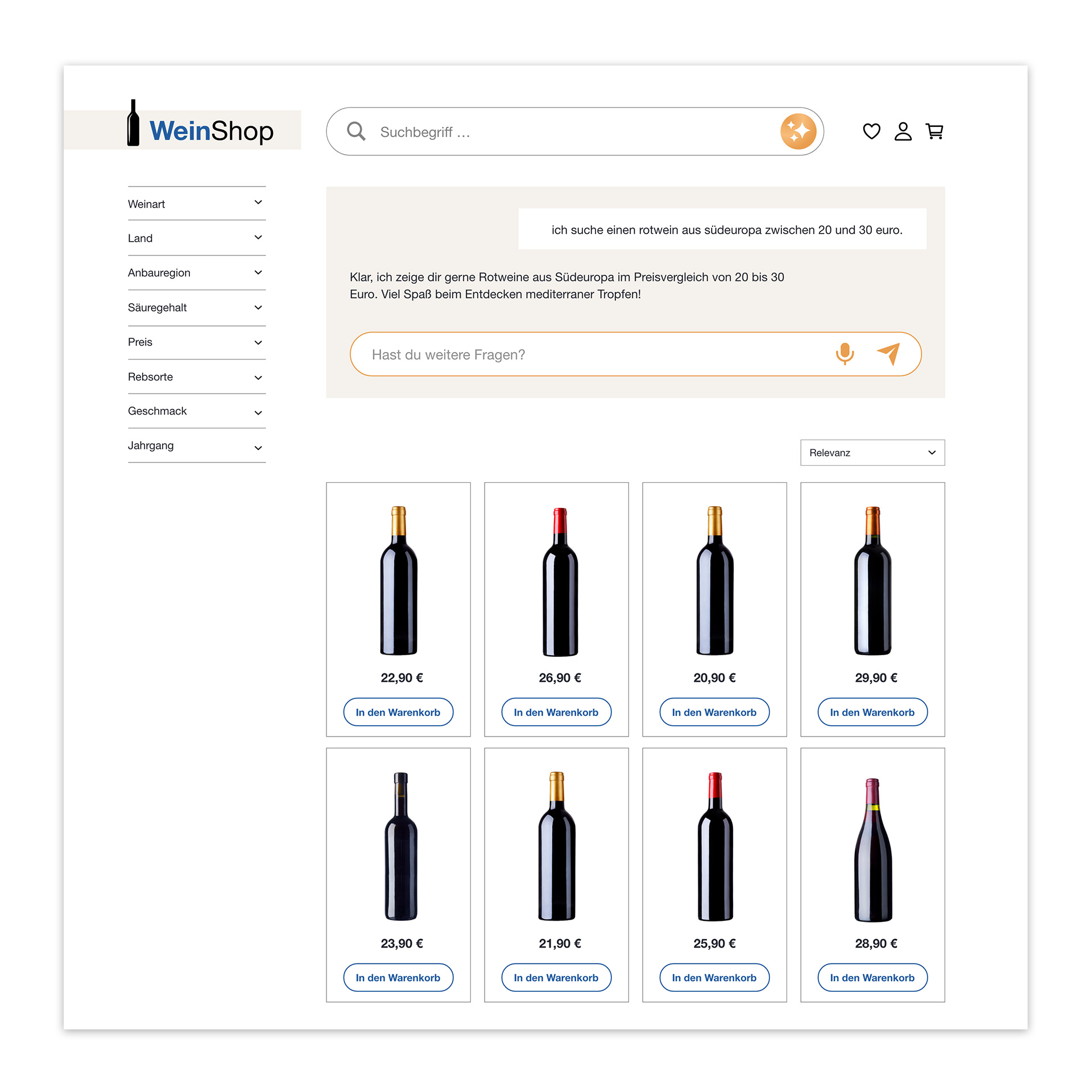
Example: In a wine shop, a customer asks, "I'm looking for a red wine from Southern Europe between $20 and $30." The AI Shopping Assistant understands the request, filters suitable Mediterranean wines in the desired price category, and presents them in a personalized list of results. The solution thus goes far beyond classic visual filter functions and offers advice that is tailored to the individual wishes of the user.

Exemplary representation of a wine shop with an AI shopping assistant as a further development of classic guided selling software, which provides suitable results with Mediterranean wines in the desired price category in response to the query "I am looking for a red wine from Southern Europe between 20 and 30 euros."

The AI Shopping Assistant offers customers personalized and dialogue-based advice in the online shop (source: own illustration).

How does an AI shopping assistant work?

The technical basis of the AI Shopping Assistant is formed by modern AI technologies such as natural language processing (NLP), machine learning, and large language models (LLM). These enable the system to understand natural language, interpret complex queries, and customize recommendations in real time. Unlike conventional tools, the AI Shopping Assistant responds dialogically and accurately recognizes the intentions of users.

The functionality can be seamlessly integrated into existing processes and creates real added value for online shoppers. At the same time, the familiar product search remains unchanged – users can decide for themselves at any time whether they want to use the AI Shopping Assistant or choose the classic navigation path. Product search is particularly useful when customers already know exactly what they are looking for and what features the product should have. However , if there is uncertainty about which product is best suited and which items meet individual requirements, the AI Shopping Assistant can provide targeted support.

Important: Traditional guided selling solutions can also be AI-based and use adaptive algorithms, for example to analyze click and purchase behavior, in order to tailor the results list to the individual preferences of users. The key difference lies in the interaction. The AI Shopping Assistant enables a dialogical experience, comparable to a live chat or chatbot application or a GPT-based chatbot that responds to requests in a personalized manner.


What are the advantages of the AI Shopping Assistant?

The AI Shopping Assistant demonstrates how AI-based purchasing advice works, with benefits for both customers and retailers.

For your customers:

  • Intuitive user experience: simple, voice-based product search with clear user guidance
  • Time savings: quick product selection thanks to 24/7 advice without waiting times
  • Relevant recommendations: tailored product recommendations that meet individual needs

For you as a retailer:

  • More targeted offers: Customer interactions provide valuable data that enables precise personalization.
  • Higher conversion rates and fewer returns: tailored recommendations increase sales and reduce mispurchases.
  • Long-term customer loyalty: Real-time advice ensures positive shopping experiences and strengthens loyalty to the store

Another advantage is flexibility: While guided selling is usually product category-specific and must be designed and technically implemented individually for each category, an AI shopping assistant can be integrated once and then used across categories. This significantly reduces the effort required for design and development and makes the solution particularly efficient to use.

Comprehensive market research also shows that these advantages pay off: According to current analyses, the market for AI shopping assistants will grow to $41.9 billion by 2034—with an annual growth rate of 26.1%.¹ Personalization software is thus already becoming the new standard in e-commerce.

One system, three levels of maturity: How digital assistance is evolving

The advent of AI-powered shopping assistants marks the beginning of a new chapter in e-commerce: the transition from traditional, rule-based guided selling tools with visual filters to genuine, interactive assistants.

While traditional systems rely on clicks and predefined options, AI-based solutions enable natural, flexible communication—similar to a real consultation.

The following table provides an overview of the three key stages in the development of digital purchasing advice.

criterion Guided selling without AI AI-based guided selling AI Shopping Assistant
Personalization No personalization 1:1 Personalization 1:1 personalization combined with LLM
Technology Rule-based, static decision trees AI-supported: Machine learning Advanced AI: Machine Learning + LLM
interaction Fixed question-answer path Dynamic question-answer path with real-time customizable results list Free dialogue in natural language (text/voice)
data processing No user data analysis Behavioral data,
Continuous learning,
Context recognition
Behavioral data,
Continuous learning,
Context recognition and language processing
quality of relationships Consulting based on selection logic Customizable counseling with learning elements Empathetic, contextual interaction as in personal consultation

Conclusion: The future of purchasing advice is dialogue-based, personalized, and intelligent.

From structured questionnaires to intelligent dialogue systems: digital consulting in e-commerce has evolved significantly in recent years. What once began with guided selling is now being taken to a new level by AI-supported shopping assistants.

The key lies in combining relevance, 1:1 personalization, and interaction. This enables you to not only guide customers to the right product in your online store, but also offer them a genuine consulting experience. And that is precisely what will make the difference in the digital commerce of the future. Because those who create a compelling consulting experience today will not only increase their conversion rate, but also customer satisfaction and loyalty. Online shops that anticipate customer expectations position themselves as trustworthy brands in the long term and at the same time create a competitive advantage for themselves.

Source: ¹ InsightAce Analytic

Frequently asked questions about Guided Selling software

Would you like to learn how to reduce the return rate in your shop?

Schedule a web demo on this topic!

Sarah, Junior Content Marketing Manager at epoq
Sarah Birk
Online Marketing Manager - Content & SEO
Sarah works as Online Marketing Manager – Content & SEO at Epoq and is responsible for the content area. Her responsibilities range from content planning and conception to analysis and optimization of various content formats, taking important SEO aspects into account.