Back to overview
  • Reduce Return Rate

Live chat in e-commerce vs. AI-supported consulting: This is how customer service works today

  • Updated March 10, 2026 ● Published October 25, 2022
  • Daniela Ilincic
  • Reading time: 14 min.

Online retailers invest heavily in generating traffic. But what happens to potential customers if they don't find what they're looking for right away? To prevent them from simply leaving, you should offer them optimal sales advice – the more personalized and targeted, the better. Live chat is an effective form of customer advice and support in e-commerce, and at the same time, it is only the first step toward innovative chatbots that can respond automatically and even act independently. Here you can read about the various advice options available and how you can strengthen contact with your customers with the right chat function and guide them step by step to the right purchase decision.

A woman is holding a smartphone with a live chat window open on it.

Live chat in e-commerce: What you need to know

The use of live chat is particularly useful when there is a need for explanation and advice due to the variety or complexity of the products. Live chat is especially worthwhile in e-commerce where a high customer lifetime value (CLV) is achieved, as the costs of customer retention can be higher for customers with a high CLV. We have compiled everything you need to know about the various options for digital purchasing advice in another blog article.


Stay up to date on personalization: Sign up for the Epoq newsletter. Register now!


What is live chat in e-commerce?

Live chat in e-commerce is a digital tool for communicating with customers in real time on a website or in an online shop , on a person-to-person basis.

For live chat, you need real, well-trained service employees who can chat with your customers. The resulting personnel costs are worthwhile, as human employees can respond to customer inquiries in a highly individualized and tailored manner.

After selecting the provider, you can easily integrate the live support chat directly using a short code snippet.

What are the benefits of live chat in e-commerce?

Communication between you and your customers is one of the most important factors for success in e-commerce. By integrating live chat into your online store, you and your prospective customers will benefit from the advantages it offers.

Direct communication with customers

By providing your customers with live chat directly in your online store, you are offering them a real-time means of communication at exactly the point in the sales process where they are at that moment. You should place the chat option across all pages so that direct communication is possible wherever it is needed. For example, if a customer is currently on the product detail page and cannot find any information about the applicable delivery costs, they can use the chat function to ask about this. Another customer, on the other hand, may need assistance with the checkout process. Here, too, communication via e-commerce live chat can help.

The direct availability of the communication channel means that customers are more likely to use it than if they can only contact you via a form, email, or phone. This keeps the effort required on the part of the customer to a minimum. Of course, you should always ensure that customers receive a direct answer to their questions and that the chat is always supervised by an employee. This allows you to answer questions before the purchase and reduces the return rate at the same time.

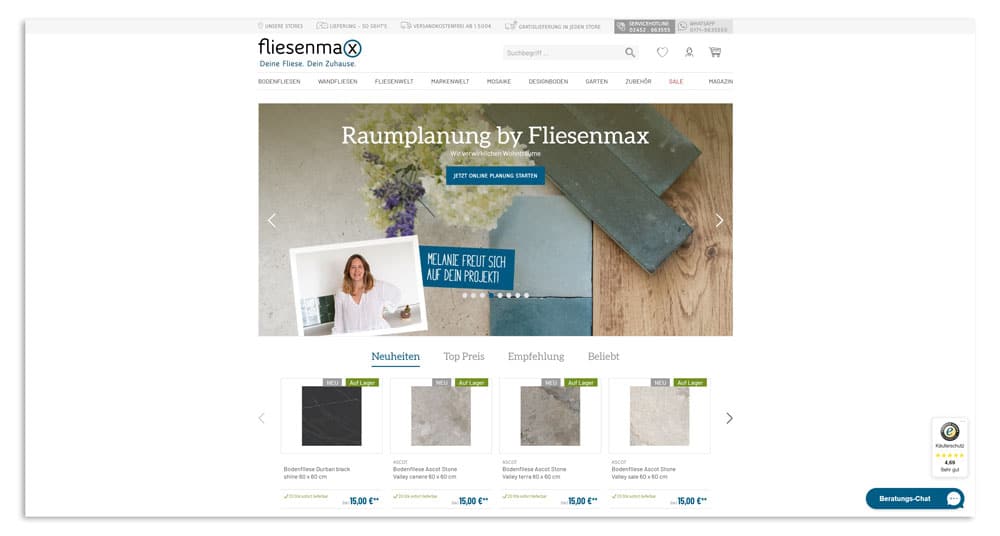
In the Fliesenmax online shop, customers can use the chat support feature on every page.
(Source: Screenshot from fliesenmax.de)

Enhancing customer satisfaction

The immediate availability of customer service also increases customer satisfaction. When customers submit contact requests via forms or email, they often receive no response or a very late response, which leads to a negative customer experience. The customer support chat function prevents this negative experience and strengthens customer loyalty. Live chat in e-commerce thus helps to ensure that customers are happy to return.

Relatively low costs

This type of customer service offers great benefits for you and your customers at low cost. Although the chat must always be staffed by an employee, they can conduct several conversations at the same time.

Furthermore, you can gain important insights for the company from the questions that arise via the chat function. For example, you can use the feedback to adjust your product descriptions or integrate an FAQ section to clarify frequently asked questions there.

Increase in conversion

As an online retailer, you usually invest a lot of money in advertising or other communication tools to increase traffic to your online store. To make the most of the traffic you generate, you should provide customers with optimal advice and support directly during their purchase process. With e-commerce live chat as an advisory function , you not only stand out from the competition, but also prevent a large proportion of the bounce rate that occurs due to a lack of advice, thereby increasing the conversion rate of your e-commerce business.

Best practices for live chat in e-commerce

If you use a support chat, you should make sure that it is clearly visible in your online shop so that customers notice and use it. Instruct your customer service representatives exactly what information they should ask customers for. They should first greet the customer and then ask for their name and, if applicable, their order or customer number.

It is also important for advisors to know which product or service the inquiry relates to. It may be helpful for your employees to have user manuals or important information files directly at hand so that they can forward them to customers. Response templates for specific topics can also support them in customer communication and save time. Furthermore, you should offer your customers the option to end the consultation via chat.

You can continuously improve your chat function by learning from previous chat histories. If certain questions were asked very frequently or specific concerns were raised multiple times, you should adapt or supplement your product pages and FAQ sections accordingly and provide your employees with additional training on the most common topics.

Before integrating live chat into your e-commerce site, you should define which elements it needs to include. Based on this, you can then decide on a live chat tool provider.

You should also leverage the benefits of social proof by integrating testimonials or reviews into your online store. This will help you build even more trust and provide further support in product selection and purchasing decisions.

Transition to chatbots and AI-supported solutions

The terms live chat and chatbot are often used interchangeably when referring to direct communication with customers on a website. However, they should be distinguished from one another due to their different modes of operation.

What is a chatbot?

A chatbot automatically sends questions and answers to the customer. A classic chatbot always operates on a rule-based approach. This means that it responds to customer inquiries, but there is no real dialogue flow.

To integrate a chatbot into your online store, you need to make certain presettings, such as defining the questions and answers that the chatbot should provide. Once integrated, the chatbot is available at any time—day or night. By defining the queries that the chatbot should make, you can collect customer data in a structured and targeted manner.

What advantages do chatbots offer compared to live chat alone?

Chatbots can be more efficient than human-operated live chat: their scalability allows them to serve any number of customers simultaneously. This reduces both waiting times and costs without compromising service quality. By automating monotonous tasks, chatbots relieve employees of routine questions and allow them to focus on more complex issues.

It is also possible to use both live chat and chatbots in e-commerce: the chatbot makes initial contact with the customer and, if necessary, forwards them to customer support chat staff. This creates an optimal combination of availability, speed, and service quality for modern e-commerce that live chat alone cannot achieve.

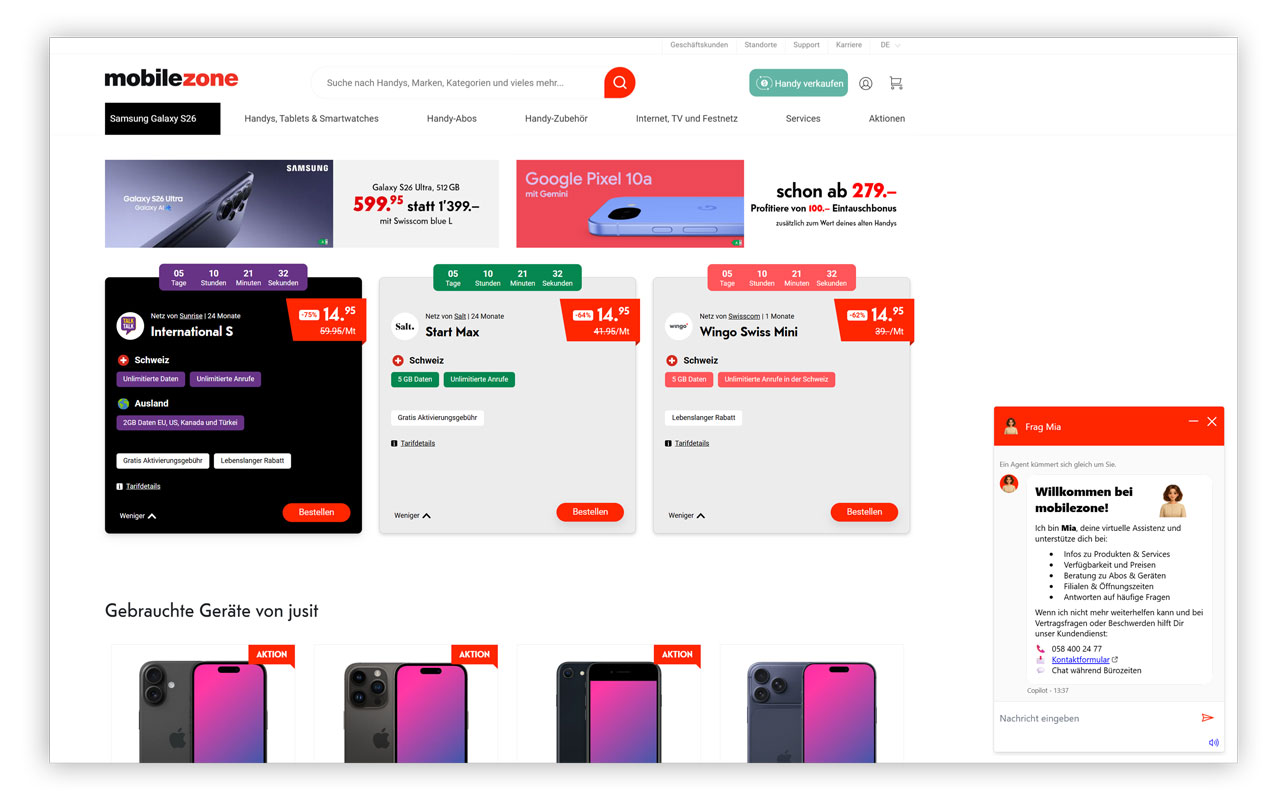
Screenshot of the Mobilezone online shop with the chatbot "Mia" displayed at the bottom right. Mia welcomes users, provides information about products and tariffs, and offers contact to customer service.

Mobilezone offers customers Mia, a virtual assistant that provides support with specific questions and various ways to contact customer service. (Source: Screenshot from mobilezone.ch)

Why AI consulting is becoming the new standard

AI-powered chatbots are making this incredibly valuable technology the standard in e-commerce for shop operators. While traditional chatbots are purely rule-based and only respond to predefined queries, modern AI-powered systems already use intent recognition and simple automation to better understand user concerns.

AI-supported chatbot solutions therefore respond more flexibly to queries, but a genuine and complex dialogue flow has not yet been achieved.

Conversational chatbots: The next stage in the evolution of digital consulting

Conversational chatbots based on AI and LLM technology go one step further and enable individualized and context-related purchasing advice.

One example of this new form of AI consulting is the AI Shopping Assistant, a virtual shopping advisor that uses artificial intelligence to talk to your customers in a natural way, understand their wishes, and guide them through the product selection process. This creates a personal, inspiring shopping experience that builds rapport—anytime, anywhere.

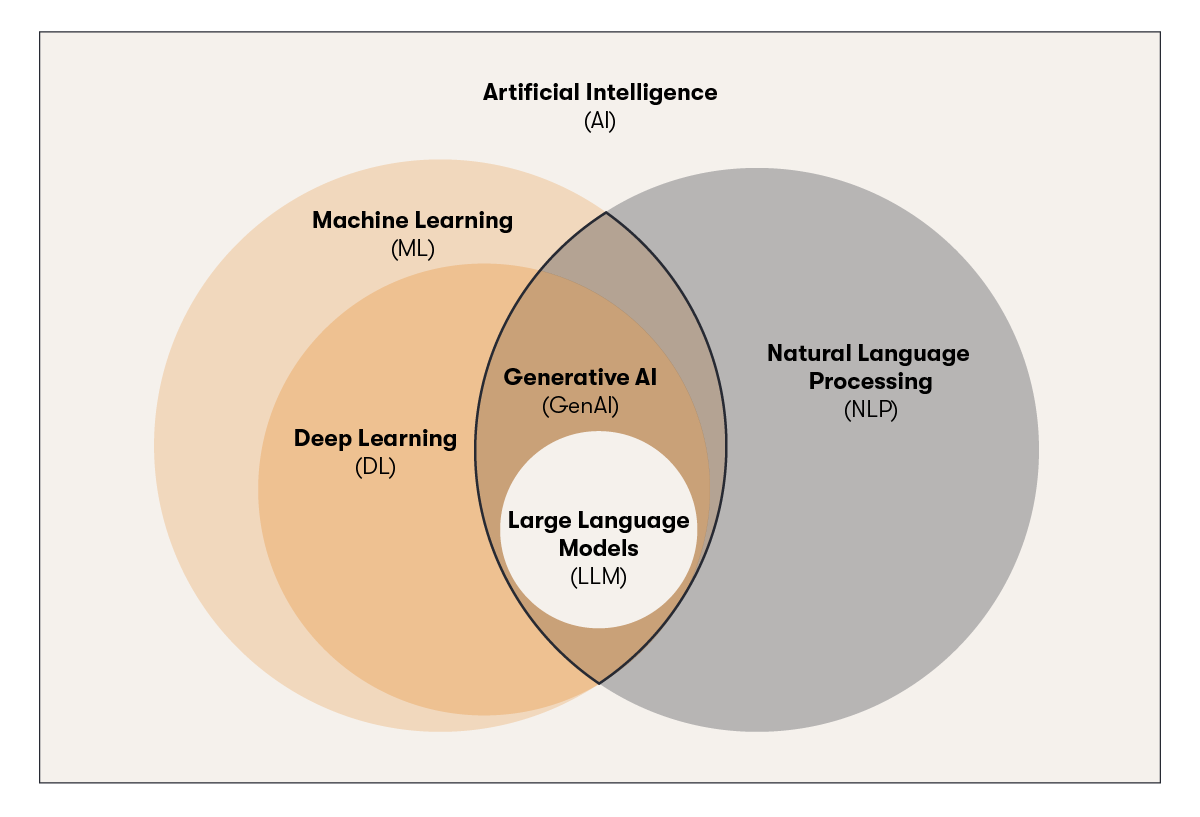
The graphic shows the overlaps and connections between key AI technologies: artificial intelligence, machine learning, deep learning, natural language processing, generative AI, and large language models.

Interrelationships between key AI technologies that serve as the basis for conversational commerce and conversational chatbots (source: own illustration)

What is the AI Shopping Assistant?

The AI Shopping Assistant is an important step toward natural-looking, AI-supported customer communication. With this consulting tool, you provide your customers with an LLM-based product advisor that proactively supports them by identifying their needs, answering questions, and recommending suitable products. This makes it easier for your customers to choose products and encourages them to make informed purchasing decisions.

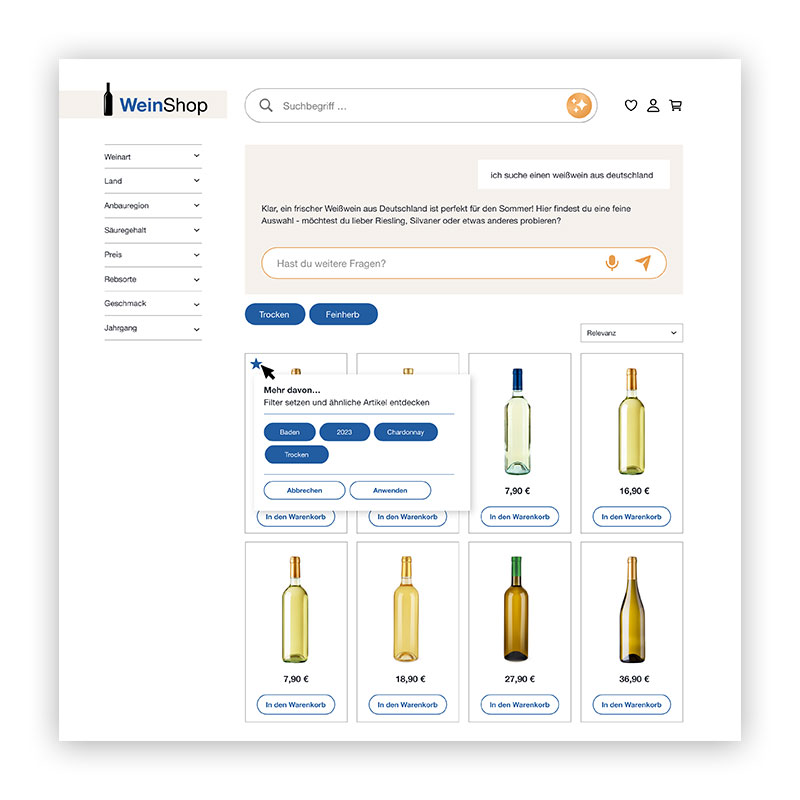
Example of a dialogue-based AI shopping assistant that advises customers on product selection.
(Source: Own representation)

What are the benefits of conversational chatbots?

Conversational chatbots offer numerous advantages—both for you as a shop operator and for your customers. They are available around the clock and answer questions immediately, regardless of the time of day or time zone. This provides greater convenience for customers and at the same time relieves your support team, who can then focus more on complex issues.

As you already know, they are based on modern AI technology, which means they understand natural language and respond flexibly to individual requests. This creates a dialogue that feels more personal and natural for your customers.

Another advantage: these chatbots can take into account your customers' click and purchase behavior and provide personalized product recommendations based on this information. This makes your customers feel better understood and helps them find what they are looking for more quickly, which in turn increases your conversion rate. With shorter response times, personalized advice, and a seamless user experience, conversational chatbots help turn visitors into buyers and make your online store more successful in the long term.

What challenges are associated with AI-supported consulting?

Despite their advantages, conversational chatbots also present a number of challenges. Depending on how complex or unclear customer queries are formulated, there is a risk that the chatbot will provide inappropriate or even incorrect answers. How well AI-supported solutions perform therefore always depends heavily on the training data.

Shop operators should continuously monitor conversational chatbots and train them regularly. They should also incorporate clear fallback strategies so that inquiries are automatically forwarded to human service representatives under certain conditions. Relevant data protection and compliance guidelines must also be observed.

Agentic chatbots: From digital interaction to autonomous consulting

Agentic chatbots mark the next step in development: they act independently, take on tasks, and make decisions to actively support users.

What is an agentic chatbot?

An agentic chatbot goes beyond reactive chatbots because it has autonomy of action. This means that it not only provides information or makes recommendations, but also independently performs actions on behalf of the user,for example:

  • Place orders
  • Book appointments
  • Send notifications

Agentic chatbots combine dialog intelligence with operational autonomy by understanding complex queries like conversational chatbots thanks to modern NLP/LLM technology and then actively implementing them.

What advantages do agentic chatbots offer?

You can use agentic chatbots in a variety of ways in e-commerce. For example, they can place orders for customers directly in the online shop, book services or trips, inform customers about delivery status or upcoming appointments, and implement individual recommendations, such as applying discounts or adding products to the shopping cart.

The added value lies primarily in the fact that agentic chatbots not only provide advice and respond quickly, but also implement decisions immediately. This saves a lot of time and makes the user experience much more interactive and efficient, which in turn can improve conversion rates and customer loyalty.


Stay up to date on personalization: Sign up for the Epoq newsletter. Register now!


What challenges are associated with agentic chatbots?

Since agentic chatbots act independently on behalf of users, errors in orders, bookings, or transactions due to ambiguous inputs are particularly problematic. In addition, such chatbots require extremely robust security and data protection measures to effectively protect sensitive customer data.

As a shop operator, you should define clear boundaries for autonomous actions, implement clear fallback mechanisms to human employees, and consistently monitor and further develop the performance of agent-based chatbots.

Transparent communication is also important so that your customers always know exactly what actions the chatbot can and cannot perform. This is the only way to build trust and ensure customer satisfaction.

At the same time, it remains to be seen in which areas the use of such systems will become established and whether users are prepared to place enough trust in AI to allow it to make independent decisions. Particularly in safety-critical industries such as healthcare, energy, transportation, and aviation, where no mistakes can be made, the use of such technologies will have to be examined with particular care.


Conclusion: Greater e-commerce success through live chat and chatbots

Customer communication is the be-all and end-all of successful e-commerce. With a human-powered live chat, you can strengthen personal communication in e-commerce and offer your online shoppers a valuable tool for purchasing advice by responding to questions and concerns from potential customers at an early stage and resolving them in a targeted manner. This allows you to offer targeted advice, avoid returns in advance, and increase the success of your e-commerce business. To further set yourself apart from your competitors and significantly optimize the user experience, you should also consider technological solutions that work automatically. This is where chatbots come into play, especially conversational chatbots that use natural language and are therefore capable of dialogue. With LLM-based advice, you can ensure enthusiastic purchasing decisions and a lower return rate, paving the way for a new era of e-commerce.

Frequently asked questions about live chat in e-commerce

Would you like to learn more about digital consulting in e-commerce?

Check out our publication on the topic!

Daniela Ilincic
Head of Marketing
Daniela Ilincic is Head of Marketing at Epoq. She comes from a background in digital marketing, specializing in SEO and content marketing. She established the digital sales channel at Epoq, which she continues to optimize with her team. In addition to her work, she enjoys sharing market-relevant information on digital topics.