
E-book – Personalization in E-commerce
In this e-book, you will learn why personalization is important in e-commerce and what the term personalization actually means.

4 Online Stores, 5 Examples of Successful Personalization. In this blog post, we’ll show you what true personalization in an online store entails, how it works, and how well-known brands are already implementing it in impressive ways. Let these examples of personalization inspire you and discover the immense potential of a tailored customer experience.

Here's what you can expect to find in this blog article:
What does successful personalization in e-commerce mean?
How does personalization work?
5 Real-World Examples of Personalization
#1 Ex Libris: AI-powered interest search with personalized gift suggestions
#2 naturPur: Personalization on the homepage
#3 mobilezone: Quick start to personalization via the shopping cart layer
#4 Ex Libris: Maximum personalization in email marketing
#5 Outletcity Metzingen: Sending category newsletters with personalized content
Personalization: Examples summarized for you
Conclusion: Our examples show that personalization leads to success in many ways
What really makes personalization in an online store successful? Is it enough for a newsletter to include the recipient’s name? Or for product recommendations to appear on every page of the store?
Successfulpersonalizationgoes much further: itintuitively and almost imperceptiblyguides customers to products that match their tastes. These can be recommendations that are thematically related to the product currently being viewed—but also suggestions that the customer may not have considered yet, yet are highly likely to be relevant to them.
It doesn’t matter which touchpoint the user discovers this personalized content through —whether it’s the homepage, a product page, a newsletter, a category page, or the shopping cart—what matters is that the experience feels cohesive and helpful to them. Personalization is particularly effective when it’s implemented throughout the entire digital customer journey.
Successful personalization, therefore, means responding specifically to the wishes and needs of online shoppers and offering them moments that pleasantly surprise them, provide guidance, and enhance the shopping experience.
Stay up to date on personalization: Sign up for the Epoq newsletter. Register now!
If you’d like to learn more about the different levels ofindividualization, adaptation, and personalization, check out our in-depth article one-commerce personalization.
In order for an online store to be successfully personalized, it is necessary to understand the wishes, needs, and preferences of its visitors. To this end, pseudonymized data on the behavior of online shoppers is collected.
Data is collected via an integrated code snippet that tracks the click and purchase behavior of all users. This information is then processed into a knowledge base using AI techniques. This provides a comprehensive picture of which products might be relevant to which users.
If you'd like to learn more about the underlying AI methods and their impact on the shopping experience, we recommend our blog post "How AI Is Redefining the Shopping Experience in E-Commerce."
In the next section, we’ll show you what personalization looks like in practice and provide real-world examples from various industries.
The following examples show how well-known online stores successfully use personalization. You’ll learn about the technologies and approaches behind it and exactly how it’s implemented in practice.
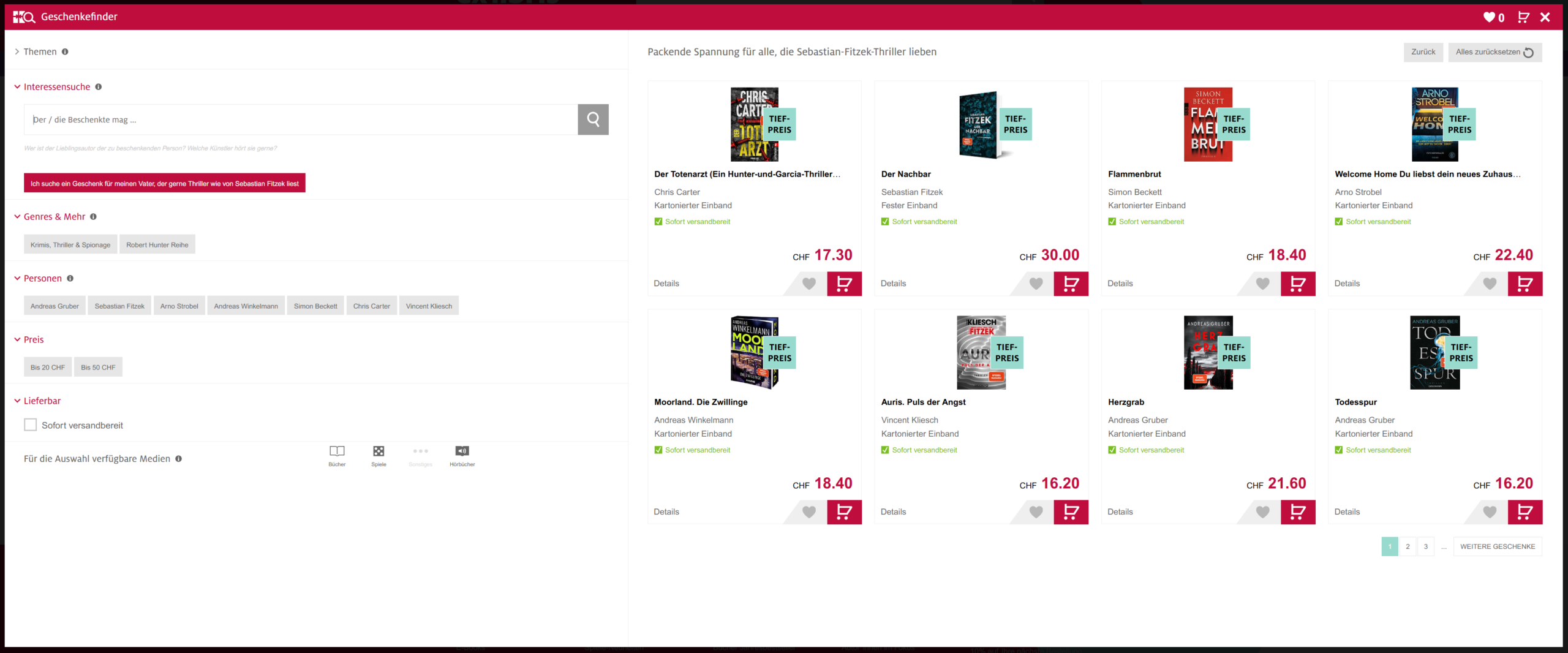
The interest search feature in Ex Libris's gift finder provides personalized book recommendations based on natural-language search queries (Source: Screenshot from exlibris.ch)
The interest-based search feature in Ex Libris’s Gift Finder demonstrates how modern personalization can work in e-commerce. When it comes to gifts, many users start out unsure and with only a vague idea of what they’re looking for. This is where the Gift Finder comes in, combining traditional product search with intelligent processing of complex and personalized requests —all directly from the search box.
Here’s how it works: Users describe in natural language who the gift is for and what the person’s preferences are—for example, their favorite author or preferred genres. The system automatically recognizes whether users are looking for a specific product (“Harry Potter Book 1”) or whether it’s a complex and personalized request (“I’m looking for a gift for my dad, who loves reading thrillers”). Once a query reaches a certain length, the integrated AI Search kicks in: It understands the context and intent of complex search phrases and translates even natural-language queries into a suitable selection of products.
To make it easier to get started, clicking on the interest search displays “conversation starters ”: suggestions that draw on current trends and popular search terms and encourage users to search semantically. The results list is then given a context-based headline, so that the results feel more like a personal recommendation than a simple list of hits.
Here’s a practical example: If someone types in “I’m looking for a gift for my dad, who enjoys reading thrillers like those by Sebastian Fitzek,” AI Search not only provides suitable thriller titles by similar authors, but also frames the recommendations with a headline such as “Thrilling suspense for anyone who loves Sebastian Fitzek’s thrillers.”
This example demonstrates how personalization works through the intelligent interpretation of search queries, thereby significantly improving the quality of search results. Interest-based search translates individual, freely formulated user requests directly into a curated selection of products. Users don’t need to know the exact search terms; instead, they can simply describe what they’re looking for—which is especially helpful in situations where they’re unsure of what to search for, such as when looking for a gift.
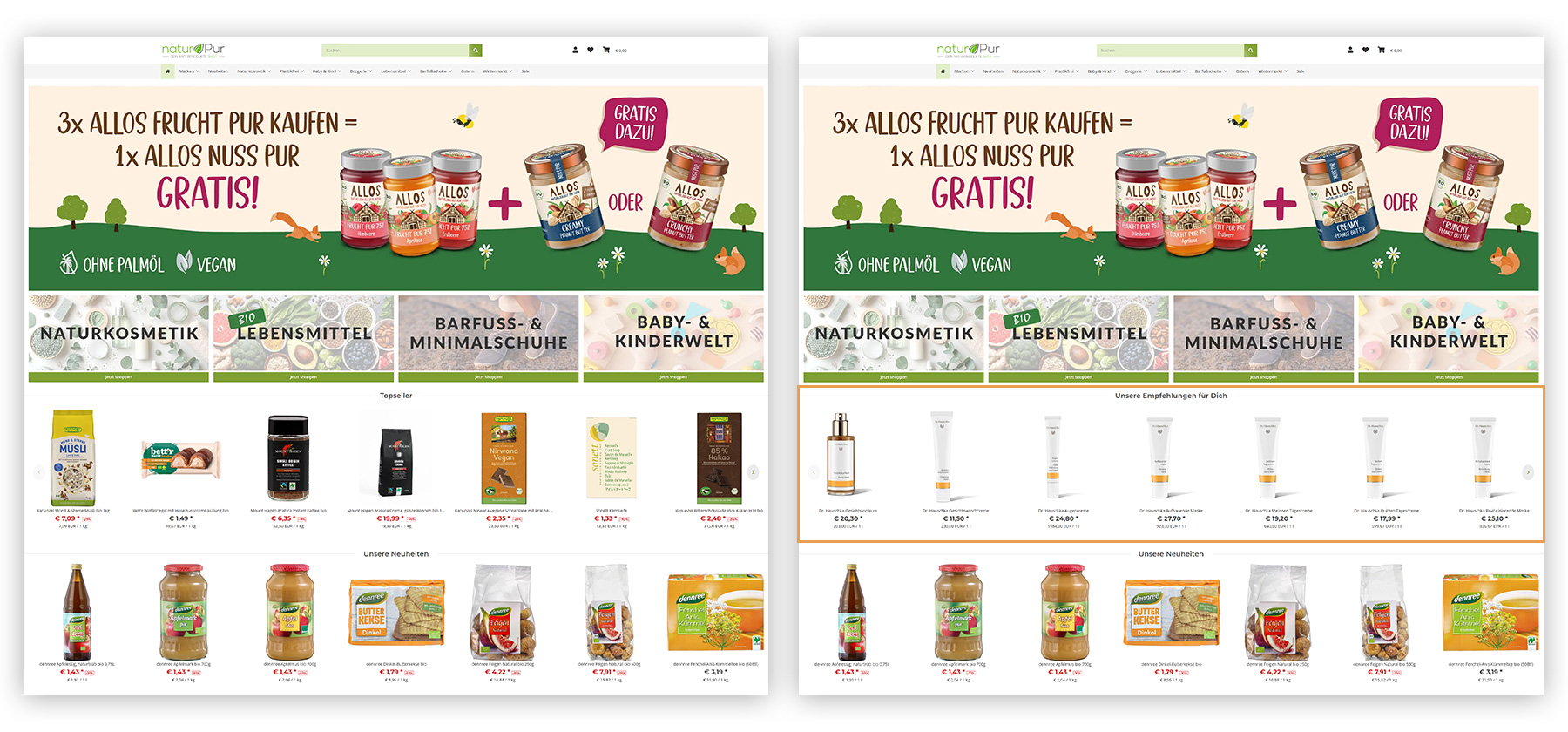
The naturPur homepage varies depending on the user's history—new visitors see general top sellers, while returning users receive personalized product recommendations (screenshot from shop-naturpur.de)
The homepage is often the first point of contact with an online store. naturPur uses this prominent touchpoint to tailor its approach to visitors based on their browsing history, thereby displaying relevant content early in their visit.
Here’s how it works: On the homepage, the store distinguishes between visitors with and without a purchase history. New visitors, for whom no data is yet available, initially see general top-seller recommendations. These provide an overview of popular products. As soon as initial behavioral data becomes available, the homepage dynamically adapts: The heading of the recommendation widget changes to “Our recommendations for you,” and products are displayed that match the user’s individual preferences and previous click behavior.
This starts working after just a few interactions: For example, if a new shopper clicks on several products in the cosmetics category and then returns to the home page, relevant, personalized product recommendations are displayed there immediately.
This example shows just how effective personalization can be right from the homepage: A personalized homepage offers a tailored entry point to the store, enhances the user experience, and helps visitors find relevant products more quickly.
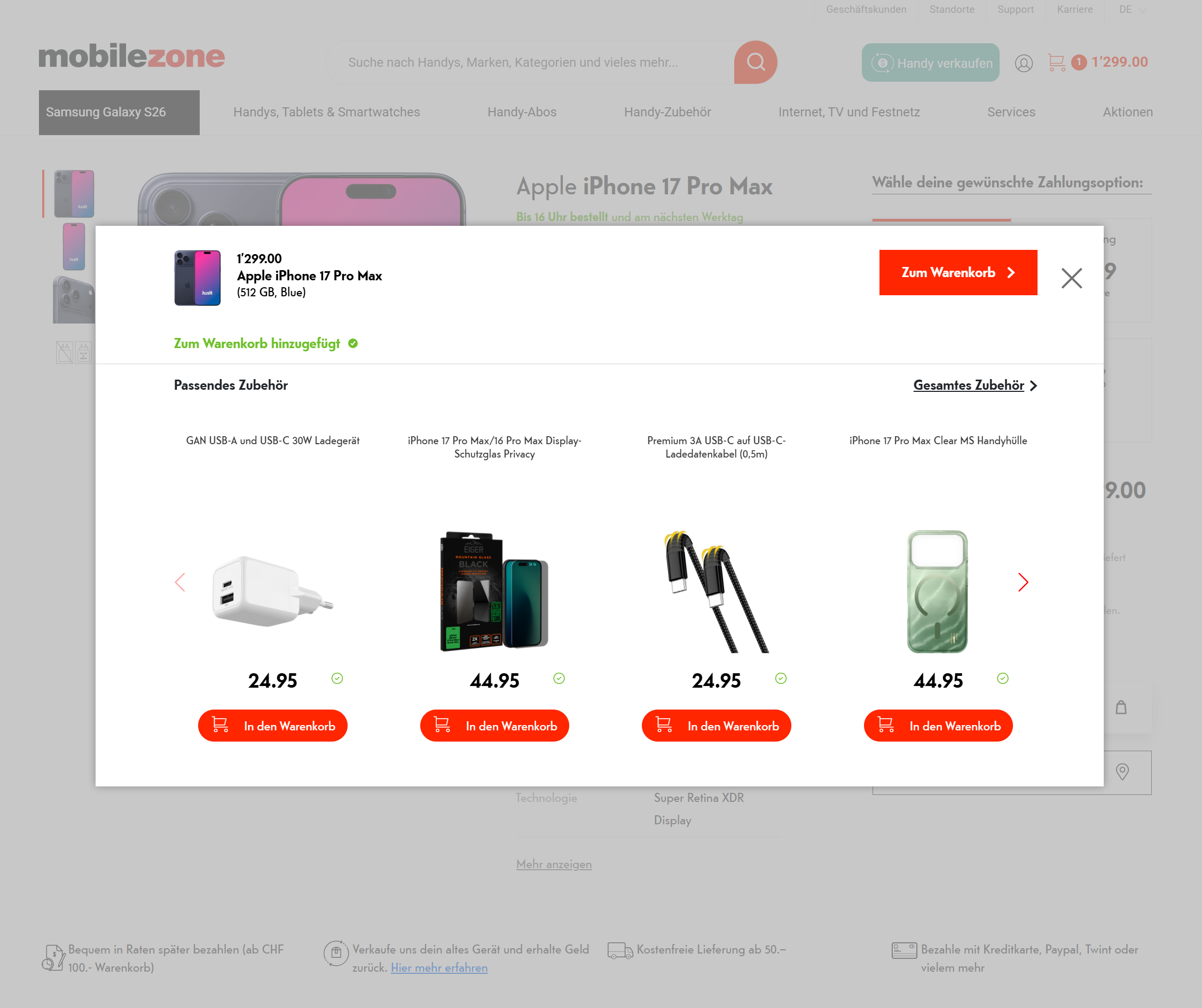
Personalized accessory recommendations on the mobilezone shopping cart page (Screenshot from mobilezone.ch)
The shopping cart layer is a perfect example of how personalization can be implemented quickly and easily for a single use case. The mobilezone online store uses a cart layer widget that personalizes the shopping cart layer with targeted, relevant product recommendations.
Here’s how it works: When a customer adds a product to their cart, a pop-up appears with recommendations tailored specifically to that product. The product just added serves as a particularly strong signal: it clearly shows what the user likes and what they want to buy. In addition to highly granular rules regarding compatible accessories, click and purchase behavior as well as frequently purchased items are also factored into the recommendations. For example, if a customer adds an iPhone 17 to their cart, they are shown complementary accessories such as matching phone cases, screen protectors, or chargers.
This example demonstrates how personalization can be implemented quickly and effectively within a single use case. The recommendations are highly relevant because they are based directly on the current product and the user’s behavior. This makes it easy for customers to discover useful accessories, while the store generates additional revenue through cross-selling.
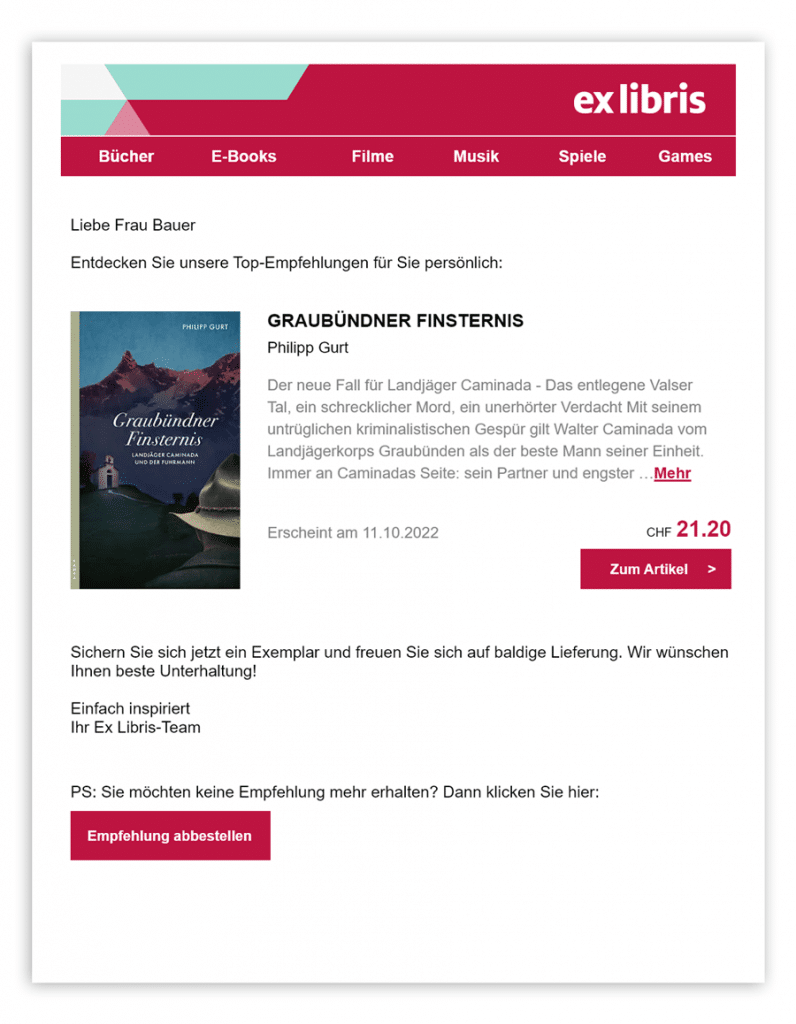
Personalized email campaign from Ex Libris, which, thanks to automated recipient selection, reaches only users who may be interested in the new book release (Source: Screenshot of an email from exlibris.ch)
Ex Libris uses personalization in its email marketing, specifically in email campaigns promoting new book releases. Approximately 90 days before a new release is published, the company aims to target customers for whom the title is truly relevant.
Here’s how it works: Before sending an email campaign, the AI automatically identifies which customers are most likely to be interested in the new release. Only these selected individuals then receive the email. The AI handles the entire target audience selection process and exports the final recipient list directly to the email delivery system. To the recipient, the email looks like a standard newsletter—the actual level of personalization happens behind the scenes.
In this example, personalization is not primarily evident in the visible content, but rather in the intelligence behind the recipient selection. Instead of sending the same message to all customers, only those for whom the content is highly likely to be relevant receive an email. This reduces wasted reach, preserves recipients’ attention, and increases the likelihood of opens, clicks, and purchases.
The results are clear: Ex Libris was able to increase revenue from email marketing in its online store tenfold compared to a standard email campaign that did not target a specific audience. You can find more details about this personalization example in the case study.
Stay up to date on personalization: Sign up for the Epoq newsletter. Register now!
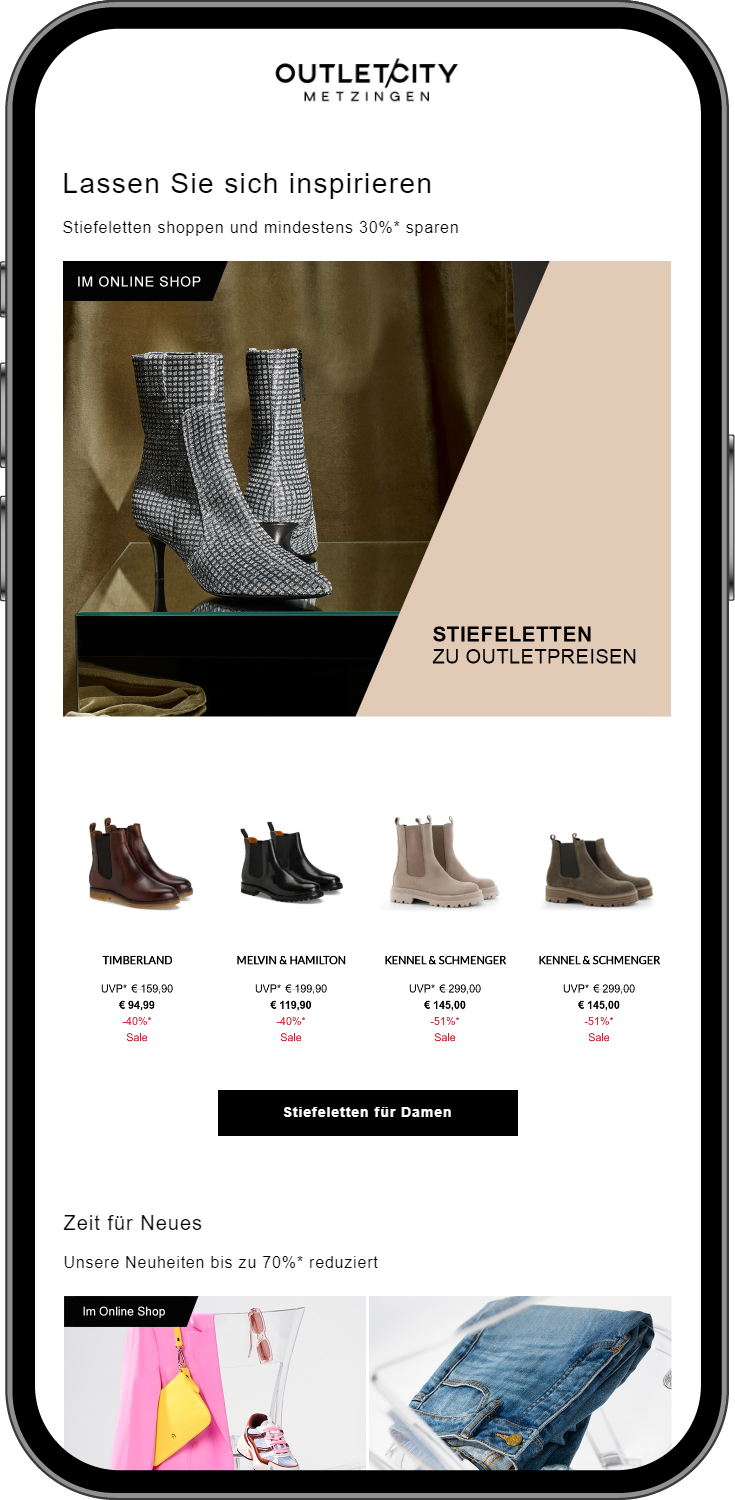
Personalization in Outletcity Metzingen’s category newsletter with personalized product recommendations (Screenshot from outletcity.com)
Outletcity Metzingenalso uses personalization in its email marketing and demonstrates how effectively it works inits category newsletters. The company was already sending editorially curated newsletters but wanted to use this channel more strategically as part of its personalization strategy. The goal was to reach recipients with content that matched their interests and likelihood of purchase as closely as possible.
Here’s how it works: Using AI, a “favorite category” is calculated for each active customer —that is, the category in which the next purchase is most likely to occur. Based on this prediction, the category newsletter is fully personalized. This applies to several elements at once: the selected category, a relevant subject line, a tailored teaser image, personalized text, and relevant product recommendations. For example, if a customer is interested in ankle boots, they receive a newsletter focused specifically on this topic with corresponding suggestions.
This example shows how email marketing, through personalization, can go far beyond simply addressing recipients by name to provide them with content that is highly relevant.
The impact of the personalized category newsletters was clearly measurable: the personalized version increased revenue generated through this channel by 44.3%. You can find all the details in the case study.
Personalization offers versatile and effective ways to make the shopping experience more relevant and personalized—from the first touchpoint on the homepage to targeted email campaigns. Our examples show how different online stores are putting these possibilities into practice. Here you’ll find a clear summary of all the use cases so you can quickly identify which approaches are right for your store.
The examples presented here clearly demonstrate the wide range of ways in which personalization can be implemented in an online store—from a dynamically adapted homepage to search suggestions, digital advice, and product recommendations, all the way to AI-powered email campaigns with precisely targeted recipient selection. At the same time, it becomes clear that successful personalization is often not even obvious to the individual user. The true success of personalization lies in how naturally it enhances the shopping experience: unobtrusive, tailored, and effective exactly when the customer needs it.
Personalization in an online store refers to the tailored presentation of content, products, or messages based on user data such as click and purchase behavior. The goal is to offer each visitor a shopping experience that best aligns with their interests, needs, and current situation.
One way to distinguish between types of personalization in e-commerce is to differentiate between segment-based and 1:1 personalization. While segment-based personalization tailors content and offers to defined customer groups (e.g., bargain hunters, high-end segment), 1:1 personalization provides each user with an experience that is as personalized as possible. Furthermore, personalization can also be differentiated, for example, by channel (onsite vs. offsite) or technical implementation (rule-based vs. AI-based).
Typical examples of personalization include personalized product recommendations on various store pages, customized search results, personalized advice options, suggestions for matching accessories in the shopping cart, and emails with personalized content.
Touchpoints that are highly relevant to the purchasing decision are particularly valuable: search, the homepage, product and category pages, the shopping cart, and email marketing. In these areas, personalization can directly influence which products a user discovers, how easily they navigate the site, and whether they ultimately make a purchase.
The speed depends on the use case. Some measures, such as personalized recommendations in the shopping cart layer, can be implemented quickly, often without the need for extensive store customizations. Others require a bit more preparation but can also be implemented efficiently.
Would you like to delve deeper into the topic of personalization?
Then download our e-book on the topic now!

You are currently viewing placeholder content from HubSpot Embedded Content. To access the actual content, click the button below. Please note that doing so will result in data being shared with third-party providers.
More InformationYou are currently viewing placeholder content from HubSpot. To access the actual content, click the button below. Please note that doing so will result in data being shared with third-party providers.
More InformationYou are currently viewing placeholder content from HubSpot Meetings. To access the actual content, click the button below. Please note that doing so will result in data being shared with third-party providers.
More Information