Back to overview
  • Reduce Return Rate

Digital returns management begins in the online store

  • Published July 26, 2017
  • Janina Küpferle
  • Reading time: 10 min.

Returns management is an important part of digital commerce. In the fashion industry, for example, a return rate of up to 50%¹ is not uncommon, meaning that almost every second order is returned in whole or in part. Even without knowing the exact figures, it is understandable that this results in a huge amount of costs. It is therefore no surprise that e-commerce managers go to great lengths to reduce the return rate. In this article, we show you how this can be done even before the purchase and provide lots of other useful information on the topic.

This picture shows an open shoebox with a new pair of sneakers. It's about returns management.

Reasons for returns

There are many reasons for returns. They can be attributable to customers, retailers, or shipping service providers.

Customer reasons for returns

Customers are probably the biggest risk factor contributing to returns in an online shop. A study by ibi Research concluded that 40 percent of online customers already assume when placing their order that they will return some of the goods to the online shop. The return rate is highest in the clothing sector at 25 percent. A study by Bitkom found that one in ten online purchases is returned, especially by the 14-29 age group. And a consumer survey by PwC Germany showed that almost one in three online shoppers occasionally orders goods with the intention of returning them immediately – an immense burden on returns management in online shops. The customer-side reasons for returns are quite clear:

  • 62 percent: Item did not fit
  • 39 percent: I didn't like the article
  • 30 percent: Item defective or damaged
  • 30 percent: Item did not match the description
  • 20 percent: Multiple variants ordered for selection
  • 7 percent: Incorrect order
  • 5 percent: Delivery time too long
  • 2 percent: Cheaper offer in another online store
  • 2 percent: Other

Reasons for returns on the retailer side

The reasons for high return rates in online shops also lie with the retailers themselves. Many retailers advertise short delivery times to encourage their customers to make purchases. If the actual delivery time is longer, customers become distrustful. Many send the goods back immediately out of frustration. Providing accurate delivery times improves return management in online shops.

Retailers who deliver their goods in dirty outer packaging increase the return rate. The same applies to poorly packaged goods, which casts doubt on the retailer's credibility. The introduction of after-sales support establishes effective returns management in the online shop. Customers who do not get along with a product right away would call the store in brick-and-mortar retail. There, their questions would be answered in just a few minutes.

Online shops without after-sales support run the risk of buyers exercising their right of withdrawal. Retailers who introduce a rating system benefit from an exchange of opinions between their customers. Reviews of individual products enable customers to buy the right product from the outset. Incorrect product descriptions and inaccurate product images are signs that the returns management system in the online shop is in urgent need of improvement. An overview of the most common reasons for returns on the retailer side:

  • incorrect delivery time information
  • poorly packaged goods
  • lack of after-sales support
  • incorrect product description
  • lack of quality assurance
  • no rating system

The proportion of returns from retailers can be reduced with relatively simple measures. This makes it all the more important for online shops to address this issue promptly.


Stay up to date on personalization: Sign up for the Epoq newsletter. Register now!


Reasons for returns on the shipping side

If the shipping service provider makes a mistake, the goods will not reach the customer. Occasionally, goods are accidentally left behind at the shipping center. It is only human that minor accidents occur and goods are damaged by employees. Trivial circumstances, such as the loss of delivery notifications, sometimes also result in returns. Here is an overview of the reasons for returns in online shops on the part of shipping service providers:

  • Goods accidentally damaged
  • Goods not delivered
  • Delivery notification lost

How does a return actually work?

The returns management process in an online shop is always the same. A customer buys a product and does not want to keep it. They exercise their right of withdrawal and send the product back. The shop operator transfers the money back or sends the customer another product. The shop operator may charge the customer for shipping costs, but they are still responsible for personnel and processing costs. Once the goods have arrived at the online shop, they must be inspected for damage. The goods are either discarded or repackaged and returned to the goods cycle.

Costs for online store returns

Over 30 percent of shop operators do not know how much an average return costs them. However, returns management for an online shop is a huge cost factor that is relatively easy to control. For each free return offered by an online shop, the shop operator incurs an average cost of around €35¹, which should be reduced in the area of returns management. This is because, in addition to the actual

  • Postage and packaging costs also apply.
  • Costs for processing and re-entering the items, as well as
  • Costs due to loss of value or, in the worst case scenario
  • Costs for destruction if the product is no longer resalable. In addition, there are the
  • lost sales and the resulting
  • tied-up capital for this purpose.

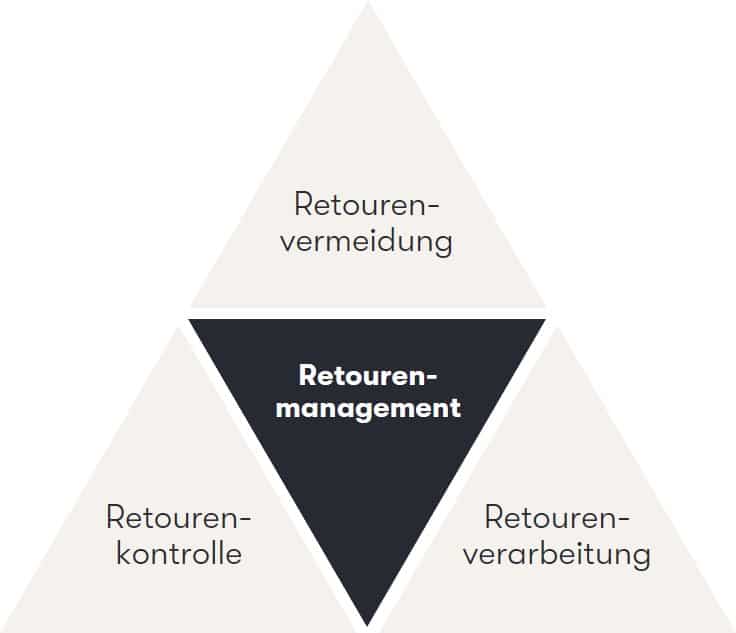
An online shop must first compensate for these €35 through other purchases. In order to be successful in the long term, it is the task of an e-commerce manager to reduce return costs through efficient returns management and thus become more profitable in this area. Over 44 percent of online shoppers also state that they have never taken advantage of the right of return in online shops. Online shops that build on this increase their sales and save on personnel and process costs. Return costs can be reduced in a variety of ways within the three areas of returns management. These areas are return prevention, processing, and control.

Fields of returns management in digital commerce (Source: Own graphic based on retourenforschung.de²)

Avoiding returns in online shops

The most effective and sensible step in returns management in online retail is to avoid returns, as this reduces the effort for both the shop operator (processing the return) and the customer (returning the order). Online shop returns can be avoided by ensuring that the customer orders the right product for their needs. This is easier said than done. After all, what is the right product for the customer? That is why advice in the online shop is an essential component in avoiding mispurchases and poor choices.If the customer does not receive advice, there is a high probability that they will return the item because it does not fit or the quality is not right. These are the two most common reasons for returns in the fashion sector.

Product presentation for known requirements

Detailed descriptions, multiple images, or even a short video help customers make purchasing decisions when their requirements are known. For example, asos.com has integrated runway videos so that customers can see how the selected garment looks when worn. In these cases, the customer's needs are known; the only thing left to do is narrow down the selection according to specific criteria such as color, material, price, etc. That's why it's important for e-commerce managers to present products comprehensively.

Determining requirements in the case of unknown requirements

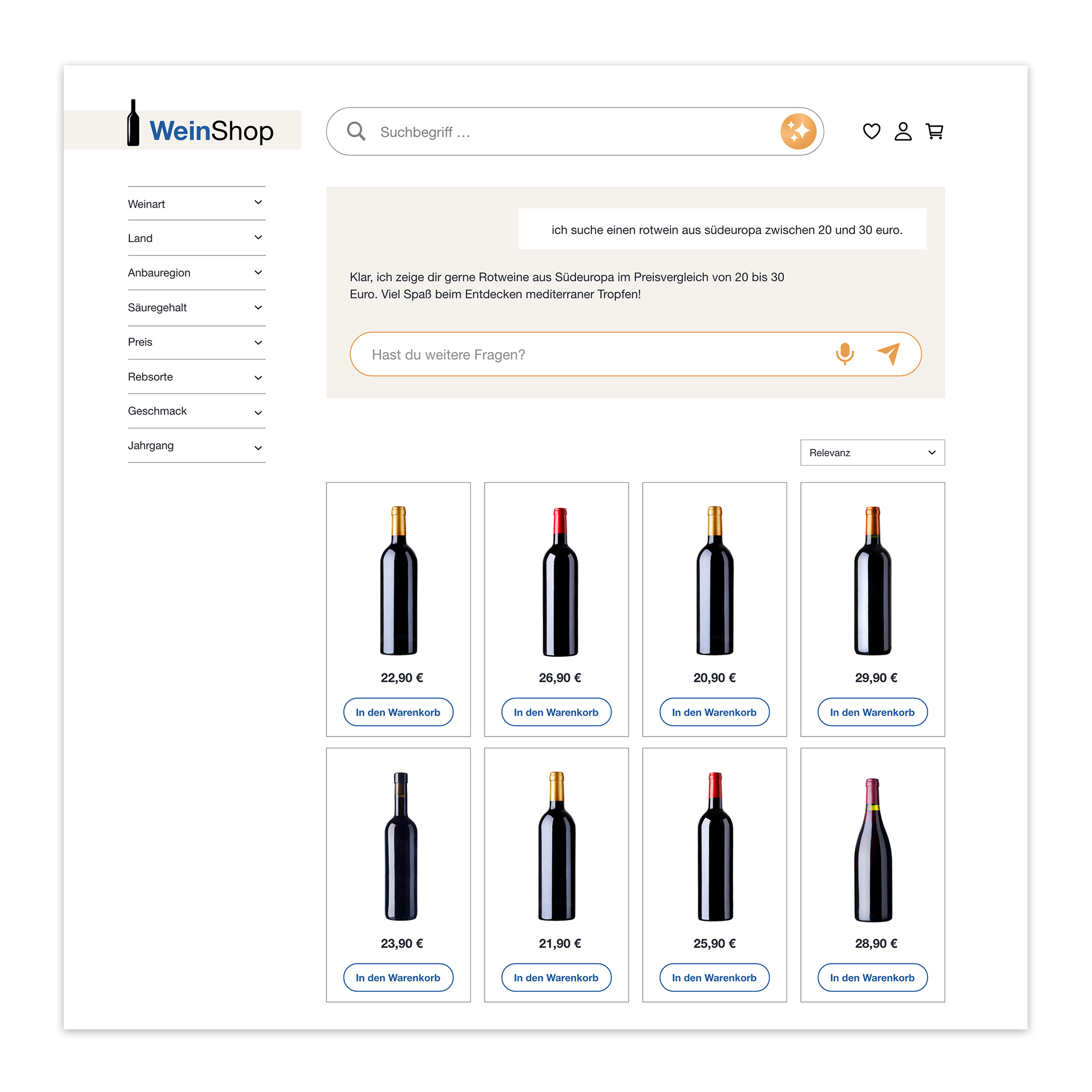
Since customers often do not know their exact requirements for a desired product, consulting services are crucial for determining their needs and supporting the right purchasing decision. This is exactly where the AI Shopping Assistant comes in: it offers natural, dialogue-based advice and is based on state-of-the-art large language models (LLMs). The intuitive product advisor understands both text and voice input in chat. Customers can ask questions, filter, or sort in natural language, while the assistant captures the context, responds in real time, and displays suitable products directly in the results list. Thanks to integrated reasoning, the AI recognizes connections between search terms, user intentions, and personal preferences. Instead of responding to individual keywords, it analyzes the overall desire and provides relevant product recommendations. This builds trust, facilitates the purchase decision, and reduces mispurchases and returns.

The AI Shopping Assistant understands even complex queries and advises customers in natural dialogue. (Source: Own representation)

Making returns processing efficient

Despite effective prevention measures in returns management, it is impossible to prevent all returns. It is therefore important to make the processing of returns as efficient as possible in order to reduce the costs incurred. This includes, for example:

  • Package notifications,
  • Automation of processes, but also the
  • Minimization of error rates and throughput time.

In addition, returns processing can be improved by simplifying the returns process for the customer. If the customer fills out the return slip correctly and sends the package early (e.g., because the return label and appropriate adhesive tape are already included in the package, as is the case with Outfittery), the return can also be processed more quickly. This does not reduce the return rate, but it does reduce the costs incurred by the return.


Stay up to date on personalization: Sign up for the Epoq newsletter. Register now!


Perform comprehensive returns inspection

Many return management measures are based on constant monitoring of all processes, e.g.:

  • What are the reasons for returns? If a product is constantly being returned because the sizes are too small, the content manager should be notified so that the product description can be adjusted.
  • Are returns entered into the system promptly? If not, you may need to increase your staff or consider outsourcing. Although this will lead to higher personnel costs, it can still pay off across the board due to shorter throughput times.

Frequently returned products can also be removed from the range and replaced with other products. Continuous monitoring helps to prevent and process returns and is therefore essential for effectively reducing returns.

Our conclusion: Implement proactive measures

Due to the high proportion of returns, the return rate in online retail is one of the main factors influencing the success of an online store. Return management measures are not only aimed at more efficient returns processing, but also at proactive measures to achieve cost improvements. Especially when needs are unclear, the AI Shopping Assistant, for example, helps to determine requirements and guide customers to the right purchase decision. If, in addition, the costs per return are reduced and constant monitoring takes place, an online shop can achieve significant optimizations and thus become more profitable.


Source: ¹ retourenforschung.de "Statistics on returns in Germany – definition," ² retourenforschung.de "Returns management – definition"

Would you like to learn more about how you can reduce the return rate in your online store?

Schedule a web demo on this topic now!

Janina Küpferle
Janina is a passionate blogger. This is also reflected in her articles on topics such as Epoq and online shop optimization. She gained her experience in this field while working for us as a junior consultant and partner manager.