
62% lower bounce rate through the use of intelligent search at NKD
The use of ecommerce search engine in NKD's online shop had a positive effect on the performance of the online shop and significantly reduced the bounce rate by 62%.

The search function is often the first point of contact for your customers in your online store. Users have a clear goal: they want to find exactly what they are looking for quickly and easily. But this is where the challenge lies, because every customer formulates their search query differently. If the search term is entered inaccurately or differently than expected, in the worst case scenario, no results or only incorrect results will be displayed, even if the product is available. The solution? A semantic search that not only searches for keywords, but also understands the actual meaning behind the query. Find out how this works and how your store can benefit from it in this blog article.

Here's what you can expect to find in this blog article:
Definition: The importance of semantic search in e-commerce
Traditional product search vs. semantic search
The role of semantic search in the customer journey
How it works: How semantic search works
Advantages: Why semantic search is worthwhile for your online shop
Relevant search results
Greater user-friendliness
More conversions and sales
Challenge: What you should definitely keep in mind during implementation
Examples: Use of semantic search in practice
Conversational Search: Search becomes digital advice
AI Shopping Assistant: The digital expert advisor
More than just product search: Intelligent helpers throughout the entire purchasing process
Conclusion: Semantic search as the key to better customer experiences
Frequently asked questions about semantic search in e-commerce
Semantic search is a modern approach to search functions that not only takes individual words into account, but also understands the user's intent and the context of a search query. Instead of simply matching exact keywords, semantic search analyzes the meaning of terms, their relationship to each other, and the user's natural language.
In e-commerce in particular, this technology makes it possible to better interpret complex search queries —such as entire sentences, questions, or colloquial expressions.
With the advent of LLMs (large language models) such as ChatGPT and the growing importance of conversational commerce, users are increasingly accustomed to searching in natural language, i.e., formulating entire sentences instead of entering individual keywords in the search field. Semantic search picks up on this behavior and delivers more relevant results, even for ambiguous or unusually worded queries.
Semantic search has long been part of our everyday lives—often without us even realizing it. If you ask a search engine, "How old is the lead singer of Coldplay?", you will get the right answer even if you didn't type in the name Chris Martin directly. The search engine understands the meaning behind the question and recognizes the user's intention.
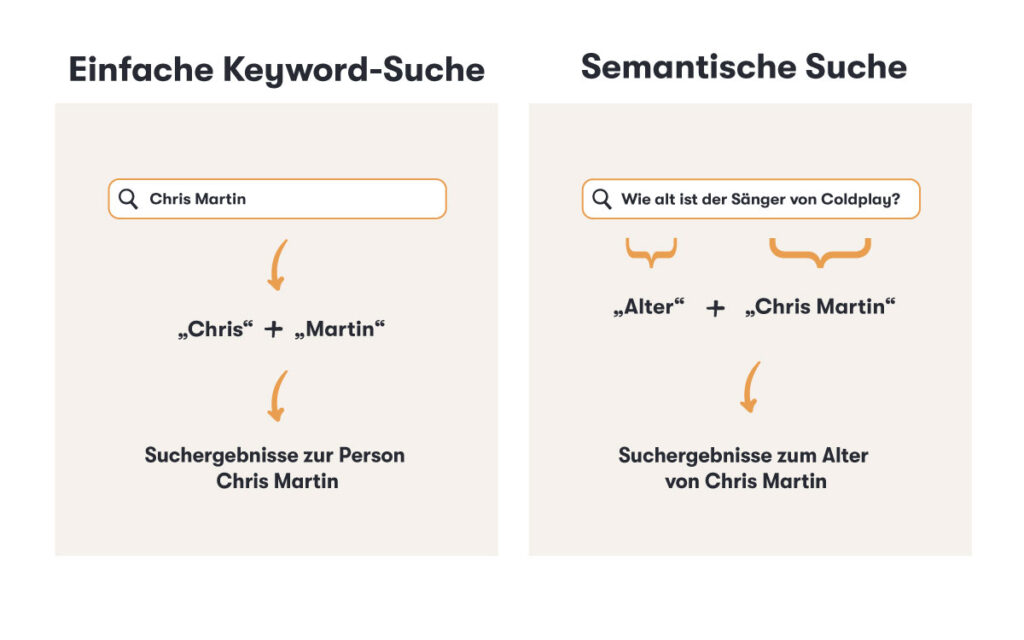
While simple keyword searches take specific keywords into account, semantic searches understand and interpret user intent and deliver more targeted results. (Source: Own representation)
Semantic search works in a similar way in e-commerce. Traditional search functions are usually based on simple keyword matching. This means that the search algorithm searches product data for exact matches with the terms entered. If a user uses alternative formulations such as synonyms, makes typos, or enters incomplete terms, relevant results are often not found, even if suitable products are available in the range.
Semantic search, on the other hand, is able to understand the meaning behind the query regardless of the specific wording. Itrecognizes context, processes synonyms, and interprets intentions. Supplemented by features such as autosuggest in natural language, users are supported as they type and receive relevant suggestions more quickly.
Semantic search plays a central role in the awareness phase of the customer journey, when potential customers are looking for guidance and often express their needs in natural, sometimes vague terms. It enables you to understand these search queries and deliver appropriate, relevant results. This allows you to optimally accompany your users on their journey of discovery.
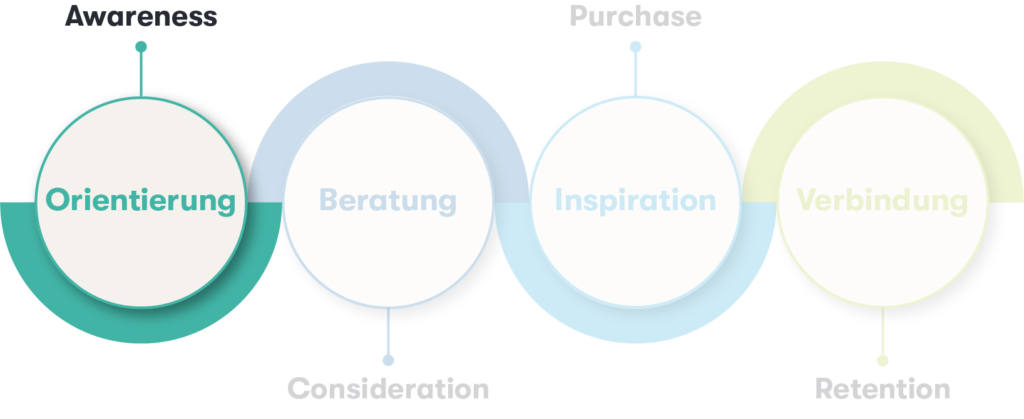
During the awareness phase, shop visitors need guidance and want to find suitable products quickly and efficiently. (Source: Own representation)
Semantic search is based on algorithms from the field of artificial intelligence that recognize and evaluate the relationship and contextual connection between words, sentences, and concepts. The aim is to understand the user's search intention, i.e., what does the person really want to find? This semantic understanding enables the system to display the appropriate search results even for vague or colloquial entries. Semantic search thus ensures greater accuracy in product searches.
In addition, semantic search is able to capture additional information and include it in determining relevant results, such as:
In this way, semantic search enables a significantly more intelligent and relevant search experience that traditional keyword searches cannot offer.
Semantic search offers decisive advantages—both for your customers and for you as a shop operator. We have summarized the three most important points for you:
In this way, semantic search enables a significantly more intelligent and relevant search experience that classic keyword searches cannot offer.
Thanks to intelligent error correction, context understanding, and personalization, semantic search delivers more accurate results, even with inaccurate or incomplete entries. It interprets natural language in context and recognizes the actual intent behind the query, thereby increasing the quality of the search results. The system learns with each additional search query and continuously optimizes itself independently.
More accurate results lead to an intuitive search experience and mean less frustration, more hits, and shorter paths to the goal. Customers don't have to deal with irrelevant results, but find exactly what they are looking for faster, even if they don't know the exact product name or a specific technical term. This increases customer satisfaction.
Satisfied users stay longer, are more likely to return, and tend to buy more often. Semantic search helps you better understand your customers' needs and serve them in a more targeted manner. This directly contributes to customer loyalty and has a positive effect on your business—through increased conversion rates and higher sales.
As promising as these advantages are, semantic search also presents challenges. Successful implementation requires technical expertise and high data quality. Semantic search reaches its full potential under the following conditions:
Want to learn how to get the most out of your product data? Then we recommend our blog article Preparing the product data feed and applying it in the online store.
Semantic search analyzes search queries not only literally, but also in terms of content. It recognizes the user's intention even if the terms do not exactly match product names and delivers appropriate, context-related, and complete results. The following scenarios show how these modern search systems interpret complex queries:
If you want to go one step further, you can refine semantic search even more with personalization. This means that the results list is not only determined by the context of the search query, but also tailored to your customers' individual preferences. For example, users will see products from their favorite brands, in their size, or in a style they often buy. The result: even more relevant search results, shorter decision-making processes, and thus an optimal search experience.
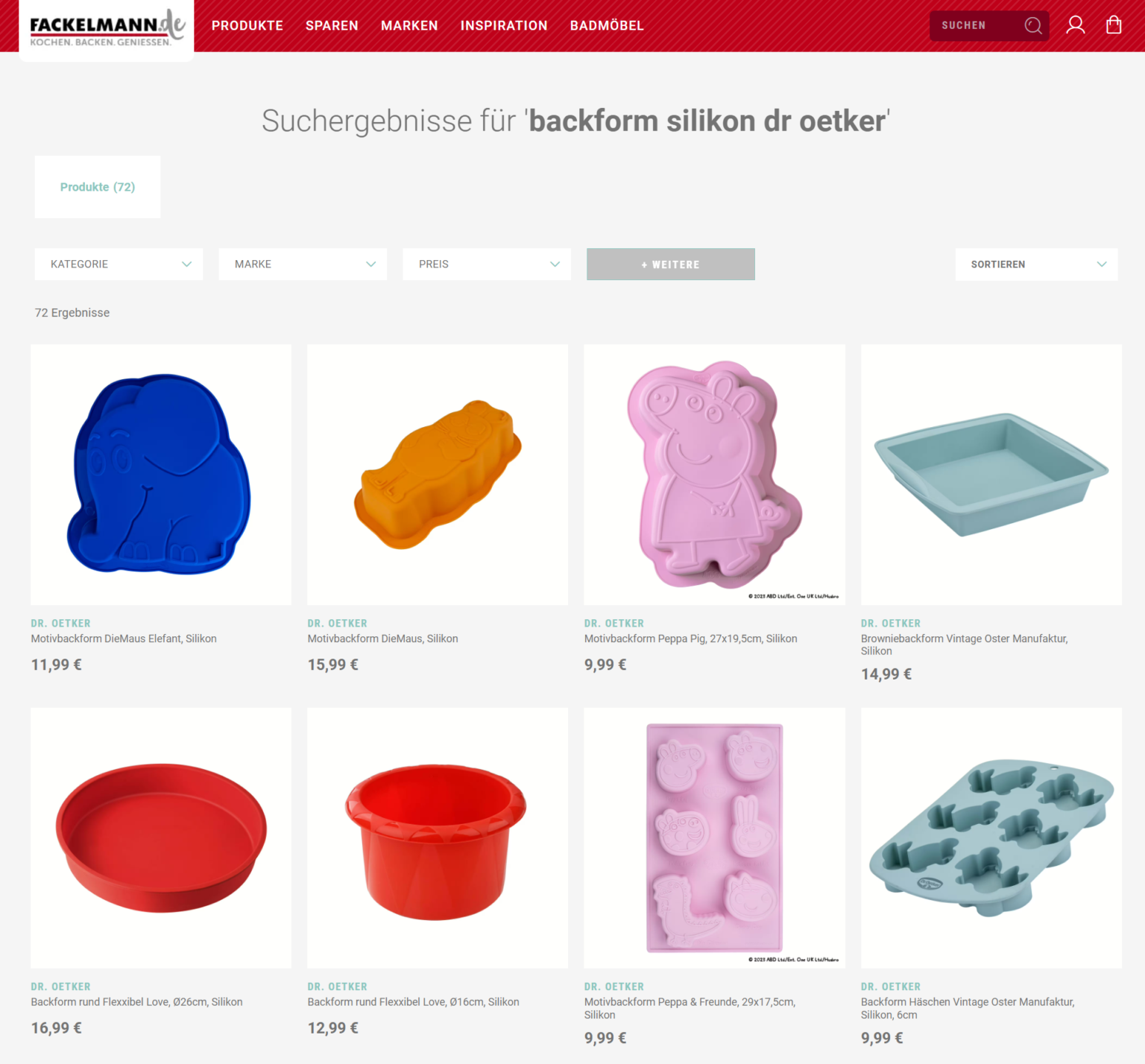
When customers search for "silicone baking pan dr oetker" in the Fackelmann online shop, all desired characteristics are taken into account and relevant results are displayed. (Source: Screenshot from fackelmann.de)
Conversational search is a particularly natural, dialogue-based form of product search, bringing the concept of genuine advice to the digital world. Users often know what they are looking for in general, but not which specific product best suits their needs.
Instead of entering individual keywords, they formulate their wishes in complete sentences such as: "I'm looking for a lightweight, water-repellent jacket for spring in blue." An intelligent AI shopping assistant can not only understand such complex queries, but also ask specific questions, for example: "Do you prefer a particular material, such as softshell or cotton?"
This turns a classic search into a genuine dialogue: the digital assistant guides the customer through the decision-making process, recognizes individual needs, and leads them directly to the right product.
With an AI Shopping Assistant, you can offer your shop customers personalized, context-sensitive advice in real time —comparable to the support provided by an experienced salesperson in a brick-and-mortar store. The AI Shopping Assistant is integrated directly into the results list and works via natural text or voice input in the chat.
Combinable filter and sorting functions give users maximum flexibility when selecting products. The assistant records specific requirements, combines product data with click and purchase behavior, and displays precise, personalized results based on this information. This reduces uncertainty, supports the right purchase decision, and lowers the return rate in the long term.
Stay up to date on personalization: Sign up for the Epoq newsletter: Register now!
Conversational interfaces such as chatbots or digital shopping assistants can not only help with product selection, but also facilitate navigation, suggest suitable alternatives, or assist with availability inquiries. This turns product searches into thematic orientation. The assistant recognizes when content rather than products are requested and automatically suggests suitable articles or help content.
A modern search function is no longer a nice-to-have, but a decisive success factor in digital commerce. With its intelligent and context-based understanding of user intent, it enables more precise results and an intuitive search experience, thereby contributing directly to higher customer satisfaction and an increased conversion rate. As we become increasingly accustomed to dialogue-oriented interfaces—whether through voice assistants or chatbots—the importance of conversational search as the next stage of development is also growing. If you want to make your product search future-proof, you should not only ensure good data quality, but also consider how semantic and conversational technologies can be meaningfully integrated into your own shop.
Instead of just searching for exact keywords, semantic search understands the meaning and intent behind a search query, thereby delivering more relevant results.
A semantic search system analyzes language, context, and relationships between terms using AI-powered algorithms to understand user intent and deliver relevant results.
Customers find what they are looking for faster—even with inaccurate or incomplete entries. This creates an intuitive, efficient, and personalized shopping experience without frustration.
Integration requires technical expertise and high-quality product data, as the quality of the results depends heavily on the data base.
Examples include search queries such as "waterproof winter jacket with hood" or "gift ideas for tech fans," which combine multiple features, intentions, or target groups.
Discover how NKD reduced its bounce rate by 62% through the use of ecommerce search engine.
Read the case study now!

You are currently viewing placeholder content from HubSpot Embedded Content. To access the actual content, click the button below. Please note that doing so will result in data being shared with third-party providers.
More InformationYou are currently viewing placeholder content from HubSpot. To access the actual content, click the button below. Please note that doing so will result in data being shared with third-party providers.
More InformationYou are currently viewing placeholder content from HubSpot Meetings. To access the actual content, click the button below. Please note that doing so will result in data being shared with third-party providers.
More Information