
- Increase Conversion Rate
Gut beats brain! The role of behavior patterns in e-commerce
Most people are aware that humans are not rational beings and make decisions based on certain behavior patterns. And yet, shop operators still largely optimize their websites for rational decision-making patterns. In doing so, they are wasting a lot of potential. Because in reality, it is our gut that decides what we buy and what we don't. In this article, you will learn which systems are used in decision-making and how you can optimize the customer experience in your online shop with the help of behavior patterns.

Here's what you can expect to find in this blog article:
Various decision-making systems determine actions
Behavior patterns support intuitive decisions
Effective tool in e-commerce
Study confirms effectiveness in e-commerce
Behavior Patterns vs. Manipulation
Manipulation is not without consequences
Win-win situations argue against manipulation
Positive impact throughout the entire customer journey
The right choice of behavior patterns
The top 5 most effective behavior patterns
Practical example: Kerbholz
Practical example: Sunrise
Conclusion: Utilize behavior patterns and exploit untapped potential
Various decision-making systems determine actions
All humans have two decision-making systems: one rational and one intuitive. 95% of all decisions are made by our intuitive decision-making system and therefore take place unconsciously. The more complex the decisions we make, the more we rely on our gut feeling. However, many shop operators have obviously not yet realized this. In most cases, websites are currently optimized for only 5% of the customer's brain. This is because optimization is based on the proven false assumption that visitors make strictly rational decisions. Website operators are thus wasting a lot of potential—not only in terms of conversion, but also in terms of user experience and overall customer satisfaction. We will now show you how the use of behavior patterns can help to exploit this potential.
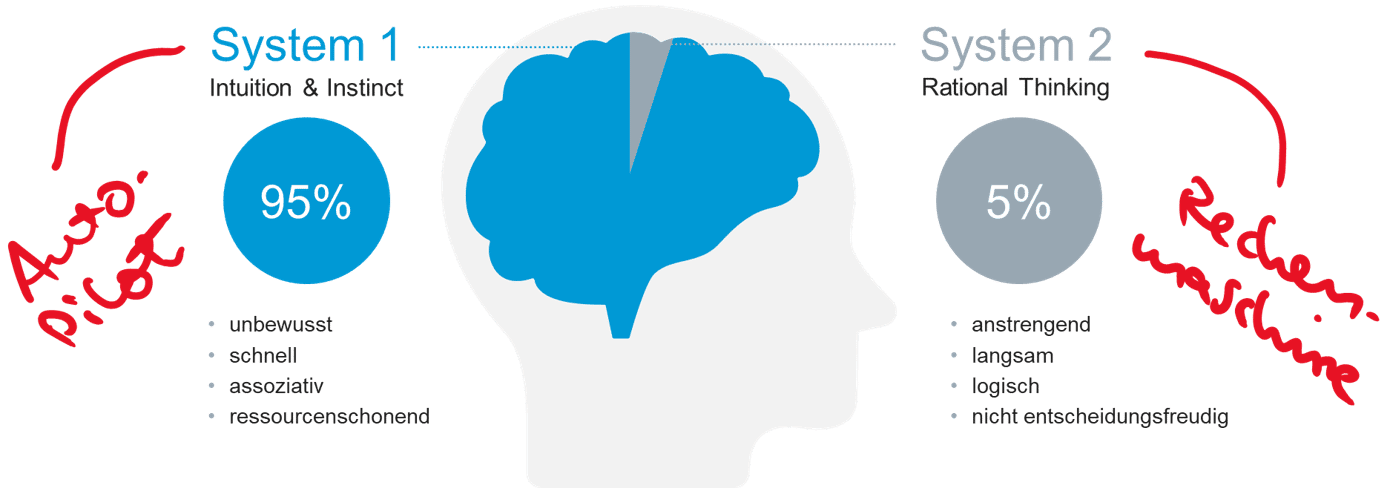
A comparison of the two decision-making systems
Behavior patterns support intuitive decisions
Decisions we make using our rational decision-making system cost us significantly more energy than those we make unconsciously. And since our brain is optimized for efficiency, we make most of our decisions using our intuitive decision-making system. But are our intuitive decisions necessarily irrational? Not at all: intuitive thought processes do not arise by chance. They result from clearly defined and recurring behavior patterns. These patterns can be thought of as templates for our actions. In everyday life, for example, a white coat or a stethoscope is often enough for us to consider a person trustworthy.
Effective tool in e-commerce
In e-commerce, these shortcuts are achieved through testimonials or external seals of approval, for example. These are largely heuristics. This means that they allow us to make good decisions with little knowledge and little time, thus conserving our brain's capacity. These standardized behavior patterns are also important from an evolutionary perspective: if our ancestors had had to think long and hard about whether every rustle in the bushes was a danger to them or not, we would probably no longer exist today. We can describe behavior patterns as the secret masters of our decisions. It is therefore obvious that they are an incredibly effective tool for positively influencing the user experience and conversion. Behavior patterns are therefore also classified as "persuasive communications" and are considered communicative persuasion tools.
Stay up to date on personalization: Sign up for the Epoq newsletter. Register now!
Study confirms effectiveness in e-commerce
At elaboratum, we were able to demonstrate the positive effect of behavior patterns in e-commerce in the "PsyConversion®" study with 2,400 participants. The results show that behavior patterns have a positive effect on the UX and conversion rate of the optimized site at several points along the sales funnel in e-commerce. Users also make higher-value purchases on sites that appeal to our subconscious behavior patterns, resulting in larger shopping carts. Behavior patterns have a subconscious effect: business value, i.e., the combination of conversion rate and shopping cart size, increases regardless of whether users rate a modified site better or not—by an average of 23.4%.
Behavior Patterns vs. Manipulation
Interest in these patterns has grown steadily over the past four decades. This is because understanding them holds enormous potential: anyone who has the circuit diagram in their hands can easily determine which levers they need to pull to trigger a certain behavior. It therefore stands to reason that, in the context of behavior patterns, the question quickly arises as to whether this constitutes manipulation of buyers. The answer is yes, behavior patterns can be used to manipulate. This is because many of these patterns are so deeply rooted in our brains that we can hardly resist their effects. If we apply Paul Watzlawick's statement "We cannot not communicate" to unconscious behaviors in e-commerce, it could be rephrased as "We cannot not manipulate."
Manipulation does not remain without consequences
Anyone who deals with this topic must face the discussion of where manipulation begins and define clear rules for where the red line is drawn. However, the debate is not based solely on moral aspects. Fortunately, it has a convincing economic foundation: any manipulation of users is punished with post-purchase dissonance. Increased return and cancellation rates and a damaged customer relationship are the undesirable consequences. In the worst case, the customer relationship may even end altogether. Anyone who thinks in terms of customer life cycles and is interested in a long-term profitable relationship should adapt the decision-making architecture so that users only receive a small nudge in the direction that meets their needs.
Win-win situation argues against manipulation
E-commerce management in the modern sense relies on recommendations and customer lifecycle value and should refrain from deliberately manipulating buyers. Acquiring new customers is significantly more expensive than maintaining existing customers. Therefore, the business goal should be to build lasting relationships with loyal customers. This can only be achieved if customers are satisfied with their decisions in the long term and if they have not made decisions against their rational will.
Even in science, behavior patterns are not considered manipulation. In her book "Webs of Influence: The Psychology of Online Persuasion," author Nathalie Nahai describes behavior patterns as a means of "reducing the distance between divergent points of view and working together toward a mutually beneficial outcome." So her definition also refers to a benefit for both sides. This clearly distinguishes behavior patterns from so-called dark patterns, which are explicitly designed to influence the buyer against their interests.
Positive impact throughout the entire customer journey
Behavior patterns improve the shopping experience for customers not only on the product pages themselves. They have a positive effect on the UX and conversion rate throughout the entire customer journey. A closer look at the customer journey shows that the intuitive decision-making system does not influence all steps equally. In some sections, it has a stronger influence, while in others we rely more on the rational system.
Advertisement texts, product pages, or even the moment we receive the package strongly appeal to our intuitive decision-making system. Here, we decide based on gut feeling. Filling out the order form as such is somewhat more influenced by the rational system. But even here, behavior patterns can have a positive effect. They can steer the focus toward the intuitive system and act as so-called "reassuring pills for the rational system."
The right choice of behavior patterns
There are countless behavior patterns that influence our decisions. Not all patterns have the same effect on users. And the effect of individual patterns also varies depending on the product and target group. In order to find out which behavior patterns can be effective for your own target group and should therefore be used for optimization, the implementation phase is preceded by an analysis phase. The aim here is to get to know the customer and their needs as well as possible. Based on this, the most relevant patterns are defined in the context of the product and used for optimization in the implementation phase.
A comprehensive library of behavior patterns, such as those found in the book "PsyConversion. 101 Behavior Patterns for a Better User Experience and Higher Conversion Rates in E-Commerce" (SpringerGabler 2018).
The top 5 most effective behavior patterns
There is a wide range of patterns to choose from. Many work very well in specific, specialized applications, but not in others. In addition, despite all the differences in target groups and business models, there are some particularly effective behavior patterns that have proven to be largely universal in their effectiveness:
- Decoy Effect: When people have to choose between a cheaper option A and a more expensive option B, they usually choose the cheaper alternative. However, if a third, significantly more expensive option C is added, this can make it easier to choose option B. Option C is the unattractive decoy, which differs so greatly from option B in terms of price or performance that the latter now appears attractive.
- Anchoring: The anchoring pattern can be understood as a metaphor. If you drop an anchor in a boat, you can no longer move far away from that spot. The so-called price anchor works in a similar way. Once a numerical value has been perceived, it is always used as a reference when processing a price. Regardless of whether the numerical value is related to the price or not. So if you include high values on your website (e.g., visitor numbers or satisfied customers), you will ensure that prices are perceived as lower. The same applies to reduced prices: the higher original price should always appear first to make the reduced price seem even cheaper.
- Authority: We tend to trust authority figures. Recommendations from experts, trust seals, or one's own expert status can act as authority figures and convince buyers of quality, encouraging them to make a purchase. The use of such authority figures on websites increases buyer confidence and willingness to purchase.
- Social proof: When we find it difficult to make a decision, the actions of other people provide a good guide. Whether it's individuals (experts, testimonials, influencers), the collective of other customers or users, or test institutes, for example: when we are unsure, we believe that other people who have already made a decision have more specific knowledge in this situation, which has enabled them to make an informed decision. This makes the perceived risk of our own decision seem lower.
- Endowed Progress Effect: Our brains want to complete incomplete tasks. Artificially created progress brings people closer to their goal, increasing their motivation to achieve it. For example, if a bonus system awards initial points or stamps, this increases customer loyalty. In online shopping, this effect can be used in the checkout process. If the progress bar shows progress right from the first step, it increases our motivation to complete the process.
Stay up to date on personalization: Sign up for the Epoq newsletter. Register now!
Practical example: Kerbholz
Kerbholz manufactures watches and eyewear from natural materials and sells them via an online store. The use of various behavior patterns was intended to optimize the online store in terms of the behavior patterns of store customers.
Building trust through the social proof pattern
Both the product presentation in the online shop and the product description have been optimized with the help of triggers that appeal to the buyer's subconscious behavior patterns. For example, the "social proof" pattern has been integrated into the product presentation. When we don't know how to make a decision, we look to other people for guidance. We trust that other people who have already made the decision have more knowledge about it and think that we minimize our risk by trusting them. An example of the implementation of the social proof pattern is the integration of customer reviews.
Optimization of price display using the magnitude priming pattern
Work was also done on the presentation of prices. The behavior pattern "magnitude priming" states that numerical expressions are processed and encoded in the brain as representations of size. If prices are to be perceived as low, it is recommended to keep the font size and line thickness of the numerical value small. These and other measures led to a 91.1% increase in the conversion rate using simple means.
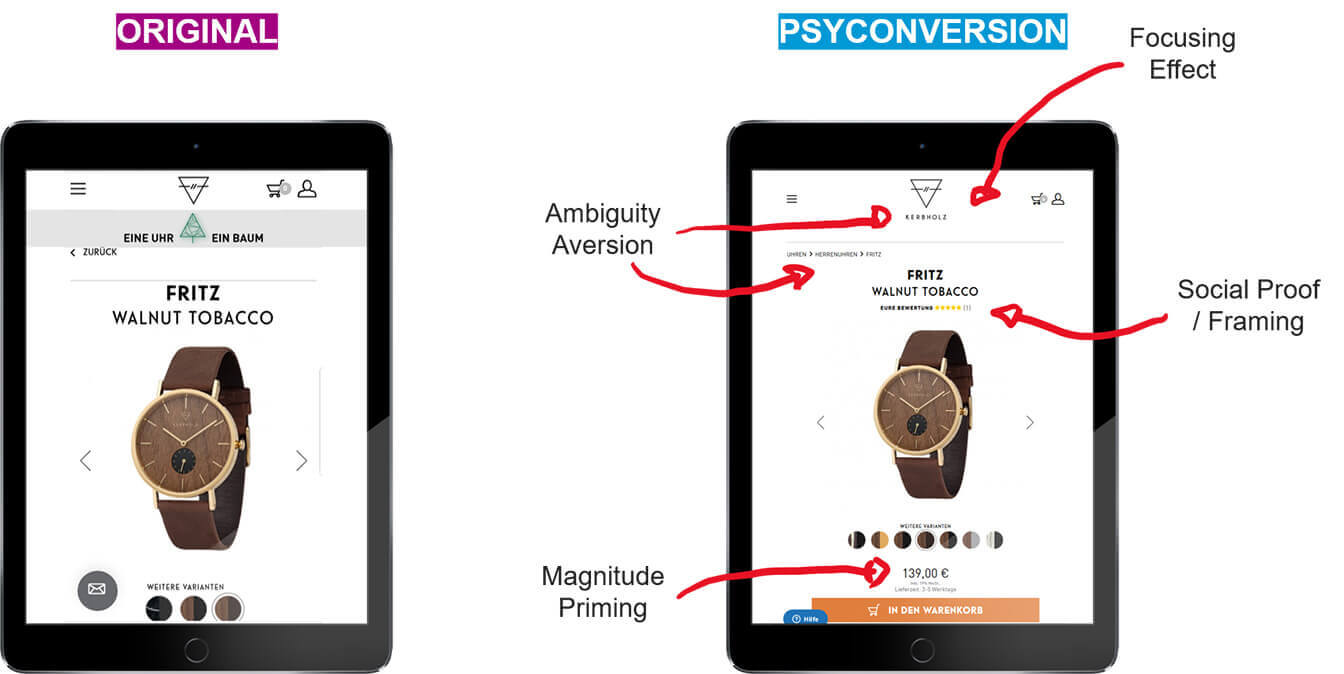
Optimization of product presentation through the use of behavior patterns in the Kerbholz online shop
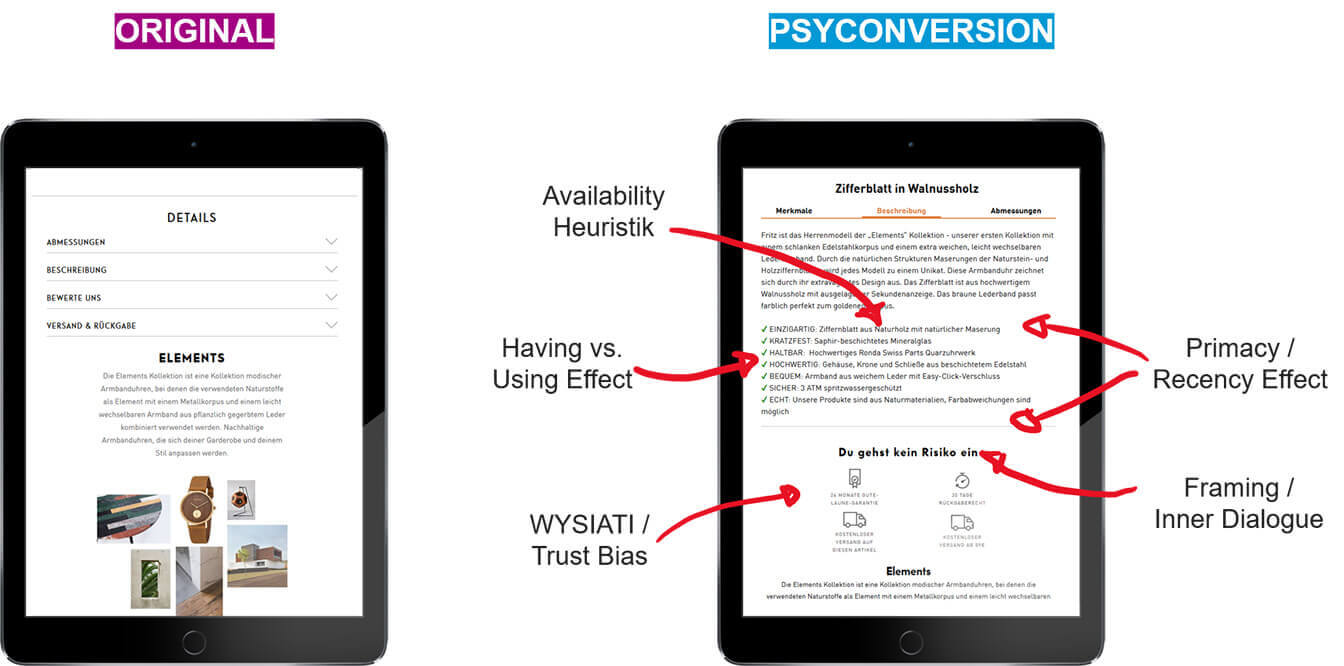
Optimization of product descriptions through the use of behavior patterns in the Kerbholz online shop
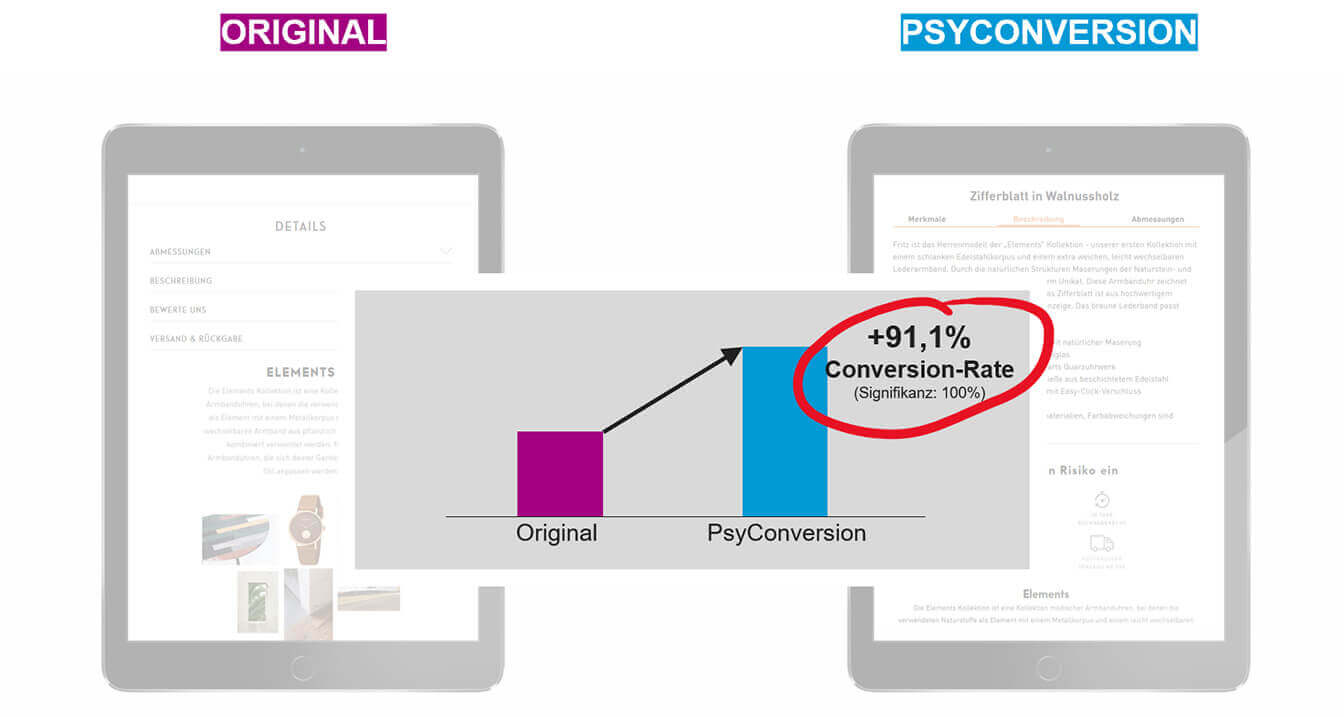
Uplift in conversion rate at Kerbholz through optimization of the Kerbholz online shop using behavior patterns
Practical example: Sunrise
Sunrise has focused on a different point in the customer journey. Sunrise is Switzerland's largest non-state-controlled telecommunications company and offers mobile, internet, TV, and landline services for private and business customers—including via its own web shop.
Optimization of the checkout area through measures with low technical complexity
Behavior patterns were used to optimize the checkout area. When selecting and designing the patterns and triggers, only measures with very low technical implementation complexity were chosen. This made it possible to take restrictions imposed by parallel projects into account while still achieving rapid improvements.
Increase conversion rates by adjusting text elements
The focus was on adapting the text elements. The use of over 15 patterns in the checkout process resulted in a 16% increase in the conversion rate, even with this limited design scope. The example shows that optimization based on behavior patterns does not always have to be visual. Sometimes, it is enough to adapt small text passages with even less effort to achieve a better result.
Conclusion: Utilize behavior patterns and exploit untapped potential
Behavior patterns offer tremendous potential for website operators to optimize their online shops. However, although knowledge about unconscious decision-making patterns is widely available and many optimization measures can be implemented quickly and easily, this potential remains largely untapped. And not just in terms of pure conversion. Those who orient their customer approach towards behavior patterns improve the customer experience and thus contribute to long-term business success.
Further Reading:
If you would like to delve deeper into the topic, you can find a free sample chapter and comprehensive explanations of important behavior patterns for immediate optimization at www.psyconversion.de.

Philipp Spreer
Principal Consultant at elaboratum | Epoq Guest authorPhilipp earned his doctorate at the intersection of marketing, IT, and psychology. His current book, PsyConversion, has become a fundamental work on behavioral psychology in digital optimization.
You are currently viewing placeholder content from HubSpot Embedded Content. To access the actual content, click the button below. Please note that doing so will result in data being shared with third-party providers.
More InformationYou are currently viewing placeholder content from HubSpot. To access the actual content, click the button below. Please note that doing so will result in data being shared with third-party providers.
More InformationYou are currently viewing placeholder content from HubSpot Meetings. To access the actual content, click the button below. Please note that doing so will result in data being shared with third-party providers.
More Information