Back to overview
  • Increase Traffic

Increase traffic and engagement with transactional emails

  • Published October 16, 2018
  • Tatiana Solarte
  • Reading time: 7 min.

The use of artificial intelligence in e-commerce is intended to turn retailers into predictive retailers. Specific customer needs are anticipated before they visit the online store, and the desired product is recommended at the right time. For example, a working mother should be shown the right products for her child's upcoming outing in the online store. Reality or vision?

The image shows a woman opening a transaction email on her laptop.

What are transactional emails?

Transactional emails are automated emails triggered by user requests. Together with newsletters and email campaigns, they are part of email marketing. Unlike traditional mass marketing, email marketing (also known as digital direct marketing) offers greater accuracy in terms of recipients and their data. This makes it easy for the sender to divide contacts into target groups and address them personally.

The main difference between transactional emails and marketing emails, such as newsletters and email campaigns, is that transactional emails are expected. The customer has taken action and thus signaled their interest. For this reason, transactional emails are opened and read more often. Typical emails of this type are registration and order confirmations, shipping notifications, or status updates.


Stay up to date on personalization: Sign up for the epoq newsletter. Register now!


Are you generally interested in email marketing and want to know how to set up a campaign? Then we recommend our blog article How to create a compelling email campaign.

Transactional emails vs. marketing emails

A study by IBM Cloud has shown that the average unique open rate for transactional emails is more than twice as high as that for marketing emails. With an average and median of 44.7% and 45.3% respectively, transactional emails perform significantly better than marketing emails, which deliver values of 22.6% and 18.3% in the same categories. Even for brands in the lower quartile, transactional emails have a double-digit unique open rate.¹
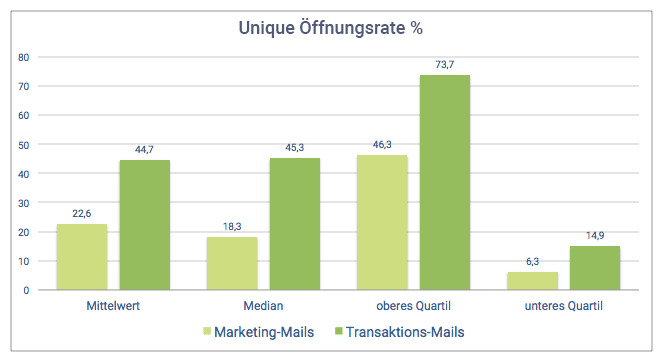
Comparison of unique open rates between transactional emails and marketing emails

You can find tips on how to increase the open rate of your newsletters in the blog article Improving newsletter open rates through subject line testing and send time optimization.

The click-through rate is also significantly higher for transactional emails than for marketing emails. On average, they have a click-through rate three times higher than marketing emails, with values of 4.8% and 1.6% respectively. Transactional emails also outperformed marketing emails in all other metrics.
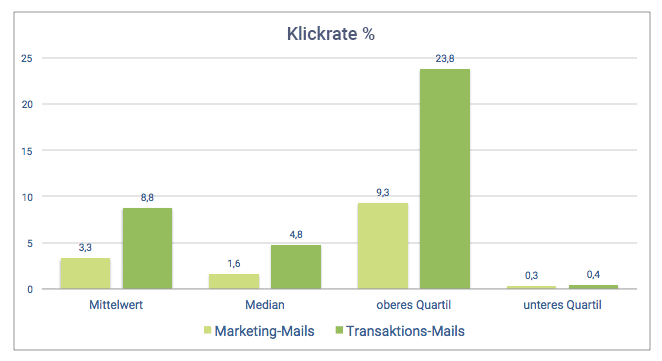
Comparison of click-through rates between transactional emails and marketing emails

You can probably guess where we're going with this. Not only are transactional emails opened more often by your customers, they are also read more often, and their links are clicked more often. Considering these statistics, it's clear that transactional emails are an excellent marketing tool. Yet their potential is often wasted.

You can find more information about email marketing personalization on our page about personalized emails.

Exploiting the potential of transactional emails

As you can see, transactional emails offer enormous potential. We will now show you how you can take advantage of this.

Integrate personalized product recommendations

By personalizing transactional emails , you can achieve cross-selling and upselling effects by including relevant product recommendations. However, these recommendations should be directly related to the products purchased or activities carried out, complement them in a meaningful way, and spark the customer's interest.

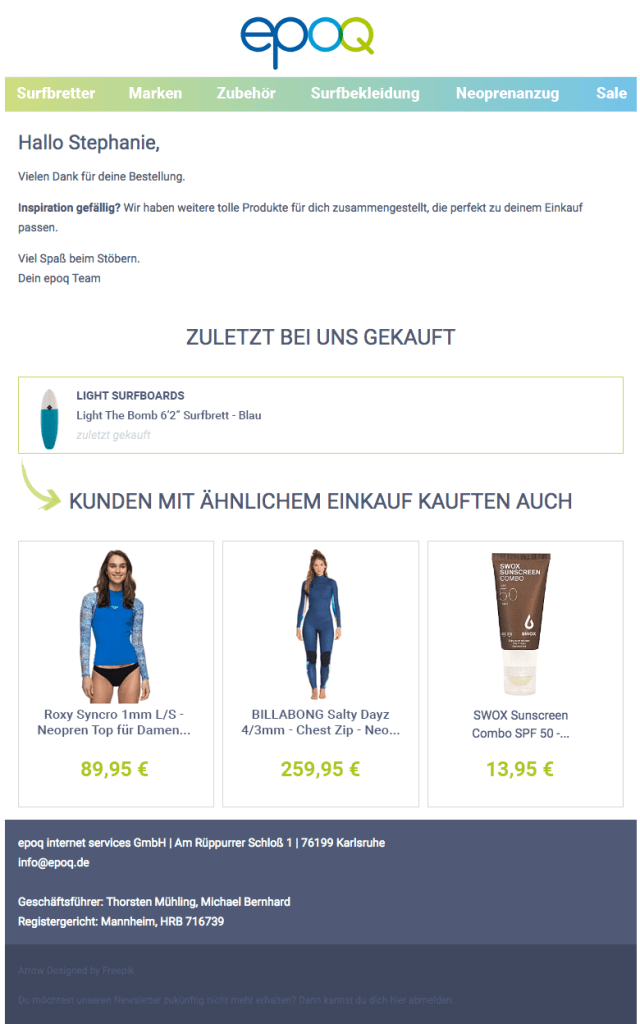
Has a customer purchased a surfboard? Include relevant recommendations in your order confirmation, such as a wetsuit or suitable sunscreen. If this customer already has an account, you can go one step further and check their history to exclude products they have already purchased from the recommendations.

Example of a transactional email following an order with personalized recommendations.

Send welcome message with incentives

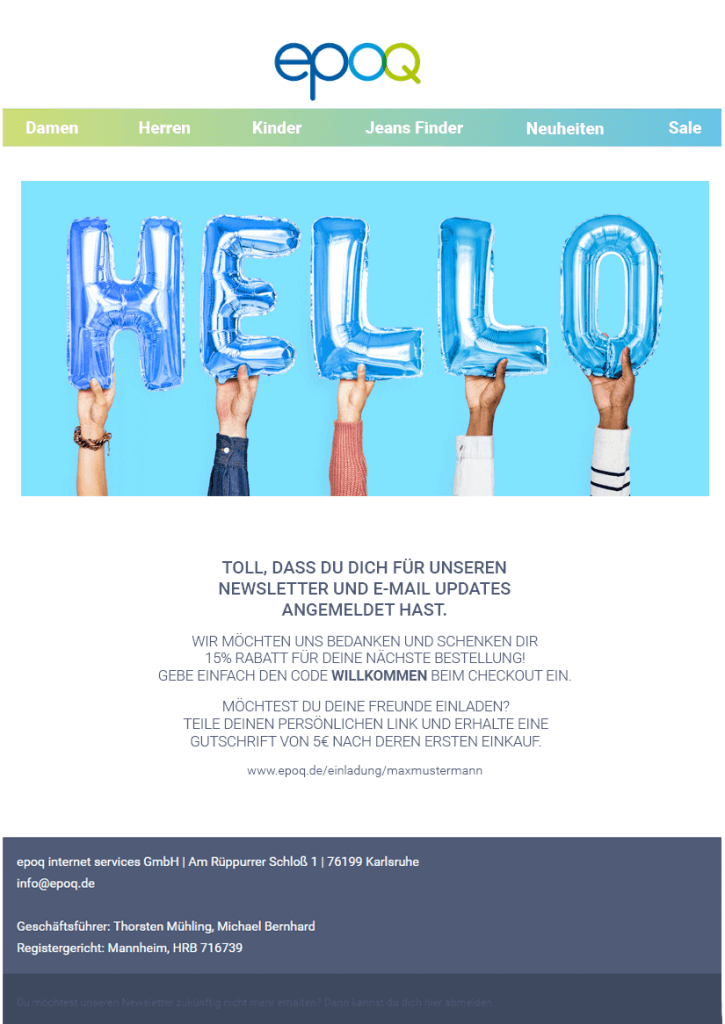
When used correctly, transactional emails can evenattract new customers and promote customer loyalty. Has a new customer created an account? Then welcome them and offer them a discount if they invite a friend.

Example of a transaction email after registration

Ask customers for reviews

You can also use transactional emails to stimulate engagement, for example by asking your customers for their opinion. Nowadays, ratings and reviews play a major role in purchasing decisions. Many customers like to actively refer to reviews, which is beneficial for other customers and therefore also for your online store.

obtain consent

Transaction emails are also suitable for obtaining opt-ins from customers. To retain customers in the long term, you can use this marketing opt-in to communicate with them. Here, for example, you can address customers who did not give their consent at checkout but now agree to receive the newsletter.

Alternatively, you can remind your customers in a transactional email about the great benefits, such as bonus programs or exclusive discounts, when they create an account or join your community on social media.

Conduct tests and optimize emails

You can exploit the full potential of transactional emails by using A/B testing or multivariate testing. Optimization is also crucial in transactional communication. Depending on the goals you are pursuing with the email (opt-in, rating, changing settings, etc.), you can use testing and tracking to find out what works best for your customers. When used correctly, multivariate testing can lead to the optimal combination of individual email elements being personalized for individual customer segments.

You can find out more about how personalized emails increase engagement in our blog article What you should know about email personalization for online stores.

There are countless possibilities; you just need to recognize them, adapt them to your online shop and your audience, and use them correctly. It is important that your customers recognize the added value of these transactional emails. The more relevant your recommendations are, the clearer the added value becomes. However, you must also take the legal framework into account.


Stay up to date on personalization: Sign up for the epoq newsletter. Register now!


Legal framework

Transactional emails are considered a response to a customer action—they contain information related to a specific customer relationship. The transaction-related content must be clearly in the foreground. Therefore , the associated recommendations, promotions, or invitations must be related to the customer's activity. For this reason, they may be sent without the customer's explicit consent. Problems arise when transactional emails contain recommendations in such a way that they are perceived as advertising emails.

As soon as transactional emails contain advertising, the recipient's consent (opt-in) and an option to unsubscribe from the mailing list are generally required. However, there is an exception to the express consent requirement, which is set out in Section 7 (3) of the UWG. In this case, the sending of advertising in transactional emails is permitted if all four conditions specified in the text of the law are met:

  1. an entrepreneur has obtained the customer's electronic mail address in connection with the sale of a product or service,
  2. the entrepreneur uses the address for direct advertising of their own similar goods or services,
  3. the customer has not objected to the use and
  4. When collecting the address and each time it is used, the customer is clearly informed that they can object to its use at any time without incurring any costs other than the transmission costs according to the basic rates.²

Conclusion: Transaction emails are an excellent tool for increasing traffic and promoting engagement.

Transactional emails offer tremendous potential that many online store operators have yet to exploit. These types of emails always reach the recipient at the right time. Byincluding relevant information or appropriate recommendations, you can skillfully guide your customers back to your online store, increasing your traffic and promoting engagement and customer loyalty.

Sources: ¹ibm.com, ² Federal Ministry of Justice and Consumer Protection

Would you like to delve deeper into the topic of smart shipping communication and learn how you can maximize sales from your existing customers with the help of cross-selling?

Then watch the webinar recording now!

Tatiana, Communication Manager at epoq
Tatiana Solarte
Communications Manager
At the time of publication, Tatiana was working as a communications manager at Epoq. She was responsible for outreach, such as maintaining social media channels. She also supported her team in content creation. In her free time, she can often be seen with a book in her hand.