
85% higher click-through rate in newsletters thanks to personalized category-based recommendations at babymarkt.de
babymarkt.de increased its click-through rate by 85% through personalized, category-specific newsletters.

Email campaigns are an online marketing tool that can be used to promote a limited-time promotion. You pursue a specific goal, such as increasing traffic to your online store or strengthening customer loyalty. To ensure success, there are several steps you should take a close look at. In this blog article, you will learn what these steps are and how to implement them successfully.

Here's what you can expect to find in this blog article:
Email campaigns as part of email marketing
Newsletter, email marketing, and email campaigns compared
The path to a successful email campaign
1. Define your strategy
2. Compile a contact list
3. Obtain consent from your customers
4. Use the subject line to grab the reader's attention
5. Personalization creates customer loyalty
6. Design and device adaptation
7. Increase click-through rates with calls to action
8. Choose the right time
9. Test, evaluate, and optimize
Before we dive into the topic of "compelling email campaigns," we would like to briefly cover some basics.
Email marketing is a form of direct marketing. It involves sending digital messages to draw customers' attention to new products or services. You can also highlight special offers that may be of interest to your customers. Email marketing serves to strengthen customer loyalty and accompany online shoppers on their customer journey. Email marketing also helps to build trust with your customers and remind them of your company or online store.
Email marketing is considered an umbrella term and encompasses numerous measures and activities. These include, for example, newsletters, email campaigns, and email marketing campaigns. But what exactly is the difference between them?
The newsletter is usually sent to your distribution list at regular intervals. All subscribers receive it at the same time and often with identical content. In general, the aim is to inform your customers about new products and events via the newsletter. You can use it to present a new collection from a particular brand or to report on events or similar. An example of a newsletter would be a themed newsletter for the summer that includes swimwear.
Email marketing is considered a classic advertising tool in direct marketing and is largely promotional in nature. While newsletters contain a wide range of information and also provide updates, email marketing is about promoting specific products or a special campaign, such as advertising a specific in-store event. Email marketing is used when you want to draw customers' attention to something, such as a product relaunch. Another difference to newsletters is that email marketing messages are often sent at irregular intervals.
An email campaign , on the other hand, is a temporary promotion. You send different emails to different addresses, allowing you to respond more specifically to individual interests. Your campaign also pursues a specific goal, such as increasing traffic to your website or online store. An example of an email campaign would be a welcome campaign aimed at new customers. Here, you can welcome a new customer with an email along the lines of "We're glad you're here!" A few days later, you can inform them about your range of services, for example. This allows you to maintain individual contact with your customers.
Now that the groundwork has been laid, it's time to implement an email campaign. Implementing an email campaign requires several steps, which are described in more detail below:
To make your email campaign a success, you first need to set a strategy. Defining clear goals will also help you set up the campaign correctly. You need to think about what you want to achieve with your campaign. For example, do you want to attract new customers, increase traffic to your site, or promote customer loyalty? Once you know what your goal is, it will be easier to implement the campaign accordingly.
Stay up to date on personalization: Sign up for the Epoq newsletter. Register now!
Your contact list is the basis of your email campaign. That's why compiling your mailing list is particularly important. It's important to note that the number of contacts is not the decisive factor for success. It's much more important to respond to the needs of your customers and tailor your email campaign to the target group and interests of your recipients. In order to offer your customers tailor-made content in your emails, it makes sense to segment and narrow down your target group. This way, you can avoid sending the same newsletter or email to all recipients. A meaningful and self-compiled contact list has the advantage that your recipients want to hear from you and are interested in your online shop and your products.
Once you have created your contact list, it often makes sense to create additional distribution lists within it. After all, your customers do not all have the same interests and needs. You should respond to these and tailor the content of your emails to your different target groups. The more you respond to your customers, the more likely it is that the content will be interesting and useful to them, which in turn increases the open and click-through rates. If you reach your target group, your campaign is guaranteed to be a success.
To make this process as effective as possible today, shop operators are using artificial intelligence. Ex Libris, for example, uses artificial intelligence to identify relevant customers and inform them 90 days in advance about new book releases. Only customers who may be potentially interested in the new book release receive an email. As a result, Ex Libris increased its email sales tenfold. You can find more details about this email campaign in our case study. Below is an email from Ex Libris about new book releases.
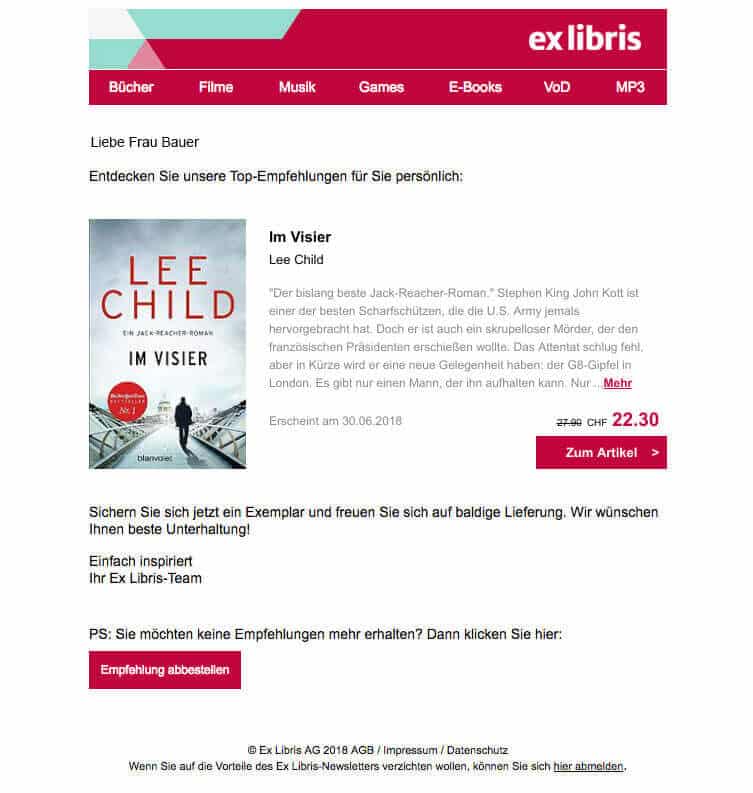
Email from Ex Libris about new book releases (source: screenshot of email from exlibris.ch)
Before you start your email campaign and send messages to your customers or potential new customers, you must obtain their express consent. You can obtain permission, for example, when they sign up for your newsletter via a double opt-in. The double opt-in process works by sending your customer a confirmation email to their specified email address after they register for your newsletter. To confirm their consent, the recipient must click on a confirmation link in the email. This ensures that the recipient is actually the person who provided their email address during registration.
Existing customers, on the other hand, may be contacted even if they have not opted in twice. However, all of the following conditions must be met¹:
Would you like to learn more about transactional emails and their legal framework? Then we recommend reading the blog article Increase traffic and engagement with transactional emails.
The subject line has a major influence on whether your customers actually open your emails. That's why it's important to grab their attention right away with this line. Use an exciting subject line that makes them curious about the content of your email and motivates your recipients to read on.
Also, be careful not to use terms that email clients recognize as spam and block. For example, you should be cautious with terms such as "bargain" or "special offer." You can find an article on which spam words to avoid and a comprehensive list of critical terms at mailjet. Instead, use a personal approach and create excitement.
Address your recipients individually and show them that every single customer is important to you. Personalization can be used in many different ways. You can achieve this through personalized communication, text design, and tailored recommendations.
For example, your reader will feel directly addressed when you use their name in the salutation. Targeted content also gives your customers the feeling that you are informed about their interests. Too much text will scare your recipients away, so keep it short and simple. Whether the content of your email is useful to your recipients is a decisive factor in whether your campaign achieves its goals. That's why it's important to convince them with appealing content that is relevant to the reader. Address the problems and interests of your target group and respond to them directly.
Stay up to date on personalization: Sign up for the Epoq newsletter. Register now!
For tailored recommendations, the click and purchase behavior of your shop visitors is recorded and processed in a knowledge base using intelligent algorithms, allowing you to display relevant recommendations for each online shopper in your emails. Relevant recommendations also allow you to draw their attention to special offers or promotions that are still in line with your customers' interests. Offer them added value and encourage them to visit your online shop.
Here we show you how Planet Sports uses personal recommendations in its newsletter:

Newsletter from Planet Sports with personalized recommendations (source: screenshot of email from planet-sports.de)
If you would like to see more examples of personalized emails, please take a look at the relevant blog article: Email marketing examples with personalized content.
When it comes to design, less is sometimes more. Use white space and clear paragraphs to give your readers a clear structure and make it easier for them to grasp the information. Images also help to support your content and appeal to your customers on an emotional level. Make your emails visually appealing and provide your readers with guidance. You can highlight important elements with color to draw your readers' attention to specific areas.
Adapting your content for mobile devices is very important nowadays and of great significance for your email campaign. Many people use their smartphones to check their emails, which is why optimal display should also be ensured on mobile devices.
Use calls to action to give your readers recommendations for action. The wording is particularly important here. Formulate your call to action as clearly and motivatingly as possible to make it clear to your customers what they should do. Specific calls to action could be, for example, "Act now" or "View offer." Well-formulated calls to action increase the click-through rate and encourage your readers to visit your online shop after reading the email.
It also makes sense to use colors that stand out and are eye-catching for your calls to action. You should position them prominently and clearly visible in your email. It is advisable to use high-contrast colors such as complementary colors to draw attention to your calls to action. It is also possible to use a specific action color that is recognizable for a special offer. It is important to use your colors consistently so as not to confuse your readers. In addition, the color scheme should be coordinated with your corporate design.
To reach your customers in the best possible way, you should adapt both the time and the day on which you send your email to your target group. To find the right time to send your emails to your customers, you can simply test different times. This will help you find out when your emails are opened most frequently. In general, however, it makes sense to try to put yourself in your readers' shoes and think about when they are most likely to read your email.
According to a study by Newsletter2Go, Friday is a particularly popular day for sending e-commerce emails, with high open and click-through rates. Wednesdays, on the other hand, see particularly high sending volumes. In terms of timing, traditional office hours are considered the most popular time for sending emails. However, open rates are usually higher in the evening, as these emails receive more attention due to the lower sending volume. The complete study, which also looks at the best shipping times for different industries, can be found at Newsletter2Go.
Before sending your email to your distribution list, you should definitely test it. Any errors that have crept in can be easily corrected by having the email proofread. It is also a good idea to send test emails to check that the email is displayed correctly.
To ensure your email campaign is successful, it is also very important to monitor its performance, evaluate key figures, and take advantage of opportunities for optimization. Key figures such as the open rate, click rate, or conversion rate help you to identify how your content is being received and accepted. Once you have evaluated this data, you can use it to further improve your future campaigns. It is also possible to find out whether an image or text link was clicked in your email. With the insights gained from this, you can customize future emails and target users more specifically.
Another important aspect is the so-called UTM parameters. They are a useful tool for tracking where traffic to your content comes from. UTM parameters enable campaign-specific tracking via Google Analytics and show how many users have reached your online shop via specific links. You can use the Google URL Builder to create a UTM parameter.
If you would like more information on the topic of email marketing, you can read the following article: 7 Email Marketing Tips.
Despite the emergence of many new media, email has become an integral part of everyday life. It plays a particularly important role in marketing. Email campaigns offer great potential and can achieve quick results with little effort and low costs. Used correctly, they can help you build customer loyalty and increase traffic to your online store.
Discover how babymarkt.de increased the click-through rate in its category-specific newsletter by 85%.
Read the case study now!

You are currently viewing placeholder content from HubSpot Embedded Content. To access the actual content, click the button below. Please note that doing so will result in data being shared with third-party providers.
More InformationYou are currently viewing placeholder content from HubSpot. To access the actual content, click the button below. Please note that doing so will result in data being shared with third-party providers.
More InformationYou are currently viewing placeholder content from HubSpot Meetings. To access the actual content, click the button below. Please note that doing so will result in data being shared with third-party providers.
More Information