
Boost your click-through rate with trigger mail: Here's how it works
Find out how you can maximize the click rate in your online store with Trigger Mail!

One of the biggest challenges in e-commerce is converting prospects into customers. This, in turn, is the basis for building customer loyalty and maintaining long-term contact with online shoppers. How can you achieve this? With email marketing: one of the most effective ways to win new customers and build relationships with them. In this article, you will learn what this means, why it is so important for your online store, and how you can use email marketing in e-commerce.
Here's what you can expect to find in this blog article:
Email marketing in e-commerce: What exactly is it?
Lead nurturing in email marketing
Advantages of email marketing in e-commerce
Low costs for using email marketing
Target customers with personalized emails
Full control and measurability of measures
Increase in e-commerce traffic
Optimize your email marketing through A/B testing
Possible uses of email marketing in e-commerce
Greet your customers with a welcome message
Send personalized and relevant recommendations
Select recipients and send email campaigns about new releases
Offer a coupon code via email for the next purchase
Use email to confirm orders
Win back shopping cart abandoners
Thank your customers for their loyalty via email
Use cross-sell and up-sell emails
Use email marketing to win back customers
Start surveys with appropriate survey emails
Newsletters vs. drip campaigns
What is a newsletter?
What is a drip campaign?
What is the difference between transactional, functional, and promotional in email marketing?
Measuring customer engagement in email marketing
Determine the open rate of your emails
Look at the click-through rate in email marketing
Pay attention to the delivery rate as an email metric
Keep an eye on your email unsubscribe rate
Measure the conversion rate in email marketing
Conclusion: Plenty of opportunities for online shops thanks to email marketing
Frequently asked questions about email marketing in e-commerce
Simply defining email marketing as the sending of emails would be too superficial. Email marketing is a form of online and direct marketing. It serves to send information or advertising messages to potential and existing customers via email.
On the one hand, email marketing can be used to provide interested parties with the necessary information and thus encourage them to make a purchase. On the other hand, email marketing also offers many advantages for long-term customer loyalty. For example, you can offer your customers high added value with purely informative newsletters or recommend suitable products to them based on items they have already purchased, thereby generating additional sales. To learn how you can also use email marketing as a temporary promotion, check out our blog article How to create a compelling email campaign.
The term "lead nurturing" plays an important role in email marketing. Derived from "to nurture," which means to cultivate or promote, the process of lead nurturing describes the measures taken in e-commerce to win new customers, win back inactive customers, and cultivate customer loyalty. The lead nurturing process is about identifying your customer's needs and providing them with the information that is appropriate for the respective phase of the purchase decision.
Stay up to date on personalization: Sign up for the Epoq newsletter. Register now!
In short: as part of your marketing mix, email marketing offers many advantages for your online shop. We have summarized the specific benefits and advantages of using email marketing for you below.
The costs for email marketing are usually lower than for advertising measures in other channels. This is because newsletters and other email campaigns can be set up and sent in-house, so the only costs incurred are the time required and the comparatively low costs for sending. You can also reduce the time required for your email marketing with the help of email automation.
Another advantage of email marketing is the ability to address your customers personally. Email personalization allows you to target your customers effectively. For example, you can personalize the content of your emails, making them more relevant to the recipient and capturing their attention. You can also schedule newsletters and other mailings to align with your customers’ needs, ensuring your content always reaches them at the right time. You can learn everything you need to know about email marketing in our blog post on this topic.
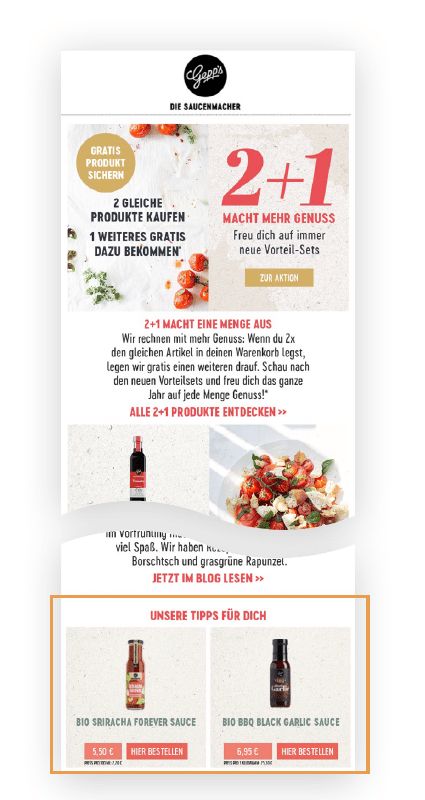
Personalized emails with relevant content are a major advantage of email marketing in e-commerce. (Source: Screenshot of email from gepps.de)
Hardly any other medium used for advertising purposes offers such a high degree of control and measurability as email marketing. This is because you yourself determine what content is sent to which customer group and when. At the same time, you can measure the success of your marketing measures directly and very specifically. To measure the success of your email marketing campaigns, you can use various important email marketing metrics.
Email marketing also has a major impact on your store's traffic. Whether it's bringing back existing customers or attracting new ones, email marketing in e-commerce drives customers to your store and increases traffic. Find out how to use email marketing effectively and what other measures you can take to increase traffic in our guide to increasing e-commerce traffic.
The field of email marketing offers you plenty of opportunities for testing. With A/B testing, you can tailor your newsletters to your customers and make them more appealing. A/B testing can be used for both the content of your emails and the time they are sent. In our guest post on improving your newsletter open rate, you can learn how to use A/B testing correctly to optimize your email marketing.
You have now read quite a bit about what email marketing actually means and what advantages it offers your online shop. In the following, we would like to show you some of the many possible applications. People often talk about newsletters in this context, but that is not the only way to use email marketing in e-commerce.
True to the motto "first impressions count," the initial contact with your customers in email marketing should also leave a lasting and positive impression. That's why it's important to welcome your buyers with a welcome email. You can find out more about the mailing in which you welcome your customers, as well as further examples of emails for specific occasions, in our article on the 5 most popular types of trigger emails.
Thanks to the wide range of personalization options, email marketing allows you to send your customers content tailored to their needs. For example, after a purchase, you can send recommendations for similar products and thus generate further sales. Email marketing is therefore also an important after-sales measure. The key here is that the recommendations are calculated at the moment the email is opened and take into account individual preferences such as size, favorite brand, etc. This ensures that the recommendations are particularly relevant to your recipients.
AI can be used to make sales predictions. You can use this, for example, to send email campaigns about new product releases only to customers who are potentially interested in the product. The key here is the selection of recipients, which can be determined fully automatically using AI processes. This means that the email can be sent precisely to those customers for whom the email content is relevant.
This enabled Ex Libris to generate 10 times higher email marketing revenue in its online shop. Find out more in our case study.
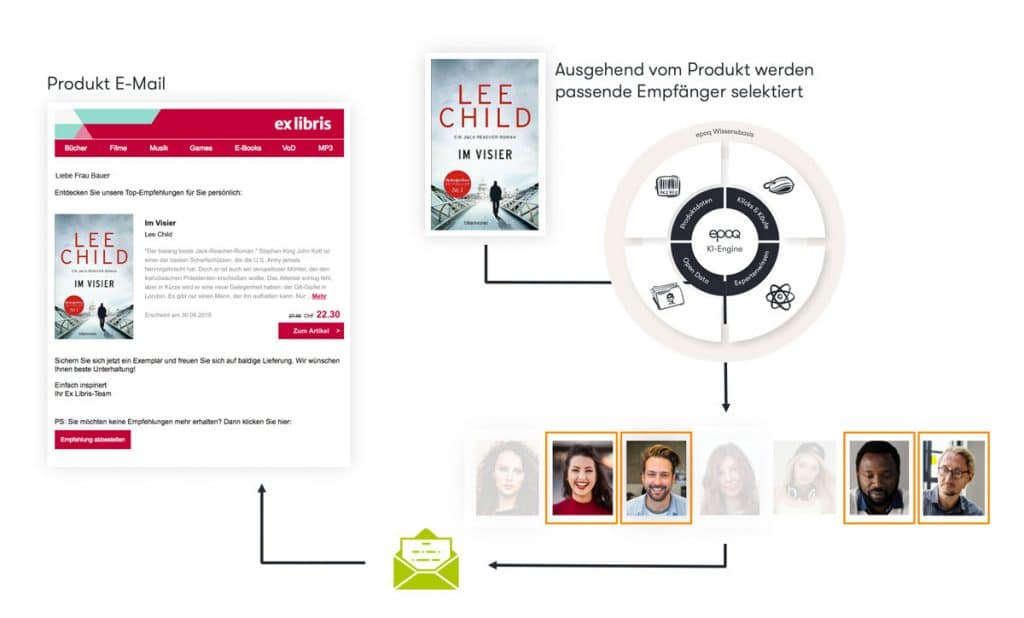
Ex Libris selects suitable recipients based on the product. Only these recipients will receive an email about the new product release.
Discount emails not only offer your customers significant added value, but also motivate them to make a purchase in your online shop. You can send newsletters with coupon codes for a wide variety of occasions. For example, you can delight your customers by sending them a birthday email with a coupon code or offering a discount on special holidays.
Transactional emails such as order confirmation emails are usually opened more frequently than other emails or newsletters. On the one hand, you inform your customers that you have received their order, and on the other hand, you can use these emails to achieve further conversions. Learn more in our blog article about how you can use order confirmation emails to tap into sales potential in your checkout process.
With an appealing subject line and personalized content in an email, you can grab the attention of customers who have left their shopping cart without placing an order. With customized cart abandonment emails, you can convince your customers to purchase the items in their cart by including additional content such as recommendations, coupons, or reviews.
Thank-you messages can be sent in many different ways. For example, you can thank your customers for shopping at your online store or send them a thank-you email for their loyalty. Optionally, you can also send your customers a voucher code as a small thank-you gift.
By sending your customers emails with items that complement the product they have purchased, you can increase conversions in your online store. Cross-sell emails can contain accessories for the purchased product, for example, while an upsell email can be used to offer a customer who has booked a trip with you an upgrade for their room. You can also take advantage of lifecycle emails by tailoring the content and timing of your emails to the current needs of your customers. Providing the content they actually need at the right time offers your recipients great added value and also helps you achieve more conversions.
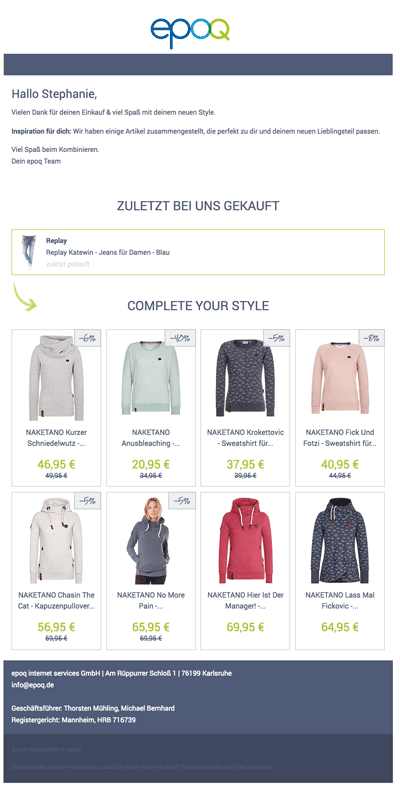
Cross-sell emails can be used, for example, to display product recommendations that complement the purchased product to create a complete style.
Email marketing is also suitable for winning back your inactive customers. You can use it to win back subscribers who haven't opened your emails for a long time, as well as customers who haven't made a purchase in a long time. So use win-back emails to grab your customers' attention and encourage them to make another purchase.
Emails with surveys offer you plenty of opportunities to learn more about your customers and their needs. There are no limits to your creativity here. For example, you can launch surveys via email to gather insights about your customers, or you can ask them for feedback on their shopping experience in your store using a survey email.
In email marketing, it is important to distinguish between newsletters and drip campaigns. But what exactly is a newsletter, and what does drip campaign mean?
Automated emails that are sent based on different actions performed count as a drip campaign. The emails in a drip campaign are sent at specified times and therefore differ significantly from newsletters. Emails in a drip campaign can be order confirmation emails or notifications about shipping status, for example.
The different types of emails pursue different goals. In email marketing, a distinction is made between transactional, functional, and promotional emails.
To get an overview of how your customers interact with the emails you send, it is necessary to monitor a few key metrics. By evaluating these metrics, you can ultimately draw conclusions about recipient engagement and the effectiveness of your email marketing in e-commerce.
The open rate tells you how many recipients opened your email. You can use this metric to create specific distribution lists. For example, you can test a new subject line with customers who did not open the email. This allows you to take measures to increase the open rate.
The click-through rate, also known as CTR, is calculated as the ratio between the total number of emails delivered and the number of recipients who clicked on a link within the email. This metric allows you to measure how many recipients were encouraged to interact with your email content. You can also use this metric to create detailed recipient lists.
On the one hand, you have the total number of emails sent, but on the other hand, this number does not correspond to the actual number of recipients. Even if you send your email marketing campaigns to large distribution lists, there is no guarantee that every one of these emails will be delivered. The delivery rate therefore indicates how many of the emails were actually delivered. You can use this metric to optimize your email distribution lists, because email addresses that never receive emails from you should be removed from the recipient lists.
The recipients who have unsubscribed from your email distribution list represent the unsubscribe rate in relation to all emails sent. If you notice a particularly high unsubscribe rate for specific email campaigns, you should take a closer look. Email campaigns with a high unsubscribe rate should be analyzed and appropriate measures taken. Such measures could include changing the frequency of mailings or revising the recipient list.
Stay up to date on personalization: Sign up for the Epoq newsletter. Register now!
Another really important metric for measuring customer engagement in email marketing is the conversion rate. For newsletters that are purely informational and have no sales intent, this metric is naturally less meaningful. However, most email campaigns aim to get customers to take action. For such campaigns, it is therefore even more important to look not only at the open and click-through rates, but also at the conversion rate. The conversion rate is the percentage of recipients who clicked on a link and those who completed a conversion.
Email marketing offers you numerous opportunities to address your customers. The many different types of emails make it possible to provide customers with the right information at the right time, thereby strengthening customer loyalty. Thanks to the personalization of email campaigns, a targeted and personal approach is possible. With email marketing, you not only maintain relationships with your customers, but also win back customers and increase traffic and purchases in your online store.
Email marketing is a type of online and direct marketing. Email marketing refers to communication between retailers and customers via email.
Email marketing can be divided into two types: newsletters and drip campaigns. Within the areas of newsletters and drip campaigns, there are many other sub-types of emails.
The lead nurturing process refers to all measures taken to acquire new customers and maintain loyalty among existing customers.
Email marketing offers many advantages in e-commerce. For example, you can advertise cost-effectively, address your customers personally, and increase traffic to your shop.
A newsletter is an email that informs your customers about promotions and new products. A newsletter is not tied to a fixed sending time.
Learn how to increase your click-through rate with Trigger Mail.
Watch our webinar recording on this topic.

You are currently viewing placeholder content from HubSpot Embedded Content. To access the actual content, click the button below. Please note that doing so will result in data being shared with third-party providers.
More InformationYou are currently viewing placeholder content from HubSpot. To access the actual content, click the button below. Please note that doing so will result in data being shared with third-party providers.
More InformationYou are currently viewing placeholder content from HubSpot Meetings. To access the actual content, click the button below. Please note that doing so will result in data being shared with third-party providers.
More Information