
AI technology – Generate a knowledge base for your online store
Learn how to generate an AI-based knowledge base for your online shop and increase your conversion rate.


Our AI technology is powered by our AI engine, a network of intelligent algorithms that generates knowledge for your online store from data. It uses data mining to identify patterns and correlations in the data and machine learning, specifically reinforcement learning, as an artificial intelligence method to deliver personalized content to each individual store customer at various touchpoints in your digital commerce. With every click and purchase, the AI engine develops through self-learning and can thus continuously refine 1:1 personalization for your shop customers. This makes it possible to deliver personalized content to each individual shop customer throughout the entire customer journey. Only in this way can holistic shopping experiences be created that inspire your shop customers and increase your conversion rate.
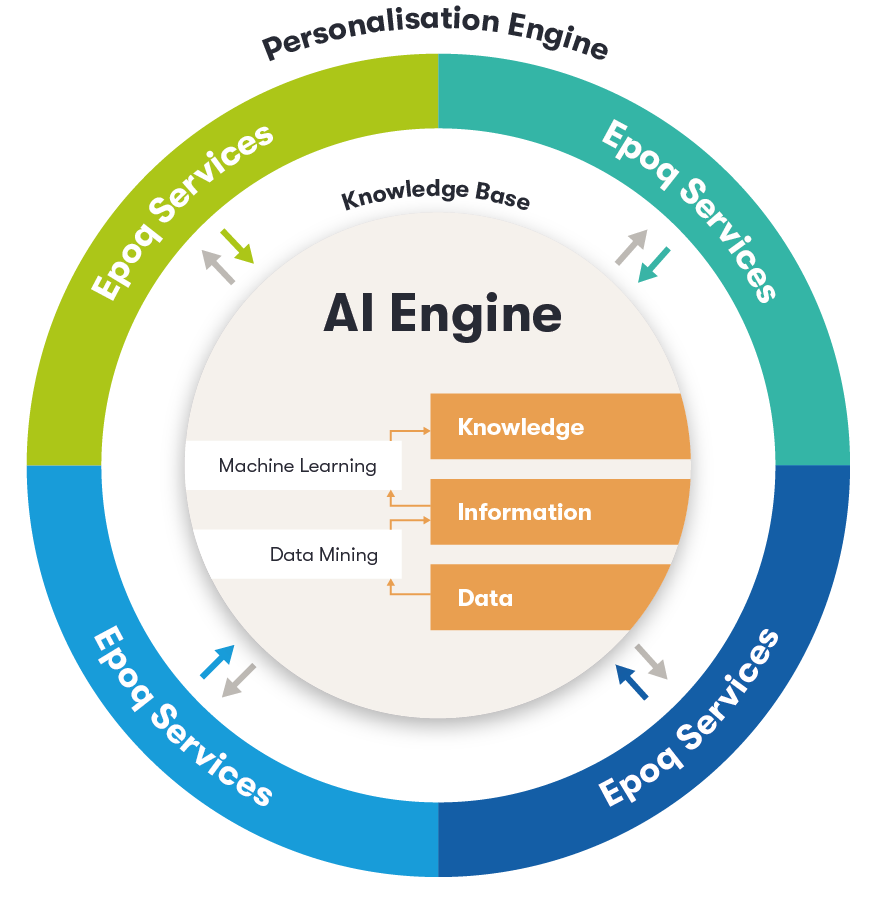
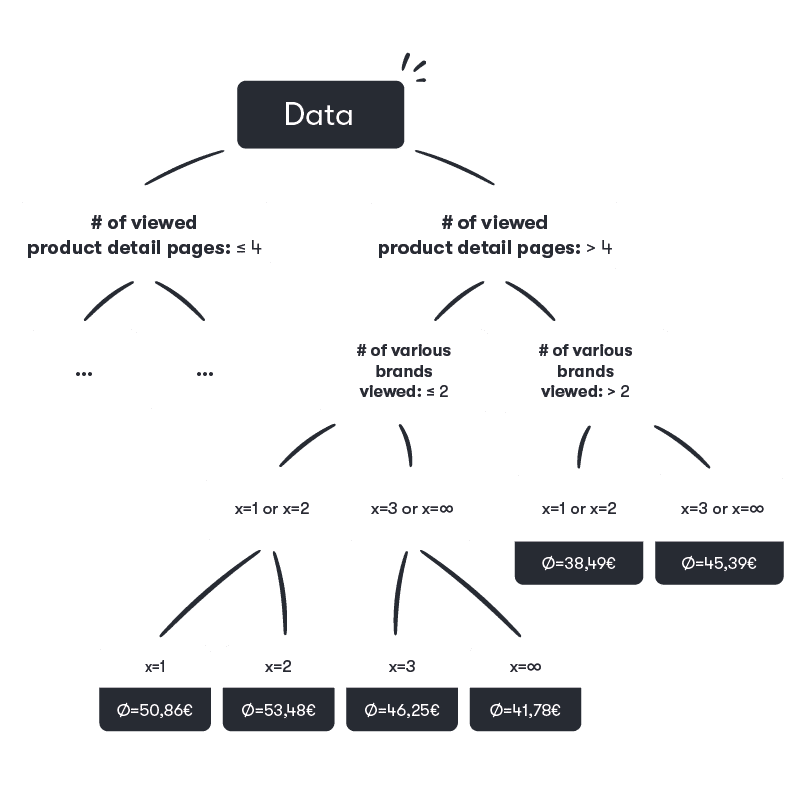
Machine learning is an artificial intelligence process that generates knowledge from experience. Our AI engine uses machine learning to deliver personalized content. Based on a corresponding database, our AI engine can recognize patterns and regularities and make predictions for the personalized delivery of content in your digital commerce. To make a prediction, regression trees are used, for example, which contain possible decisions depending on the objective. Our AI engine learns from every click and purchase in your online store and thus develops independently. It generates artificial knowledge from the experiences in your digital commerce. The insights gained can then be transferred to other shop customers. Learn more about machine learning in our blog article.
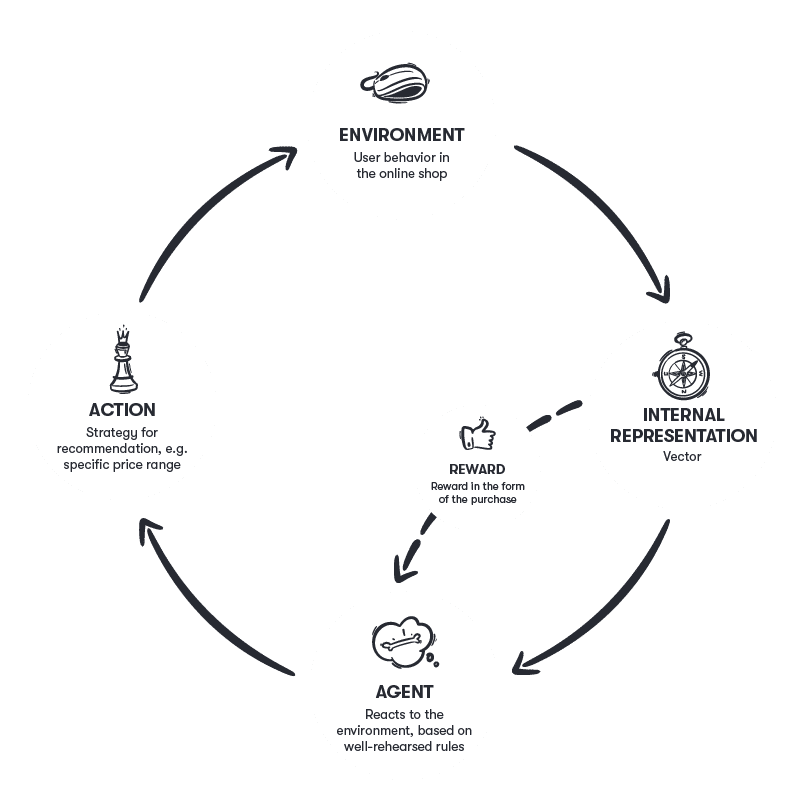
Reinforcement learning is a subfield of machine learning and thus also a method of artificial intelligence. Reinforcement learning ensures that our AI engine develops itself through self-learning. It works similarly to instrumental conditioning, in which, for example, a dog learns to fetch a ball. In this case, the dog is an agent that perceives its environment. When a trainer throws a ball, the dog can run after it and bring it back to the trainer, receiving a reward in return. Just like the dog, the AI engine must be able to perceive digital commerce and decide on an action, such as displaying a particular brand to a customer. If the customer buys the product, the AI engine receives a digital treat. This reward reinforces the behavior of the AI engine. This means that if a similar customer visits the online store later, it is more likely to behave in the same way again. Learn more about reinforcement learning in our blog article.
As part of our AI technology, we generate a knowledge base for your online store. To do this, we need a database consisting of your product catalog, the click and purchase behavior of your store customers, and expert knowledge from you and us. Our AI engine processes this data into knowledge and uses it to make predictions about the purchasing behavior of your shop customers (predictive analytics) and ultimately to deliver personalized content across various touchpoints in real time. If you would like to delve deeper into the knowledge base, watch our webinar recording "Generating a Knowledge Base".
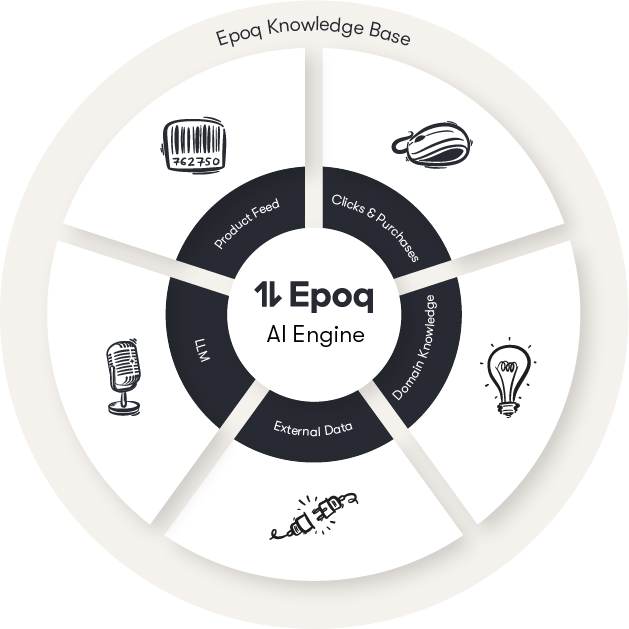

Your product catalog is required for our AI engine to build up product knowledge. If important data is missing, the product catalog will be prepared by our experts.

To enable the AI engine to learn from the behavior of individual store customers as well as from all store customers as a whole, click and purchase behavior from your digital commerce is recorded using a tracking code.

You can incorporate your specialized shop and industry knowledge, which you have gained over time in brick-and-mortar retail and online shops. Our data scientists optimize all data with regard to consumer psychology and transmit rules to the AI engine for analyzing the data and recognizing patterns.
Your product data is the foundation for personalization along the customer journey of your digital commerce. However, it also has a direct impact on the performance of your online store. That's why it's important that your product data is complete and well maintained for your project. For example, do you want store customers who follow a vegan diet to only be recommended vegan products? Then your product catalog needs the attribute "vegan." Even the best AI technology can only play out what is contained in your product catalog. That's why our data scientists check your product catalog and, if necessary, prepare it for use. Want to know how your data is doing? Then take a look at our checklist "Product data as a sales booster".

Click and purchase behavior also plays an essential role within the knowledge base, as it ensures the further development of our AI engine and the personalized delivery of content. However, here too, it is important to separate the wheat from the chaff. The data used for knowledge generation by our AI engine must be relevant. "Smart data" must therefore be extracted from "big data." This process is called data mining. Our data scientists take on this task. This enables our AI engine to recognize patterns and correlations that provide useful information for your digital commerce. This extracted information is then processed into knowledge by our AI engine and applied as predictions in your online store.

Stefan Jährlichen | FZI Research Center for Information Technology and Head of Smart Data Accompanying Research

Our decades of expertise are embedded in every component of our AI technology, as described above, in product data preparation, smart data extraction, and the application of sales psychology insights. However, in order for our AI engine to learn independently and find solutions, the prior actions of our experts are necessary. Our data scientists therefore provide it with the appropriate algorithms and rule systems for analyzing the data pool and recognizing patterns, as well as with the right communication structure between the individual software services on our platform. This is crucial for the quality of personalization. Only in this way can your shop customers receive high-performance personalized content at every touchpoint in your digital commerce. To keep our finger on the pulse, our data scientists are constantly developing our AI technology. Learn more about our e-commerce data science.

No personal data is collected as part of our AI technology. Identification features are rendered unrecognizable by using a pseudonym. In addition, all data is hosted in Germany and is therefore subject to German data protection law.



#multitasking #therock #motivator #hacker #visionary
CTO


#webalyzer #everlearner #front(doesnotmean the)end #metalisforever
Head of Service Platform


#admin #development #aheadbangersjourney
Software Developer


#development #search #runner
Software Developer


#chocolatedestructionmachine #search-engine #archDevOp… #$(“body”).hide(); #someonealwaysshouts #kickern #hardcourthero
Software Developer


#jsninja
Front-end Developer


#allfiredup #alwaysready
Software Developer


#horsewhisperer
Software Developer


#pixelperfectionist #search #unl #coffee
Front-end Developer


#CleanCode #2Keyboards #deliciousTea #Spiderman #playfulChild
Software Developer
Discover now what is possible in terms of personalization!