
E-book – The Digital Salesperson – Reinforcement Learning in E-commerce
Get comprehensive insights into the use of reinforcement learning for personalizing online shops.

Machine learning is not just a buzzword, but already a reality in many companies. Those who know the advantages are not surprised: self-learning algorithms offer great potential for optimizing processes that are crucial to success, especially in online retail. Here you can find out what the technology is all about and how it works. We also report on interesting use cases of machine learning in e-commerce and show you its strengths.

Here'swhatyou can expect to find in this blog article:
Machine learning in e-commerce: definition and objectives
How does machine learning work?
What types of machine learning are there?
What is the difference between machine learning and deep learning?
Using machine learning in e-commerce: Application examples demonstrate the huge potential
Management of supply and demand
Churn management
Fraud detection
Improved customer service
Website and product search
Personalization
Advantages of using machine learning in e-commerce
Smarter decisions based on larger amounts of data
More successful marketing campaigns
Higher conversion rates
Higher ROI through greater efficiency
Conclusion: Machine learning in e-commerce is a powerful technology.
In machine learning, an artificial system generates valuable knowledge by learning from examples and generalizing them. Developers no longer strictly dictate what the computer should do. Instead, they show it the necessary data and the computer figures it out for itself.
The system gains insights in a similar way to humans: it "gains experience" and derives meaningful behavior from it. With machine learning, it can only learn what occurs in the data.
Stay up to date on personalization: Sign up for the Epoq newsletter. Register now!
Machine learning is a subfield of artificial intelligence (AI). To distinguish it from other forms of AI, experts also refer to "true artificial intelligence" as artificial general intelligence (AGI).
The exact process also depends on the type of machine learning used. However, the basic principle is that developers train the AI or machine learning model using data. The algorithm analyzes this data and draws conclusions from it. The models consist of parameters that are applied to new data to make predictions such as "What will the customer do next?"
In order for "the machine to learn," the AI must evaluate a large amount of data on any number of events. Here is an example:
An ad content is displayed. The AI assumes with a probability of 50% that the ad will be clicked on. If the ad is clicked on, the AI uses this information instead of the previous assumption and calculates that this ad will be clicked on with a probability of 100% in the future. It displays the ad again. This time, it is not clicked, and the probability of a future click drops to 50%. The learning process continues in this way, constantly approaching reality.
However, other parameters are also included in the calculation of the probability of the event "click" occurring, such as the channel, the time of day, the browser, geography, etc. The machine learns from the past and predicts the future based on probabilities. Self-learning algorithms can therefore use this data and the result of the prediction to further improve themselves.
In machine learning, developers distinguish between four types:
Deep learning is a subcategory of machine learning. It uses so-called neural networks. These enable systems to make decisions even when problems and data are very complex. Deep learning can be combined with other types of machine learning. Developers refer to the simultaneous use of neural networks and reinforcement learning as "deep reinforcement learning." This is used, for example, in AlphaGo or in the development of robots and self-driving cars.
Machine learning has already arrived in e-commerce and is becoming increasingly important thanks to the further development of this and similar e-commerce technologies. The possible applications, which we will describe in more detail below, are already impressive today.
Algorithms can identify phases and target groups in which demand is particularly high. This enables companies to optimize prices or streamline warehousing, for example. A classic example of this is airline pricing, where algorithms find the perfect balance between capacity utilization and price in real time.
Those who conclude long-term contracts with their customers benefit particularly significantly from AI in churn management. Churn management is concerned with preventing customer churn. Today, algorithms are used by energy suppliers and telecommunications companies, for example, to predict the likelihood of customers terminating or concluding contracts and to support customer service with suitable offers for each customer—at the most promising time.
Attempts at fraud are similar. Algorithms can process data much faster and recognize these patterns even in current processes. If a transaction is suspicious, they issue a warning message and stop the attempt in time.
Machine learning also enriches e-commerce in customer service. This is because companies know individual customers better when they have similarities to others and these are recognized. This allows them to know when it is promising and service-oriented to proactively approach them with offers. In addition, AI enables new ways of providing support and assists customers with self-service via chatbots or virtual assistants.
Search terms entered by customers and the data for the corresponding products do not always match. Machine learning helps online shops optimize their search function so that customers can still find the items they are looking for. This kind of ecommerce search engine function quickly and easily guides shop customers to the product they want, thereby reducing the bounce rate. Search engines such as Google also use this technology and are constantly developing it further to display better search results.
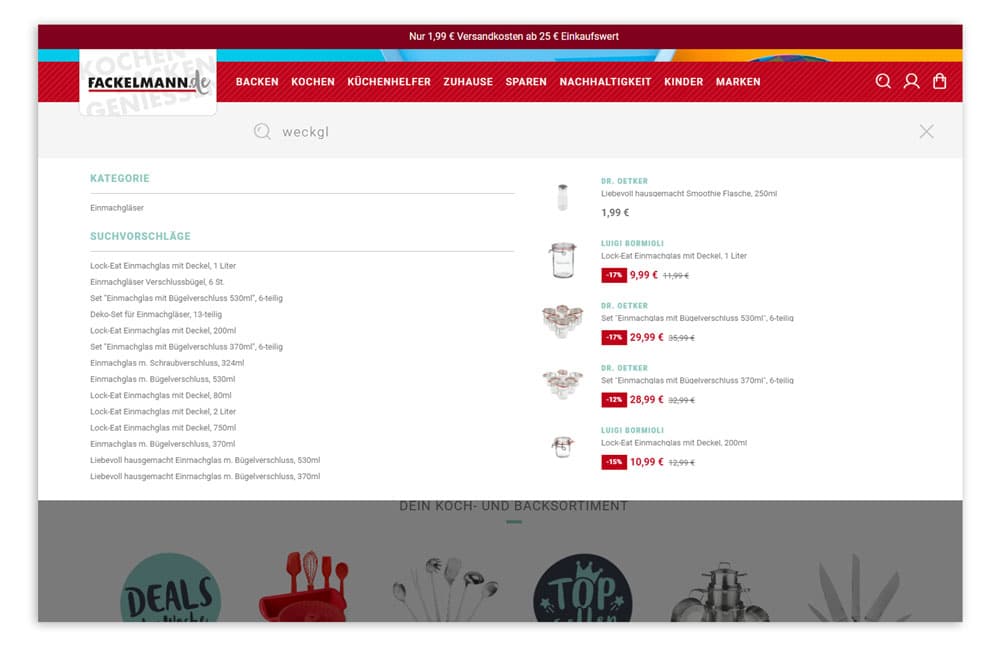
An ecommerce search engine takes into account, for example, the language used by customers (e.g., preserving jar instead of canning jar) and displays suitable suggestions as soon as you start typing.
(Source: Screenshot from fackelmann.de)
AI software for online shops based on machine learning enables companies to understand their customers and even first-time visitors much better. This allows them to offer products and content tailored specifically to each individual user. This personalization in turn leads to a higher conversion rate and thus to an increase in sales.
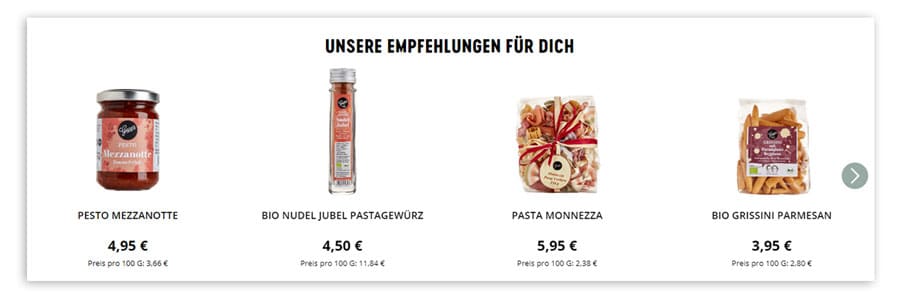
Personalization can be used, for example, in product recommendations and ensures relevance and inspiration in the online shop.
(Source: Screenshot from gepps.de)
Machine learning has significant advantages over "manual" data processing. It is faster, more accurate, and scalable. What's more, it is extremely efficient. As a result, machine learning is increasingly proving to be an indispensable technology in e-commerce.
Those who know a lot find better solutions. That's why big data has become so important in e-commerce. But no one can process a huge database as well as a self-learning algorithm. The human brain is incapable of performing a similar task.
What's more, carefully constructed artificial intelligence does not make the same errors in reasoning as humans. The reason: because it does not incorrectly weight data based on prior knowledge, it is not subject to cognitive bias. Careful construction is crucial here.
It is no coincidence that many of the successful new marketing methods are data-driven and therefore significantly more efficient than traditional advertising measures. After all, the possibilities for precisely targeting customers are limited if they are not supported by machine learning. It is almost impossible to address prospective and existing customers at the right moment with arguments that are convincing to them. With hypertargeting, however, marketers can tailor campaigns to almost any customer without investing a huge amount of time.
Example: A brand campaign is to be implemented via search, i.e., a specific brand (e.g., Tommy Jeans) is to be promoted in the search results. In addition to promoting the brand, personalization also makes it possible to take into account the preferences of the customer searching (favorite color, discounted items, correct size). The customer thus only receives relevant items that are still in line with the current marketing campaign.
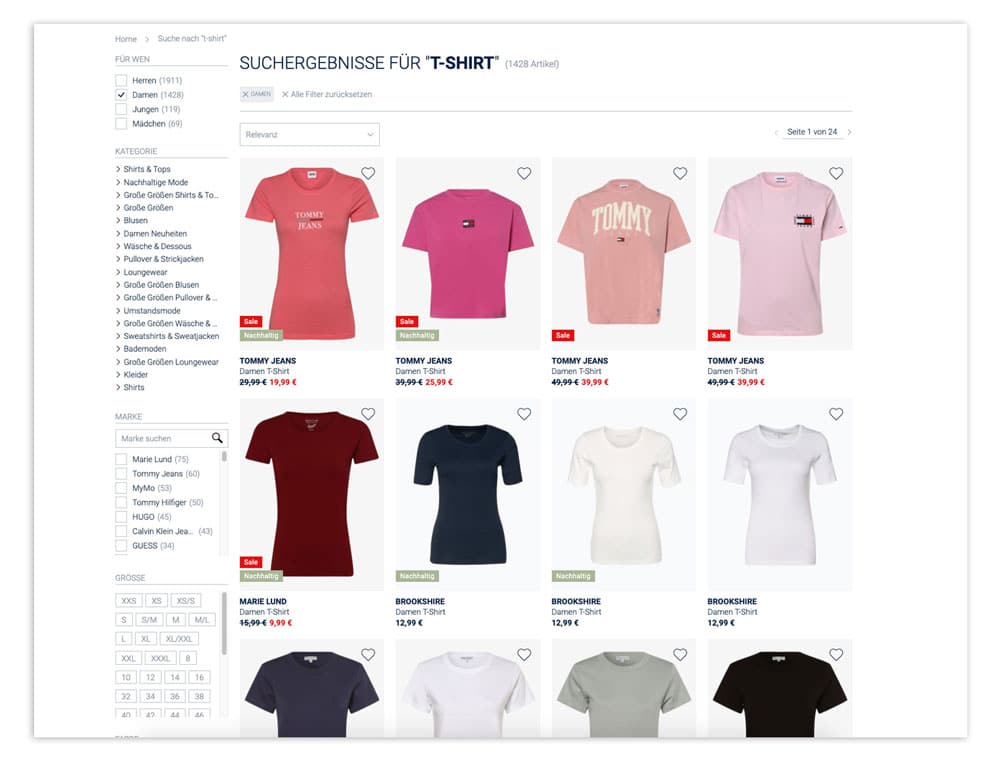
Personalization allows marketing campaigns to be tailored to individual customers.
The process of turning a prospective customer into a buyer is time-consuming and prone to disruption. With machine learning, online shops can make this process more targeted by making it easier for customers to find the products they are looking for. Relevant content also binds them to the company, and even the price can be tailored to them. By implementing the insights gained through AI, an online shop can provide many selling points and avoid mistakes that prevent a purchase.
Stay up to date on personalization: Sign up for the Epoq newsletter. Register now!
Machine learning supports companies by automating routine tasks and generating accurate forecasts. This increases efficiency in many areas. AI reduces the workload on customer service and sales, provides logistics with facts for planning, and improves the yield of marketing campaigns.
Machine learning enables algorithms to learn from data and draw the right conclusions. The technology helps companies to work more efficiently and in a more customer-oriented manner. Its advantages and strengths are particularly significant in online retail, where customer interaction generates large amounts of data.
Machine learning is a subfield of artificial intelligence in which systems learn from examples and derive generalized knowledge from them. In e-commerce, the system recognizes patterns in data and independently gains useful insights from them—similar to how humans learn through experience.
There are four types of machine learning: supervised learning, in which the system is trained with target specifications; unsupervised learning, which recognizes patterns in data without specified targets; semi-supervised learning, which is a hybrid of the two; and reinforcement learning, in which the system learns through trial and error by means of rewards.
Deep learning is a special form of machine learning that uses neural networks to solve complex problems. It is particularly useful when conventional methods reach their limits.
Machine learning is used in many ways in e-commerce, for example for price optimization, fraud detection, personalized product recommendations, ecommerce search engine functions, and improved customer service.
Machine learning enables faster and more precise processes, personalized marketing campaigns, and a more targeted customer approach in e-commerce. This leads to higher conversion rates, better ROI, and well-founded analyses based on large amounts of data.
Would you like to learn more about the use of reinforcement learning?
Check out our e-book on the topic!

You are currently viewing placeholder content from HubSpot Embedded Content. To access the actual content, click the button below. Please note that doing so will result in data being shared with third-party providers.
More InformationYou are currently viewing placeholder content from HubSpot. To access the actual content, click the button below. Please note that doing so will result in data being shared with third-party providers.
More InformationYou are currently viewing placeholder content from HubSpot Meetings. To access the actual content, click the button below. Please note that doing so will result in data being shared with third-party providers.
More Information