
E-book – The Digital Salesperson – Reinforcement Learning in E-commerce
Get comprehensive insights into the use of reinforcement learning for personalizing online shops.

Decisions in e-commerce happen quickly, sometimes in a fraction of a second. Modern deep learning methods are capable of evaluating huge amounts of data in a very short time—much faster than any human being. And best of all, with every decision made by artificial intelligence (AI), the algorithm learns more. This article shows you how the technology works, what advantages it has, and how you can use deep learning in e-commerce to increase your success.

Here'swhatyou can expect to find in this blog article:
Definition: What is deep learning in e-commerce?
Deep learning vs. machine learning: AI beats the brain
Use of deep learning in e-commerce: practical examples
Optimization of search results
Automated determination of the optimal price
Prevention of customer churn
Detection of fraud
Support for customer service
Personalization in e-commerce
Potential: What advantages does deep learning offer in e-commerce?
Conclusion: Successfully implementing deep learning in e-commerce
Frequently asked questions about deep learning in e-commerce
Like the broader topic of machine learning, deep learning deals with the learning processes of artificial intelligence. It is based on so-called neural networks. These are structured similarly to the brain: they consist of different layers, the input, intermediate, and output neurons, which connect the artificial brain. The more extensive this neural network is, the more complex the situations that the deep learning algorithm can process.
To better understand the definition of deep learning, it helps to look at how humans learn. They take in all the details of a situation and weigh them up before making a decision. They then question their decision: if it was incorrect, they correct it and learn from it. If it was correct, this confirms their initial choice.
Stay up to date on personalization: Sign up for the Epoq newsletter. Register now!
Deep learning works according to the same principle: the machine makes decisions independently and questions them. Deep learning is therefore able to develop independently and learn from both mistakes and successes.
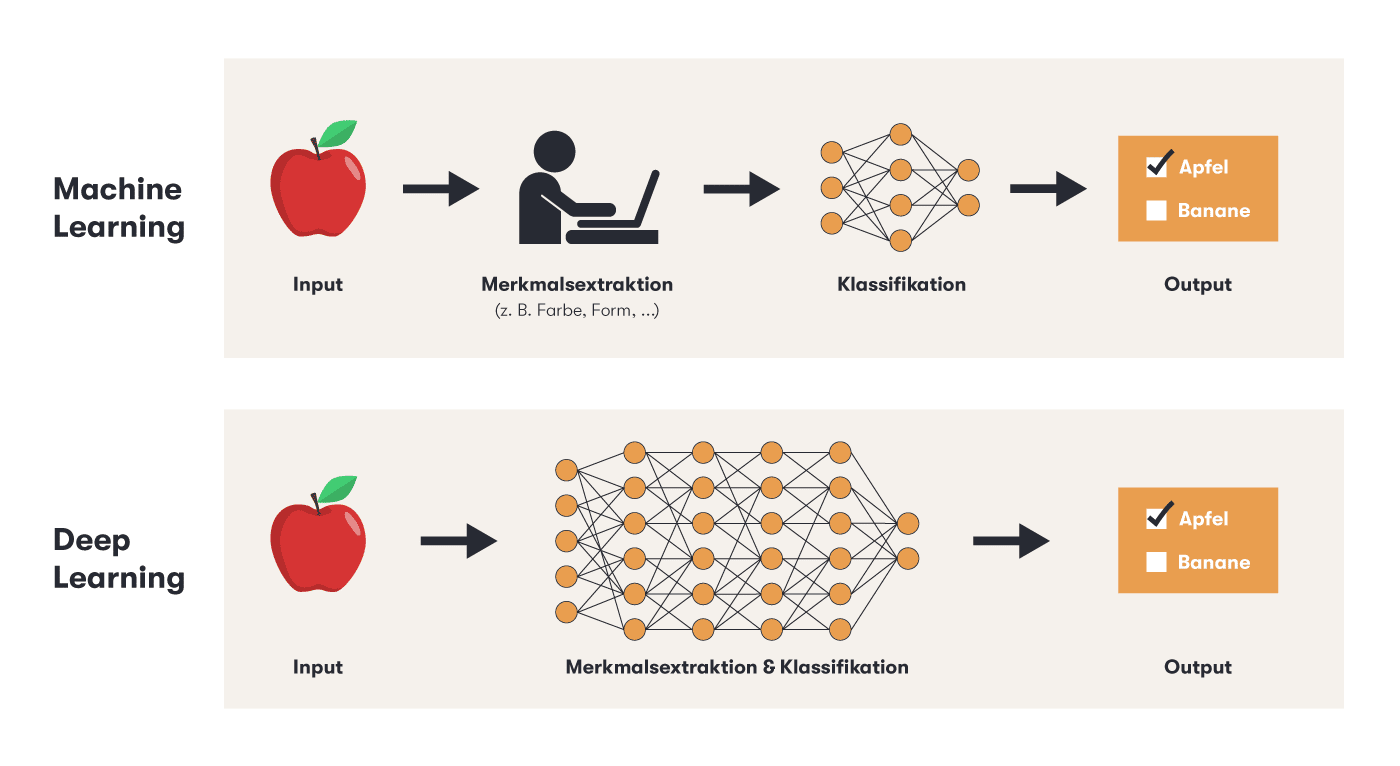
Deep learning and machine learning have one thing in common: both make artificial intelligence usable for companies in e-commerce technology. But despite their common basis, there is one key difference:
Example: The model is supposed to learn whether an object is an apple or a banana and is given images of both objects to learn from. In machine learning, a human can specify features such as color and shape to solve the problem quite well. In deep learning, the image, i.e., all pixels, is entered as input. In the output, the network sends a signal indicating whether it believes it is more likely to be an apple or a banana. It then receives feedback on whether the prediction is correct. Based on this, the parameters of the network are adjusted in several stages. This process is repeated until the model can no longer make better predictions or the parameters can no longer be adjusted.
By the way: The machine learns through reinforcement learning based on the principle of trial and error. Initially, it does not have the information necessary to make decisions, but must work this out for itself.
Artificial intelligence is not a thing of the future —it is already being used successfully in e-commerce data science today. The following examples of deep learning show how you can use autonomous machine learning in online retail.
Deep learning can optimize search results. The machine evaluates user behavior to determine whether the user has found the desired product. If this is not the case, it incorporates the findings into the ecommerce search engine in order to gradually improve the output of the correct products.
Product prices in e-commerce are no longer fixed, but require daily adjustment. However, making these changes for thousands or millions of products is not feasible for humans. Deep learning enables dynamic pricing by independently evaluating the effects of a price increase or decrease and drawing conclusions for future decisions. You can base your pricing on various aspects:
Abandoned shopping carts during product searches or checkout cost e-commerce businesses money. Artificial intelligence helps online retailers keep potential buyers on board. If users threaten to abandon the purchase process, the machine can display a personalized offer within fractions of a second to encourage them to stay. Churn management can therefore help you reduce your bounce rate and increase your conversion rate.
Damage caused by fraud can be enormous—in addition to expensive chargebacks, in the worst case scenario, irreparable damage to the company's image can result. Deep learning can learn to find the one transaction out of a huge number that shows anomalies and suggests fraudulent intent. This enables AI to prevent fraud.
Deep learning can also revolutionize customer service in e-commerce. Thanks to deep learning, chatbots communicate with customers in natural language, identify and interpret their problems, and provide them with qualified solutions. By asking customers questions ("Were we able to solve your problem?"), the machine learns whether its proposed solution was correct or needs to be adjusted. It no longer outputs text modules, but responds independently and individually.
With the help of deep learning methods, online retailers can also find out what actions buyers are planning next. Based on the products viewed, the length of time spent on the site, and user behavior, artificial intelligence can deliver personalized content, for example, to display suitable alternatives, recommend other products, or support the purchase decision.

In the Görtz online shop, customers can find product recommendations with suitable alternatives on the product detail page.
(Source: Screenshot from goertz.de)
Stay up to date on personalization: Sign up for the Epoq newsletter. Register now!
Deep learning offers numerous advantages in e-commerce:
With deep learning, you can improve the customer journey for your customers, create a personalized shopping experience, revolutionize your customer service, and prevent fraud. This allows you to increase your sales, optimize your marketing campaigns, and make your business processes more efficient.
Deep learning is a subfield of machine learning that works with huge amounts of data. A characteristic feature of deep learning is that artificial intelligence develops independently and without human intervention.
In traditional machine learning, humans must define rules to enable the machine to make decisions. A deep learning algorithm makes decisions independently, meaning that no human influence is necessary.
Neural networks form the basis for the intelligent decisions made by deep learning. They are artificially constructed, but are networked in a similar way to the neurons in the human brain.
E-commerce provides vast amounts of data that you can use to optimize sales. Deep learning enables companies to efficiently exploit this potential.
There are numerous areas of application in e-commerce, for example, to achieve greater personalization in e-commerce, prevent fraud, provide even better customer service, or make the results of a product search in an online store more accurate.
Want to get started with AI?
Get our guide to reinforcement learning in e-commerce now!

You are currently viewing placeholder content from HubSpot Embedded Content. To access the actual content, click the button below. Please note that doing so will result in data being shared with third-party providers.
More InformationYou are currently viewing placeholder content from HubSpot. To access the actual content, click the button below. Please note that doing so will result in data being shared with third-party providers.
More InformationYou are currently viewing placeholder content from HubSpot Meetings. To access the actual content, click the button below. Please note that doing so will result in data being shared with third-party providers.
More Information