
E-book – Personalization in E-commerce
In this e-book, you will learn why personalization is important in e-commerce and what the term personalization actually means.

Many of the most important e-commerce trends for 2026 are directly related to artificial intelligence: from hyper-personalized product recommendations and intelligent product search to automated email communication and AI-supported logistics processes. AI is also gaining importance in customer service, for example through smart chatbots or automated processes that ensure greater efficiency and scalability. According to The Future of Commerce, AI personalization and supply chain optimization will be among the key drivers of digital commerce in 2025. Online stores and marketplaces are increasingly benefiting from this, with a clear trend toward automation throughout the entire customer journey. In this article, learn how you can make your store more attractive and user-centric with the right AI e-commerce strategy.

Here's what you can expect to find in this blog article:
Why is AI necessary in e-commerce?
The demands of e-commerce are increasing
How AI is changing the shopping experience
What is AI e-commerce? A definition
Deep Dive: What is Artificial Intelligence?
Types of artificial intelligence: Weak AI vs. strong AI
Subfields and methods of artificial intelligence
Advantages of AI technology in e-commerce
Challenges in implementing AI in e-commerce
How AI e-commerce is changing the shopping experience for customers
Awareness: Guidance in product searches
Consideration: Advice on product selection
Purchase: Inspiration during the purchase decision
Retention: Connection after purchase
AI use cases in e-commerce from a retailer's perspective
1. Automated order processing
2. Sales forecasts through predictive analytics
3. Support for assortment planning and inventory management
4. Dynamic pricing
5. Target group analysis
6. Voice assistants
7. Content creation through generative AI
8. Retargeting of potential customers
9. Fraud detection
10. Filtering fake reviews
Rising customer expectations, growing complexity, and the desire for personalization are among the biggest challenges in e-commerce. The larger your product selection, the more difficult it is for users to find the right product quickly and conveniently. What is often missing in the digital space is the personal advice that is familiar from brick-and-mortar retail. This is exactly where AI fills the gap: with semantic search and smart navigation, your customers can find relevant results faster. Digital product advisors such as shopping assistants provide individual support in selecting the right product, and automated onsite merchandising with curated shelves and dynamic sorting also helps customers find their way around your product range more easily. Dynamic prices and automated content such as product texts or images also provide the right information and incentives for each situation.
Your customers expect intuitive navigation, personalized offers, and consistent communication across all channels. Retailers, on the other hand, are faced with increasing complexity, rising costs, and growing competitive pressure. So you need the "Impact of AI in E-Commerce" to overcome all these challenges. AI-powered systems create data-driven services that provide guidance, streamline processes, and take the shopping experience to a new level.
Stay up to date on personalization: Sign up for the Epoq newsletter. Register now!
What does that look like in practice? By using AI-powered e-commerce solutions, you can make product searches smarter, advice more personal, recommendations more relevant, email communication more individual, and (logistics) processes more efficient. According to surveys, 92% of companies already use AI-driven personalization in e-commerce.
The goal of AI e-commerce is clear: digital consulting, automated processes, and AI-supported personalization throughout the entire customer journey for a scalable, personalized shopping experience across all channels.
AI e-commerce refers to the use of artificial intelligence in online retail with the aim of analyzing large amounts of data, identifying relevant patterns, and gaining insights from which automated decisions, predictions, and recommendations can be derived.
Various technologies are used for this purpose, such as:
Artificial intelligence (AI) aims to replicate human decision-making structures in order to solve problems automatically. From an economic perspective, the focus is on solving practical problems, e.g., through automation and more efficient processes.
Machine learning has proven particularly powerful in recent years: systems recognize patterns in data, generalize experiences, and can thus also evaluate new situations, while methods such as natural language processing enable better understanding of human language.
Research in the field of AI distinguishes between weak and strong AI in terms of its objectives.
Machine learning is one of the most important methods used to implement AI. Deep learning and reinforcement learning are, in turn, specific methods of machine learning. The terms are briefly explained below.
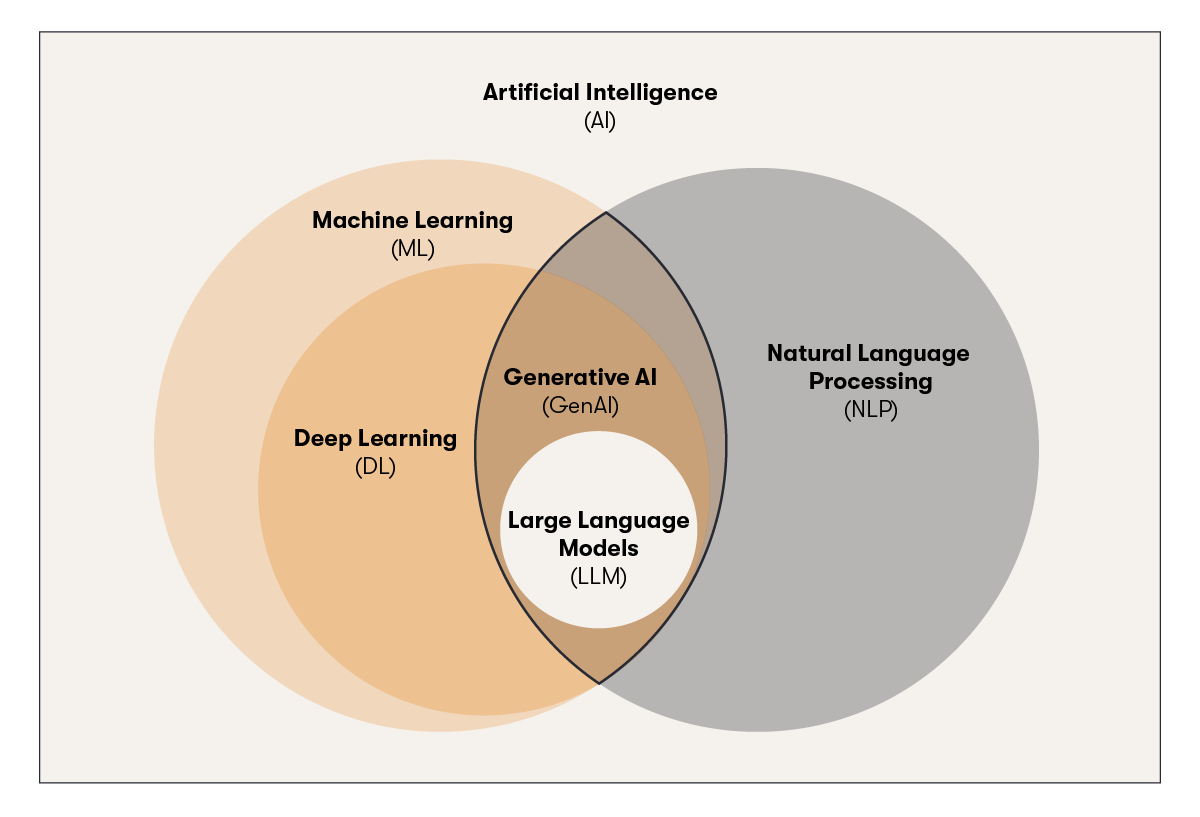
In e-commerce, various sub-areas of AI work together to create the basis for intelligent applications. (Source: Own representation)
Whether for optimizing internal processes or improving the shopping experience, the use of AI in e-commerce offers compelling added value for both sides. The following overview shows the key benefits for retailers and customers.
| For retailers | For customers |
|---|---|
| More efficient processes along the entire value chain, from automated product recommendations to optimized logistics. | AI-based systems tailor not only product recommendations, but also content, navigation, and communication—e.g., in newsletters or on the website—to individual needs. |
| Faster response to market changes through AI-supported analyses and forecasts. | Round-the-clock customer service: AI-powered chatbots offer help with questions, returns, or delivery status at any time. |
| Higher service quality with simultaneously lower process costs through automation. | Visual search, smart navigation, and personalized content make product selection easier and help you find what you're looking for faster. |
| Transparent business management through e-commerce AI tools and real-time data. | AI analyzes demand and market trends to create attractive offers—including personalized discounts and dynamic pricing. |
| Competitive advantages through AI-powered e-commerce solutions and differentiated user experiences. | Automated warehouse processes and accurate demand forecasts reduce delivery times and ensure better shipping quality. |
In addition to all the advantages, you should also keep an eye on the stumbling blocks. Data protection and GDPR are key here: your customers must be able to understand at all times what data you collect and how you use it. Clear consent mechanisms create trust here.
Another issue is bias in training data: if algorithms are based on unbalanced or flawed data sets, they can produce discriminatory results.
Costs also play a major role, especially for smaller shops: The introduction of AI requires investment in tools, data integration, and skilled personnel, or managed services from service providers.
As always, you need a well-thought-out strategy that will enable you to turn these hurdles into real competitive advantages.
AI in e-commerce represents a new level of digital customer experience: AI technologies are changing not only individual processes, but the entire logic of online retail. From the initial product search to advice and recommendations to email communication, intelligent systems accompany users throughout the entire customer journey.
Within the digital customer journey, we distinguish between four phases in which AI use cases are particularly effective in e-commerce:
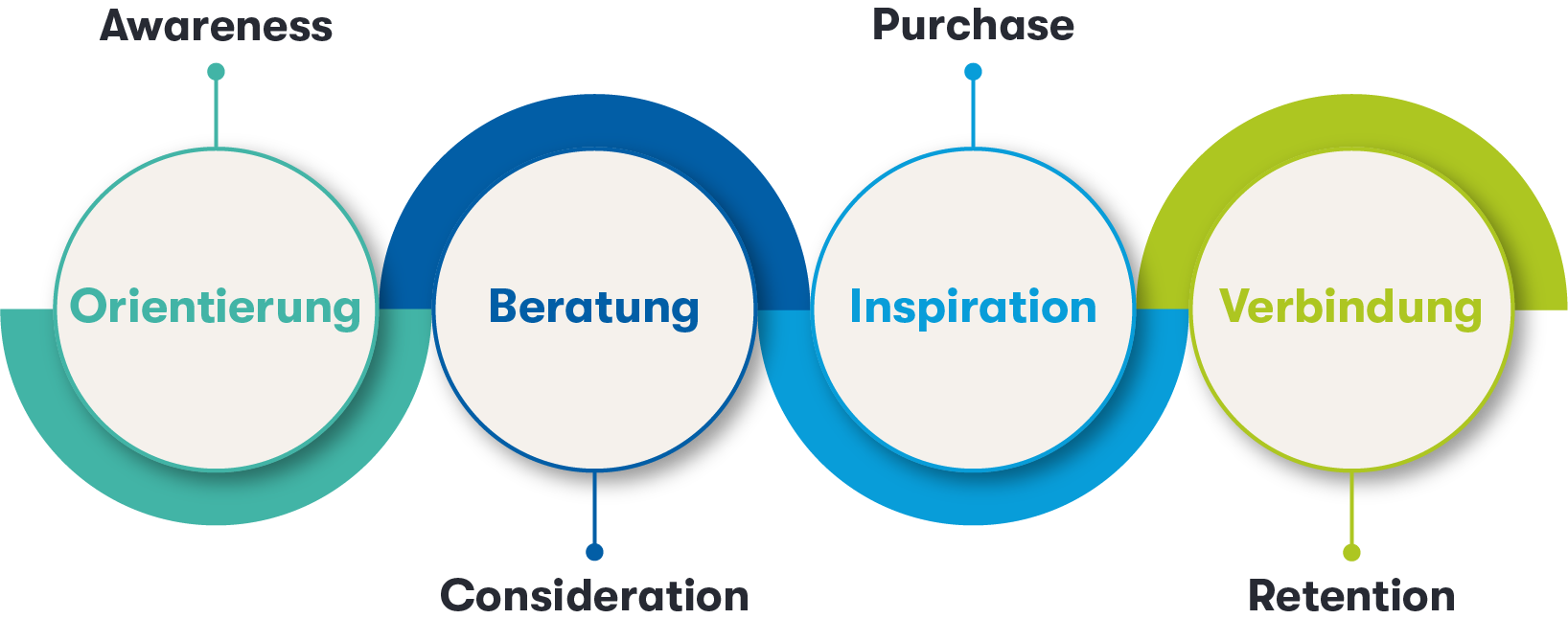
Intelligent systems create added value at every stage of the digital customer journey. (Source: Own representation)
The shopping experience usually begins with the search bar. This is exactly where AI comes in with semantically intelligent product search: even with typos, unclear wording, or colloquial terms, AI recognizes what your users really mean and displays relevant results. This not only improves the user experience but also increases the conversion rate.
Smart search no longer works solely on the basis of search terms, but now understands text semantically. This applies both to the search queries themselves and to the recognition of content on the website. This enables it to present users with the content that best matches their search query. For example, a customer searching for "plain long-sleeved dress" will receive results that exactly match this search query.
Another feature: Visual Search. Users can upload a product photo or screenshot. The AI uses image recognition (object classification) to identify the product being searched for and displays matching offers.
AI-supported personalization can also enable an individualized shopping experience right from the product search stage. Search suggestions in autosuggest and on search results pages can be personalized. By adapting the results to the individual preferences and behavior of visitors, they receive particularly relevant content, such as products from their favorite brand or only items that are available in their size.
In addition, AI systems can display personalized welcome messages based on location, time of day, or user history, making the initial experience even more personalized.
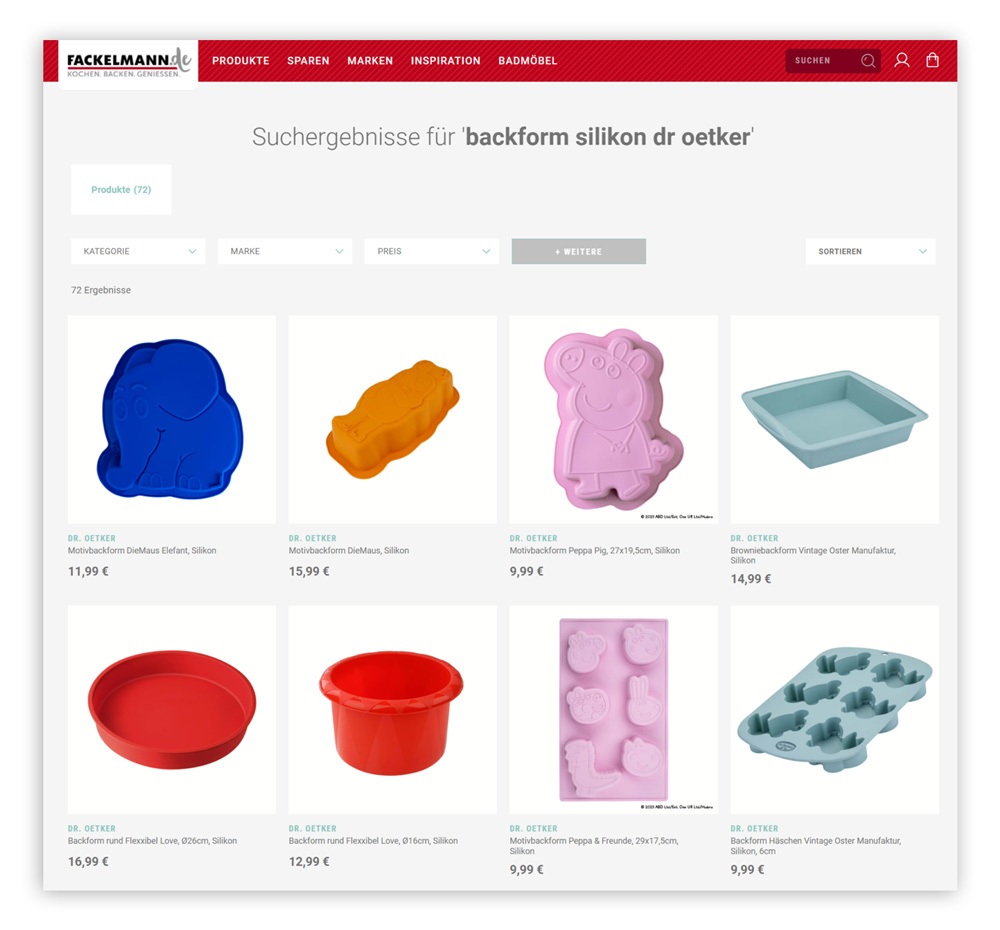
Fackelmann delivers relevant results even for complex search queries with multiple attributes. (Source: Screenshot from fackelmann.de)
In brick-and-mortar retail, there is a specialist available to provide advice on site. In the digital space, this role can be taken on by the AI shopping assistant.
The AI Shopping Assistant processes natural text and voice inputs in chat using a large language model (LLM). This allows it to accurately identify the needs of your online shoppers and suggest suitable products from your range. It combines current product data with the click and purchase behavior of shop visitors. The result: personalized advice that meets today's user needs.
Modern systems also use sentiment analysis to recognize emotions such as uncertainty or frustration and adjust the tone of conversation accordingly. The result: individual, context-aware advice in real time through data analysis.
In addition, AI-based tools enable virtual fittings or digital assistants that interactively illustrate complex product information. This turns consulting into an immersive experience.
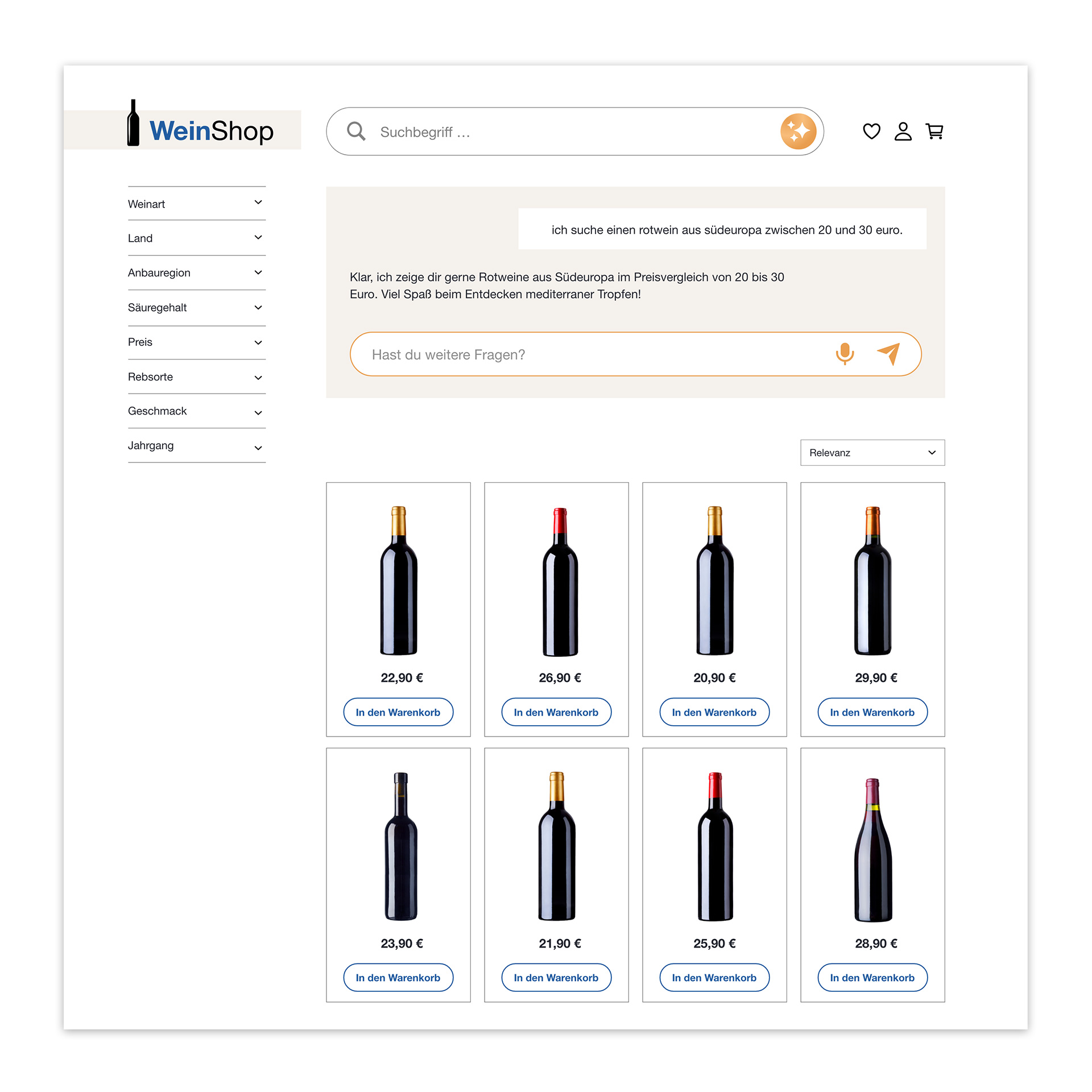
The AI Shopping Assistant offers customers personalized and dialogue-based advice in the online shop. (Source: Own representation)
Throughout the entire shopping process, a recommendation system can help your customers identify suitable products, discover alternatives, or suggest complementary items that meaningfully expand their shopping cart and enrich their shopping experience.
Product recommendations can be used at all relevant touchpoints, from the home page to the shopping cart. Based on real-time data, previous behavior, and similar user profiles, AI recognizes which items are most likely to be purchased. This ensures that customers always receive context-related suggestions.
Reinforcement learning methods enable personalized recommendations to be displayed. The more information available about the customer, the more targeted and individual these recommendations can be tailored to the customer.
This form of recommendation is a central element in every AI e-commerce website concept and contributes significantly to increasing the length of stay and the value of the shopping cart.
AI can also speed up the checkout process by automatically pre-filling forms, suggesting personalized payment options, and reducing barriers in the purchasing process. The user interface can also be adapted to individual user behavior to make the purchase more intuitive and seamless.
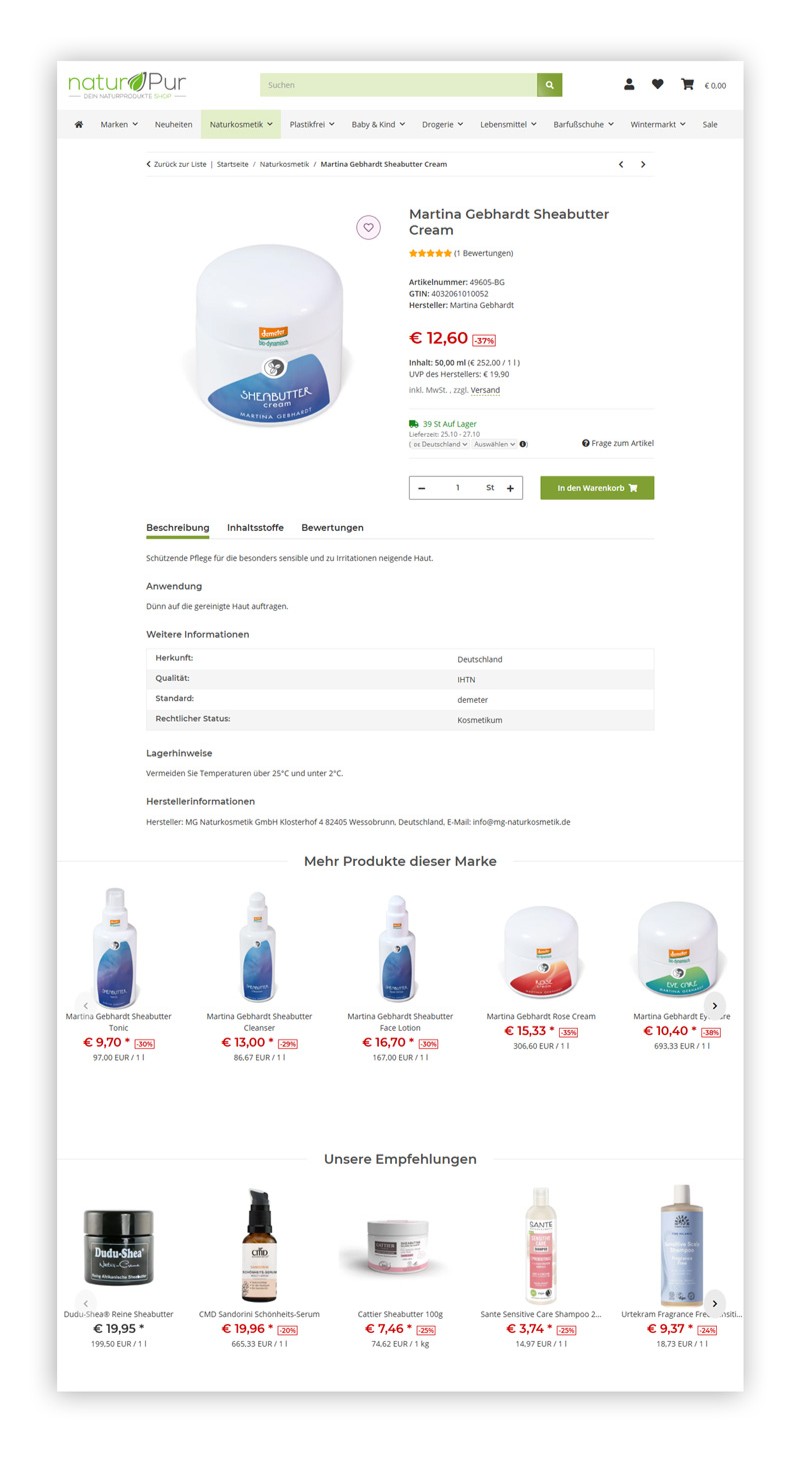
The naturPur online shop recommends other related products on product detail pages.
(Source: Screenshot from shop-naturpur.de)
Even after a visitor leaves your website , AI ensures relevance in e-commerce , for example, in email communications. With email personalization, the content in your newsletters or email campaigns dynamically adapts to the behavior and interests of the recipients.
When the personalized email is opened, product recommendations are generated in real time based on clicks, purchases, or recently viewed products in the online store. In addition to the recommendations, subject lines, content modules, and CTAs can also be customized.
In addition, AI recognizes patterns and forms targeted AI segments, such as "outdoor enthusiasts." These recipients then automatically receive relevant content, tips, and offers. This significantly increases relevance and thus open and click rates.
After the purchase, AI also provides support through loyalty programs tailored to individual interests or through proactive service offerings. These include reminders about follow-up purchases, accessories, or software updates. This keeps the customer relationship alive and relevant.
AI is not only shaping today’s shopping experience, but is also one of the key drivers of future e-commerce development—we’ve summarized the other trends that online retailers should keep an eye on in our article on the future of e-commerce.
There is often more to a successful shopping experience in an online store than meets the eye. Powerful e-commerce AI tools work behind the scenes for your store, automating processes, making predictions, and making online stores more efficient. To make this more tangible, let's look at typical use cases that show how retailers are already benefiting from AI today.
Fewer clicks, fewer errors: AI can take over many manual order processing tasks for you. This has several advantages: Automated capture of address and order data minimizes typos and time spent on data entry. In addition, order processing and warehouse processes are largely automated, and orders automatically trigger follow-up processes such as warehouse checks, invoicing, and shipping. Overall, AI interfaces to fulfillment systems ensure fast shipping.
Use your data to make informed decisions and strategically manage sales. With predictive analytics, AI not only analyzes historical sales figures, but also takes into account seasonality, weather data, and current events. This allows you to identify early on which products will be in demand in which regions and plan proactively rather than reactively.
Example: If the probability of rain increases in a certain area, the demand for rain jackets can be predicted accordingly. Stock levels are managed proactively and campaigns are targeted specifically. The result: better planning, more efficient resource allocation, and greater impact in your sales campaigns.
However, AI can be used not only to analyze sales figures in advance, but also to identify potential risks at an early stage. Predictive models evaluate purchasing behavior and help to avoid overstocking or understocking in the warehouse. Return rates can also be anticipated, for example in the case of fashion items, which experience shows have a high return rate.
AI also offers tangible advantages in category management. Here are the three most important ones summarized:
Based on information such as operating costs, customer surveys, demographics, and psychological data, AI is now able to use machine learning to determine the exact price that will best achieve the company's goals. It analyzes demand, competition, and inventory in real time to automatically adjust prices. This allows retailers to optimize both sales and margins and respond flexibly to market changes.
AI evaluates customer data and purchasing behavior to precisely segment target groups. On this basis, retailers can tailor marketing measures, campaigns, and product offerings specifically to relevant customer segments. In addition, individual 1:1 personalization is also possible, whereby offers and communication are tailored directly to individual customers.
Target and Walmart enable voice-controlled purchases as part of voice commerce, which they then deliver to customers. For customers, this is a convenient service. Online retailers, on the other hand, benefit from the opportunity to minimize technical hurdles and address customers on another channel. This also results in additional cross-selling and upselling opportunities, especially since voice assistants know a lot about their users.
The use of artificial intelligence goes beyond analysis and forecasting and also opens up new possibilities in content creation.
Tools such as ChatGPT can be used to automatically generate product descriptions, category texts, email content, and advertising banners. This not only saves time, but also ensures consistent quality with high scalability. This is a real advantage, especially for large shops with frequently changing product ranges: new content can be provided quickly without losing consistency or tone.
Whether it's Google Ads, social media advertising, or display banners, sometimes advertising doesn't reach potential customers at the right time. With AI , users who are receptive to the offer can be targeted again.
Artificial intelligence detects suspicious orders, unusual payments, or return patterns. This allows fraud to be prevented at an early stage and losses to be minimized.
AI systems such as Fakespot can detect and filter fake reviews. They are primarily used for consumer protection, but can also be used by marketplaces that want to filter out inferior goods from their product range, for example.
Stay up to date on personalization: Sign up for the Epoq newsletter. Register now!
For your customers to truly accept AI-based services, the following three things are essential: explainability, transparency, and security. Make it clear why certain products are recommended and show how you collect and use data. In addition, you should implement strong protective measures against fraud and data misuse. If your customers can trust that their data is secure and will be treated fairly, they will perceive AI-supported shopping experiences as genuine added value – and your store will benefit from this in the long term.
AI in e-commerce is no longer a topic for the future; it is already changing online retail forever. By relying on intelligent systems, you can scale personalized shopping experiences, optimize processes, and better understand and serve your customers across all channels. It is no longer enough to address a single buyer's journey. Instead, it is important to map different user needs in flexible, personalized journeys, from the first touchpoint to after-sales support. AI technologies make this possible: they link data, interpret user behavior, and deliver automated, context-related recommendations in real time. Ultimately, it's about "making customers feel seen and understood."¹
Source: ¹ The Future of Commerce, ² Venturebeat
AI e-commerce describes the use of artificial intelligence in online retail. The aim is to automate processes, create personalized customer experiences, and make data-driven decisions in real time—across all touchpoints.
The most common use cases include intelligent product searches, personalized product recommendations, dialogue-based advice, email personalization, and predictive analytics for warehousing and returns. Content creation using generative AI in e-commerce is now also part of this.
AI tools in e-commerce help reduce manual tasks, minimize sources of error, and respond more quickly to market changes. At the same time, they improve efficiency along the entire value chain.
Customers receive personalized product recommendations, ecommerce search engine results, personalized advice, and relevant content—automatically tailored to their behavior and interests. This ensures greater convenience, faster decisions, and a consistent user experience across all channels.
The effort involved depends on the existing system landscape and the desired use cases. Many AI-powered e-commerce solutions have a modular structure and can be implemented step by step.
Want to delve deeper into the topic of personalization in e-commerce?
Then download our e-book now!

You are currently viewing placeholder content from HubSpot Embedded Content. To access the actual content, click the button below. Please note that doing so will result in data being shared with third-party providers.
More InformationYou are currently viewing placeholder content from HubSpot. To access the actual content, click the button below. Please note that doing so will result in data being shared with third-party providers.
More InformationYou are currently viewing placeholder content from HubSpot Meetings. To access the actual content, click the button below. Please note that doing so will result in data being shared with third-party providers.
More Information