
Success factor product data: How inadequate product data affects the performance of online shops
The product data of an online shop is the foundation for selling products. You can find out what sources of error you need to watch out for on page 62.

How can time-to-market and conversion rates be optimized, and how can abandoned purchases in online shops be prevented? And what does all this have to do with a PIM system as a strategy? Can online orders be implemented more sustainably and returns avoided? If companies can no longer make sense of their product ranges, how are end customers supposed to do so? The answers to these challenges are defined in a strategy for the use of Product Information Management (PIM for short). You can find out everything you need to know about this topic in this guest article.

Here's what you can expect to find in this blog article:
Challenge: Product data management without a PIM strategy
Master data in the merchandise management system
Special data for online marketplaces
Digital assets beyond product data
Solution: PIM system with strategy
More streamlined processes
Shortened time-to-market
Monitoring of data quality
Digital asset management
PIM strategy as the basis for high-quality product content
Granular data maintenance
Win-win for shop operators and customers
When it comes to product data management, many companies face the same everyday challenges. Important information about the same product is often scattered across different systems, or data is maintained redundantly on different platforms. This results in lengthy processes and data silos. For new target channels, relevant information must therefore be compiled from multiple systems.
The initial creation of a new product usually takes place in a company's merchandise management system, where pricing and master data maintenance are also carried out. This data is visually prepared in catalog templates and enriched with appropriate short texts, which are used for the print layouts. As part of a rapid digitization strategy, these texts often end up in "newer" channels, such as an online shop or a content management system. Optimizing these texts for search engines usually falls by the wayside.
If additional online marketplaces are to be supplied with polished product data, there are usually no clearly defined processes, including quality control, in place for transferring the data to the appropriate templates. If marketplaces also require special data that may not even be recorded in the merchandise management system (e.g., a separate packaging weight), then values for this purpose must be requested from the production department or the manufacturer.
In addition to all product features, digital assets such as assembly instructions, quality seals, product images and videos, etc. are also part of products. In practice, however, these are rarely located in the same place as the product features. Instead, they are usually found on internal company network drives or other storage media, meaning that they can only be clearly identified by their file names. In painstaking detail, customer managers must even preprocess them (rename files, crop images, etc.) before they can transfer them to the other party via file sharing tools.
Stay up to date on personalization: Sign up for the Epoq newsletter. Register now!
Each of these difficulties calls for a universal solution, centralization, and consistency. Good news for all companies whose staff are confronted with such problems in their daily work: a PIM system does exactly that. As the linchpin for product data, such a system integrates itself into complex system landscapes, right at the center. This is where information from suppliers in merchandise management and production can be aggregated and enriched before being sent to various target channels.
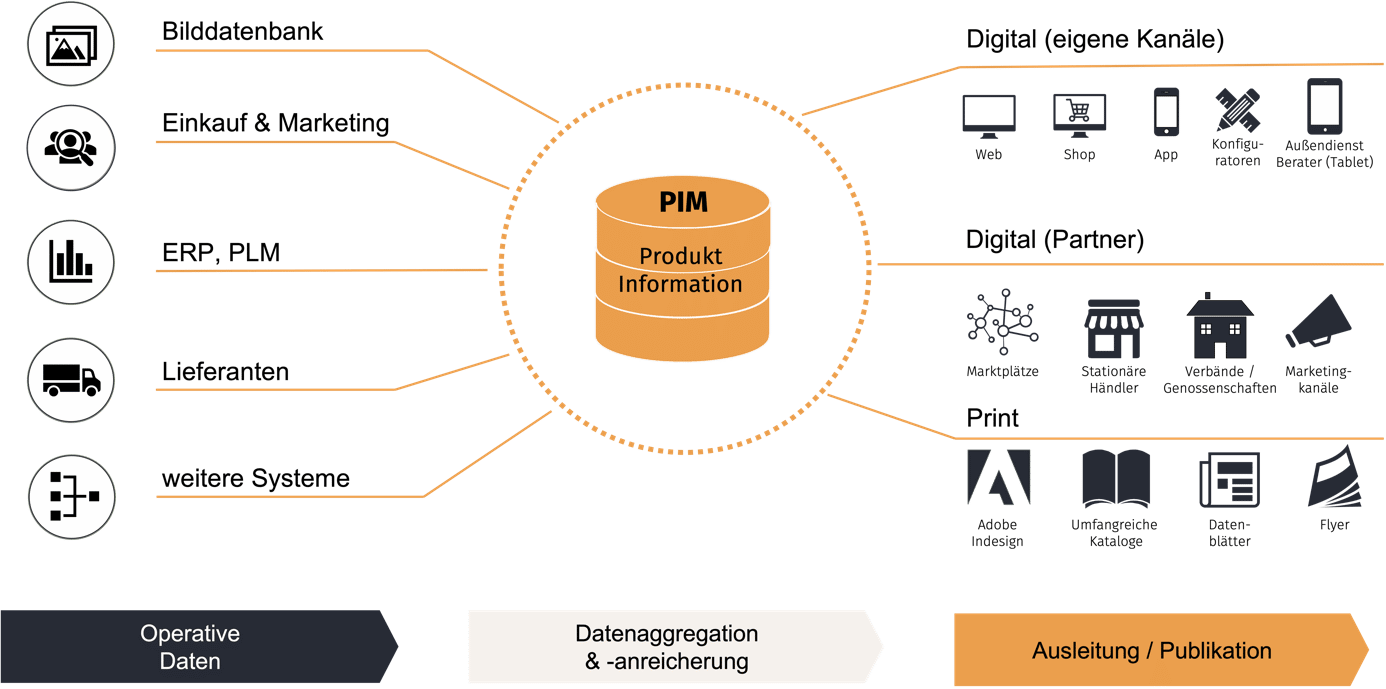
The PIM system as the hub for product data (source: hmmh¹)
However, it would be short-sighted to say that buying a PIM system for your company will solve all your problems. PIM is more than just a system. PIM is a strategy.
When selecting a suitable system, the rule "the more expensive, the better" does not apply. Instead, in addition to the exact requirements for the system, you must above all define responsibilities for product data from different sources (e.g., master data, marketing texts, image referencing, etc.).
You must also adjust the following processes:
Once these new paths have been taken, the use of a PIM strategy quickly reveals profitable advantages.
With the introduction of PIM, workflows involving product data are also optimized outside the new system and mapped or supported by workflows when working in the system. This not only saves you valuable time, but also makes onboarding easier for new content managers.
The newly created central database means that all relevant product information is stored in one place. To connect a new target channel, such as an online marketplace, all you need to do is map the relevant fields from the system so that the flow of information can then be automated. This means you no longer have to compile product data manually, resulting in sales that are up to 80% faster.
A good PIM system offers various options for monitoring data quality. The overview can be displayed visually in the system in dashboards or sent to responsible parties via email notification. Inconsistent and incorrect publications are avoided by defining mandatory quality rules.
The search on drive T:\ for the right images and documents in the correct formats has finally come to an end. Once you have saved references to files in the product data record and stored the relevant information in the file properties, the file name is no longer important. Files can be made available on demand in any format, and it is no longer necessary to store them redundantly on network drives in the company.
The introduction of a PIM strategy therefore lays the foundation for providing your end customers with high-quality product content. But how should data be maintained for this purpose? After all, insufficient product information is one of the most common reasons for abandoned online purchases. Preparing product details helps to increase the conversion rate. Thanks to comprehensive information, end customers are less likely to opt for a different product or a more interesting online store.
Our expert recommendation is therefore: the more granular the data, the easier it is to process. For example, fields containing measurements can be converted into other units of measurement more easily if the numbers are not stored with a measurement abbreviation in the same field.
When using tools for automated text generation (natural language generation), greater variety is also beneficial if these tools are fed with individual characteristics such as color and material rather than half-sentences. If product detail pages are rich in variety, this also has a positive effect on search engine visibility.
Stay up to date on personalization: Sign up for the Epoq newsletter. Register now!
In addition, size guides, color filters, and product comparisons are easier to implement in online shops or online marketplaces. This allows end customers to search specifically for products that meet their needs (e.g., comprehensive information instead of just size specifications from XS to 3XL). You can avoid multiple orders of the same item due to uncertainty about product features and the associated returns thanks to informative product detail pages, making your business a little more sustainable.
PIM is not just a system. It is much more a strategy for managing product data centrally and consistently. The use of a PIM strategy provides profitable advantages and creates the basis for high-quality product content. By maintaining your data in a fine-grained manner, you create a win-win situation for yourself and your customers. Thanks to a successful PIM strategy, nothing stands in the way of efficient product data management.
Source: ¹ hmmh
Would you like to learn more about product data as a success factor?
Check out our publication on the topic!

You are currently viewing placeholder content from HubSpot Embedded Content. To access the actual content, click the button below. Please note that doing so will result in data being shared with third-party providers.
More InformationYou are currently viewing placeholder content from HubSpot. To access the actual content, click the button below. Please note that doing so will result in data being shared with third-party providers.
More InformationYou are currently viewing placeholder content from HubSpot Meetings. To access the actual content, click the button below. Please note that doing so will result in data being shared with third-party providers.
More Information