
5.04% increase in sales per session thanks to new personalization strategy at Outletcity Metzingen
Outletcity Metzingen puts its personalization strategy to the test and increases revenue per session by 5.04%.

One-to-one marketing enables shop customers to find their own individual, personalized shop. Special software can be used to create a personalized customer experience throughout the entire customer journey, which can lead to an increase in the conversion rate. Creating an appealing customer experience, for example by making customers feel well advised or enabling them to quickly find exactly what they are looking for via an intelligent and personalized search, should be in the interest of every shop operator. We will now reveal how this can be implemented and how important customization is for the personalized customer experience.

Here's what you can expect to find in this blog article:
Definition of one-to-one marketing
Two types of one-to-one marketing
Personalization as an important element of one-to-one marketing
Technical background
Examples of one-to-one marketing along the customer journey
Search function as a personalized guide
Advice like in brick-and-mortar retail
Recommendations for individual purchasing impulses
Emails as reminders
Customization as a prerequisite for successful one-to-one marketing
Include time span for repeat purchases
Consider the specific characteristics of the industry and product range
Align strategy with the respective customer journey phase
Conclusion: Tailored personalization for successful one-to-one marketing
Compared to mass marketing, one-to-one marketing focuses on an individualized customer approach that generates the greatest possible customer interest. The term was first coined by Don Peppers and Martha Rogers, who published the book "The One to One Future" in 1993.¹ By receiving suitable offers—i.e., relevant, interesting, useful, and entertaining ones—customers can be addressed in a personalized and thus targeted manner. Artificial intelligence (machine learning) processes are what make one-to-one marketing possible in the first place.
Stay up to date on personalization: Sign up for the Epoq newsletter. Register now!
One-to-one marketing refers to a marketing measure that is individually tailored to each customer using data science methods. In e-commerce, one-to-one marketing means personalizing the online shop as comprehensively as possible for each customer.
The openPR wiki distinguishes between two main types of one-to-one marketing: adaptive marketing and personalized marketing.
Customization marketing encompasses measures that enable customers to customize products or similar items according to their own preferences. In this case, the shop operator offers its customers the opportunity to tailor a product to their specific tastes. The openPR Wiki cites the computer company Dell as an example of this, which meets specific customer requirements by offering customers the opportunity to customize the computers they purchase.²
Personalized marketing, on the other hand, involves personalization measures based on information about a customer or their behavior. In this case, the seller or shop operator finds out what the customer's tastes and personal preferences are and tailors their content (product suggestions, etc.) individually to each individual.
In the following, we primarily understand one-to-one marketing to mean personalized marketing.
One-to-one marketing is therefore about using personalization to display individual content to customers. But what exactly does the term personalization mean?
The Gabler Business Dictionary describes it as the adaptation of website content to the respective user (based on information collected about user behavior).³ Personalization therefore involves recording the visitor's previous behavior in order to display exactly the content they want at the right time. This allows online shoppers to be picked up at the stage of the digital customer journey they are currently at. Shop operators can thus use personalization to create a shopping experience for their online shoppers.
It is important that personalization is carried out in real time, so that content is only generated when the visitor requests it, e.g., by opening an email or clicking in the online shop. This allows current behavior and all up-to-date information (such as item availability) to be included in the calculation.
But how does it all work? By using software services that record online shoppers' clicks and purchases with the help of self-learning algorithms and deliver personalized content—automatically and in real time. This reduces manual effort. To do this, the integrated algorithms use the concept of reinforcement learning, which originates from machine learning and enables self-learning optimization. This is based on a knowledge base that is generated individually for each online shop. This enables the algorithms to provide 1:1 communication at the various touchpoints in the online shop. In a sense, every online shopper finds their own individual shop. They are shown exactly the products and content that match their own preferences. This is achieved by making predictions about future interests based on a customer's past clicks and purchases.
Would you like to learn more about the knowledge base? Then we recommend watching our webinar recording on this topic.
The customer journey in an online shop should offer a similar level of convenience and service to shopping in a brick-and-mortar store. Customers who find their way around easily and feel well advised stay on the site longer, are less likely to bounce, and are more likely to purchase a product.
Various software tools enable automated one-to-one marketing throughout the entire customer journey. The following touchpoints of an online shop can be personalized and thus used for one-to-one marketing:
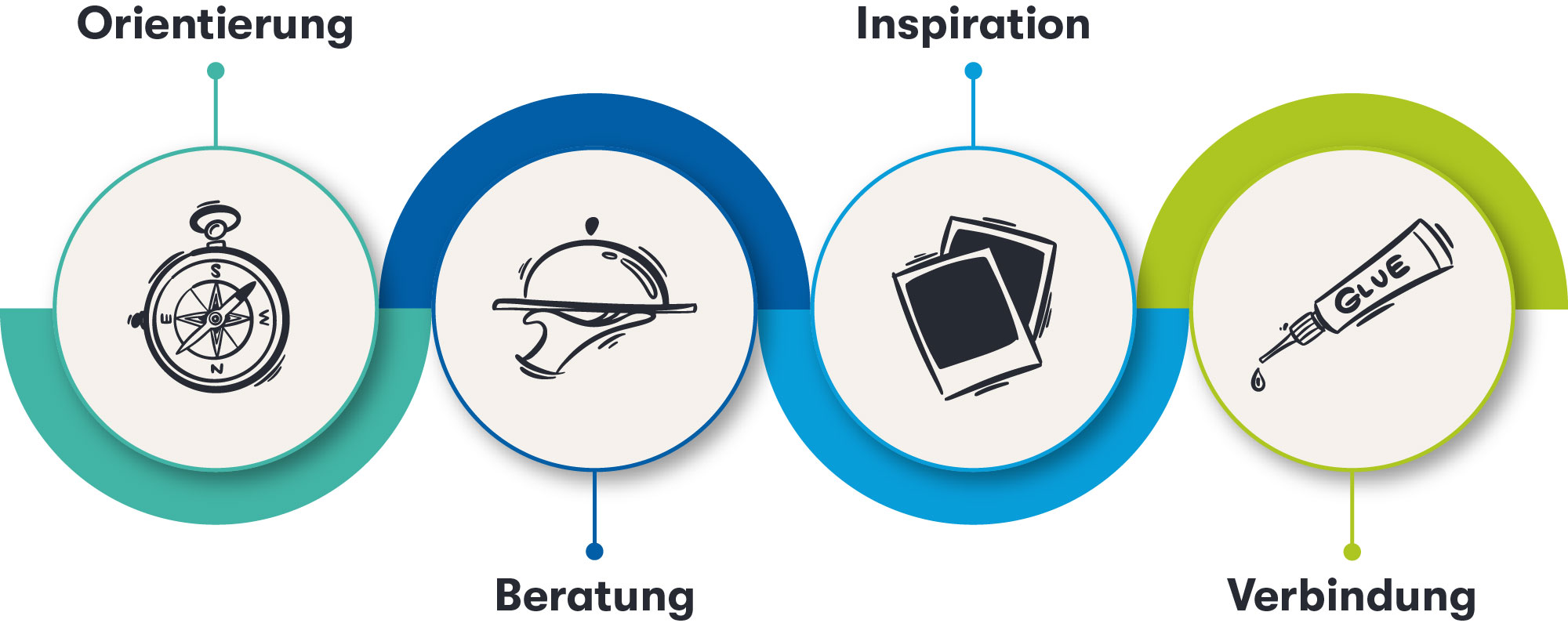
Customer journey in e-commerce
According to the E-Commerce Guide, 80 percent of online shoppers use search almost exclusively to find the product they want.⁴ This clearly demonstrates not only the relevance of suitable search functions, but also the need for a shopping experience that is as convenient and guided as possible.
A user-friendly onsite search function provides guidance and helps shop customers find the product they want quickly and easily without leaving the site. To do this, the search function should be error-tolerant, support the entry of search term combinations or item numbers, and take language usage into account. A type-ahead function also makes it easier for shop customers to find suitable products.
In the context of one-to-one marketing, search suggestions in Autosuggest and on search results pages can be personalized. This means that the results are tailored to the visitor's behavior and take their individual preferences into account. Standard product searches, which are not customizable, cannot implement these individual circumstances and, compared to an ecommerce search engine, do not deliver one-to-one marketing.
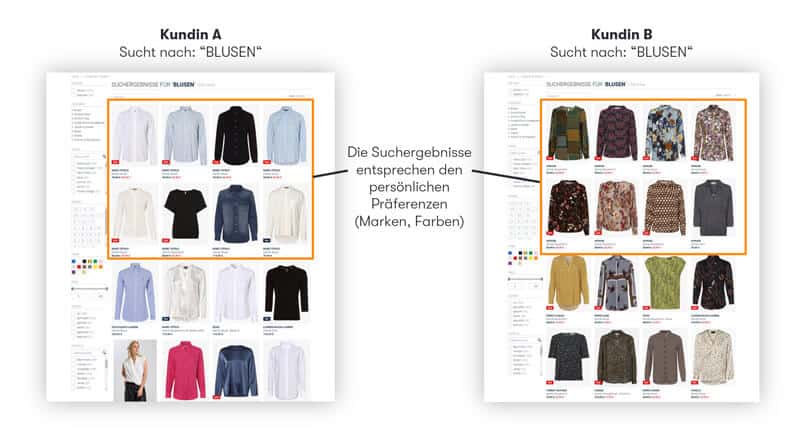
Personalized search results for two customers
Not every shopper knows exactly what they want from the outset—some are unsure, while others want to explore different options. This is where the AI Shopping Assistant takes on the role of a personal advisor and guides the user through the selection process.
The dialogue-based product advisor analyzes visitor input and behavior in real time, identifies their needs, and filters out suitable products from the range. It processes natural text and voice input in the chat, accurately captures customer needs, and quickly and reliably guides each user to the right product. This conveys a positive feeling of "being well advised" and at the same time reduces the return rate.
The advice is tailored to the individual store and product range. Questions, filters, and recommendations adapt dynamically to the product selection as well as to the behavior and preferences of the users. This creates an advisory experience that is comparable to the personal service offered in brick-and-mortar stores.
As part of one-to-one marketing , the AI Shopping Assistant enables personalized product advice tailored to each individual customer, creating a customized, positive shopping experience.
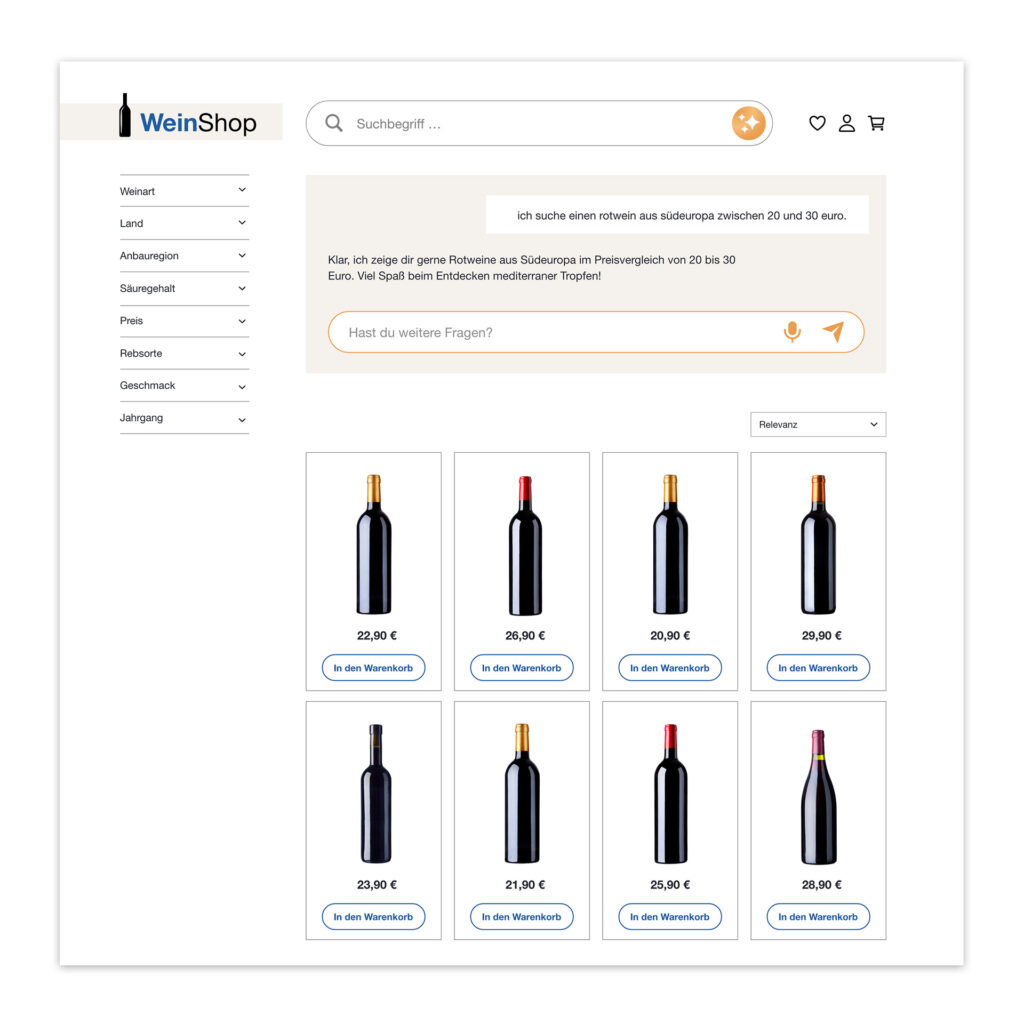
AI shopping assistant in an example online wine shop (source: own illustration)
If the visitor is already in the purchase decision phase, a recommendation system provides inspiration to stimulate impulse purchases for other products in the range. A recommendation system can inspire the buyer with suggested additional products directly when they click on the shopping cart button, put together and recommend product sets, identify thematically matching products, and suggest bundle purchases or complete packages, thereby increasing the shopping cart value.
The impulse to buy is created by displaying recommendations that match previous behavior according to specific strategies. It is important that the strategy of the individual recommendation widgets (interactive elements in the online shop that contain recommendations) is personalized for the shop. To implement this, individual rules and filter settings are required, for example. An online shop may have a rule that only recommends items from the same or a similar brand for certain brands. However, if an online shop only offers one brand, this rule is meaningless. Customized recommendation systems can also integrate additional data sources, such as loyalty programs or CRM systems, to further optimize personalization. Personalization software that works exclusively with standard rules cannot therefore reflect the individual needs and circumstances of each individual customer and thus does not deliver one-to-one marketing.
One-to-one communication also arises when shop customers are only recommended products that are actually of interest to them. In addition to personal preferences (such as brands, colors, styles, patterns, etc.), availability should also be taken into account.
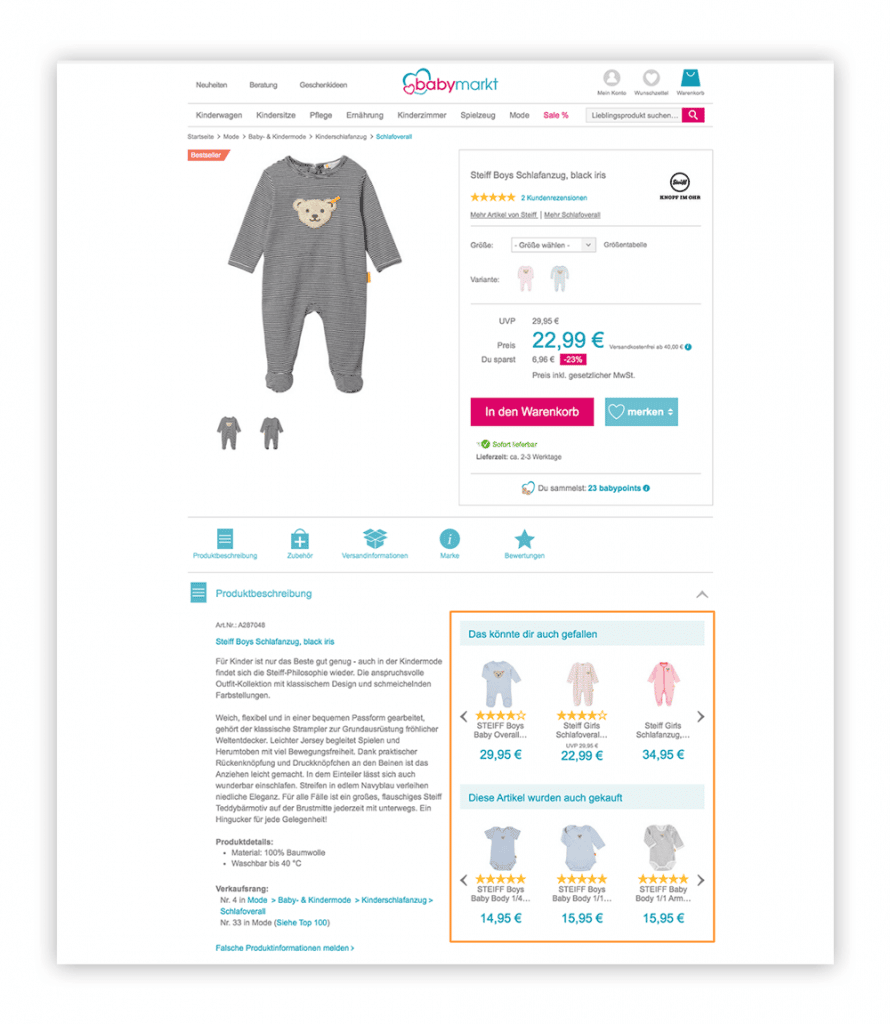
Personalized product recommendations in the babymarkt.de online shop as an example (source: screenshot from babymarkt.de)
By combining relevant recommendations with newsletters, one-to-one marketing can be implemented through email personalization, which drives traffic to the online store. This allows online shoppers to be reached on additional channels outside the online store. Email personalization delivers personalized purchase prompts via email, thereby guiding the recipient back to the online store.
Customers receive products specially selected for them and are informed about current trends and news. In addition, customers who have been inactive for a long time can be encouraged to return to the shop via a "We miss you" email. The content is tailored to the individual customer, enabling one-to-one marketing at this touchpoint.
Stay up to date on personalization: Sign up for the Epoq newsletter. Register now!
In addition, emails can be sent on specific occasions, such as the customer's birthday. A child's life cycle can also be incorporated to offer clothing items that are appropriate for their age and size. For industries where prices change quickly, such as airlines or booking portals, prices can also be dynamically displayed in the email when it is opened. You can find more information on this in the blog article Dynamic Pricing: Curse or Blessing for E-Commerce.
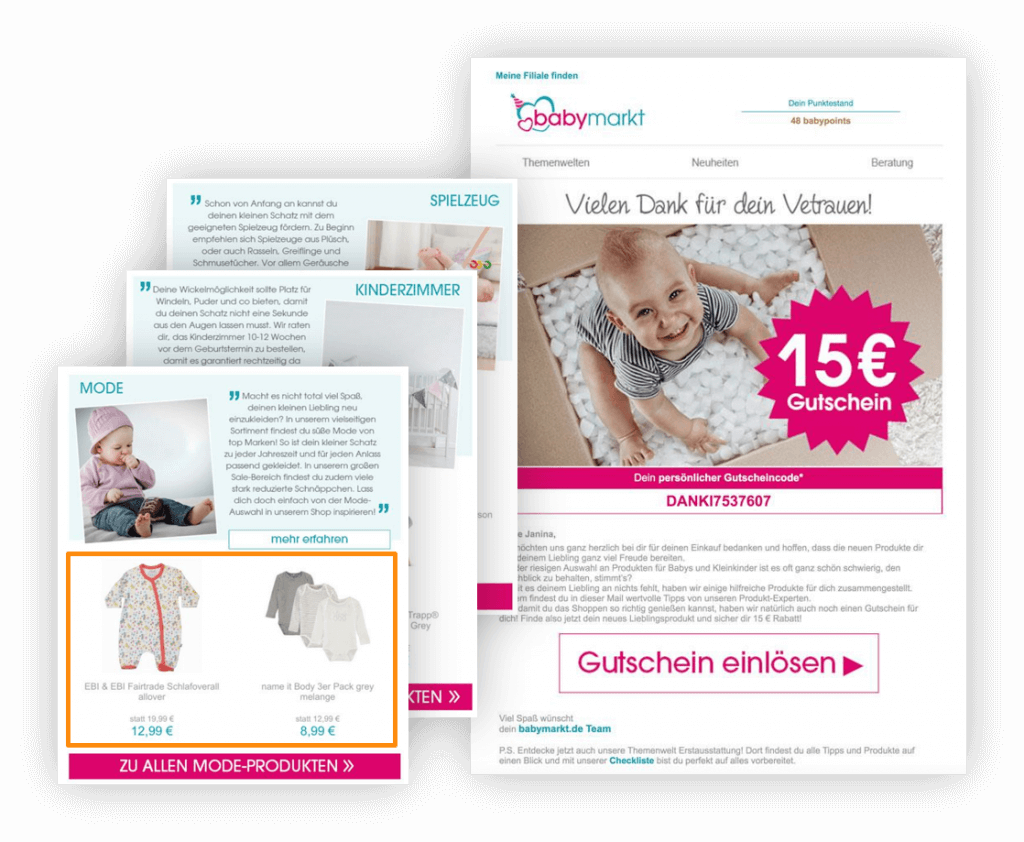
Example of a newsletter from babymarkt.de with personalized recommendations for various categories (source: screenshot from newsletter from babymarkt.de)
All of these are measures for personally addressing customers through one-to-one marketing, based on the clicks and purchases of online shoppers. Overall, both the customer, who feels well taken care of in the personalized shopping experience through 1:1 communication and finds exactly what they are looking for, and the shop operator, who can achieve a significant increase in the conversion rate, benefit from the unique customer experience throughout the entire customer journey and automated one-to-one marketing.
Looking at examples of one-to-one marketing in e-commerce, it quickly becomes clear that this can only work if personalization is tailored to the individual online store. This is because online stores all differ from one another, for example in their product ranges and marketing strategies.
This means that special rules and adjustments are needed to ensure that personalization and one-to-one marketing lead to a positive shopping experience and do not come to nothing. Because not all personalization is the same.
The strategy that makes sense for each online shop depends on various factors. You should therefore consider, among other things, the...
The likelihood of repeat purchases or the time span until the same or similar products are purchased again plays a central role. It can vary greatly depending on the industry or product range. Here are a few examples:
Every industry and its products have their own challenges when it comes to sales and personalization. Depending on the industry, there are specific characteristics that should be taken into account for personalized communication. Here are a few examples:
The customer journey phase and the touchpoints at which one-to-one marketing is used are also of great importance for the strategy.
As already described, an ecommerce search engine function is helpful in the product research phase, for example. This is useful for every shop, as it provides orientation and guides customers quickly and easily to the desired product. During the product selection phase, however, good advice is crucial. Depending on the type of product (products that require explanation, such as suitcases, running shoes, or bathtubs, vs. self-explanatory products, such as clothing, books, or furniture), different strategies can be pursued.
In the purchase readiness phase, you can provide inspiration by using recommendations on various shop pages. Here, too, very different strategies can be applied. While it makes sense to display alternative products on product detail pages to help customers choose the right product, you should definitely refrain from offering alternatives in the shopping cart so as not to unsettle shop customers in their choice at this point. Here, additional items that can fill the shopping cart are suitable. But there are also differences in the recommendation strategy. For example, you can simply display cross-sell items in the shopping cart of a fashion store. Alternatively, however, it would be better to select cross-sell items from specific categories that go well with the outfit, taking into account the visitor's clothing size. A sales assistant in a brick-and-mortar store would not recommend an item that is no longer available in the right size.
Good personalization therefore requires customizable software that can be adapted to the various conditions of the online store. This is the only way to achieve successful one-to-one marketing for every store.
Personalization is essential for successfully implementing one-to-one marketing in e-commerce. However, effective personalization is rarely achievable off-the-shelf. Therefore, it is essential to tailor personalization to the online store, its product range, and its strategy in order to create a seamless shopping experience throughout the customer journey. You can utilize the various touchpoints for your one-to-one marketing by implementing appropriate personalization measures. It is important to note that the content displayed must be individually tailored to each customer and thus personalized. In addition, the customization of personalization must not be neglected. If customization does not take place, the wishes and needs of visitors are not fully taken into account and one-to-one marketing is not achieved. Customized personalization, on the other hand, leads to 1:1 communication, which provides great added value for both the customer and the shop operator.
Sources: ¹ betriebswirtschaft-lernen.net, ² openPR, ³ Gabler Business Dictionary, ⁴ E-Commerce Guide (2015)
One-to-one marketing refers to a marketing strategy in which measures are individually tailored to individual customers using data science methods. The aim is to generate maximum customer interest through personalized and relevant content.
The two types of one-to-one marketing are customization marketing, where customers can customize products themselves, and personalized marketing, where online retailers tailor offers based on customer information and behavior.
Using self-learning algorithms from the field of reinforcement learning, software services analyze users' clicking and purchasing behavior and deliver personalized content in real time. This creates a kind of individual online store for each customer, in which products and content are tailored precisely to their preferences—without any manual effort.
One-to-one marketing can be used throughout the entire customer journey: in personalized search functions, product advisors, product recommendations, and individual emails. Special software tools ensure automated and relevant communication at each of these touchpoints.
Since online shops differ in terms of product range, target groups, and marketing strategies, personalization must also be tailored to each individual case. Only through individual rules and adjustments, taking into account factors such as repurchase cycles, industry-specific characteristics, and the respective customer journey phase, can one-to-one marketing create a relevant and compelling shopping experience.
Would you like to delve deeper into the topic of personalization?
Then we recommend the OUTLETCITY METZINGEN case study!

You are currently viewing placeholder content from HubSpot Embedded Content. To access the actual content, click the button below. Please note that doing so will result in data being shared with third-party providers.
More InformationYou are currently viewing placeholder content from HubSpot. To access the actual content, click the button below. Please note that doing so will result in data being shared with third-party providers.
More InformationYou are currently viewing placeholder content from HubSpot Meetings. To access the actual content, click the button below. Please note that doing so will result in data being shared with third-party providers.
More Information