
E-book – Personalization in E-commerce
In this e-book, you will learn why personalization is important in e-commerce and what the term personalization actually means.

The use of sales channels has undergone an exciting development in recent years: for a long time, multichannel commerce was considered the ultimate goal for successful brands. Today, however, retailers should focus primarily on an omnichannel strategy. Why? We explain this in this blog article.

Here's what you can expect to find in this blog article:
Omnichannel commerce explained briefly
Why omnichannel commerce is more than just a buzzword
Personalization via omnichannel commerce
Touchpoint 1: Mobile
Touchpoint 2: Display ad
Touchpoint 3: App
Touchpoint 4: Email
Touchpoint 5: Store
Touchpoint 6: App
In multichannel commerce, as well as in omnichannel commerce, companies use different sales channels. The key difference between the two approaches lies elsewhere: in the interaction between the sales channels used. A multichannel strategy also involves multiple channels, but these are treated separately from one another. Omnichannel commerce, on the other hand, is based on synergies between the individual sales channels. The aim is to create a consistent and, above all, seamless shopping experience for the customer across all online and offline channels, i.e., along all conceivable touchpoints of the customer journey.
Stay up to date on personalization: Sign up for the Epoq newsletter. Register now!
Customers no longer come into contact with just one sales channel during their customer journey, as a recent study from 2017 shows. 46,000 customers were asked which channels they had used when shopping in the past 14 months. Seventy-three percent said they used several different online and offline channels. This also illustrates the increasing convergence of online and offline. By comparison, only 20% of respondents were purely offline shoppers, while 7% shopped exclusively online.¹
It is therefore not surprising that companies that already implement an omnichannel strategy enjoy greater customer satisfaction and increased customer loyalty. But the higher sales figures of active retailers also speak in favor of omnichannel commerce. According to the study, the value of a customer increases with each additional channel. The above-mentioned study found that customers who used more than four different channels spent 9% more money than customers who only used one channel.¹
Today, customers have countless touchpoints with retailers across numerous sales channels. In the context of omnichannel commerce, it is important to connect and design these channels in such a way that customers enjoy a consistent and seamless shopping experience—from searching for information to making a transaction to after-sales service!
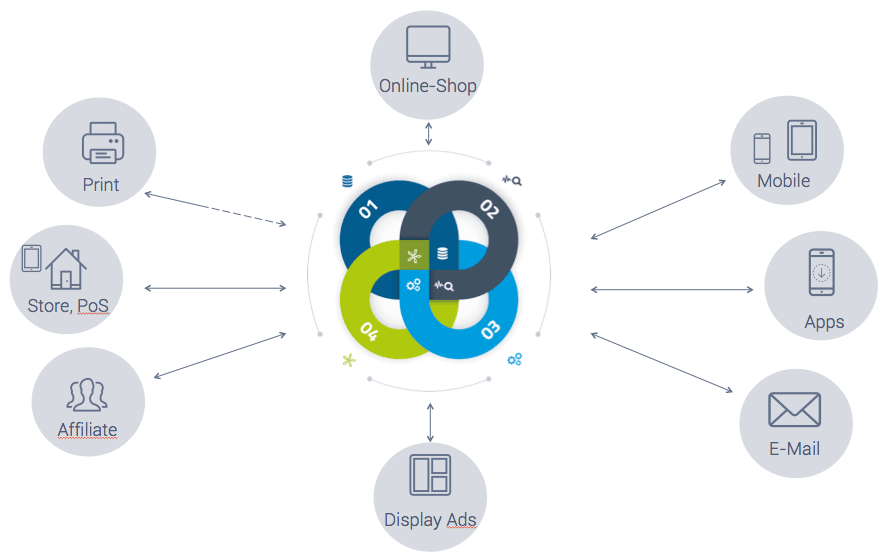
Potential sales channels in omnichannel commerce
The possible combinations of individual sales channels are virtually endless. For this reason, we have prepared an example approach below to show you what omnichannel commerce can look like in practice.
In our example, we start with Max, who wants to buy a new wristwatch. Whether he orders it online or buys it in a brick-and-mortar store is irrelevant to him at first.
After a long day, Max is lying on the couch with his tablet in the evening. He uses this time to search online for a suitable watch. He quickly comes across the online store Armbanduhr24(fictitious online store), where he uses semantic search to look for watches from his favorite brand and views some of the search results out of interest. Since he quickly likes what he sees, Max decides to download the app version of the online shop. However, before taking a closer look at the app, he decides to go to bed and continue his research at another time.
On his way home from the office the next day, Max absentmindedly scrolls through various social networks on his smartphone. There he notices an advertisement from Armbanduhr24 featuring one of the watches he looked at yesterday. Because he was particularly interested in the advertised model the previous evening, he clicks on the display ad...
...and is redirected to the corresponding product detail page in the app. Upon closer inspection, Max discovers additional features that appeal to him, so after a moment's consideration, he adds the watch to his shopping cart and begins the checkout process. During the ordering process, he sees that it is also possible to have the goods sent to a partner store near him (delivery time: two business days) and decides to choose this option.
After making his purchase, Max receives an order confirmation email containing all the relevant information. The personalized email also recommends matching wristbands for his new watch (cross-selling). Since the watch is ready for pickup a day earlier than expected, Armbanduhr24 immediately sends Max an email informing him of the change in pickup date.
Stay up to date on personalization: Sign up for the Epoq newsletter. Register now!
On the same day, he goes to the neighboringArmbanduhr24 partner store to pick up his watch. The salesperson there informs him that he is welcome to use the service in this store for repairs, battery replacements, or other conveniences, which Max particularly likes because of its proximity to his home.
About a week later, he receives apush notification from the app asking him if he would like to rate the watch he ordered. Since Max is completely satisfied with the model, he clicks on the notification to open the app and leaves a positive review.
Our example shows that the possibilities in omnichannel commerce are virtually limitless! The important thing is to engage with customers at every conceivable touchpoint—regardless of when they use the individual channels during their customer journey. If you succeed in doing this, you will not only benefit from happier and more loyal customers, but you can also look forward to higher sales.
Source: ¹ Harvard Business Review
Learn how to use personalization profitably in e-commerce:
View the e-book now!

You are currently viewing placeholder content from HubSpot Embedded Content. To access the actual content, click the button below. Please note that doing so will result in data being shared with third-party providers.
More InformationYou are currently viewing placeholder content from HubSpot. To access the actual content, click the button below. Please note that doing so will result in data being shared with third-party providers.
More InformationYou are currently viewing placeholder content from HubSpot Meetings. To access the actual content, click the button below. Please note that doing so will result in data being shared with third-party providers.
More Information