
4.23% higher click-through rate on product overview pages thanks to self-learning ranking at A-Z Gartenhaus
A-Z Gartenhaus increased the click-through rate on product overview pages by more than 4% using a self-learning ranking system.

Have you ever been in a store without signage? It's a rather strange idea, isn't it? Product categories form the backbone of every online store. Our definition: Product categories are like a road map that directs traffic. The easier the signage is to understand, the faster customers reach their destination—the product they need. Customers need guidance when shopping. For a first-class shopping experience, they expect products to be correctly categorized and grouped together so they can be found easily, whether they are looking for breakfast cereals, kitchen utensils, or winter coats. The same applies to e-commerce. In this article, you will learn how product categories improve the user experience, optimize your marketing investment, and contribute to your business goals.
Here's what you can expect to find in this blog article:
How can products be categorized for your marketing?
What product categories are there?
How can product categories be analyzed and utilized?
How are product categories created for marketing?
Step 1: Identify the purpose of the product detail pages and product category pages
Step 2: Design your product categories with customers in mind
Step 3: Use options to narrow down the selection
What else can product categories be used for in marketing?
Conclusion: Well-thought-out product categories are an indispensable part of e-commerce marketing.
Frequently Asked Questions About Product Categories in Marketing
Similar products with similar characteristics form a product category. The characteristics used to group the items in your range—i.e., the product categories you define for your online shop—should already be taken into account in your marketing strategy, but should also be continuously iterated.
Take H&M's online store, for example:
In addition to the typical "shop by product, " visitors can also search "by occasion" or browse categories such as "Higg Index" (sustainability), "Stylish relaxation" (perfect for wintertime), or "Seamless sportswear" (a current trend among women). These are categories that correspond to the current interests of the target group. In this way, H&M bundles its products in ever-changing contexts to show buyers new ways to use them.
In the Fackelmann online shop, customers can also find product categories for specific contexts, such as various "baking occasions."
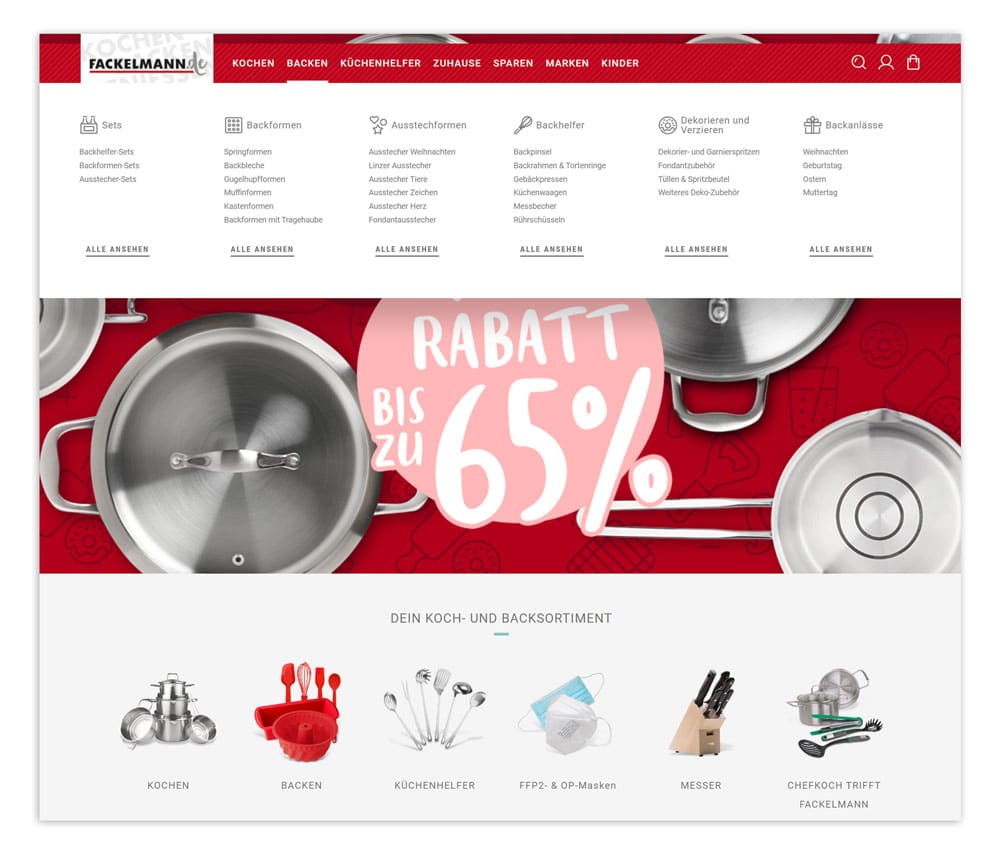
In addition to classic product categories, Fackelmann's online shop also features contextualized product categories, such as "Baking occasions." (Source: Screenshot from fackelmann.de)
However, products can also be categorized according to frequency of use. A product such as mayonnaise, which tends to be purchased less frequently, is therefore sorted into the "pantry" category by the mobile delivery service Gorillaz, where it sits next to the jar of Nutella, which would have been on a completely different shelf in a physical store.
By categorizing their product range in a user-centric way, e-commerce operators can increase their conversion rates and reduce bounce rates. However, this also means that a product categorization strategy must be constantly reviewed.
What product categories have you defined, and how do you use them for your marketing? Let us know in the comments.
You can create as many product categories as there are features, locations, functions, etc. This is because a product category comprises products with similar product characteristics and similar benefits for your customers. You can structure product categories hierarchically in the form of a tree structure. For example, in the "Clothing" category, you will often find a distinction between women's and men's clothing. These categories in turn include subcategories such as "Pants," "Jackets," etc.
Before finally categorizing an item, you should be clear about which classification makes sense. A well-known method of product classification is to divide items into the following four broad categories. Please note that some of the definitions overlap.
An analysis of product categories begins with the recording and evaluation of product features. Factors that positively or negatively influence demand for a product are also identified. To this end, not only is your own traffic evaluated, but competing online shops can also serve as a source of inspiration.
In addition to defining the product categories to be assigned, an analysis also includes an in-depth analysis of each individual product type.
Stay up to date on personalization: Sign up for the Epoq newsletter. Register now!
The data expands your understanding of your customers. How do they perceive categories and product types? How do they communicate, and what are their purchasing habits?
A comprehensive analysis also helps shop operators to reflect current market trends and develop new strategies for category formation.
We will now show you how to create product categories that you can use effectively for your e-commerce marketing in two simple but important steps.
The most important pages of any online shop are the individual product detail pages and the product category pages. Both page types serve a specific purpose.
Clearly, product pages are not just shop windows for products. Here, the focus is on conversion rather than navigation. Before visitors reach the product page, they are confronted with product categories. These serve to guide customers and lead them smoothly through the product range. In other words, they help users to navigate.
When developing product categories, the customer's perspective should always be taken into account. What really motivates them to buy? What information must be included in the listing for each product?
To optimize conversion rates in marketing using product categories, shop operators can make the following adjustments:
Products can be grouped according to the criteria and characteristics described above. You can then use these groups for your menu and define main and submenu items.
To give your menu an extra boost, you also have the option of displaying the categories in a personalized order. This means that a customer who is primarily interested in the "Sneakers" category will see this at the top of the list, while another customer will see "Sneakers" further down and "Jackets" at the top, as this category is currently particularly relevant to them.
The product category pages should be clearly laid out and attractively designed. Personalization also makes it even easier for customers to find their desired product.
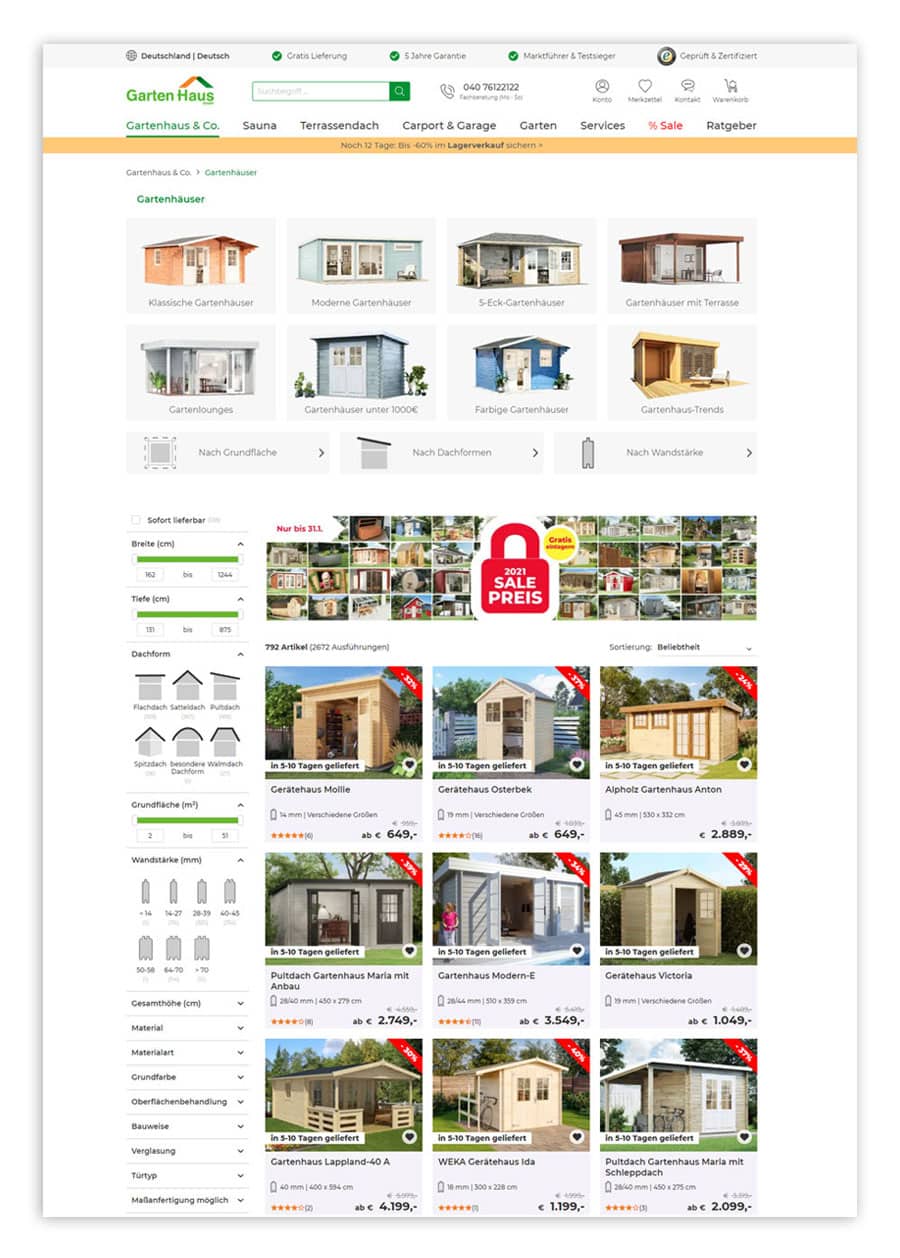
The product category page "Garden Sheds & Co." from Gartenhaus GmbH displays a clearly structured and limited number of products. (Source: Screenshot from gartenhaus-gmbh.de)
Each of the following methods reduces the number of items displayed. This makes it easier for customers to choose products and increases the conversion rate.
Stay up to date on personalization: Sign up for the Epoq newsletter. Register now!
Tracking and analyzing customers' surfing habits and purchasing behavior enables e-commerce companies to make personalized product recommendations. After all, very few customers have a need for or interest in the entire product range. In addition, the data obtained through personalized recommendations provides valuable information about the behavior of shop customers and visitors.
To get even more out of your product categories for marketing purposes, you can also use them to display category-specific recommendations. For example, you can provide an overview of specific categories on the home page and display matching items from the respective category. Based on your customers' click and purchase behavior, you can also personalize the recommendations and thus present products that are particularly relevant to them.
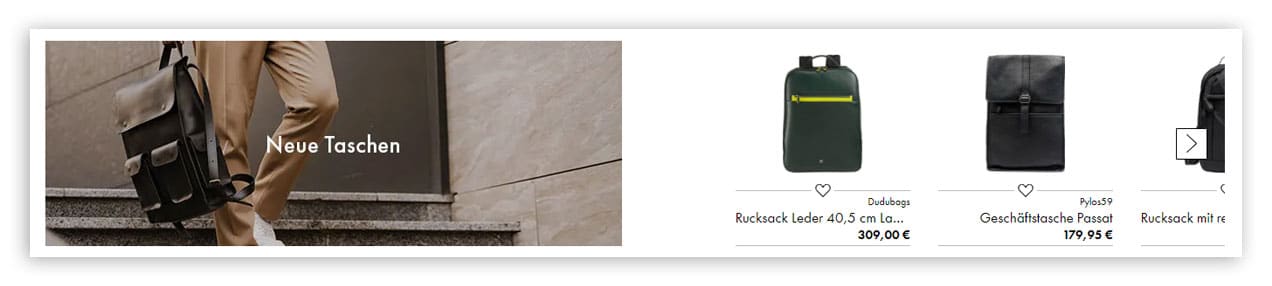
Personalized product recommendations on the Görtz homepage from a specific category ("New Bags").
(Source: Screenshot from goertz.de)
Product categorization is an essential part of conversion optimization for online shops. This is because a better understanding of customers' clicking and purchasing behavior allows you to optimally guide customers through your product range using product categories. This enables you to reduce bounce rates and increase conversion rates. The insights gained from analyzing product categories are therefore becoming an indispensable part of e-commerce marketing.
Product categories are groupings of similar products with similar features and uses. They function like a road map: The clearer the structure, the faster customers can find the product they're looking for, and the better the user experience.
Product categories help users find their way around and quickly navigate to the product they're looking for. Intuitive categorization reduces the bounce rate and increases conversion rates.
Personalization allows categories to be displayed in a customized order—based on each customer's behavior and interests. The order of products on category pages can also be personalized.
Consumer goods (purchased regularly), shopping goods (purchased less frequently, more expensive), specialty goods/luxury goods (exclusive, status-related), and unsought goods (purchased only when needed).
With a well-organized structure, clear images and icons, a balanced selection of products, informative product descriptions, and personalized rankings based on click and purchase behavior.
By analyzing browsing habits, click and purchase behavior, and by monitoring market trends. These insights help to continuously improve the categorization strategy.
More than 4% higher click-through rate on product overview pages?
In this case study, we'll show you how it works!

You are currently viewing placeholder content from HubSpot Embedded Content. To access the actual content, click the button below. Please note that doing so will result in data being shared with third-party providers.
More InformationYou are currently viewing placeholder content from HubSpot. To access the actual content, click the button below. Please note that doing so will result in data being shared with third-party providers.
More InformationYou are currently viewing placeholder content from HubSpot Meetings. To access the actual content, click the button below. Please note that doing so will result in data being shared with third-party providers.
More Information