
E-book – Personalization in E-commerce
In this e-book, you will learn why personalization is important in e-commerce and what the term personalization actually means.

Designing the customer journey is not only important in brick-and-mortar retail. In e-commerce, too, every effort should be made to provide customers with the best possible support on their journey through the online store. Wondering what you need to keep in mind? We'll tell you – in our blog article on the topic of customer journey in e-commerce.

Here's what you can expect to find in this blog article:
Why is the customer journey important?
What does the ideal customer journey look like?
Many paths lead to the goal: the home page
Spoiled for choice: faceted navigation
Everything at a glance: the product detail page
Last but not least: the ordering process
Our conclusion: Personalization and customer journey simply belong together.
The customer journey is a term used in marketing to describe the journey of a potential customer from initial contact to the purchase of a product. The target action within the customer journey is not always the completion of a purchase, but can also be signing up for a newsletter or subscribing to social media. Often, the customer does not decide to make a purchase immediately. Instead, they usually go through several different touchpoints until the desired goal is achieved. In the next section, we will show you how to map the ideal customer journey in your online shop. But first, you should know why it makes sense to optimize the customer journey.
By optimizing the customer journey, you can guide your customers and make their shopping experience as pleasant and easy as possible. Gain knowledge and insights into your customers' preferences and behavior and use this information in a targeted way in your marketing. By responding to your customers individually, you can optimize the customer journey in your online store, simplifying the process and ensuring an inspiring customer experience. Enough theory. Now let's get down to practice.
We would like to use a practical example to show you what a personalized customer journey in e-commerce looks like. We will focus exclusively on the touchpoints within an online shop.
If you would like to learn more about combining multiple sales channels in the context of omnichannel commerce, werecommend reading ourblog article Omnichannel Commerce: For a Seamless Shopping Experience Throughout the Customer Journey.
Stay up to date on personalization: Sign up for the Epoq newsletter. Register now!
The focus of our example is Marie, who is searching online for a new pair of jeans. After a quick search on Google, she finds an appealing online shop for fashion items, clicks on the suggested link...
...and lands directly on the online shop's home page. Here, you are offered various options tohelp you find what you are looking for quickly:
Since Marie has not yet specified the requirements for her new jeans in advance and is visiting the website for the first time, she clicks on the corresponding category...
...and sees the online shop's entire range of jeans, comprising almost 1,000 items, on the category page. She immediately notices the faceted navigation—a welcome feature that allows her to narrow down the selection according to her personal taste.
Marie has now decided exactly what she wants: a pair of blue, slim-fit jeans in size 29. The price should not exceed 60 euros.
Accordingly, she selects the subcategory "Skinny Jeans" in the faceted navigation, filters by women's jeans and the color blue, marks size 29 as the size she is looking for, limits the price to a maximum of 60 euros – and thus reduces the search results to a manageable five items. Marie particularly likes one pair of jeans, so she clicks on the product...
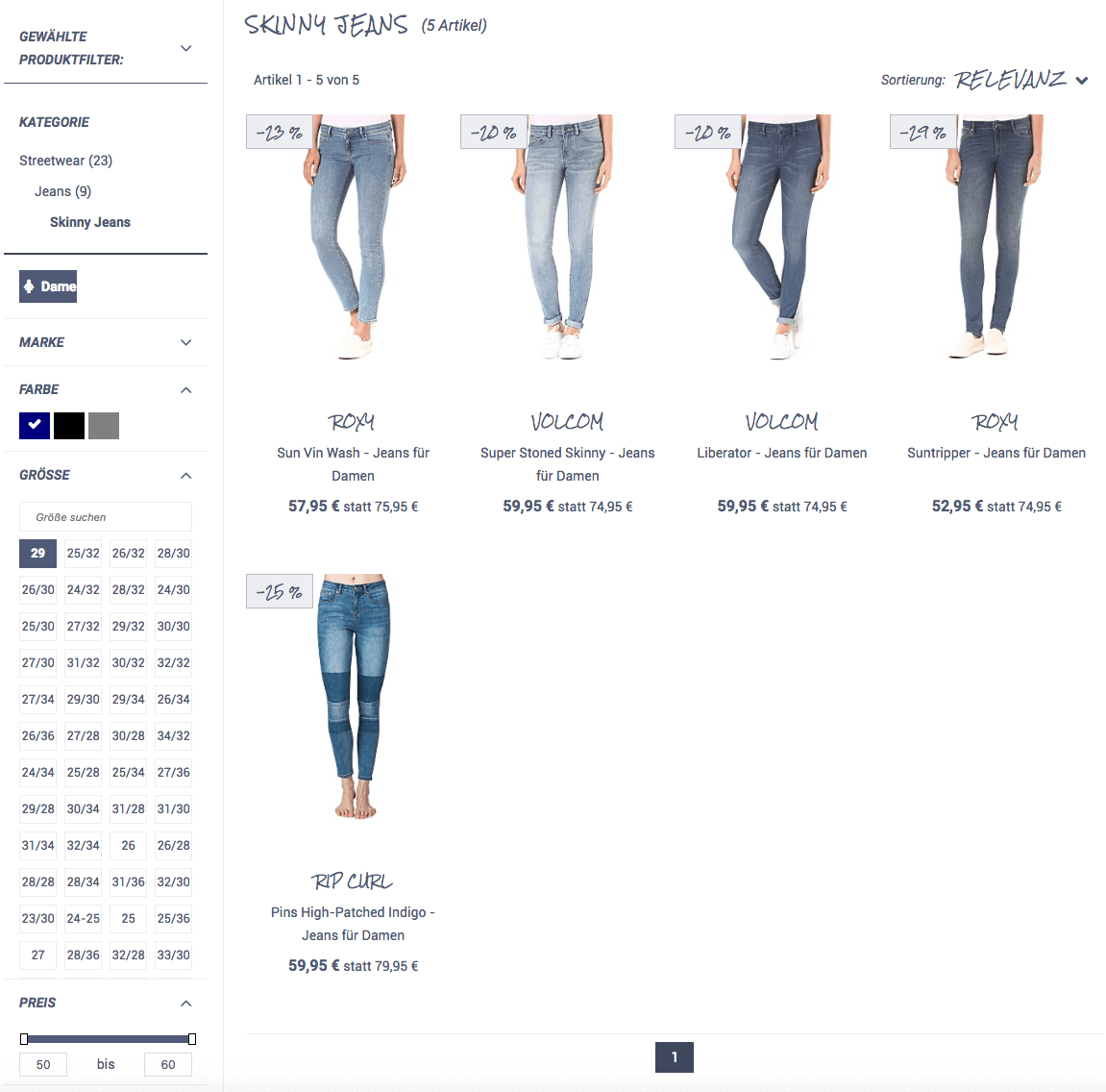
The faceted navigation allows you to personalize your product selection with just a few clicks.
...totake a closer look at themon the product detail page. In addition to the familiar aspects such as price, color, and appearance, Marie also expects to find other important information about the producthere , such as material, cut, and features. Information about delivery times is also important for most online shoppers at this point.
In addition, she receives relevant recommendations for the selected jeans on the product detail page in the form of similar items from the "Skinny Jeans" category or matching items from other product categories, such as "Cardigan."
Stay up to date on personalization: Sign up for the Epoq newsletter. Register now!
If Marie is convinced by the jeans, the CTA buttons at the end of the product detail page offer her the option of either adding the item directly to her shopping cart or placing it on her wish list. Since Marie really likes the skinny jeans, she adds them to her shopping cart and opens it...
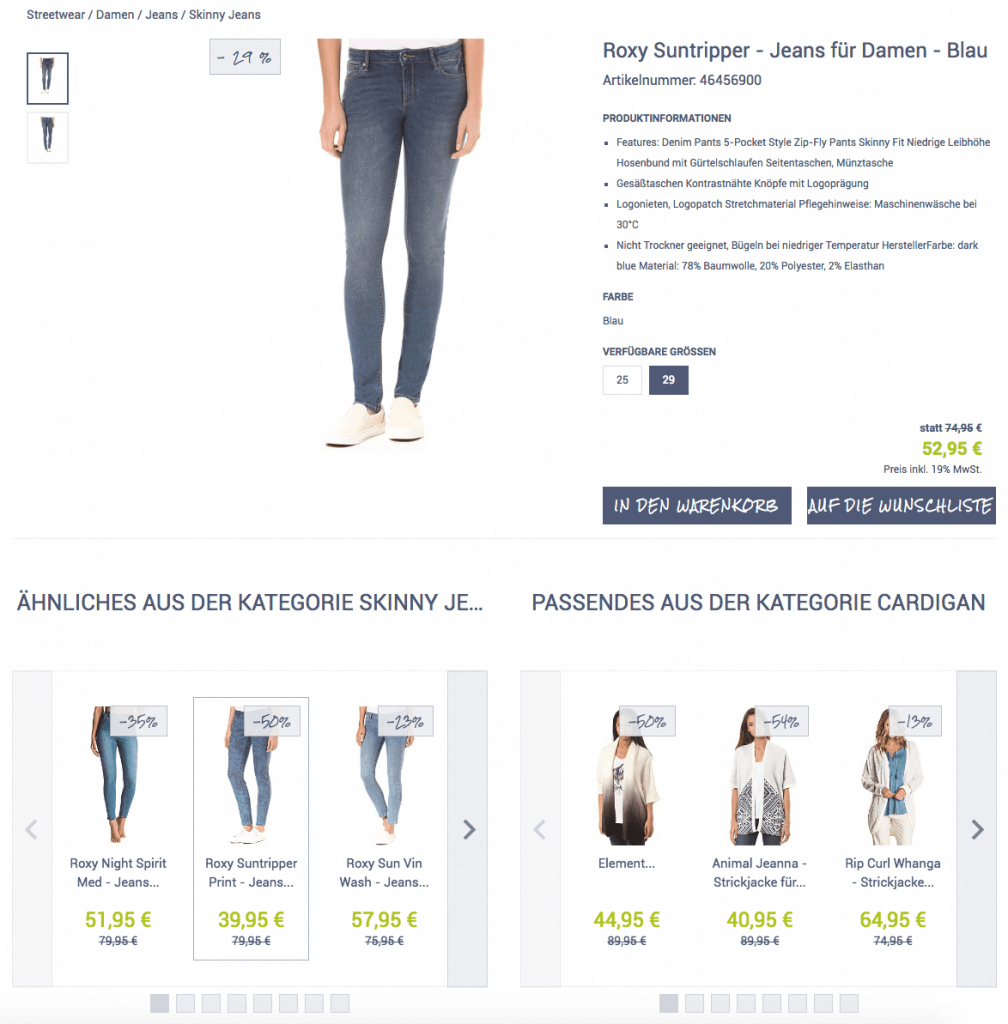
On the product detail page, online shoppers can find further information about the selected products.
...and starts the ordering process without hesitation. At checkout, she is asked to enter her contact details, billing and delivery address, and payment details, and to select her preferred payment method. For verification purposes, Marie is then shown an overview of her entire order, including all important information such as price, size, and delivery date. If everything is correct, she can order the product by clicking on the CTA button...
...and will soon be able toenjoy a new pair of jeans in herwardrobe! 🙂
Want to learn more about the ordering process? Then we recommend our blog article Discover revenue potential in your checkout process.
There's no question that the customer journey is just as important in online shops as it is in offline retail! Online shop operators must therefore ensure that visitors can find their way around the shop – from the home page to the checkout process. After all, longer dwell times, lower bounce rates, and higher conversion rates speak for themselves!
Want more exciting insights on personalization?
Get our e-book now!

You are currently viewing placeholder content from HubSpot Embedded Content. To access the actual content, click the button below. Please note that doing so will result in data being shared with third-party providers.
More InformationYou are currently viewing placeholder content from HubSpot. To access the actual content, click the button below. Please note that doing so will result in data being shared with third-party providers.
More InformationYou are currently viewing placeholder content from HubSpot Meetings. To access the actual content, click the button below. Please note that doing so will result in data being shared with third-party providers.
More Information