
E-book – Personalization in E-commerce
In this e-book, you will learn why personalization is important in e-commerce and what the term personalization actually means.

High return rates, immense costs, and high customer expectations of online stores regarding returns make it clear that effective returns management is of enormous importance. However, it would be best if returns did not occur in the first place. We will now show you how returns can be avoided in advance and what role personalization plays in this.

Here's what you can expect to find in this blog article:
Importance of avoiding returns
Different measures depending on requirements
Requirements are known
The path to the product: search, navigation, and results list
Product presentation: Product information, reviews, etc.
Consulting within the customer journey
The product advisor as a digital sales specialist
Appropriate consulting strategy depending on product type
Appropriate consulting strategy depending on customer type
Step by step to becoming an online product advisor
Individual advice through 1:1 personalization
Conclusion: Personalization plays a major role in e-commerce consulting.
65% of German shoppers return a product if they are not satisfied. 52% of European consumers always check the return policy before deciding to purchase a product from an online store. 60% of European online shoppers believe that the responsibility for organizing and paying for returns lies primarily with the online retailer or online store.¹
These statistics show that returns play a major role in online retail and highlight how important effective returns management is for shop operators. High returns are associated with immense costs and a lot of organizational effort. It is therefore not surprising that e-commerce managers go to great lengths to reduce the return rate. The most effective and sensible step in returns management in e-commerce is to avoid returns. This reduces the effort for both the shop operator and the customer.
There are different approaches to avoiding returns. First, you should distinguish between whether a customer's requirements are known or unknown. In both cases, there are various ways to provide shop customers with the best possible support.
Once the requirements are known, a customer already has a fairly clear idea of which product they are interested in and what features or functions it should have. Two aspects are particularly important here.
If a customer already knows exactly which product they want to buy, they will probably use the search or navigation function to find the right product category or the right product. These two elements therefore play an important role here. You should ensure that your menu structure is intuitive. An ecommerce search engine function that offers features such as error tolerance, auto-suggest, and semantics will also help your customers find the product they want quickly and easily. Faceted navigation gives your customers the additional option of filtering products by selecting the exact features and characteristics that the desired item should have.
Stay up to date on personalization: Sign up for the Epoq newsletter. Register now!
In addition, personalized results lists can help customers find exactly the right product for them from the wide range available. Personalized search results not only display products that match the search term entered, but are also sorted according to individual preferences. This significantly increases the likelihood that the customer will like the product and that it will suit their taste, so that they will not want to return it later.
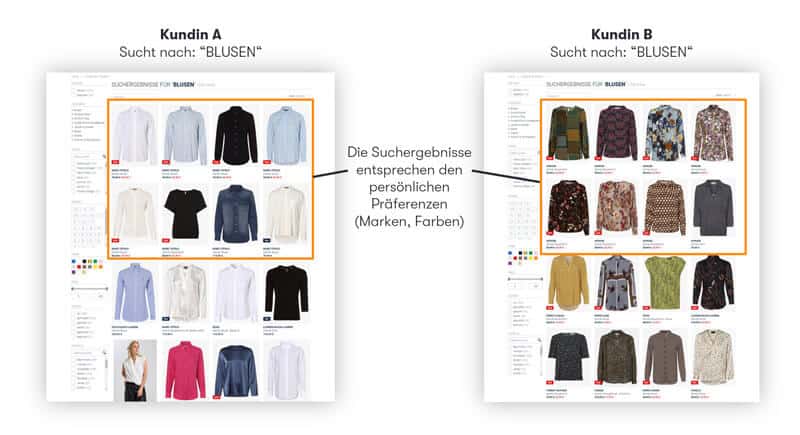
Example of personalized search results for two different customers searching for "blouses"
Once a customer has found a suitable product via the search function or categories, they are taken to the product detail page. Here, too, you can offer support to avoid returns in advance. Be sure to present all important product information in a transparent and clear manner. Provide a complete product description, important information, and several images or videos showing the product (in use, if applicable) to give your customers as accurate an idea of the product as possible. Test reports and trust symbols can also be very helpful at this point to build trust and confidence and to rule out false expectations of the product.
Product reviews are also very important here. They can provide information about product features that are not included in the description. For example, if several customers write that the shoes run small and that it is better to choose a size larger, this helps potential customers when selecting their size. If an online shopper chooses the right size from the outset, returns can be avoided. It also makes sense to provide information about price, availability, and delivery time on the product detail page so that customers do not experience any unpleasant surprises later on.
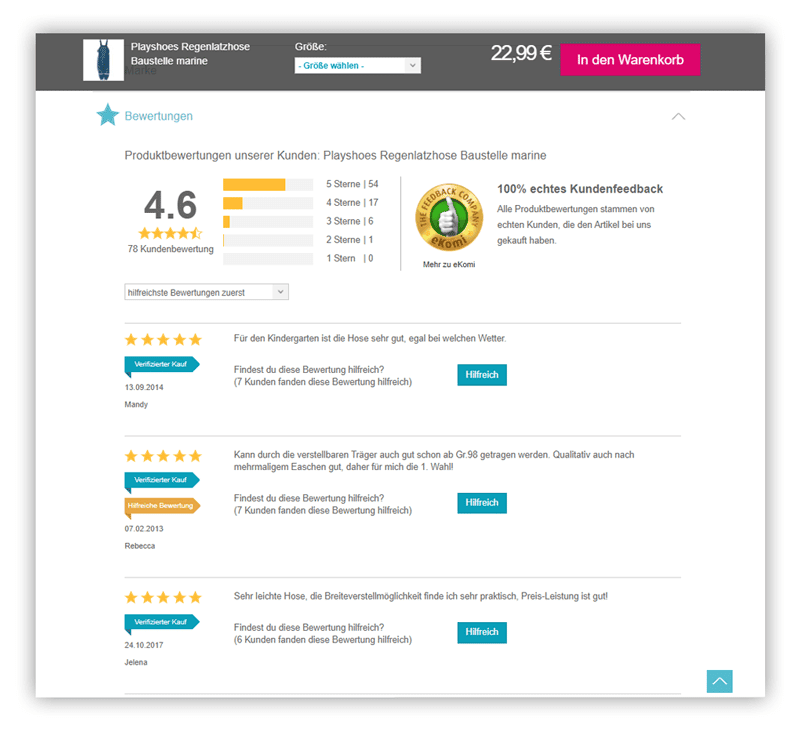
Example of product reviews in the online shop of babymarkt.de (Source: Screenshot from babymarkt.de)
If a customer only has a rough idea of the type of product they want to buy but does not yet know exactly which product meets their requirements, the first step is to determine their needs. Personalized advice offers a good opportunity to do this. Similar to brick-and-mortar retail, advice is used to determine the customer's needs and assist them in selecting a specific product. Personalized advice in e-commerce is a particularly effective measure for avoiding returns. This is because it can ensure that returns do not occur in the first place by enabling customers to purchase the product that exactly meets their expectations and requirements.
Customers usually need advice during the product selection phase (consideration phase). At this point, customers already have a product in mind but need support in selecting the right item from the respective product range. The following graphic shows where the consideration phase with the customer's need for advice can be placed within the customer journey.
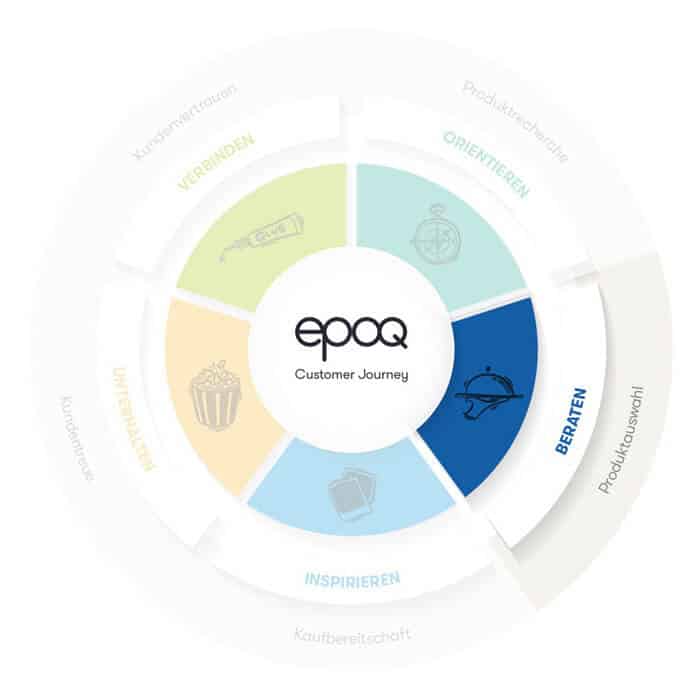
Product selection phase with the need for advice within the customer journey
An intuitive product advisor can help to meet the need for advice.
The intuitive product advisor in the online shop is similar to a sales assistant in a brick-and-mortar store. It assesses the needs of an online shopper and recommends suitable products. Through a visual and interactive dialogue, the customer is guided step by step to the right product. By providing arguments and comparisons , the online product advisor reduces uncertainty and leads to the right purchase decision, which reduces returns. The online shopper gets exactly what they are looking for and makes the purchase.
Artificial intelligence methods are used to select the right product for your customer's needs, helping them make the right purchase decision. After each interaction, the products that match your shop customer's personal preferences at that moment are displayed. The products that match their needs are displayed based on their current clicks and purchases.
The use of an online product advisor is suitable for products that require explanation, functional products, self-explanatory, preference-based products, and various types of customers.
Depending on whether the products require explanation, such as suitcases or running shoes, or are self-explanatory, such as clothing or books, different consulting strategies can be pursued. Both strategies involve advising customers on the right product selection in order to avoid returns.
Products that require explanation include suitcases, running shoes, bathtubs, and strollers. These are relatively complex products in which functionality plays a major role. It is therefore important to determine the right functionality for the customer's needs and to match this with the customer's preferences. Visually designed filters help to determine requirements and capture your customer's product requirements by asking the right questions. In addition, info icons can assist with filter selection by explaining specific product features or their benefits with the help of info boxes.
When a customer answers the questions step by step, products that match their needs are displayed one after the other. The top selection (the products with the greatest match) is displayed at the top. The customer can now see at a glance which product features meet their requirements and which do not. To make the final purchase decision, they can compare products and further narrow down the results displayed using filters. From the consultation, the customer is then taken directly to the product detail page and can purchase the product that suits their needs.
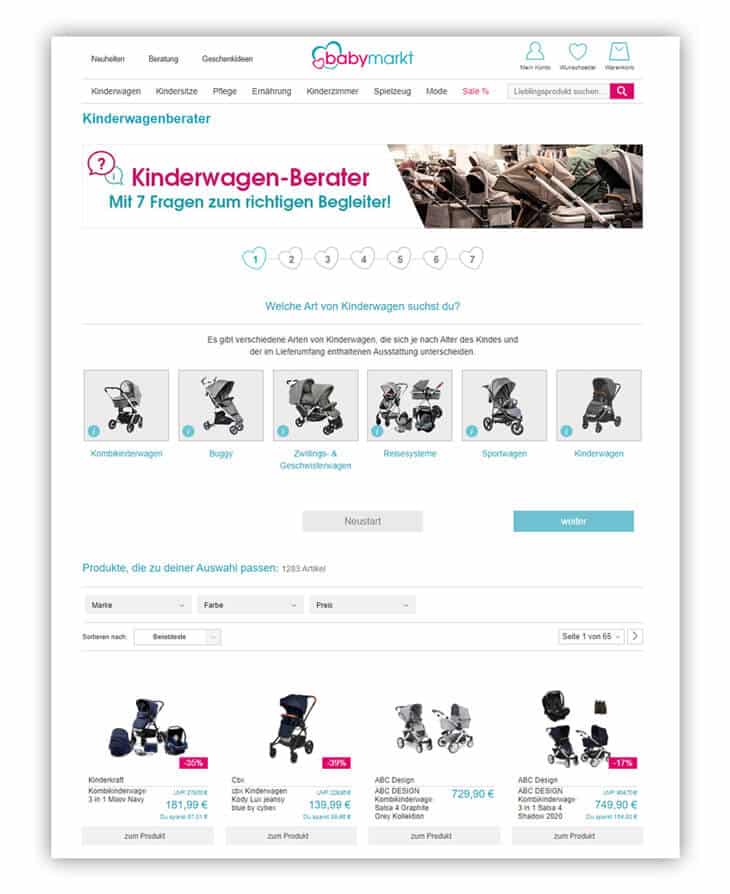
Example of a product advisor for products requiring explanation in the online shop of babymarkt.de (Source: Screenshot from babymarkt.de)
For self-explanatory products such as books, clothing, or furniture, personal preference is the focus, which is why product selection is preference-based using tags. In this case, a customer without visual filters recognizes what "short-sleeved," "100% cotton," "reading from age 8," or similar terms mean. The various products on a shop page are each labeled with tags.
When a customer clicks on preferred tags, the results list is refined until the right product is selected. The products and tags displayed depend on the clicks and purchases of the respective customer. If, for example, all products of a certain brand (identified by the customer as preferred) have already been displayed, it is also possible to offer alternatives or similar products (e.g., products of a similar brand).
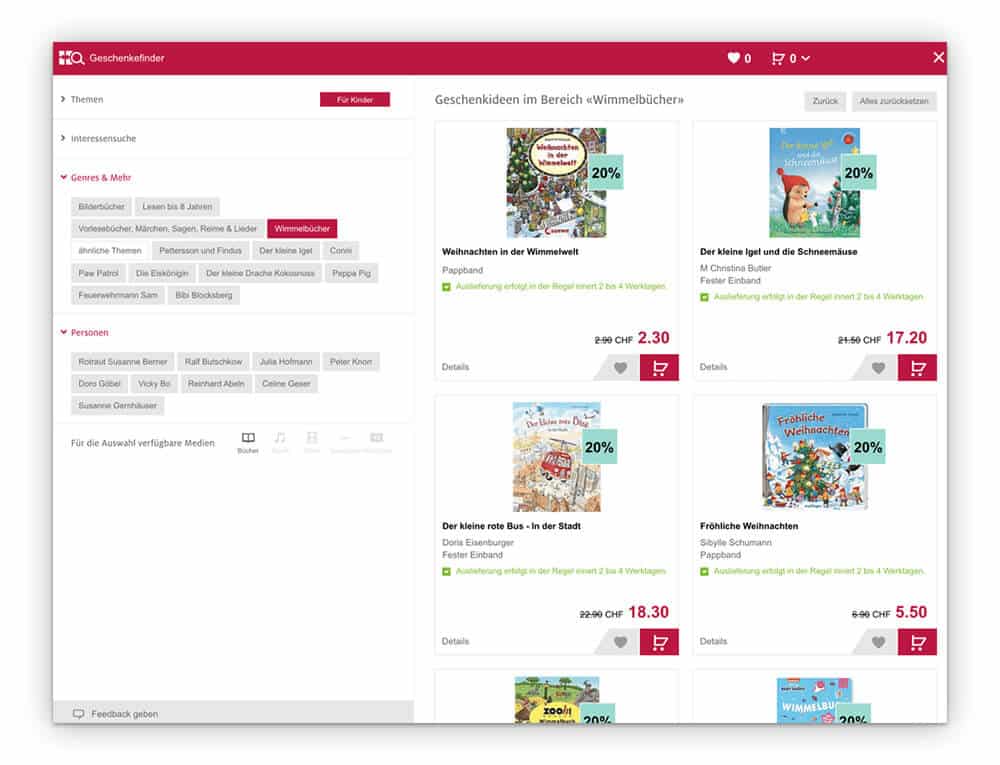
Example of a product advisor for self-explanatory products in the Ex Libris online shop (source: screenshot from exlibris.ch)
The consulting strategy can also vary depending on the type of customer. Let's imagine the following scenario in a brick-and-mortar store. The salesperson approaches a customer and asks, "Can I help you?"
In all cases, the online product advisor takes on the role of a specialist salesperson in a brick-and-mortar store. Depending on the type of customer, the product advisor either conducts the consultation themselves by asking specific questions (example 1), or the customer "leads" the consultation process and the product advisor shows them products that match their requirements (examples 2 and 3).
Stay up to date on personalization: Sign up for the Epoq newsletter. Register now!
There are a few things to consider when integrating a product advisor into your online shop, regardless of whether the products require explanation or are self-explanatory. The following steps must be taken:
You can find out exactly how to proceed if you want to use a product advisor and what you need to bear in mind in the blog article Online product advisors: Help your customers choose products.
If you map the sales process digitally using an online product advisor and display products with matching features, you can also tailor the product selection to your customers' personal preferences and display personalized results accordingly. This allows you to transfer the 1:1 communication from brick-and-mortar retail to digital retail, enabling you to provide individualized advice that avoids returns.
How to move from optimization to 1:1 personalization:
Display relevant results based on total clicks and purchases.
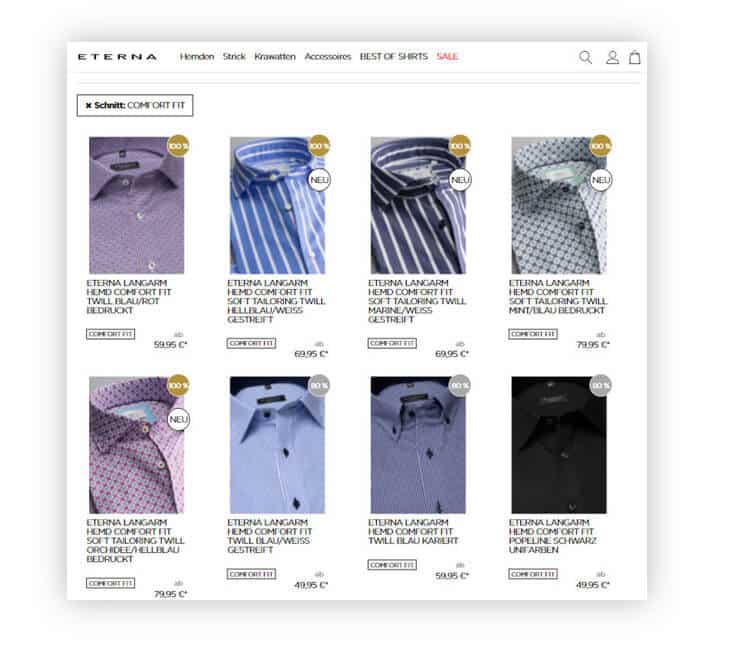
The results are displayed according to the total number of clicks and purchases (source: screenshot from eterna.de)
Sort the displayed products additionally based on segment. For example, show sale items to the "bargain hunters" segment.
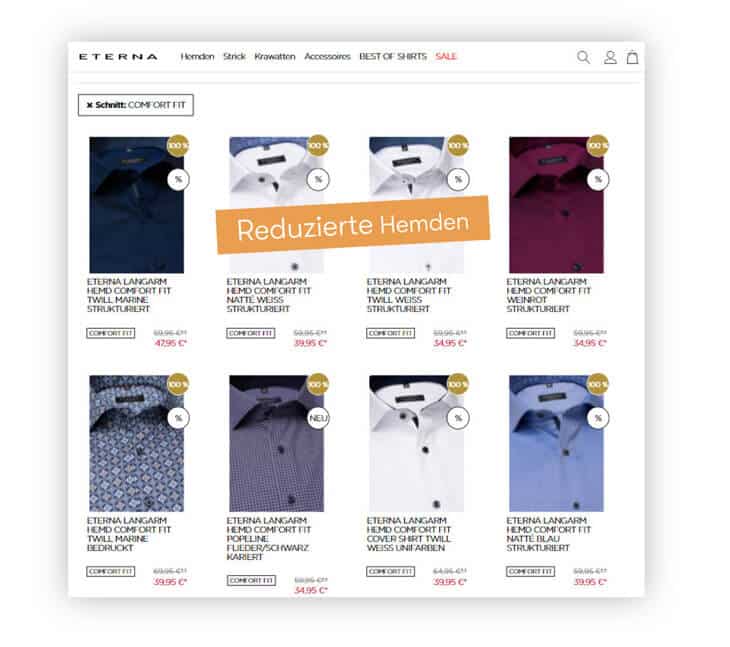
The results are displayed based on segments (e.g., discounted shirts for "bargain hunters") (Source: Screenshot from eterna.de)
Display products that match your customer's needs based on their individual clicks and purchases. Take preferences such as favorite color, size, etc. into account in the results.
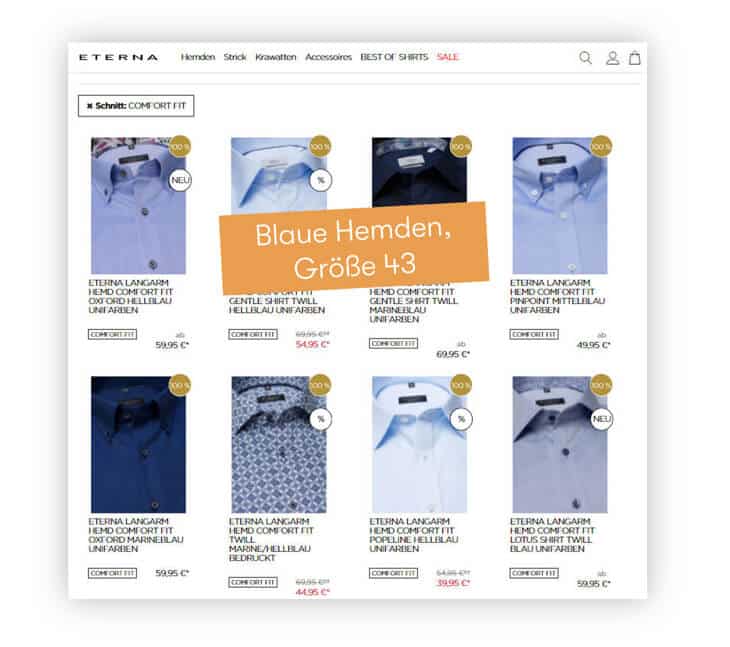
The results are displayed based on individual clicks and purchases (e.g., blue shirts in size 43).
Returns are a constant companion in e-commerce. Personalization plays a major role in avoiding them. There are various measures that can be taken to reduce the return rate. If the requirements are known, search and navigation as well as the product detail pages are important elements. If the requirements are unknown, the needs must first be determined, which is why personalized advice is an effective option here. Similar to brick-and-mortar retail, the online product advisor supports customers in their product selection and acts as a digital sales assistant. Personalization allows for completely individualized advice and 1:1 communication. This helps shop customers find the product that suits their needs and preferences, reducing the return rate.
Of course, not all returns can be avoided. A well-functioning returns management system and an optimized returns process are therefore also of great importance.
Want to learn more about personalization in e-commerce?
Then take a look at our e-book on the topic now!

You are currently viewing placeholder content from HubSpot Embedded Content. To access the actual content, click the button below. Please note that doing so will result in data being shared with third-party providers.
More InformationYou are currently viewing placeholder content from HubSpot. To access the actual content, click the button below. Please note that doing so will result in data being shared with third-party providers.
More InformationYou are currently viewing placeholder content from HubSpot Meetings. To access the actual content, click the button below. Please note that doing so will result in data being shared with third-party providers.
More Information