
- Increase Conversion Rate
Shop performance: Important KPIs in e-commerce
Long loading times, the shopping process crashes or freezes... If customers are dealing with an online shop that performs poorly, there is a high risk that they will leave. But performance is not only important for usability and customer satisfaction—search engine rankings also depend on it. But how can you improve your shop's performance? We'll tell you in this blog post.

Here's what you can expect to find in this blog article:
Which KPIs are crucial for shop performance?
Tips for better shop performance
Less is more: reduce content and compress files
Convince search engines: Improve user experience
Distance helps: Outsource applications (if possible)
Keep your head in the clouds: Change providers if necessary
Conclusion: Improved shop performance increases customer satisfaction and conversion rates
Which KPIs are crucial for shop performance?
It should come as no surprise that shop performance is extremely important. But before we show you what optimization options you have, there is one question that needs to be answered: Which KPIs can provide you with information about poor shop performance? Analyzing data provides insight here. Depending on which analytics tool is used, changes in purchasing or ordering processes can indicate that shop performance has deteriorated. Certain tools also display loading times directly. If these are already visible to the shop operator, it can be assumed that users are also experiencing the same problems.
Important indicators for measuring the shop performance of your own platform include page impressions or the number of page views in general. Furthermore, comparisons within the last three months can usually provide information about whether performance has deteriorated significantly and where the problem might lie.
Tips for better shop performance
Julia from Y1 has put together some tips and tricks that you can use to improve your shop's performance—both for customers and for Google and other search engines.
Less is more: reduce content and compress files
If you have a lot to carry, you walk slower. What's true in real life can also be a reason for sluggishness in online applications. If the online store is too cluttered, performance will gradually deteriorate. This applies to all types of content (text, images, videos, product data) as well as the structure of the store.
Reducing content and simplifying the shop structure can help if your platform is performing poorly. True to the motto "less is more," you should think carefully about what you need and where. Overloading your offering often not only scares customers away, but also slows down your shop, increases loading times, and thus reduces shop performance.
Furthermore, compressing files can help if it is difficult to reduce the overall amount of data. Some file formats take up less space than others and therefore also reduce loading times. This applies in particular to visual content such as images, videos, graphics, or design elements, which may also be suitable as smaller file formats.
There is also the option of outsourcing audiovisual files to a streaming provider. This takes up less storage space on your own server.
Search engines are convincing: improving user experience
Search engines also scan performance to determine which shops to rank at the top for which industries or products. The search engine takes the customer's position here and carefully considers which shop they would like to "visit." Their favorites come first.
In search engine rankings, every millisecond counts when it comes to shop performance—it's comparable to top-level sports. As is generally known, search engines evaluate the loading time of websites. In addition to criteria such as page structure and user experience, they rank slow shops lower than their faster competitors. This negatively impacts both the visibility and the conversion rate of the online platform.
In this case, it's a "lose-lose situation" for the operator, an SEO downward spiral, because one negative factor influences the other. With improved shop performance, you can not only rank your platform higher, but also improve general factors that positively influence search engine rankings and turn a "lose-lose" situation into a "win-win" situation.
Distance helps: Outsource applications (if possible)
If purely content-based reduction does not help, there is also the option of outsourcing applications on the backend. If many other functions are integrated into the shop system, such as CRM, ERP, or similar, it may help to outsource these. This means that the shop itself only has to deal with the frontend and the shop database.
Here, you must note that outsourcing such components has no impact on usability and thus the user experience. Separating such components can ultimately lead to missing information for a smooth processing procedure for the customer. Although this has no lasting impact on shop performance, it does affect customer loyalty. And, as we all know, customer loyalty is something that needs to be improved in any case.
Stay up to date on personalization: Sign up for the Epoq newsletter. Register now!
Keep your head in the clouds: Switch providers as needed
A slow or poor server can also be a reason for performance problems. If these are temporary problems, there may be a short-term and acute reason on the part of the server or hosting provider. If the problems are persistent or steadily worsening, switching to another provider is one way to improve the shop's performance (again).
Cloud-based hosting is often recommended here. In addition to faster performance, cloud applications also offer better reliability and better "crisis management" in the event that an application should ever crash completely.
Cloud-based hosting not only improves shop performance in the long term, but also increases usability thanks to its reliability, which in turn improves the user experience.
The most important information at a glance:
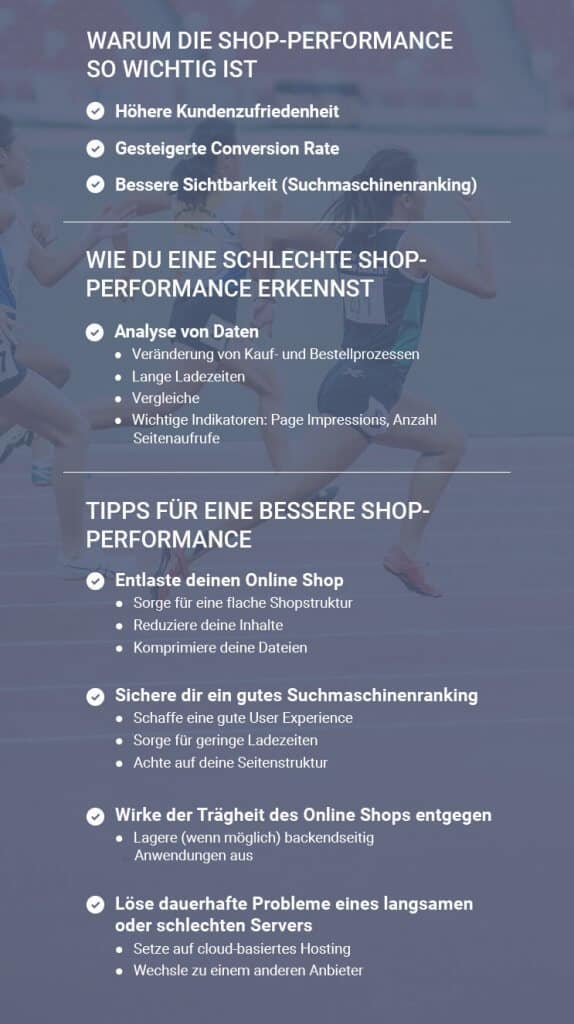
Summary of the most important aspects
Conclusion: Improved shop performance increases customer satisfaction and conversion rates
The performance of your online shop is not only relevant for customer satisfaction, but also for the overall conversion rate of the application. Both customers and search engines should be equally satisfied in order to ensure sustainable customer loyalty and successful online commerce.

Julia Lotz
Content Marketing Manager at Y1 | Epoq Guest AuthorYou are currently viewing placeholder content from HubSpot Embedded Content. To access the actual content, click the button below. Please note that doing so will result in data being shared with third-party providers.
More InformationYou are currently viewing placeholder content from HubSpot. To access the actual content, click the button below. Please note that doing so will result in data being shared with third-party providers.
More InformationYou are currently viewing placeholder content from HubSpot Meetings. To access the actual content, click the button below. Please note that doing so will result in data being shared with third-party providers.
More Information