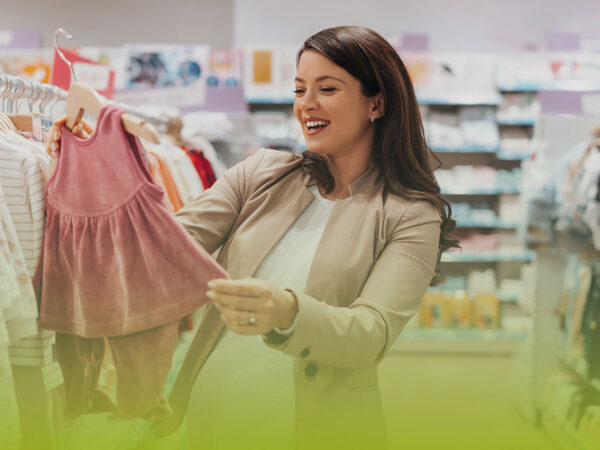
85% higher click-through rate in newsletters thanks to personalized category-based recommendations at babymarkt.de
babymarkt.de increased its click-through rate by 85% through personalized, category-specific newsletters.

Lifecycle emails are a special form of personalized emails. They contain content that is relevant to your customers by focusing on their current situation and needs. Lifecycle emails are based on specific occasions or time-based stages. Once you have thought them through, planned them, and created them, you can automatically send them to your target group again and again. Lifecycle emails promote long-term customer loyalty and help you increase your success by achieving more conversions. You can find out how to implement this in practice in this article.
Here's what you can expect to find in this blog article:
The lifecycle email – the all-round companion for your customers
The customer relationship lifecycle
Email types for the customer relationship lifecycle
Examples of lifecycle emails in the customer relationship lifecycle
The customer lifecycle
Example: Life cycle of a child
Example: Life cycle of a pet
Conclusion: Increased conversion rates through lifecycle emails
The term "lifecycle email" refers to personalized emails whose content and timing are tailored to the current needs of your customers. Different information is relevant and of interest to customers in different phases. Lifecycle emails take precisely these different stages in your customers' lifecycle into account. The recipients of your emails are segmented according to the phase they are currently in and then addressed appropriately and individually with tailored content.
There are two different types of lifecycle emails:
Both forms are presented in more detail below.
Stay up to date on personalization: Sign up for the Epoq newsletter. Register now!
With regard to the customer relationship lifecycle, a fundamental distinction is made between four different stages:
At each stage, the individual concerned has a different level of attachment to the company and the relationship has a different intensity. The requirements for information provision also differ depending on the position in the life cycle. The customer relationship life cycle begins with communication with prospects, who then develop into new customers and eventually become existing customers. Inactivity on the part of customers should ideally be avoided, or at least postponed for as long as possible.
You should first introduce interested parties to your company and your products and specifically motivate them to make their first purchase.
You want to retain new customers by convincing them of the long-term value of your product.
For existing customers, your goal is instead to encourage them to make follow-up or repeat purchases. Your emails to customers during this phase are based on past purchases and known interests.
You should try to reactivate inactive customers, for example, with attractive offers and bring them back to your online store.
With lifecycle emails, your recipients are supported throughout the entire customer relationship lifecycle, i.e., in all of the phases mentioned above. This leads to lively interaction with your customers, which generates higher traffic and more conversions in your online store. The duration of the customer relationship can vary greatly depending on the customer.
Basically, you can distinguish between different types of lifecycle emails:
Among other things, there are event-based emails, which use specific events or time-based milestones as triggers for sending personalized emails. These could be congratulatory emails for your customer's birthday, for example, or you could use a customer or company anniversary to send your customers special offers. Welcome emails after your customers register also fall into the "event-based" category.
You can therefore use events to seek contact with new customers or reconnect with existing customers and retain their loyalty to your company in the long term.
There are also transaction-based emails. These are all emails related to your customers' purchasing process, such as personalized emails confirming orders, deliveries, or returns. For example, you can send your customers additional recommendations by email after a purchase or encourage them to review products.
You can therefore use transactional emails to turn new customers into existing customers.
Would you like to receive more tips and information on the legal framework for using transactional emails to increase traffic to your online store? Then we recommend our blog article Increase traffic and engagement with transactional emails.
If your customers have been inactive for a long time, you can try to bring them back to your online store with reactivation emails. You can show them that you value their opinion by sending them a "We miss you" email or asking for feedback on their last order, thereby maintaining or even strengthening your relationship with your customers.
You can find more information about feedback emails and further examples of trigger emails in our article 5 popular types of trigger emails.
In general, it is important to have information about your customers and their user behavior in order to address their needs in a targeted manner.
We will now show you the specific options available for engaging with your customers at each stage.
After registering in your online shop or for your newsletter, your customers expect to hear from you promptly. You can use this to welcome new customers and make a positive first impression. Since your customers' interest is usually very high at this point, it makes sense to introduce them to your company and thank them for registering with your online shop, for subscribing to your newsletter, or for making their first purchase. You can also welcome them with interesting product presentations. Overall, it is important to make a convincing first impression.
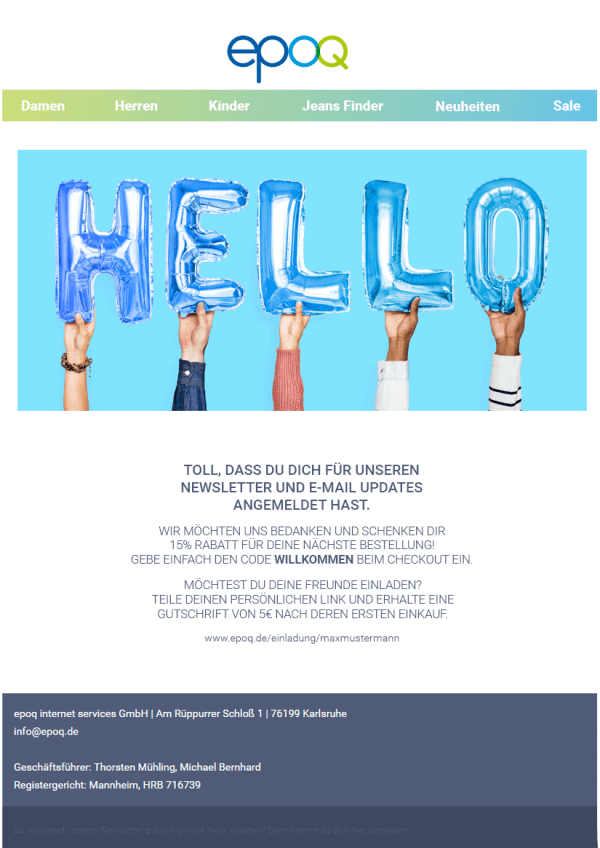
Example of a welcome email after successful registration
Birthdays are very special days of the year—for your customers too. Show them that they are important to you and that you are thinking of them on their birthday. Surprise them on their special day with congratulations and personalized content such as tailored recommendations, or invite them to visit your online store again with a voucher or discount code.
If you are interested in learning how to design a birthday email that will be well received by your customers and help you increase customer loyalty, please read our blog article Using birthday emails in e-commerce to increase customer loyalty and traffic.
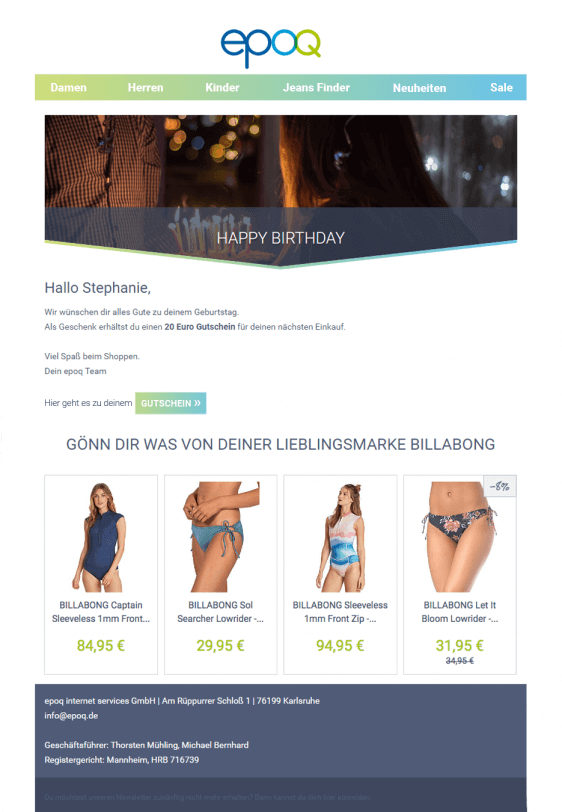
Example of a birthday email with personalized content
The advantage of transactional emails is that they are expected by your customers and are therefore opened and read more frequently. Typical examples include order confirmations after your customers have made a purchase in your online store. You can personalize your transactional emails and provide your customers with relevant product recommendations through cross-selling or upselling. Inspire your customers by offering them similar or complementary products to their purchase. You can also offer incentives such as a discount or free shipping on their next order.
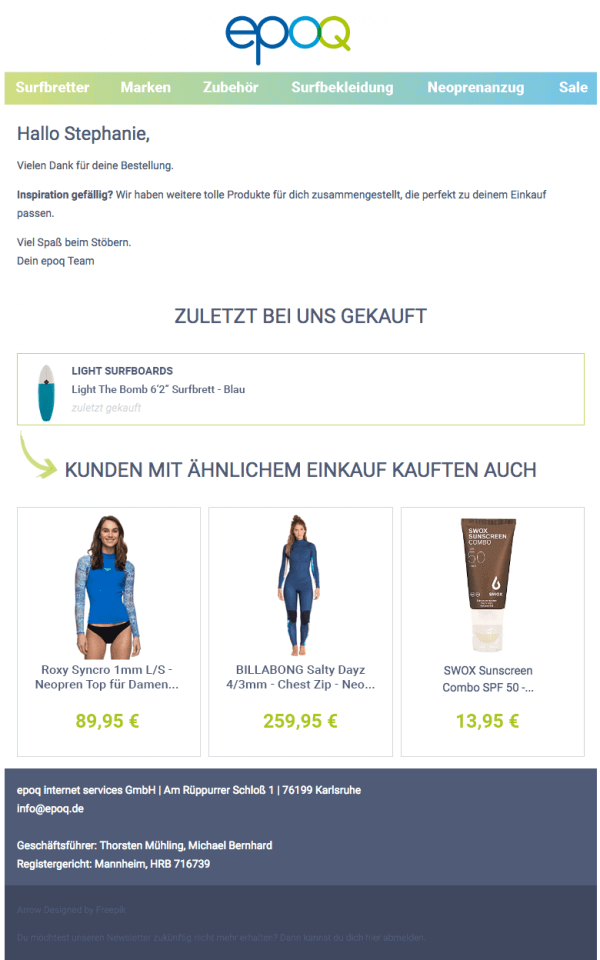
Example of an order confirmation email with additional recommendations for the ordered product
If your customer has recently returned an item, you can also use this to send them a transaction email referring to the return. Here, you again have the opportunity to make recommendations to your customers and offer similar products that may better suit their interests.
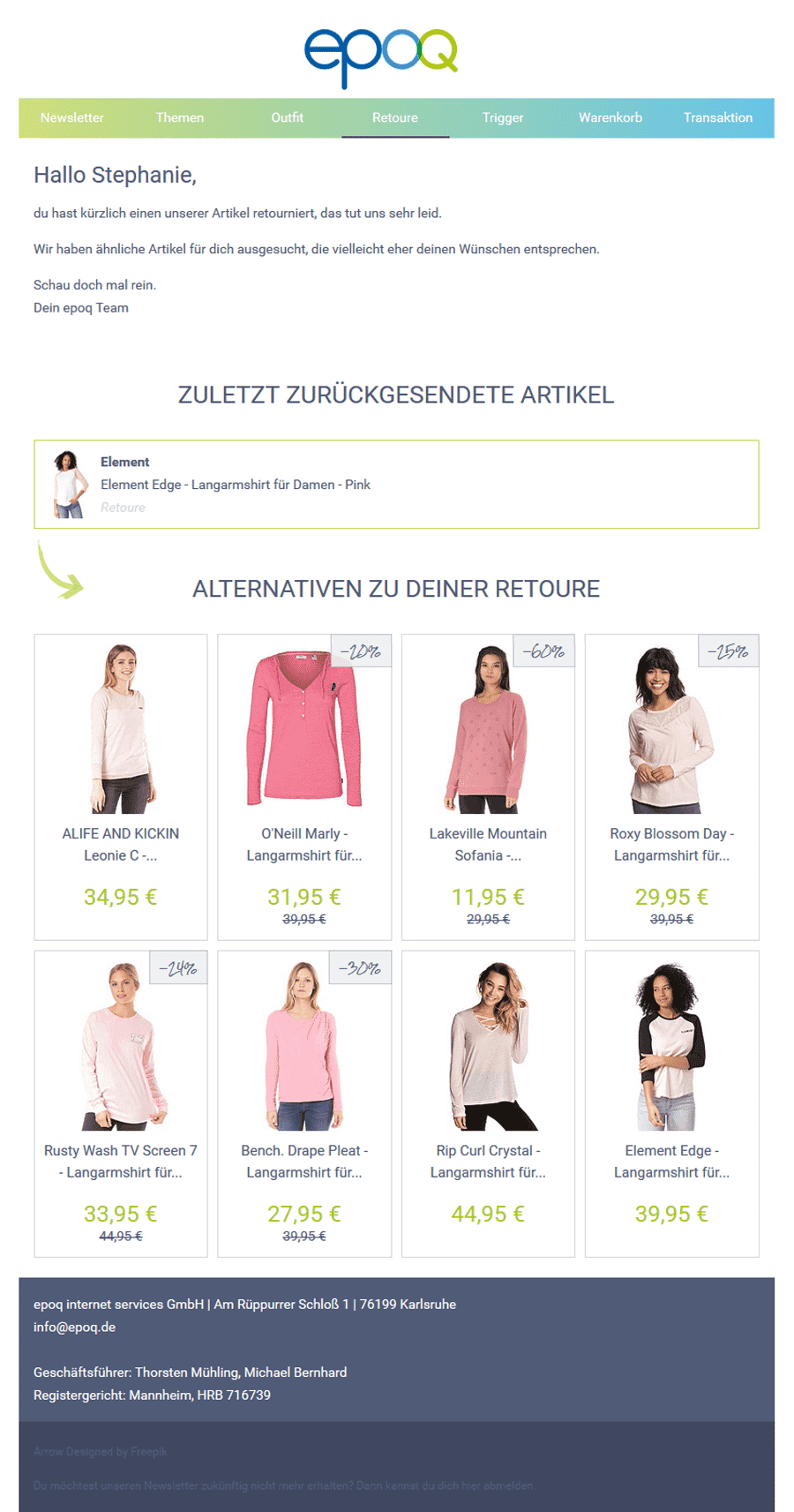
Example of a return email with personalized recommendations
You can find tips on how to avoid returns in advance in our blog article Avoiding returns: The role of personalization in e-commerce consulting.
Have your customers not visited your online store for a long time? To ensure your customers don't forget you, you can send them a reactivation email along the lines of"We miss you" to remind them of your existence. To achieve the desired response to these emails – namely, your customers returning to your online store – they should stand out from other emails. For example, you can offer individual discounts to give inactive customers an incentive to visit your online store again. It's also a good idea to use these personalized emails to find out, for example, with the help of surveys, what content is relevant to each customer and what they want from you as a provider.
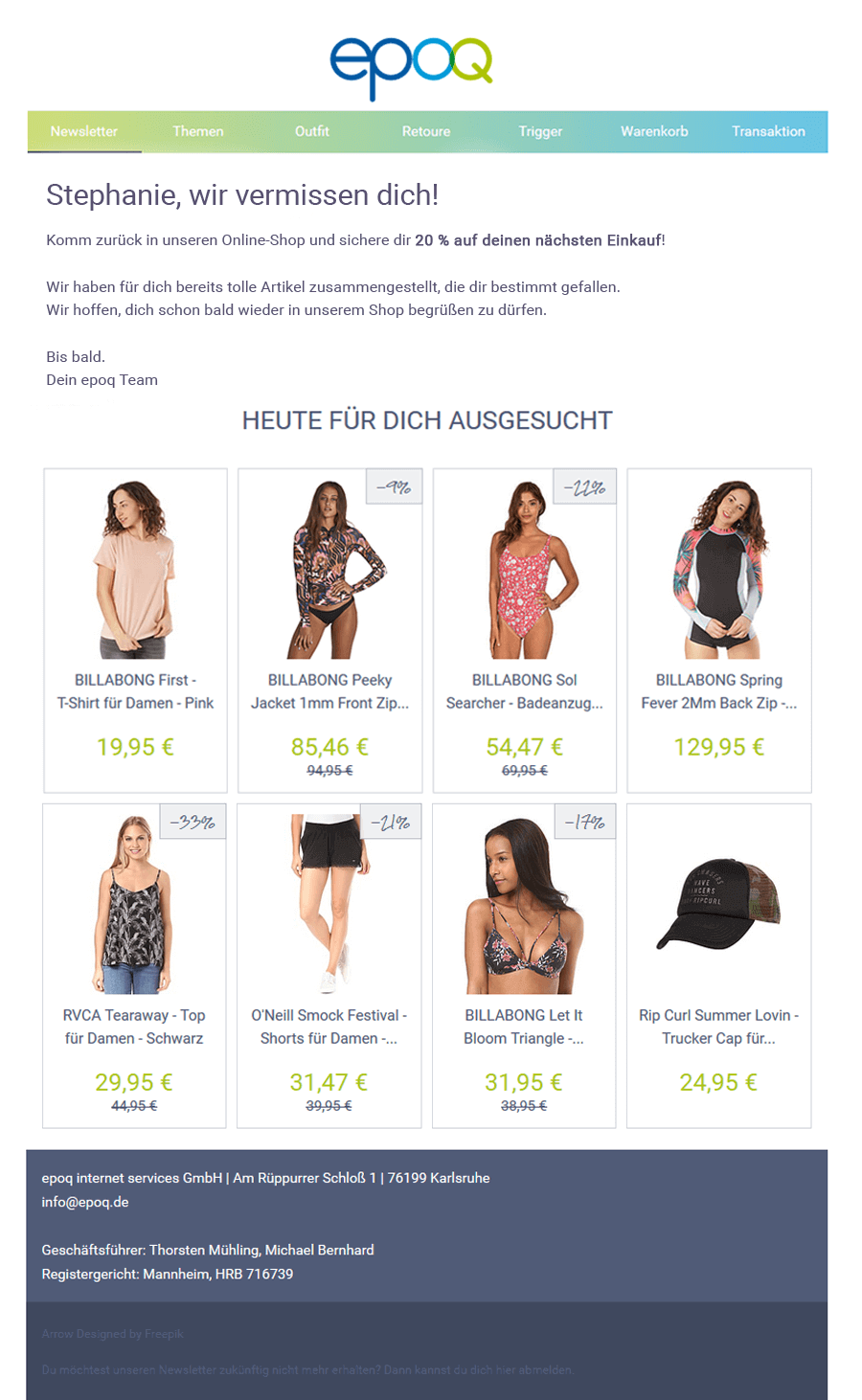
Example of a reactivation email with incentives and personalized recommendations
If a customer is disturbed or distracted during the shopping process, or simply cannot make up their mind, they may have already added products to their shopping cart but leave it there without completing the order process. At this point, you can also follow up and remind your customers about the products in their shopping cart with a cart abandonment email. You can also include additional content such as recommendations or coupons to make it as easy and pleasant as possible for your customers to return to your online store.
You can find even more helpful information on the topic of shopping cart abandonment emails in our blog article Increase sales with personalized shopping cart abandonment emails.
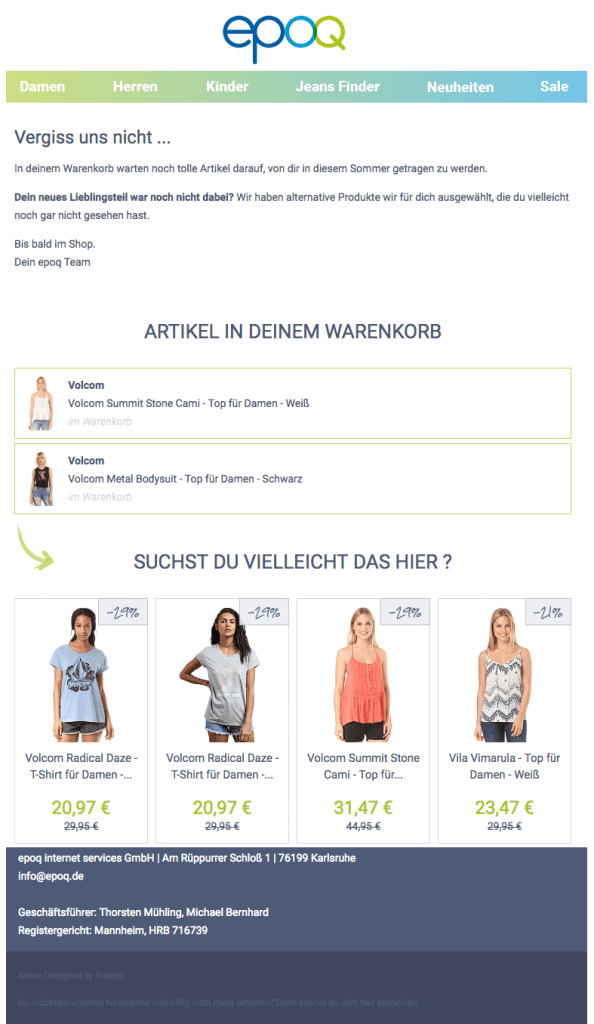
Example of an abandoned cart email with inspiring recommendations
You can reach your customers in an even more personal way with emails that pick up on their individual stories. This can be applied in a wide variety of industries:
A fashion store such as Zalando, for example, identifies various personality traits and preferences that can be derived from customer data and purchase history. These include, for example, favorite colors and preferred products. The respective email then shows how these characteristics have changed over the course of the customer relationship.
As a tour operator, for example, you can package your customers' latest travel destinations as a personal story by compiling an overview of the places your customers have visited or calculating the total distance your customers have traveled so far during their customer relationship lifecycle.
This allows you to address your customers in a very personal way, remind them of past events or shopping experiences, and thus bring them back to your online store.
If you are interested in more illustrative examples, we recommend our article Email Marketing Examples with Personalized Content.
In addition to segmenting by phases in the customer relationship lifecycle, you can also segment by your customers' life stages. These include phases such as school, starting a career, marriage, or pregnancy. This makes sense because the requirements and needs regarding products and services change constantly over the course of your customers' lives. To avoid losing your customers after they have reached a new phase, you should adapt your offers and the content of your emails to your customers' life stages. You can also address the life stages of your customers' children or pets.
Stay up to date on personalization: Sign up for the Epoq newsletter. Register now!
For example, in your lifecycle emails, you can tailor offers for children's clothing to your customer's childas they grow. As the child gets older, parents receive relevant offers for clothing or other products that are appropriate for the child's age and size. In addition, it is possible to provide parents with useful information tailored to the age and development of their child over time.
If your emails are properly tailored, they will be highly relevant to your customers. This allows you to build a close relationship with them and ensure that your brand is remembered as a competent partner.
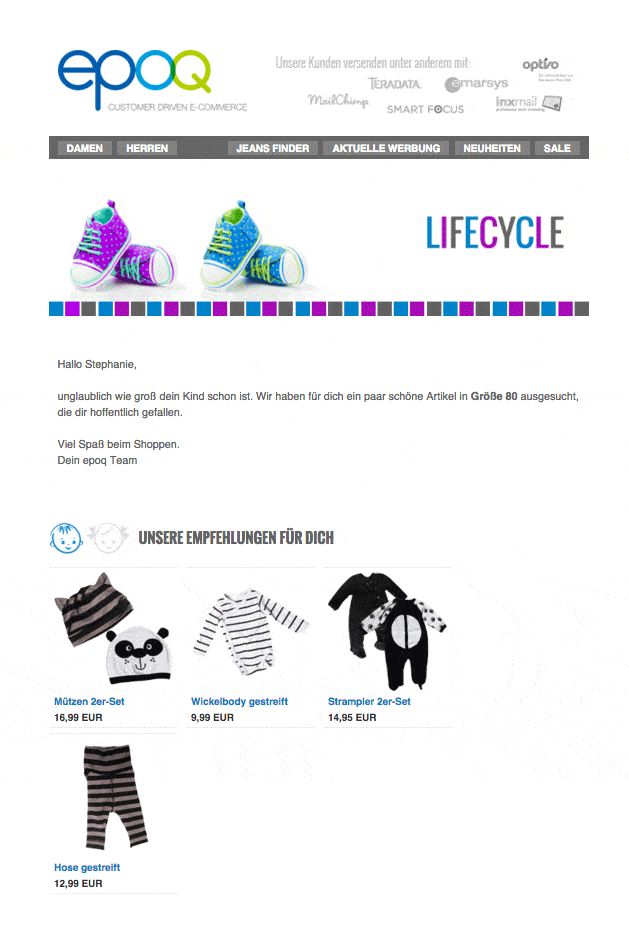
Example of a lifecycle email with personalized recommendations based on age
Another example would be to accompany your customer's pet throughout its life cycle. Here, it is possible, for example, to provide dog owners with helpful tips from the puppy stage onwards and thus support them as a trusted partner during other stages of their pet's life.
Do you accompany your recipients through the different stages of life? How do you implement this and what experiences have you had with it so far? Tell us about it!
Lifecycle emails are a useful marketing tool for building or strengthening customer loyalty. The advantage of these emails is that your readers receive information and offers when they actually need them, meaning that the content offers them relevant added value. Lifecycle emails therefore have high response rates and help you achieve more conversions. If you accompany your customers throughout the entire customer (relationship) lifecycle and tailor your emails to the current situation and needs of your customers, you can significantly increase your success.
Discover how babymarkt.de increased the click-through rate in its category-specific newsletter by 85%.
Read the case study now!

You are currently viewing placeholder content from HubSpot Embedded Content. To access the actual content, click the button below. Please note that doing so will result in data being shared with third-party providers.
More InformationYou are currently viewing placeholder content from HubSpot. To access the actual content, click the button below. Please note that doing so will result in data being shared with third-party providers.
More InformationYou are currently viewing placeholder content from HubSpot Meetings. To access the actual content, click the button below. Please note that doing so will result in data being shared with third-party providers.
More Information