
E-book – Personalization in E-commerce
In this e-book, you will learn why personalization is important in e-commerce and what the term personalization actually means.

Landing pages are one of the most important tools in online marketing and a decisive factor for success in generating leads and sales. You can achieve even greater persuasiveness with personalized landing pages and thus targeted offers for each prospective customer. In this guide, you will learn about the different types of landing pages, what makes them indispensable for your online marketing, and how you can use personalization for your shop to increase your success.
Here's what you can expect to find in this blog article:
What are the strengths of landing pages in marketing?
Generate leads and sales
Enabling targeted user control
Generating important data for marketing and sales
What are the different types of landing pages in e-commerce?
How do you optimize a landing page with the help of psychology?
Build trust through social proof
Always use eye-catching CTAs
Put the customer at the center
4 Ways to Personalize Your Landing Pages
1. Personalization in Product Recommendations
2. Personalization for brands and categories
3. Personalization in the way you address visitors
4. Combining Content and Products
How do you create a personalized landing page?
Step 1: Identify opportunities and develop a concept
Step 2: Implement the personalized landing page
Step 3: Collect and analyze data
Step 4: Optimize the ongoing campaign
Conclusion: Win over shop visitors with personalized landing pages
Landing pages are websites that are specifically designed to convince potential customers to purchase a product or service. Their goal is always conversion. In other words, they are intended to turn as many visitors as possible into leads or even buyers.
Good landing pages are sophisticated websites that are optimized for sales psychology. This is necessary because they have to convince users in the shortest possible time. Optimized landing pages are often created through so-called A/B testing. This involves playing two versions of a page and checking their conversion rates. This allows online marketers to better tailor the landing page to the target audience.
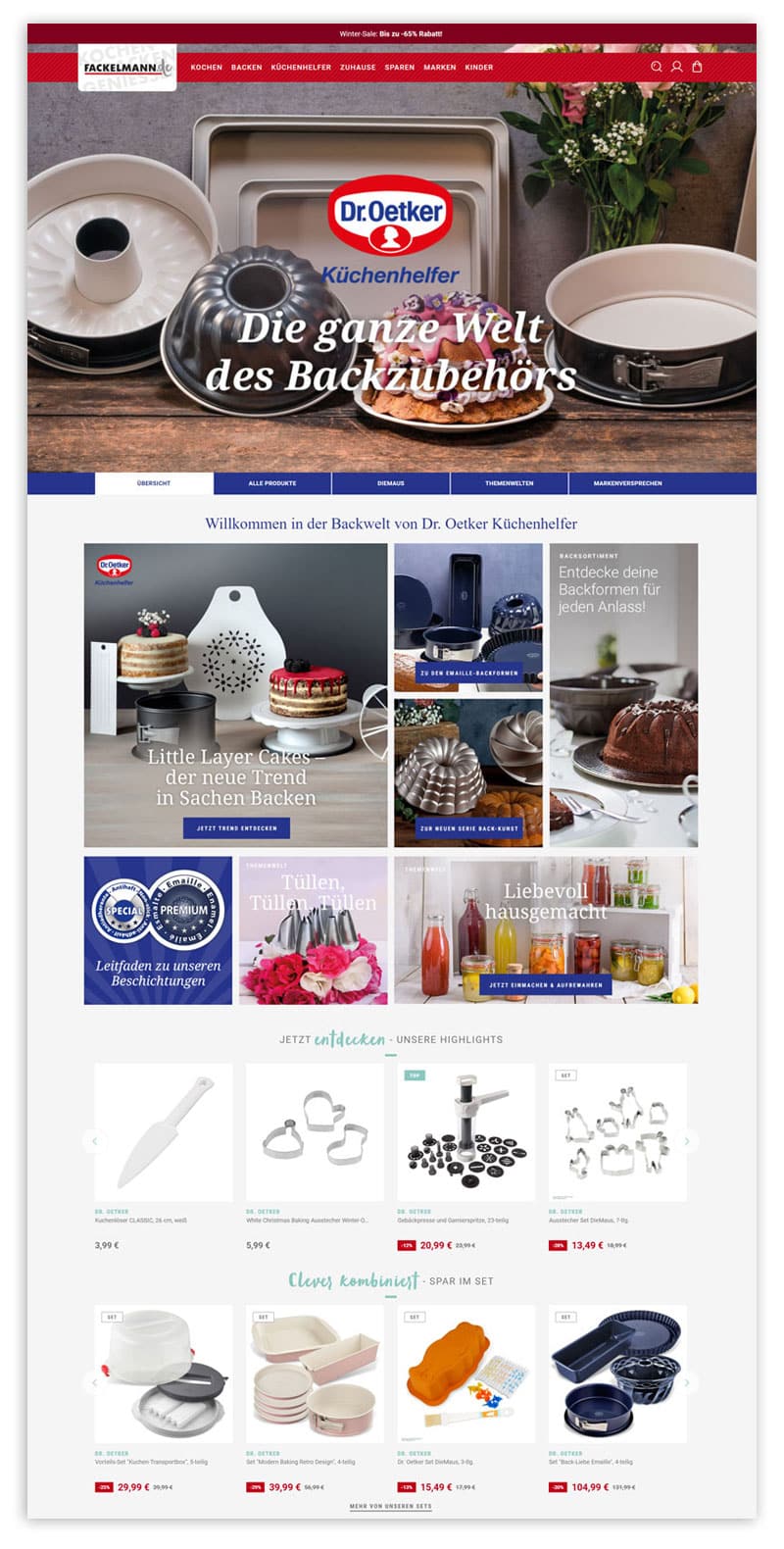
Example of a landing page in the form of a brand page on the topic of baking with content and product recommendations. (Source: Screenshot from fackelmann.de)
Landing pages are real sales boosters, but their advantages are even more versatile:
Landing pages convince your visitors that your offer is right for them. That's why they give you their email address, for example, allowing you to stay in touch. In this way, landing pages strengthen your email marketing. You can generate and qualify leads and actively guide them through your marketing funnel.
Ideally, a landing page is structured in such a way that your customers receive all the information relevant to their purchase decision. By focusing on the essential information, the customer is guided directly to conversion or checkout without distraction.
Each landing page allows you to obtain even more information about your target group by analyzing your traffic. From demographic data to search intent, you can learn a lot about your potential customers. For example, you can use A/B testing to find out which customer approach your target group responds to positively, which offer is irresistible to them, or which arguments convince them to buy.
There are a variety of different landing pages in e-commerce. Here are five examples:
Stay up to date on personalization: Sign up for the Epoq newsletter. Register now!
Basic tricks of sales psychology will help you create the optimal landing page:
Reviews from real customers, seals, or awards help turn potential customers who are not yet familiar with your shop into actual customers.
Be clear and concise in the wording and placement of your CTAs. Don't make your customers search or even guess.
What advantages does the customer gain by choosing your product? Every word on a (personalized) landing page must convince the customer of the specific benefits and should not just be a list of product features taken out of context.
Personalization also comes from the bag of tricks used in sales psychology and can increase the success rate of landing pages by putting the customer at the center of attention. Since e-commerce providers already have data on almost every visitor, they can use their personal preferences and characteristics to present offers in an even more convincing way.
There are various ways to use personalized landing pages:
Many customers discover your online store through organic or paid search results. You can take advantage of this by picking up on the search term that customers used to find your store. For example, you can show customers who found your site using the search term "blue T-shirt" other blue T-shirts from your catalog. You can also tailor your offerings to visitors based on their location or browsing history.
You can even go one step further and use your customers' previous click and purchase behavior to take into account the individual preferences of each customer when displaying items. This means that a customer doesn't just see blue T-shirts, but blue shirts that are available in their size, from their favorite brand, or made from their favorite material.
You can present products from the same category or brand to visitors to your shop on search results pages or product detail pages to show them items that may be of interest to them. So, instead of using specific characteristics such as the color "blue" for certain products, you present products from a common parent category.
This method works very well with existing customers who repeatedly choose the same brand.
With targeted offers, you can re-engage them and show them items from your online store's product range that are relevant to them based on their previously demonstrated preferences.
You can also personalize the results within these pages even if you don't know your potential customers yet. One option is to pre-sort the ranking of products within a category page according to popularity among similar users or search queries. If you already know your customer, you can even personalize the first search results 1:1, taking individual preferences into account.
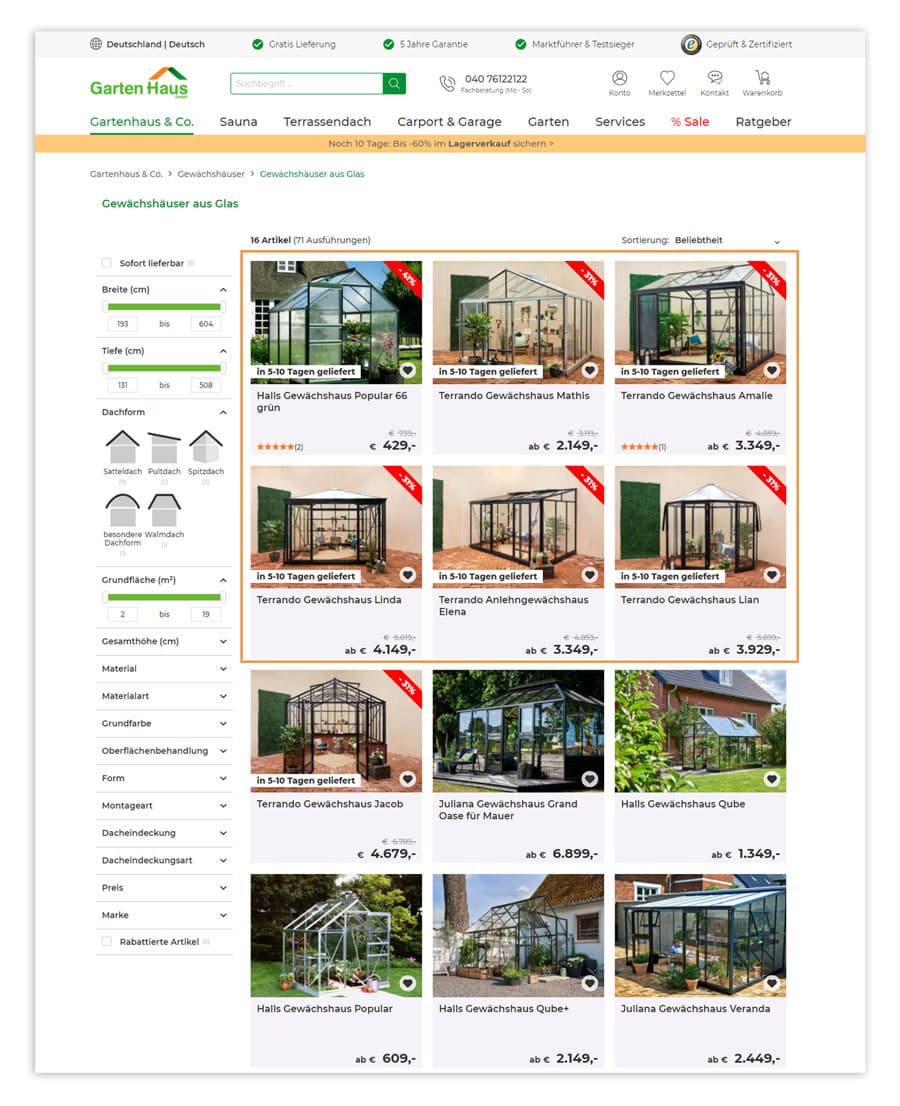
Landing page in the form of a category page for glass greenhouses, where the first six products are displayed in a 1:1 personalized manner. (Source: Screenshot from gartenhaus-gmbh.de)
You can also target users on a personalized landing page, for example by using search terms: "Hello! Are you looking for a blue T-shirt? Here is a selection of our most beautiful shirts in blue, especially for you." As described above, you can present products that match personal preferences and are therefore particularly relevant to your customers.
Content in guide format is a useful addition to category pages or product detail pages. You can present it specifically to customers who are likely to be interested in it, based on the products they have already viewed or the search terms they have used.
Conversely, it is also possible to enrich your content with selected articles in order to offer users products that match their interests. Here, too, you can take your customers' preferences into account and tailor the products displayed or content presented to the respective customer.
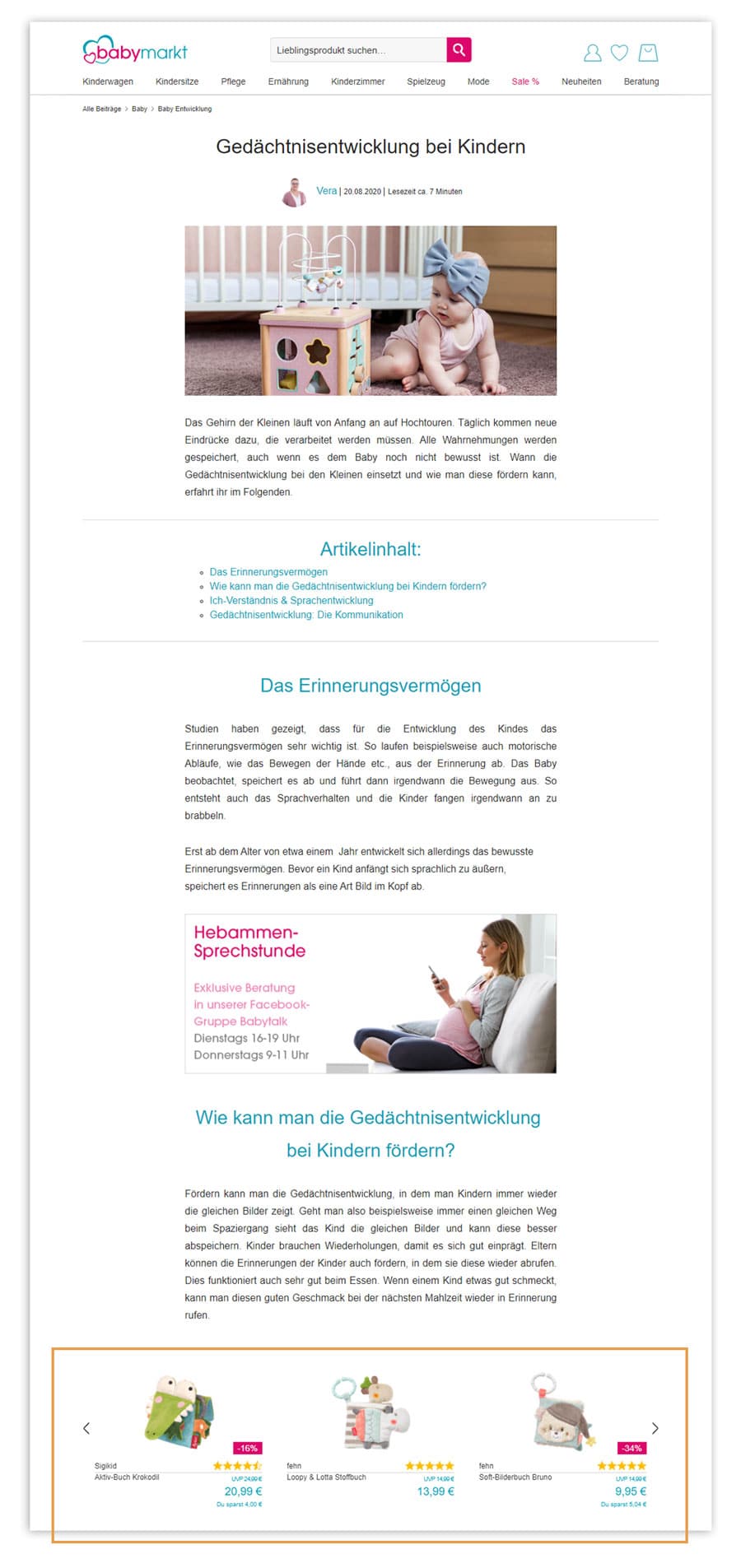
Customers receive product recommendations tailored to the content on the landing page. (Source: Screenshot from babymarkt.de)
To create an optimal landing page, you should proceed carefully and follow these steps:
You need a concept to ensure that potential customers find your products on a landing page. To do this, you need to consider what data is relevant for presenting suitable products to your customers, how you obtain this data, and how you technically implement e-commerce personalization based on it. There are various tools that use your data to generate suitable recommendations. To know which ones you can use, you need to know what you want to achieve. It often makes sense to bring in external companies with the relevant expertise in implementing personalization in order to benefit from their experience.
Stay up to date on personalization: Sign up for the Epoq newsletter. Register now!
Depending on the type of personalization you have in mind, you’ll need different technical tools to create personalized landing pages. For example, you can select relevant products with similar keywords from the same category. You can also direct new and existing customers to different campaign pages featuring special offers.
Personalization only works with data and can be very costly. AI software is required to collect and analyze information in real time. It collects and analyzes data and gradually becomes better at predicting what a prospective customer is really looking for.
Either way, links are essential: products must be tagged so that they can be related to each other. This includes simple characteristics such as color and materials, but also structural information such as categories.
If you would like to learn more about the important fields in your product data feed, we recommend reading our blog article Product Data – Sales Booster for Your Online Shop.
Your conversion rate should increase as a result of personalization. If this is not the case, an in-depth error analysis is necessary to find out where the strategy needs to be adjusted. Even if you are achieving good results, we recommend that you continuously review your funnel and look for opportunities for optimization.
Personalized landing pages are an important tool for convincing potential customers of your products. They show users products tailored to them or explain conclusively why a product is particularly suitable for them. Thanks to modern personalization technologies, landing pages are even more convincing and can even strengthen customer loyalty by bringing existing customers together with products relevant to them more quickly.
Personalized landing pages dynamically tailor their content, product recommendations, and offers to each visitor based on their origin, behavior, device, or customer segment. Instead of a one-size-fits-all page, each user sees a version tailored specifically to them.
Personalized landing pages appeal to visitors in a more targeted way, thereby increasing the relevance of the offer. This leads to lower bounce rates, longer time spent on the site, and a higher conversion rate.
Personalized landing pages are particularly effective for campaign traffic from newsletters or social ads, for returning customers with known purchasing behavior, and for seasonal promotions
The technical implementation is handled by a personalization platform that analyzes user data in real time and dynamically displays relevant content modules, product recommendations, or banners.
A landing page is specifically tailored to a particular traffic channel or campaign, with a clear call to action (CTA) and minimal navigation. A product page is a permanent part of the online store and is aimed at a broader range of users without a specific campaign focus.
A high-converting landing page is characterized by: a clear headline with a direct value proposition, relevant product recommendations, trust-building elements such as reviews and seals of approval, an eye-catching CTA, as well as fast loading times and mobile optimization.
Yes, and that’s particularly effective. When users from a Google Ads campaign land on a page that exactly matches their search query and user profile, the bounce rate drops significantly and the conversion rate increases. So-called “message matching” is the key factor for success here.
Want to delve deeper into the topic of personalization in e-commerce?
Then download our e-book now!

You are currently viewing placeholder content from HubSpot Embedded Content. To access the actual content, click the button below. Please note that doing so will result in data being shared with third-party providers.
More InformationYou are currently viewing placeholder content from HubSpot. To access the actual content, click the button below. Please note that doing so will result in data being shared with third-party providers.
More InformationYou are currently viewing placeholder content from HubSpot Meetings. To access the actual content, click the button below. Please note that doing so will result in data being shared with third-party providers.
More Information