
E-book – Personalization in E-commerce
In this e-book, you will learn why personalization is important in e-commerce and what the term personalization actually means.

In times of increasing customer demands and growing competition in online retail, a good product alone is no longer enough. Today's consumers expect personalized shopping experiences that are tailored precisely to their needs. This is exactly where e-commerce personalization comes in. It enables online stores to provide personalized recommendations, tailored content, and individual offers, among other things—not only creating satisfied customers, but also increasing sales and customer loyalty. In this article, we take a comprehensive look at the basics, advantages, and challenges of e-commerce personalization and provide concrete examples and trends for the future.

Here's what you can expect to find in this blog article:
What is e-commerce personalization?
Why is personalization important in e-commerce?
What are the advantages of personalization in e-commerce?
What is the difference between personalization and customization in e-commerce?
What is personalization in B2B e-commerce?
What personalization options are available along the customer journey?
Awareness: Provide guidance and facilitate product searches
Consideration: Offer advice and support purchasing decisions
Purchase: Provide inspiration and optimize checkout
Retention: Build connections and strengthen customer relationships
How does personalization work in e-commerce?
What are some examples of e-commerce personalization?
AI-supported category selection at Outletcity Metzingen
ecommerce search engine at NKD
Self-learning ranking on product overview pages at A-Z Gartenhaus
What are the challenges for e-commerce personalization?
What does the future hold for personalization in e-commerce?
Conclusion: Create exciting shopping experiences with e-commerce personalization
Personalization in e-commerce means addressing each customer individually —similar to a good salesperson in a brick-and-mortar store. Instead of treating all customers the same, online stores cater to the personal interests and needs of each individual. This is also known as one-to-one marketing or 1:1 communication.
The aim of e-commerce personalization is to present customers with exactly the products and offers that are relevant to them. This allows them to find what they like more quickly—without the personalization seeming intrusive. This can mean suggesting products that match the item currently being viewed, or new, previously undiscovered items that are highly likely to appeal to the customer's taste.
The term hyper-personalization is also frequently used in e-commerce. This is a further development of classic personalization: it not only uses historical data such as "last viewed" or known preferences, but also collects information about your customers' purchasing behavior, location, and preferences in real time. It also takes into account the user's current intention (e.g., browsing or targeted purchasing) and the type of buyer (bargain hunter, collector, etc.).

Personalization is more than product recommendations
In e-commerce, personalization is often reduced to product recommendations by a recommendation system or simply inserting the customer's name in an email. But true, AI-powered 1:1 personalization encompasses much more: it refers to individualized communication and tailored content throughout the entire customer journey – from the first contact with the store to long-term customer loyalty.
Today's customers have a huge selection of shops and products to choose from and can switch to the next provider with just one click. At the same time , they expect online experiences that resemble personal advice in a store. In a brick-and-mortar store, a salesperson can provide individual attention to each customer. Online, however, this is impossible due to the large number of visitors.
This is precisely where personalization—supported by AI—comes in. It analyzes data in real time and automatically tailors content, offers, and recommendations to the interests of each user. This allows you to replicate the feeling of personal service digitally and design the customer journey in a targeted manner.
Stay up to date on personalization: Sign up for the Epoq newsletter. Register now!
Personalization makes your online store an individual experience for every customer— automated, data-driven, and in real time. It recognizes what interests your users and adapts content at every touchpoint, from the first click to the purchase.
Targeted website personalization can be used to optimize various key figures:
All these effects contribute to increasing the conversion rate and strengthening customer loyalty: satisfied customers who are targeted specifically are more likely to buy more often and return.
What's more, personalization gives your store a clear competitive advantage: it makes it unique, increases customer satisfaction, and promotes long-term customer loyalty.
In online retail, terms such as personalization, individualization, and customization are often used interchangeably. However, they differ significantly:
Personalization means that content or offers are automatically tailored based on data about user groups or individual users. For example, an online store shows customers who frequently buy sports shoes suitable sneaker offers. E-commerce personalization is typically data-driven and automatic.
Individualization, on the other hand, means that users themselves decide how content or offers are displayed. For example, customers can specify which product category they want to see on the home page. Individualization is therefore manually controlled and initiated by the user.
Customization describes something else entirely: here, the customer actively designs products or services according to their own ideas. A typical example is when a buyer customizes their sneakers at Nike By You or uses a product configurator in an online shop. While personalization and individualization primarily concern the presentation of content, customization is about the design of the product itself.
Personalization also plays a central role in B2B e-commerce. In B2B e-commerce, personalization means tailoring online experiences, offers, and content specifically to the individual needs, preferences, and purchasing behavior of business customers.
B2B customers increasingly expect the benefits they are familiar with from B2C shops—such as intuitive usability, fast loading times, and individually tailored content. At the same time, their requirements, goals, and framework conditions for online shopping differ from classic B2C behavior, meaning that companies must respond to these needs in a targeted manner.
Current trends confirm the growing importance of personalization in B2B: by 2024, 57% of B2B companies will offer personalized pricing, and the use of AI for hyper-personalized experiences is growing rapidly. For companies, this means that only those who offer personalized, relevant, and convenient online experiences will be able to retain B2B customers in the long term and grow successfully.
The possibilities for personalization in e-commerce—whether B2C or B2B—are manifold: It can accompany the entire digital customer journey — from the first visit to post-purchase communication. At each touchpoint, content, offers, and recommendations can be tailored to the interests and needs of users. Whether it's navigating the store, during consultation, at the point of purchase, or for customer loyalty, personalized experiences ensure that customers feel understood and reach their goals more quickly.
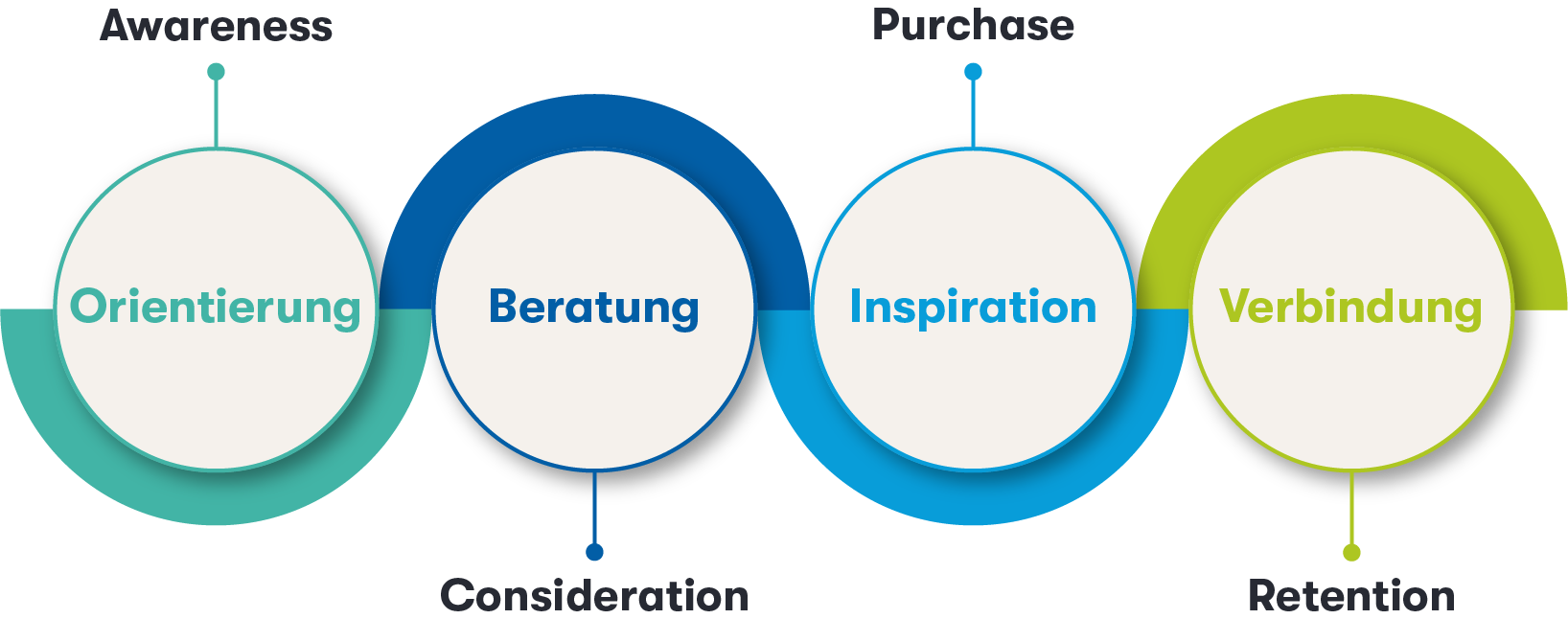
E-commerce personalization can be used throughout the entire customer journey (source: own illustration)
During the awareness phase, the aim is to spark the interest of your shop visitors and make it easier for them to find their way around your online shop.
Personalization options:
Practical tip: The awareness phase is all about making it as easy as possible for visitors to get started. The faster new visitors find relevant content, the more likely they are to stay in the shop and continue clicking through.
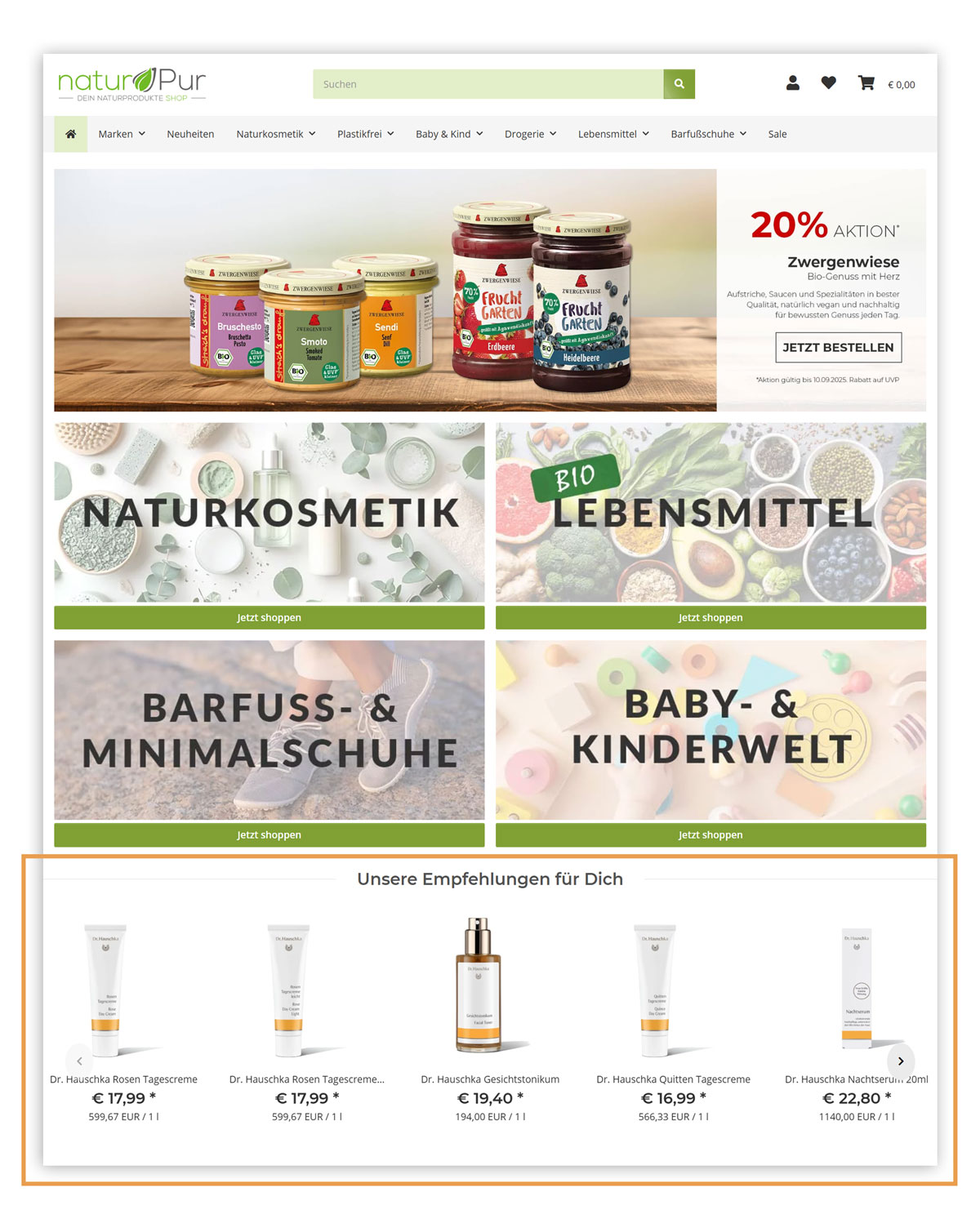
naturPur presents personalized product recommendations for returning users on its homepage, while new customers see the current top sellers (source: screenshot from shop-naturpur.de)
The focus of the consideration phase is on supporting customers in their purchasing decisions and providing them with relevant information and offers.
Personalization options:
Practical tip: Users are specifically searching for information during this phase. The more relevant and personalized your answers to their questions are, the higher the chance that they will choose your shop.
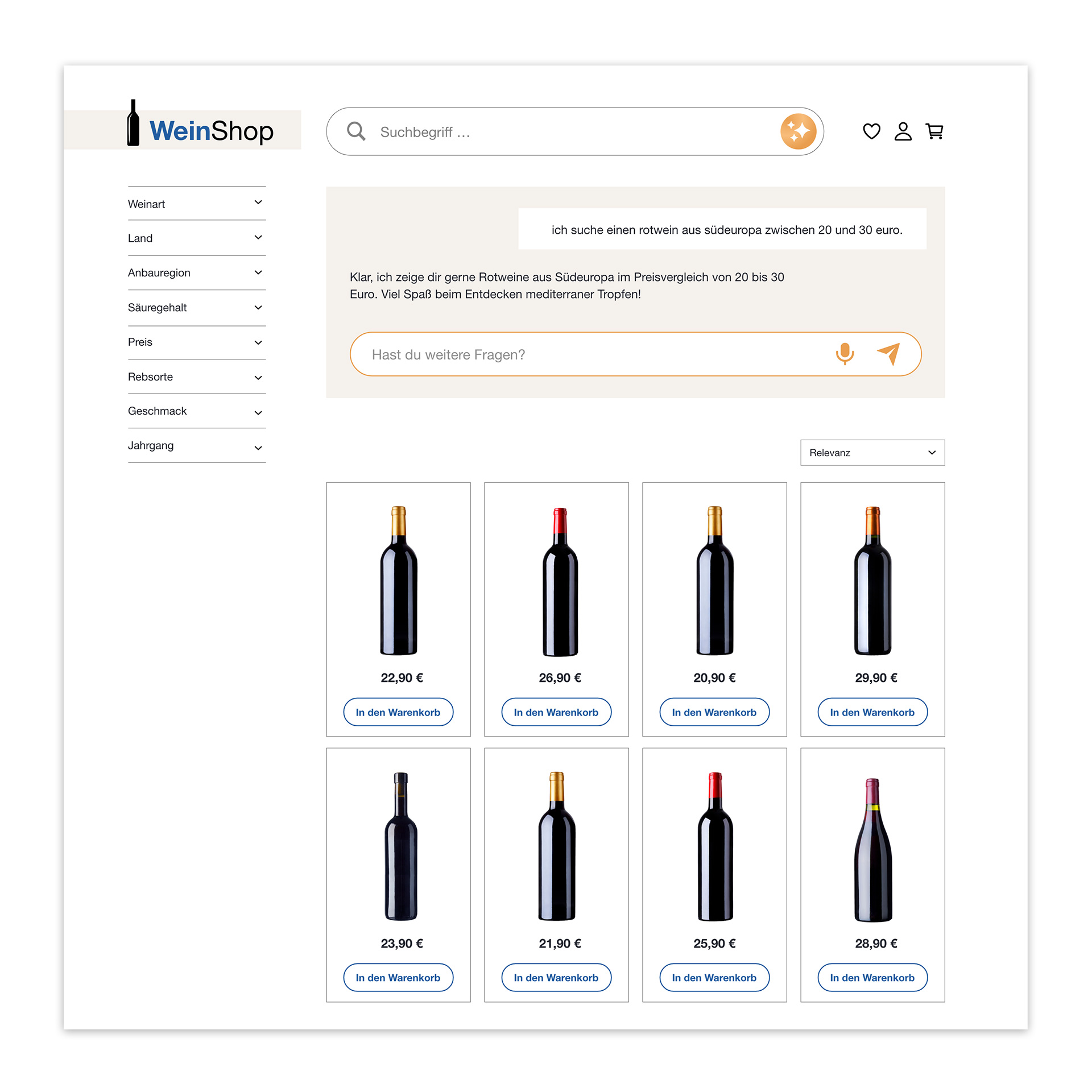
The AI Shopping Assistant offers customers personalized and dialogue-based advice in the online shop (source: own illustration).
The purchase phase aims to inspire customers at the moment of purchase, helping them discover suitable products and fill their shopping carts.
Personalization options:
Practical tip: Keep the purchasing decision as simple as possible. The more relevant your recommendations are, the higher the chance of cross-selling and upselling—and thus of increasing the value of the shopping cart.
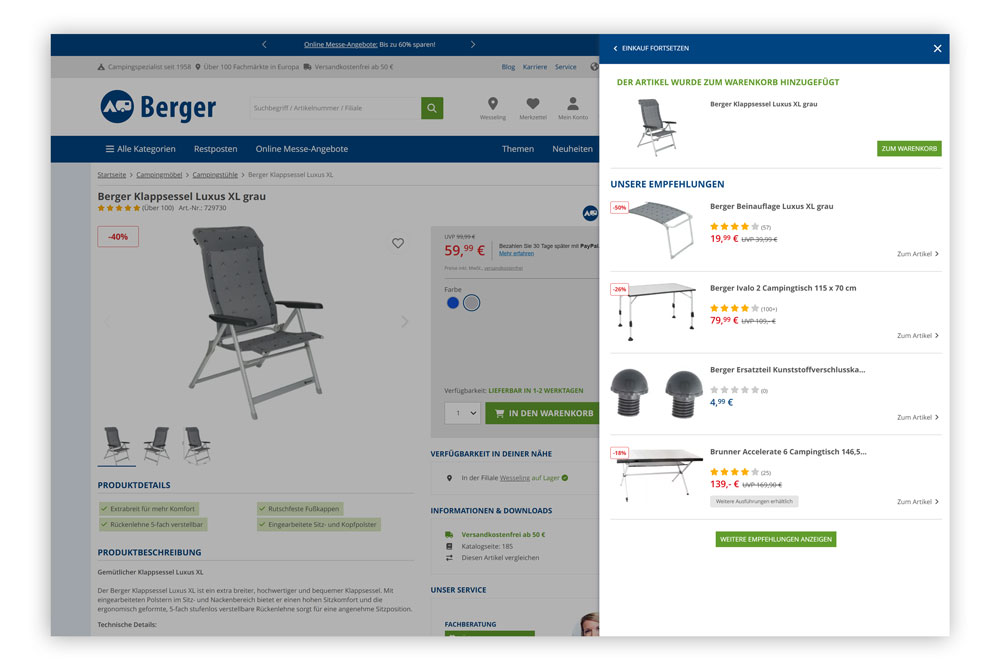
In the shopping cart layer, Fritz Berger recommends matching accessories in the form of other camping items such as leg rests and camping tables after a camping chair has been added (source: screenshot from fritz-berger.de).
The retention phase is about building a connection with your customers after the purchase, encouraging repeat purchases, and deepening the relationship with the store.
Personalization options:
Practical tip: Customer loyalty does not end with the purchase. By offering personalized added value, you increase the repurchase rate and turn one-time buyers into long-term regular customers.
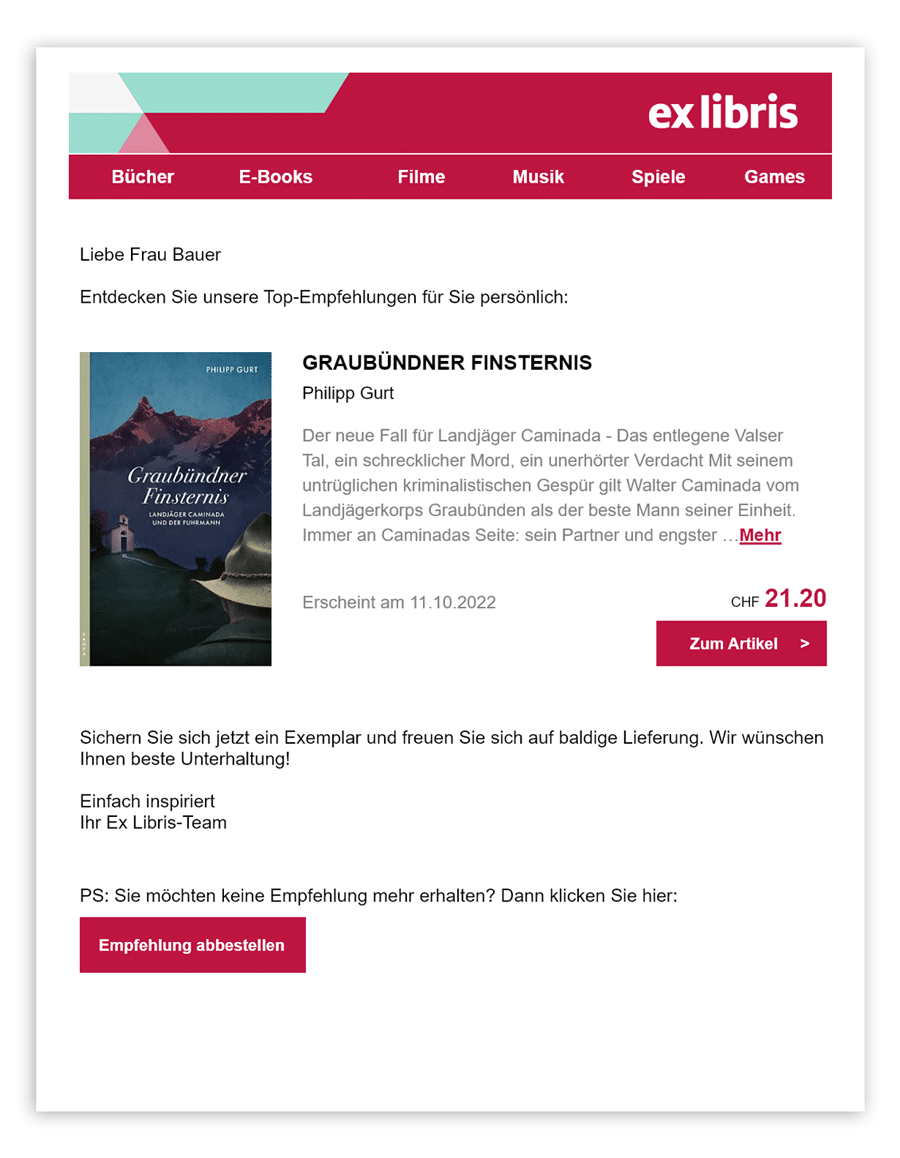
Ex Libris selects suitable recipients based on the product and sends only them an email with the potentially interesting new release (source: screenshot of email from exlibris.ch).
Would you like to learn more about content personalization? Then we recommend reading our blog article on the topic.
Personalization is achieved by using data and intelligent algorithms to tailor the shopping experience to each individual customer. First, the available information—such as the product catalog, customer click and purchase behavior, and domain knowledge (expert knowledge) —is combined into a knowledge base. This knowledge base can be supplemented by external systems such as a PIM, CRM, or merchandise management system and grows as more personalization takes place in the store. Technologies such as reinforcement learning are used for analysis and pattern recognition, supplemented by modern large language models (LLMs) that incorporate complex relationships and contextual information.
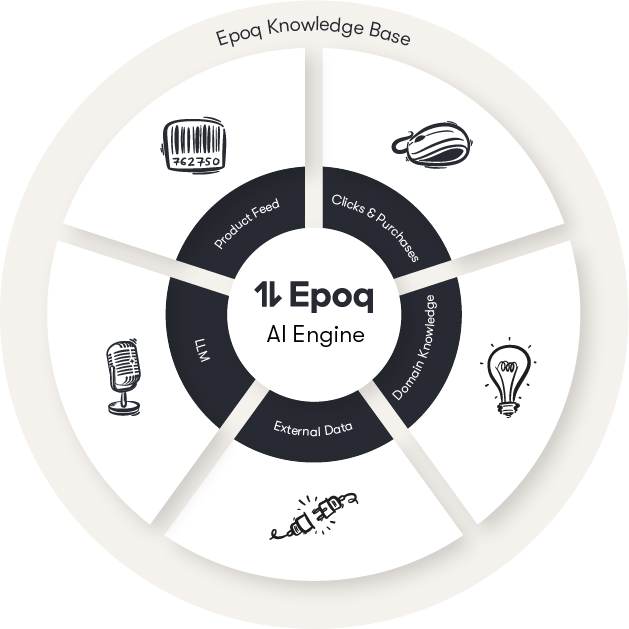
From data to personalized shopping experiences: An intelligent knowledge base links product and user data with LLMs and algorithms to enable individual shopping experiences (source: own illustration)
Another key aspect is real-time personalization: based on current user interactions, the shop can immediately adapt content and recommendations. This enables targeted 1:1 communication throughout the entire customer journey. Personalization can be implemented comprehensively for all phases of the customer journey or limited to individual areas on a modular basis.
Personalization is evident in many areas of the online shop—from the search function to product pages to the newsletter. Concrete examples from real life clearly show how companies have been able to improve their e-commerce metrics by using personalization software:
Outletcity Metzingen increased sales in its newsletter by 44.3%. The company had previously sent out editorially selected category newsletters and is now focusing on AI-supported personalization to further optimize performance. Learn more in the case study.

By using an ecommerce search engine function, NKD reduced the bounce rate in its shop by 62%. The company relies on an AI-supported shop search with all features, offering customers a shopping experience that is just as personalized as in its stores. In particular, this allows the changing product range to be displayed flexibly and campaigns to be highlighted in a targeted manner. You can find more information in the case study.
Stay up to date on personalization: Sign up for the Epoq newsletter. Register now!

A‑Z Gartenhaus was able to increase the click-through rate on its product overview pages by 4.23%. The previously manually created product ranking was replaced by a self-learning, personalized ranking that reduces the amount of work required while delivering better results. Read more in the case study.
You can find more exciting examples and insights into e-commerce personalization at epoq.de/insights.
Personalization in e-commerce offers enormous opportunities to tailor the shopping experience and strengthen customer loyalty—but at the same time, it also presents a number of challenges that need to be considered.
The future of personalization in online shops lies in intelligent, dialogue-based systems that complement traditional personalization systems in a meaningful way. Large language models (LLMs) make it possible to provide customers with individual, context-sensitive support in real time – whether via chat, messaging apps, or voice assistants. AI shopping assistants act as personal sales advisors, answering questions, suggesting suitable products, and guiding customers through the purchasing process.
One exciting prospect is Agentic Commerce—the idea that, in the future, systems will not only provide advice but will also actively make purchasing decisions on behalf of customers. Viewed critically, however, the question arises as to how much control customers are truly willing to hand over to a machine. For everyday reorders, such as groceries or products needed on a regular basis, this can be practical and convenient. When it comes to higher-priced or emotional purchases, however, the willingness to “let the machine decide how to spend the money” is likely to be significantly lower. You can learn more about this topic in our blog post on Agentic Commerce.
You can also find a comprehensive overview of key trends that will shape e-commerce through 2030 in our article on the future of e-commerce.
Personalization opens up enormous opportunities for online shops: it enables individual shopping experiences, strengthens customer loyalty, and can directly lead to higher sales. However, the key to success lies in well-thought-out implementation—from structured data and a central knowledge base to real-time algorithms, continuous monitoring, and data protection-compliant procedures. Those who take these factors into account and introduce personalization strategically and modularly can exploit its full potential: satisfied customers, efficient processes, and sustainable competitive advantages.
Source: ¹Adobe for Business
Personalization in e-commerce means tailoring content, product recommendations, and offers to the behavior, interests, and needs of individual customers. The goal is to create more relevant shopping experiences and increase conversion and customer loyalty.
Personalization can significantly increase conversion rates, sales, and customer loyalty. It enables businesses to target customers specifically, creating a tailored shopping experience that sets stores apart from the competition.
The main distinction is between onsite personalization (e.g., product recommendations, dynamic content, personalized pricing) and offsite personalization (e.g., email personalization, retargeting, push notifications). In addition, omnichannel personalization ensures that all channels are seamlessly connected to create a consistent, personalized shopping experience.
Personalization not only makes the shopping experience faster and more relevant, but also more convenient. Customers find suitable products more easily and feel that they are being treated as individuals, which increases satisfaction and loyalty.
Yes, personalization is scalable and can be used selectively or comprehensively depending on the goal, data availability, and technical maturity of the shop. Each measure builds knowledge and improves future AI-supported personalization along the entire customer journey.
Want to delve deeper into the topic of personalization in e-commerce?
Then download our e-book on the topic!

You are currently viewing placeholder content from HubSpot Embedded Content. To access the actual content, click the button below. Please note that doing so will result in data being shared with third-party providers.
More InformationYou are currently viewing placeholder content from HubSpot. To access the actual content, click the button below. Please note that doing so will result in data being shared with third-party providers.
More InformationYou are currently viewing placeholder content from HubSpot Meetings. To access the actual content, click the button below. Please note that doing so will result in data being shared with third-party providers.
More Information