
E-book – The Comprehensive recommendation system Guide
Learn more about recommendation strategies, areas of application, personalization, and success factors for product recommendations, as well as successful use cases in this guide.

We often encounter product recommendations when browsing online stores. They show us alternative or complementary products, new products, or top sellers. While product recommendations in e-commerce provide customers with inspiration for further purchases, they offer you, as a store operator, the advantage of increasing the value of the shopping cart in your online store. Product recommendations can accompany the user throughout their entire journey in the online shop—from the home page to category and product detail pages to the shopping cart and beyond in emails. In this article, we'll show you where product recommendations make sense in e-commerce and what special features you should consider when displaying recommendations depending on their position in the shop.

Here's what you can expect to find in this blog article:
Product recommendation, Reco Engine, widget – what's behind it all
Distinction between new customers and existing customers
Existing customers: Online shoppers with a history
New customers: Online shoppers without a history
Where product recommendations can be placed in e-commerce
Homepage: Engage users
Product detail page: Relate recommendations to a specific product
Search results page: Show alternatives
Shopping cart: Offer additional products
Thank You Page: More than just order information
Content page: Topic-related recommendations
Newsletter: Real-time recommendations
Why the visibility of your recommendations is crucial
Frequently Asked Questions About Product Recommendations in E-Commerce
Product recommendations are displayed in e-commerce via recommendation systems, or reco engines for short. These provide recommendations that are tailored to the visitor and therefore relevant. These recommendations usually consist of products, but can also include content or similar. The recommendations are presented using widgets. These provide the framework for the relevant product or content recommendations and can vary greatly in terms of design and layout.
Would you like to learn more about the recommendation system and see how it works in practice? Then take a look at our short explanatory video.
You are currently viewing a placeholder content from Default. To access the actual content, click the button below. Please note that doing so will share data with third-party providers.
More InformationBefore we show you where you can sensibly position product recommendations in e-commerce and take a detailed look at the individual pages and their special features, we would first like to make a distinction between new and existing customers. Why is this useful? You need to know that your recommendation system offers you different options for displaying product recommendations – depending on whether a customer has already visited your online store, clicked through the categories and perhaps even bought something, and thus has a history, or whether an online shopper is visiting your store for the first time.
If your customers already have a history, you can use this to display relevant recommendations. Personalized recommendations can be calculated based on your customers' click and purchase behavior. These are particularly relevant because they are tailored to the individual interests and preferences of online shoppers.
You can't make recommendations tailored to the personal interests of customers who are new to your online store—i.e., who don't have a history with you—but you shouldn't miss the opportunity to engage these online shoppers and inspire them with products from your store. Top sellers, interesting sale items, or new products are ideal for this purpose.
Stay up to date on personalization: Sign up for the Epoq newsletter. Register now!
There are many ways to position product recommendations in your online store. Online shoppers can be greeted and inspired with relevant recommendations right on the home page. On the product detail page, you have the opportunity to supplement a customer's selection with items that match the product. In addition, the shopping cart can be used as a checkout area, for example. To help you keep track of the numerous options available to you, here is an overview of positions that are suitable for recommendations in online shops, among other things:
It should be noted that each of the sites mentioned has its own specific features , and the recommendations displayed must be adapted accordingly. To illustrate this more clearly, we have selected a few sites that we would like to discuss in more detail below. We will show you what you should bear in mind with regard to your recommendations on the different sites.
Recommendations are already available on the home page. As mentioned above, you can directly target existing customers here with personalized recommendations. Just as in brick-and-mortar retail, where salespeople know their regular customers and what products they prefer to buy, and recommend items that match their interests, you can also show your customers in your online store that you know what they are interested in.
For example, an online pet store knows that a person is a cat owner and what food they always buy. Accordingly, this customer is immediately shown their preferred food on the home page, as well as other cat products that may be of interest to the online shopper.
Since new customers do not have this information, the homepage could feature top sellers, sale items, or new products, for example.
For example, the bicycle shop ROSE Bikes displays top sellers or personalized recommendations on its homepage based on customer history.
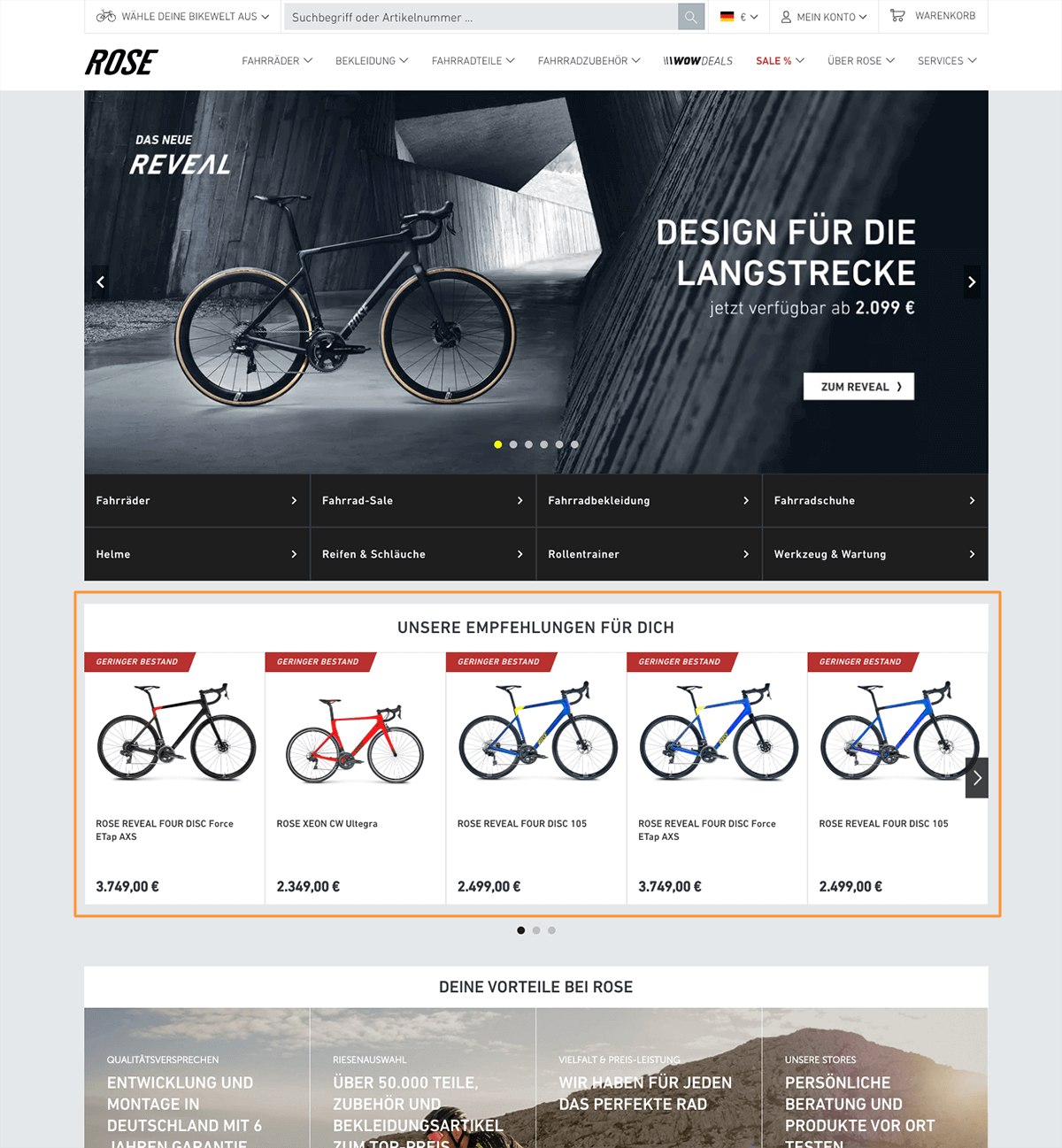
Personalized recommendations on the ROSE Bikes homepage (source: screenshot from rosebikes.de)
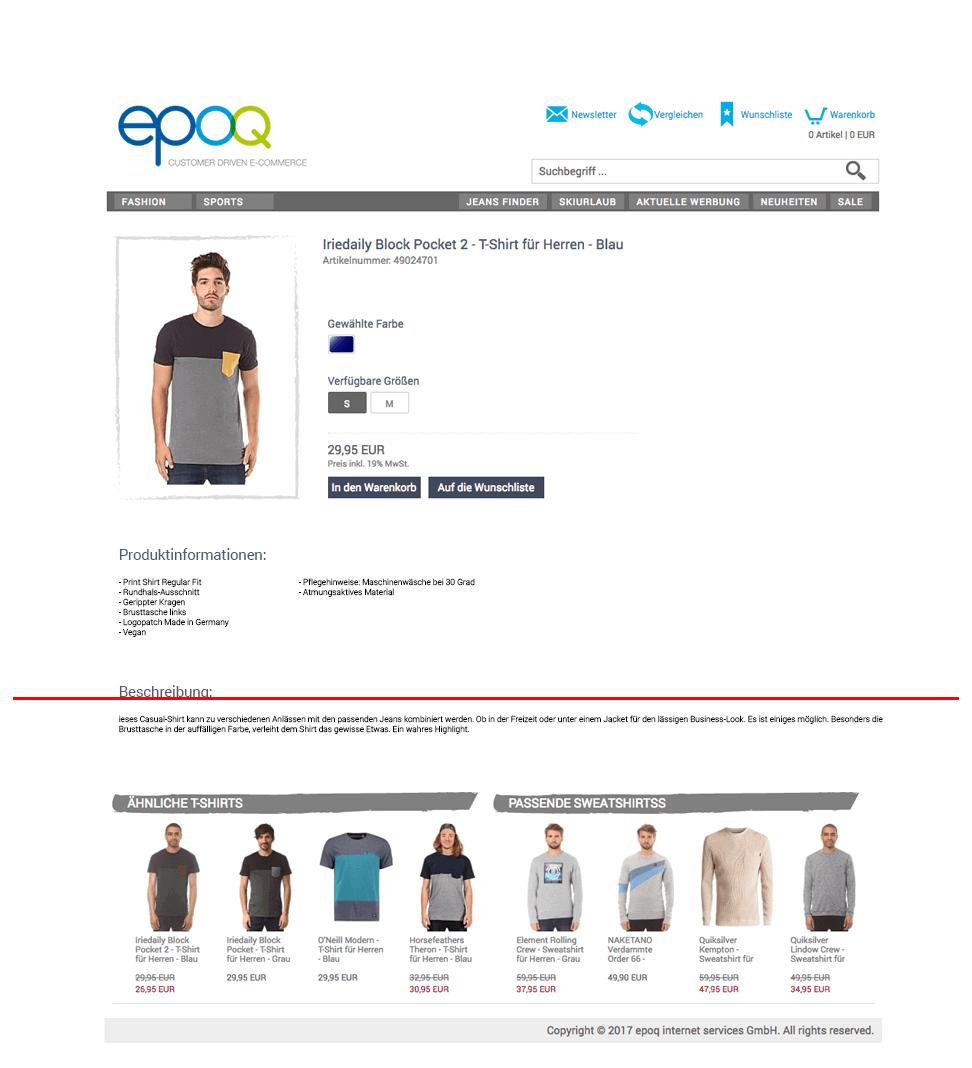
On the product detail page, unlike the home page, there is already a specific product that you can refer to. For this page, two different types of product recommendations are particularly suitable: similar products and matching cross-selling recommendations.
Showcase product diversity with similar items
An online shopper navigates to the product detail page because a particular product appeals to them or interests them more specifically. If they already like the selected item quite a bit but are still undecided about their choice, similar products can show them what else your range has to offer. Here, the customer can become aware of products that may better suit their needs.
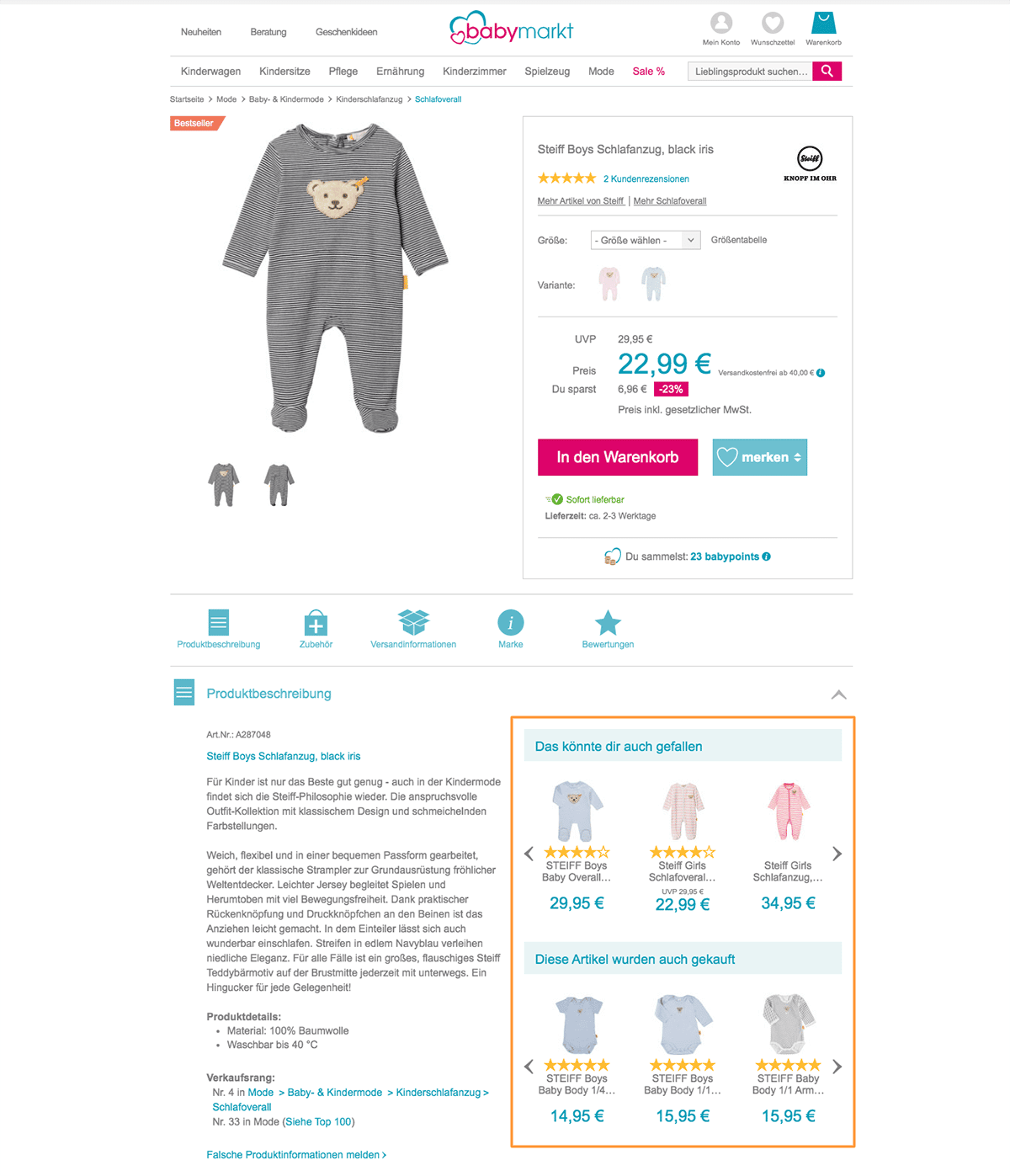
Suggestions for similar items on the product detail page of babymarkt.de (source: screenshot from babymarkt.de)
Supplement your product selection with cross-selling recommendations
Appropriate cross-selling recommendations are also suitable for the product detail page. If the customer is convinced by the selected product, you can inspire them with matching items. You can draw their attention to other products that complement the selected product.
Overall, it is particularly important that the product detail page takes the customer's preferences into account. These include, for example, the size in which they usually buy items, popular brands, preferred materials, and ingredients. The latter is particularly valuable if there are ingredients that a user must avoid, such as lactose in food products.
It is also important to take availability into account and not to recommend products that are currently not in stock. This will help you avoid disappointing your online shoppers.
Create complete looks with product sets
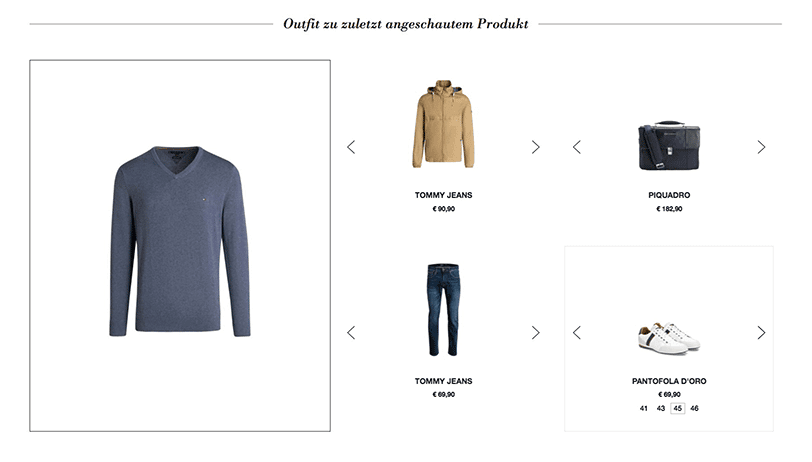
Recommendations that suggest a complete product set for a product are also particularly popular on the product detail page. These are recommendations that present customers with a complete look. Online shoppers can click together a complete set based on a single product. This allows them to quickly put together a stylish outfit or compatible snowboarding equipment, for example. In an online shop for cameras and photo equipment, for example, a set with matching lenses, memory cards, batteries, and carrying cases can be created for the selected SLR camera. The set can then be purchased directly or saved for later.
It can always happen that users search for something in your online store that you don't have in your product range. To prevent your online shoppers from landing on a blank results page and leaving the store immediately because they haven't found what they're looking for, you can use a recommendation widget here too. After all, a visitor should not be considered lost just because their search query does not perfectly match the range of products in your online shop.
Recommendations on the zero results page can show searchers alternatives from your product range. For example, if a user searches for a specific brand that is not in your range, you can recommend products from a similar brand or style. This inspires your customers and keeps them in your shop despite the zero results page.
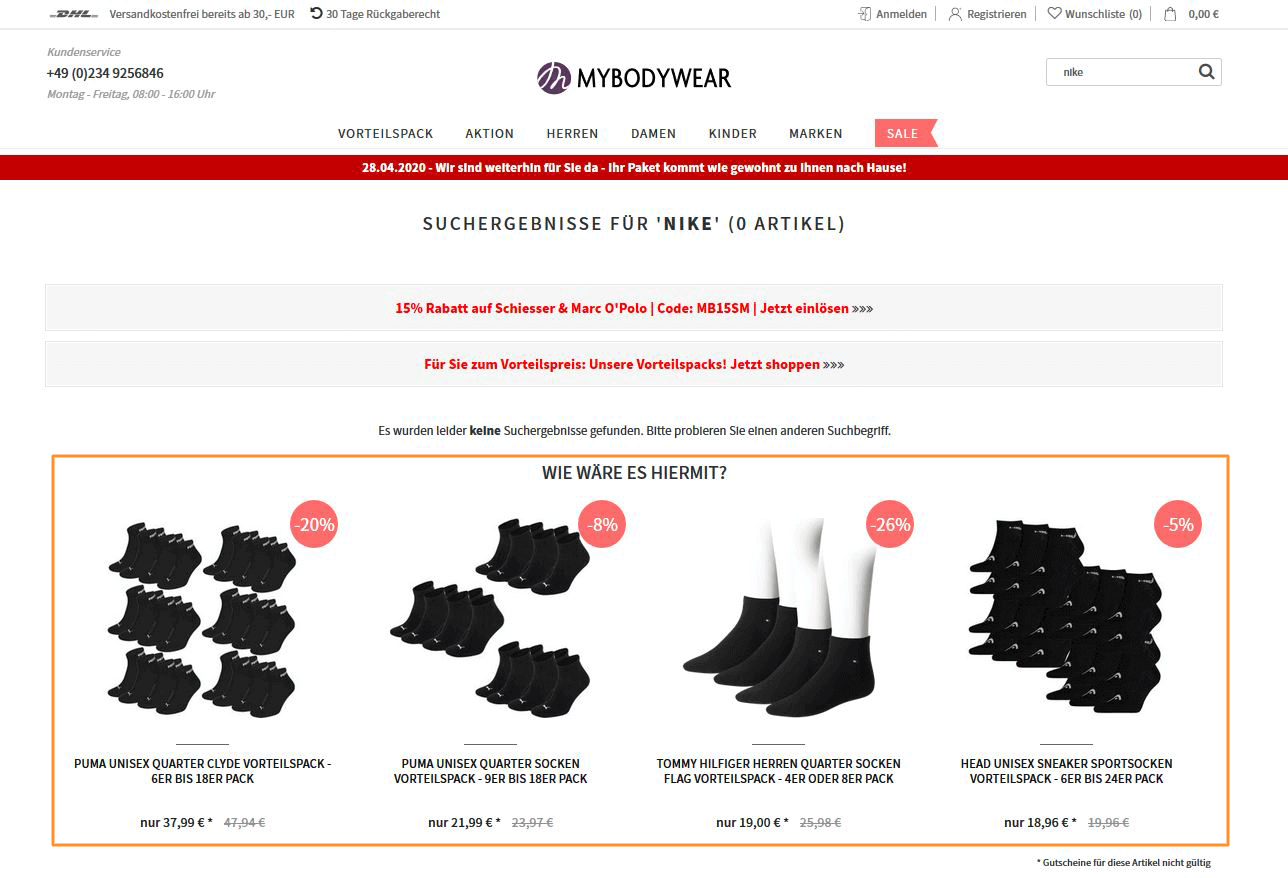
Recommendations for alternative products from similar brands such as "Nike" on the zero results page in the mybodywear.de shop (source: screenshot from mybodywear.de)
You can find more tips on this topic in the blog article Reduce bounce rate | Part 1: 4 tips for dealing with zero-hit pages.
A user has decided on a product and adds it to their shopping cart. Great! That means you're almost there. But the checkout process also offers potential for increasing sales.
Recommendations in the shopping cart layer
By clicking on the "Add to cart" button, you can use a cart layer widget to calculate personalized recommendations in milliseconds and display them via a layer.
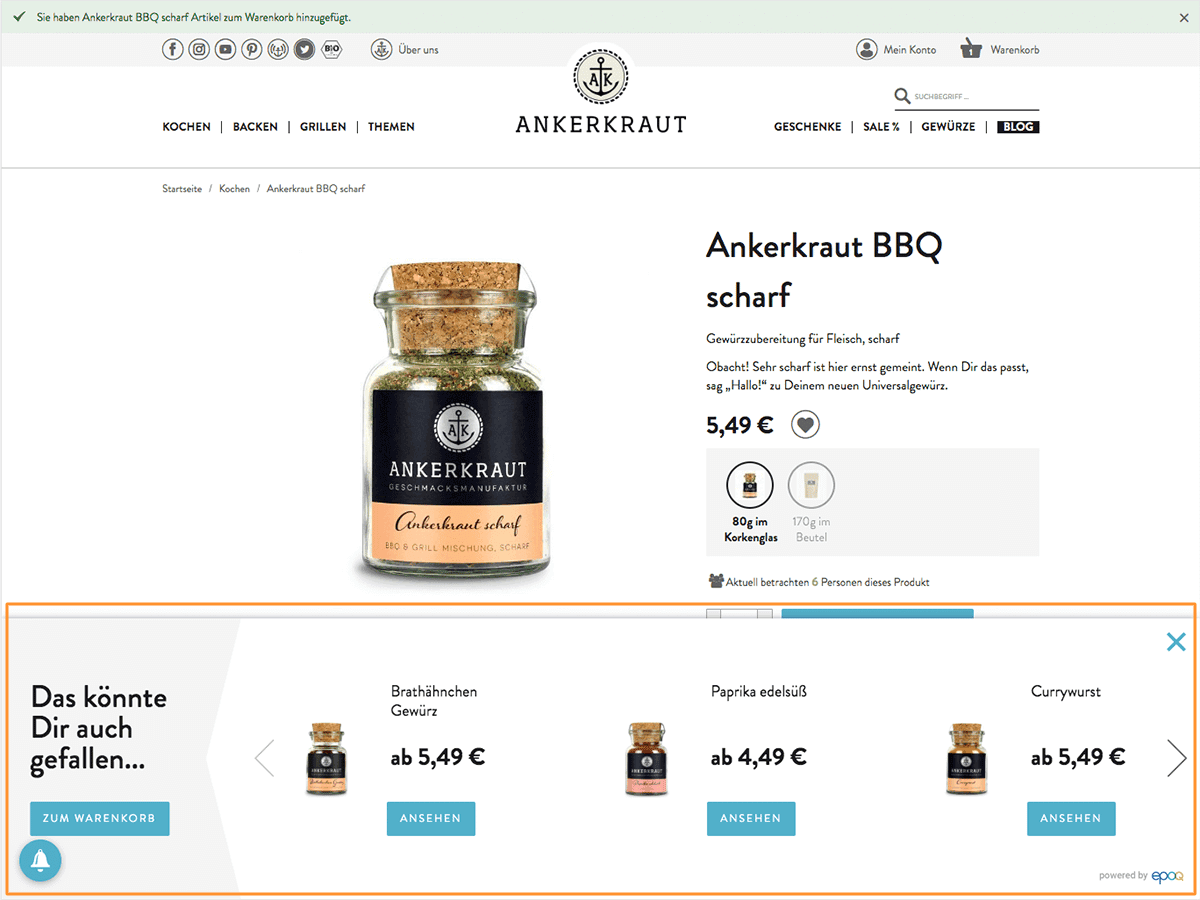
Recommendations in the shopping cart layer at Ankerkraut (source: screenshot from ankerkraut.de)
Recommendations on the shopping cart page
But you can also use the shopping cart page itself to display recommendations. It is important to note that you should not show similar products in the shopping cart. This could unsettle the online shopper in their decision. Personalized cross-selling items are more suitable here. Additional products that complement the original product or cheaper cross-selling items are often purchased together and are therefore ideal for increasing the value of the shopping cart. You can set up a checkout area in your shopping cart which, similar to brick-and-mortar stores, encourages customers to purchase cheaper small items.
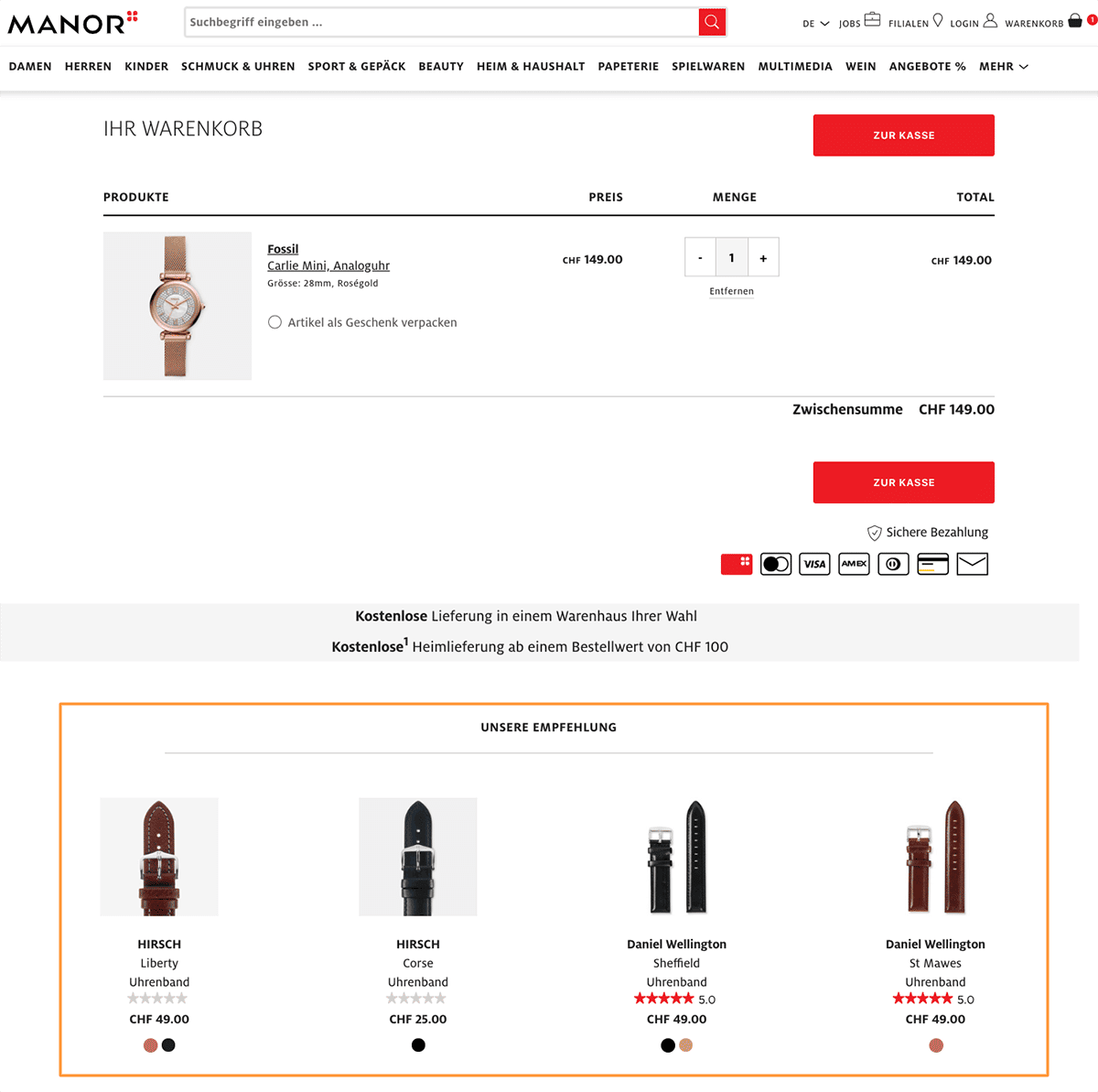
Personalized recommendations for matching additional items in the shopping cart at MANOR (Source: Screenshot from manor.ch)
You have two different options for the recommendations in your shopping cart. You can take the entire shopping cart into account for your product recommendations, or you can base them only on the most recently added product. Depending on the shop, one or the other may be more effective.
The notes on the recommendations in your shopping cart can also be transferred to the wish list in your online shop.
You can find more information about the checkout process and the potential it offers in the blog article Discover revenue potential in your checkout process.
A thank-you page is also a good place for product recommendations. This page should not only contain information about the order, but can also serve as a source of inspiration. With appropriate, relevant recommendations, you can ideally direct customers straight back to a product detail page and keep your users in your shop for longer.
Stay up to date on personalization: Sign up for the Epoq newsletter. Register now!
You have now learned that relevance is key when it comes to recommendations. However, it can sometimes still be useful to manually expand the relevant recommendations with regard to certain attributes. You can use this, for example, if you have planned a specific marketing campaign or want to place your recommendations on thematic content pages.
By combining content and topic-related product recommendations, you can use digital storytelling to engage your online shoppers on an emotional level. You can create a digital story on any topic, such as a skiing vacation or surfing trip. The combination of content and e-commerce—known as content commerce —creates a whole new feeling of online shopping, moving away from purely functional product providers to an emotional shopping experience.
We'll show you what such a content page could look like in an online shop. Our example focuses on the topic of surfing trips. In addition to information and stories about the perfect surfing trip, the page primarily offers visitors inspiration in the form of thematically relevant product recommendations.
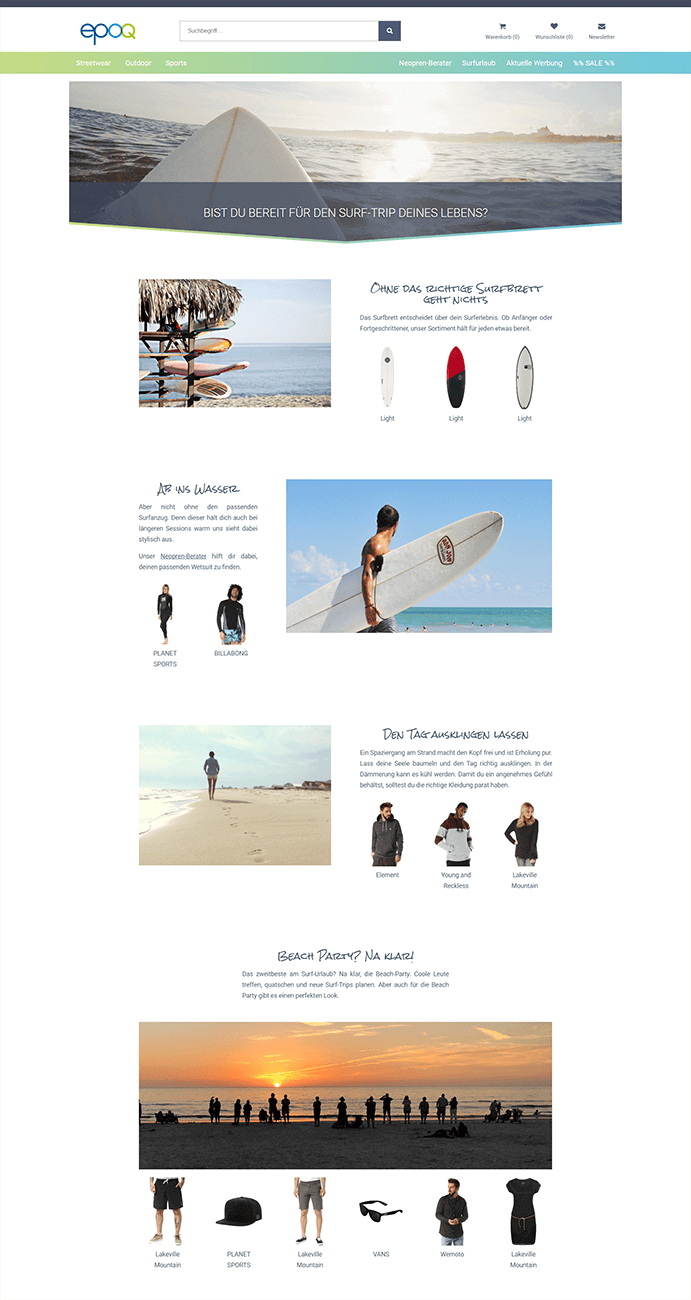
Example of a content page with product recommendations related to the topic of 'surfing trips'
Are you curious and want to learn more? In our blog article Content Commerce: Creating Online Shopping Experiences Through Content, we give you a deeper insight into creating emotional shopping experiences.
Product recommendations in e-commerce are not only useful directly within your shop. You can also include them in your emails and newsletters, for example. It is also particularly important that these are personalized and therefore take into account the individual preferences of your customers.
Since your email recipients read your newsletters and email campaigns at very different times, it is particularly important that the recommendations are calculated in real time when the email is opened. This is the only way to ensure that all information (such as the availability of items) can be taken into account.
You also have various options for displaying different types of recommendations:
Cross-selling recommendations
Depending on the email you send, you can tailor your recommendations to the content. For example, if it is an order confirmation email, you can recommend products that complement the purchased item, similar to the thank you page.
Alternative product recommendations
If you want to remind inactive customers of the product left in their shopping cart after abandoning it, you can suggest similar items or product alternatives.
Topic-related recommendations
Newsletters also offer the opportunity to highlight a specific topic and tailor the relevant recommendations accordingly. With the help of theme worlds, you can adapt personalized content in your newsletter to the topic of the newsletter and thus send out topic-specific newsletters. In the Planet Sports newsletter, for example, a theme world was set up for a Naketano brand sale promotion.
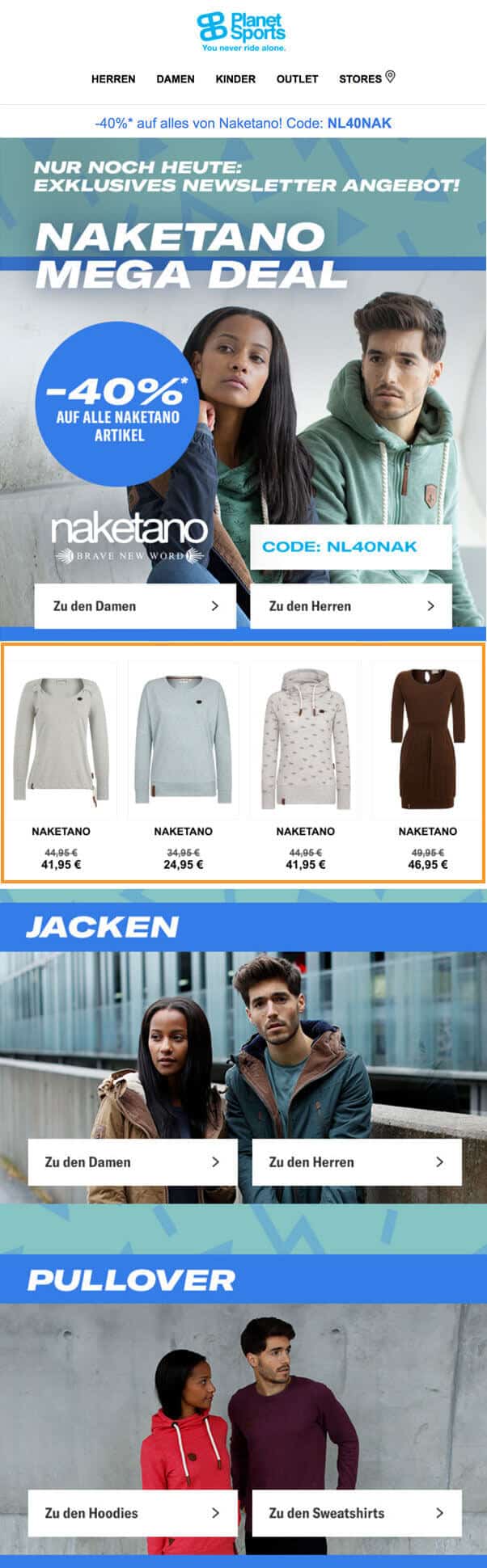
Personalized recommendations in Planet Sports' topic-specific newsletter (source: screenshot of email from planet-sports.de)
In order for recommendations to receive the desired attention and achieve the expected effect, it is crucial that they are positioned in such a way that users can see them. For example, it is important that recommendations are not displayed below the fold. This is because users will only see them if they scroll down at least once. Experience has shown us that only about 20% of recommendations below the fold are actually seen. This means that even if perfectly matching products are recommended that the visitor would actually buy, in 80% of cases they will not see them and will leave the store without interacting with them.
This, in turn, also has a negative impact on the quality of the recommendations displayed. Without interaction with the recommendations displayed, the recommendation system cannot learn and optimize itself effectively.
So if your recommendation system is set up correctly but the recommendations are not being seen, you are wasting valuable potential and ultimately also revenue. For this reason, positioning on the individual pages of your online shop also plays a very important role. Make sure that your product recommendations are noticed by your customers so that they interact with them.
Are you interested in product recommendations in online shops and would like to learn more about the different options available and how integration works? Then we recommend reading our blog article Recommendation Widget: Options and Implementation.
Product recommendations in e-commerce offer a win-win situation: your users are inspired while shopping and discover new products, and you, as the shop operator, increase the shopping cart value and thus your sales. To exploit the full potential of a recommendation system in your online shop, you should display recommendations in various positions, each adapted to the page and its specific features. Consider what the customer expects and needs on the respective page and recommend relevant products from your range accordingly. Make sure that online shoppers actually see your recommendations and bring your customers back to your shop with real-time recommendations in personalized emails. The use of product recommendations offers a lot of potential and numerous possibilities – now it's your turn to implement this in your online shop!
Product recommendations are personalized or rule-based suggestions for products that inspire customers while they shop or help them make choices. They are often displayed through recommendation engines and widgets.
Product recommendations can be strategically placed in many areas of the online store. They can be used on the home page, category pages, product detail pages, results-empty pages, in the shopping cart, on the wish list, on the thank-you page, on content pages, and in newsletters, among other places.
For existing customers, personalized recommendations based on their purchase history are effective. For new customers without a purchase history, top sellers, sale items, new products, or popular categories can be useful.
On product detail pages, similar products, cross-sell items, and complete product sets are good options. It's important that recommendations align with the product being viewed and the customer's preferences.
Similar products can make customers in the shopping cart feel uncertain, causing them to second-guess their decision. Complementary cross-selling products that meaningfully expand the shopping cart are a better option.
They draw customers' attention to additional, related, or complementary products. If the recommendations are relevant and prominently displayed, customers are more likely to purchase additional items.
Recommendations are only effective if they are seen. If they are placed too far down the page, fewer users will interact with them—which means revenue potential goes untapped and the recommendation engine receives fewer learning signals.
Learn more about the use of recommendation systems in e-commerce.
Request your e-book now!

You are currently viewing placeholder content from HubSpot Embedded Content. To access the actual content, click the button below. Please note that doing so will result in data being shared with third-party providers.
More InformationYou are currently viewing placeholder content from HubSpot. To access the actual content, click the button below. Please note that doing so will result in data being shared with third-party providers.
More InformationYou are currently viewing placeholder content from HubSpot Meetings. To access the actual content, click the button below. Please note that doing so will result in data being shared with third-party providers.
More Information