Back to overview
  • Reduce Return Rate

Advise and persuade with social proof in e-commerce

  • Published June 7, 2022
  • Nadine Roth
  • Reading time: 10 min.

People are herd animals: other people's arguments convince us more than advertisements. That's why social proof plays such an important role in e-commerce. In this article, you'll learn what the term means, how social proof elements can play an advisory role, and how the phenomenon can help you increase your conversion rate. We will also provide you with numerous examples of social proof that you can use in your online shop.

The picture shows three people looking at a smartphone.

What is social proof?

Social proof can be translated as "social evidence" or "social validity." It is a psychological phenomenon: people incorporate the actions of others into their own decision-making. We orient ourselves toward the behavior of others in order to find the right path for ourselves. This gives us security, in the sense that "everyone is doing it, so it must be right."

An example from everyday life: When someone looks up at the sky, the other people around them do the same to see what is happening up there.

In many cases, a group of people serves as the behavioral reference. But a single authority figure can also inspire action: an expert in the field, an influencer, or a celebrity.

According to sales and motivation coach Cavett Robert, social proof is the strongest argument for convincing others.¹ That is why it plays such an important role in online marketing and, more specifically, in e-commerce.


Social proof – an important component in e-commerce

In online shops, social proof serves as a reference and purchasing advice for visitors. When many other customers rate a product positively, it strengthens the credibility of the brand. In addition, case studies, testimonials, or experience reports allow visitors to assess the extent to which a product or service meets their expectations. This provides them with indirect advice. Building and strengthening credibility plays an important role both at the beginning of the customer journey and in the subsequent phases leading up to the purchase.


Stay up to date on personalization: Sign up for the epoq newsletter. Register now!


Social proof also improves Google rankings. The reason: Google analyzes the credibility of a domain partly based on how important a company appears to be to users. If they discuss or link to a particular online store on social media, Google rates the credibility of that store higher.

Advantages of social proof for online shops

Credibility and trust in a brand are the main goals that shop operators want to achieve with social proof. They ensure a higher conversion rate and ultimately more sales. Social proof also offers other advantages.

Reduce support requests

When visitors to an online store have questions about products or services, they often contact customer support. However, social proof such as case studies, reviews, or testimonials can answer many of these questions. This reduces the number of support requests, allowing you and your service team to focus on other important matters.

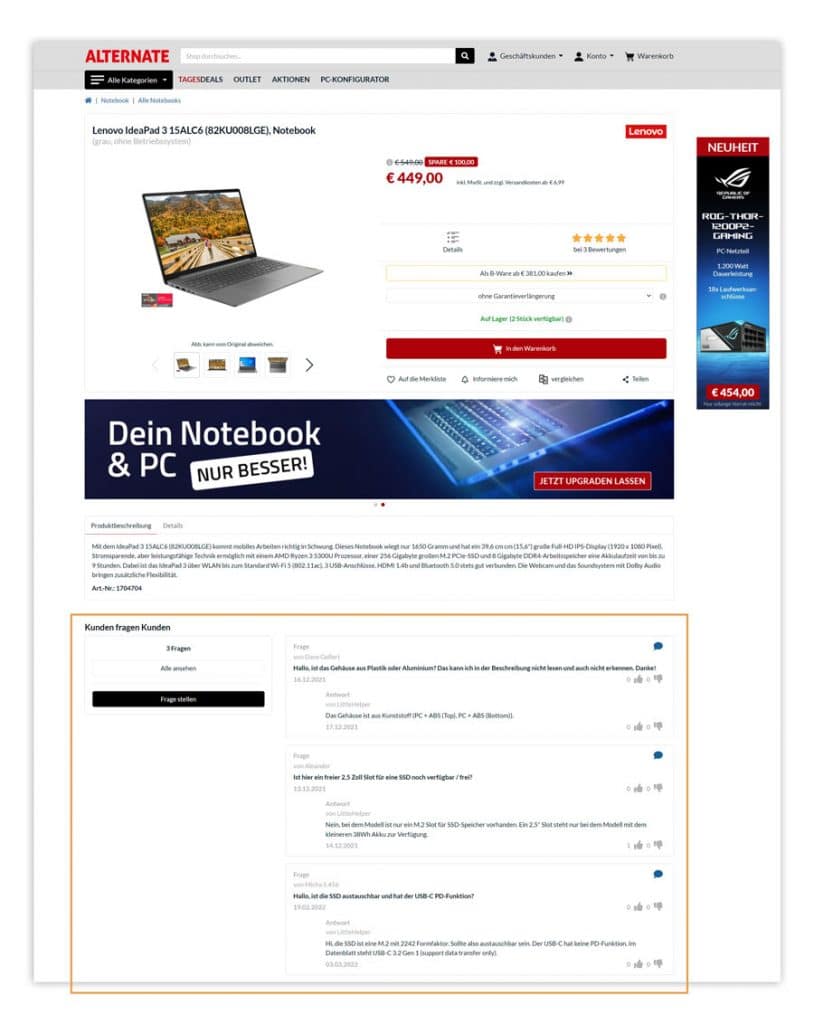
ALTERNATE offers a section on product detail pages called "Customers ask customers," where users can answer each other's questions.
(Source: Screenshot from alternate.de)

Reduce return rate

Customer reviews and case studies give shop visitors a good impression of what they can expect from a product or service. Social proof can therefore also help you reduce the return rate in your online shop. This is because information from other users helps shop customers make an informed decision. This reduces the risk of them not liking the product. In the fashion sector, the experiences of other customers, expressed in comments such as "Runs large, better to order one size smaller," can prevent returns in advance, as other shop visitors take this information into account when placing their orders.

Reduce customer churn

Social proof also helps to reduce customer churn. This refers to the percentage of customers who have stopped buying from a particular company. This metric is particularly important for online stores that offer subscriptions to their services, such as Netflix or Amazon Prime. The more trust customers have in a brand, the more stable their relationship with the company will be.

Improve customer loyalty

Customer loyalty is also improved by social proof. After all, satisfaction and trust are the basis for a long-term relationship with customers. Based on the reviews of other users, shop visitors can assess how satisfied other customers are with the company and its products. Positive testimonials strengthen trust and the effect of social proof takes hold: because other customers trust this online shop, I can too.

Examples of social proof in e-commerce

You can integrate various social proof elements into your online store. These include reviews, testimonials, quotes, case studies, and trust icons. Below, you will learn how to use these and other elements.

Case studies

Case studies allow you to demonstrate the value of your products or services. Using a customer example, you can show the challenges this customer faced, their requirements, and how your product or service ultimately solved the problem. This provides your shop visitors with concrete illustrative material that helps them make a purchase decision. You can include a teaser for the case study on the product detail page or link to the case study detail page.

Quotes

Use testimonials from satisfied customers on your website to build trust among your visitors. You can include statements about your company in text or video format, for example on a separate reference page.

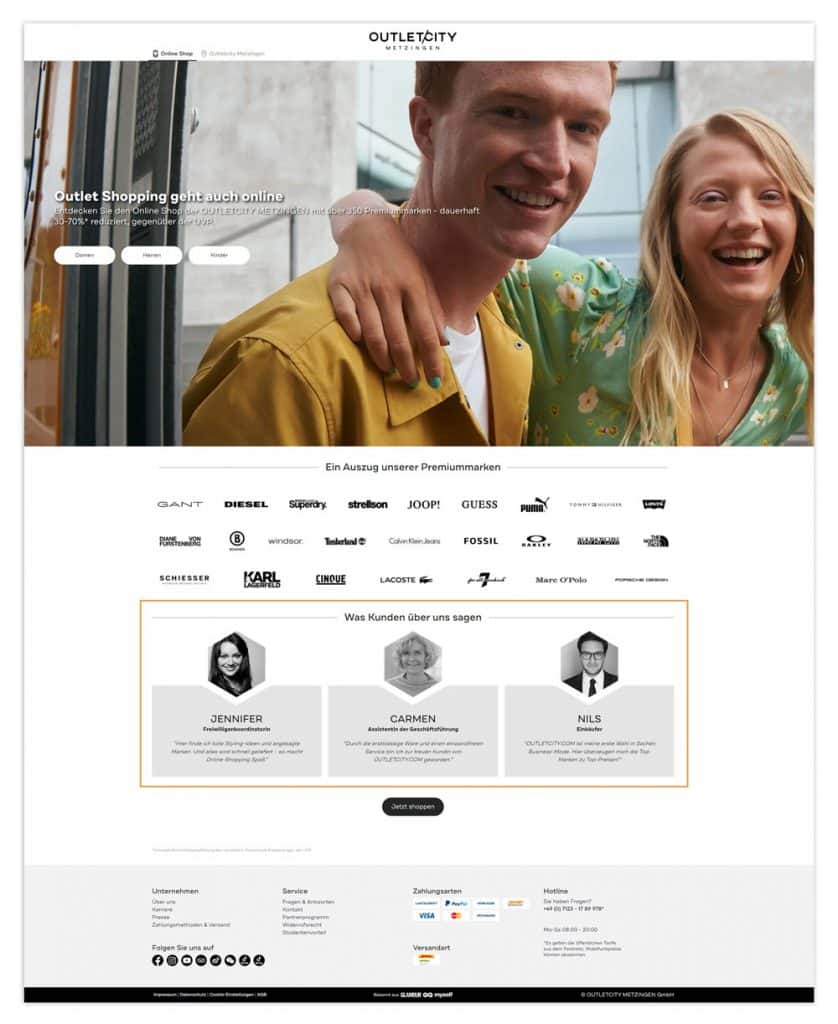
Outletcity Metzingen uses customer quotes and incorporates them in the form of text and images on its shop page.
(Source: Screenshot from outletcity.com)

reviews

When other customers review products and services from an online store, it not only increases credibility. Similar to a case study, store visitors get a concrete picture of the product, which makes it easier for them to decide whether to buy. In addition, you can use these reviews or excerpts from them for your social media marketing, thereby attracting the attention of other potential customers. Reviews also serve an advisory purpose, as other customers share their experiences with the product and point out, for example, what you should look out for when making a purchase.

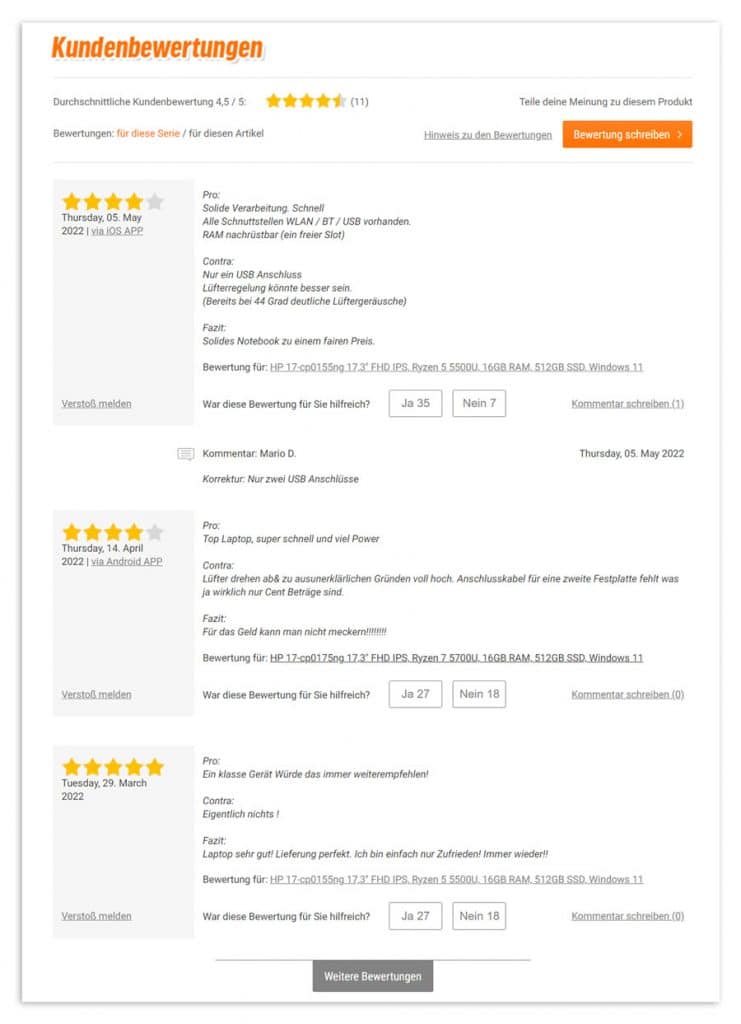
Customer reviews, such as those on notebooksbilliger.de, can help other users make purchasing decisions.
(Source: Screenshot from notebooksbilliger.de)

If you want to provide your customers with even more targeted support in their product selection, you can also use an AI shopping assistant. This LLM-based online product advisor determines the needs of online shoppers and suggests suitable products from your range.

social media integration

You can use social media as social proof in two ways: first, by allowing your customers to share content from your website on Facebook, Twitter, and other platforms. For example: "I just bought this product on XYZ." The second way is to incorporate what people are saying about your store and your products on social media into your website. For example, you can display relevant tweets, Instagram pictures, or Facebook posts.

Trust Icons

Trust icons lend credibility to your online shop. In e-commerce in particular, many potential customers are reluctant to disclose their sensitive data if they do not trust a shop. By placing trust seals on your website, you show your shop visitors that it is a reputable online shop and that their data is secure.

You can place the trust icons on the home page, in the footer, on the product detail pages, and/or at checkout. Trust badges include Trusted Shop, accepted payment methods (Visa, Mastercard, PayPal, etc.), or seals for SSL certificates. It is best to use official trust seals and provide the necessary links to show shop visitors your actual certification.

A-Z Gartenhaus builds trust through various trust icons placed in the footer area. (Source: Screenshot from gartenhaus-gmbh.de)

Data, figures, facts

Information about the number of your customers or newsletter subscribers, customer satisfaction rates, or the high number of downloads of an e-book are also ways you can integrate social proof into your shop. They create trust and increase the conversion rate. Examples of this type of social proof include "Customer satisfaction: 95%," "More than 10,000 downloads," or "Get our free newsletter, trusted by 350,000 marketing experts."


Stay up to date on personalization: Sign up for the epoq newsletter. Register now!


User-generated content (UGC)

More and more online shops are using user-generated content as social proof. They encourage their customers to report on the products and services they have purchased in short videos and blog posts. You can then use UGC for your marketing campaigns on social media platforms. By tagging the creators of the content, you can reach these people's social networks and increase your reach.

Conclusion: Social proof is one of the most compelling arguments for shop visitors.

Alongside optimal product advice, social proof is one of the most important elements for success in e-commerce. This is because positive opinions and testimonials from customers about your products or services are unique selling points. They can convince your shop visitors to trust your online shop and buy from you. This increases the conversion rate and ultimately generates more sales. Since some of these elements also have an advisory effect, you can also reduce the return rate.

Sources: ¹ Convertize, ² Orange SEO

Frequently asked questions about social proof in e-commerce

Would you like to learn how to reduce your return rate?

Schedule a web demo on this topic now.

Nadine Roth
Online Marketing Manager - Social, Email & Events
At the time of publication, Nadine Roth was working as an online marketing manager at Epoq. She was responsible for email, social media, and event marketing, where she handled the planning, design, and implementation of various measures. She also supported the marketing team in content creation.