Back to overview
  • Reduce Return Rate

Return rates in online retail: background and opportunities

  • Published March 25, 2022
  • Sarah Birk
  • Reading time: 8 min.

The return rate is crucial in determining whether your online store is profitable or not. That's why there is hardly a more important metric. It indicates how many items are returned in relation to sales. Here you can find out what types of calculations there are for the return rate, how good your rate is in comparison, and how you can improve it to your advantage.

A woman unpacks a package of shoes and smiles contentedly.

Return rate in online retail: definition and significance

A return is an ordered item that the customer sends back. The return rate compares the number of returns to the number of sales. In online shops, the return rate is often significantly higher than in brick-and-mortar stores because more customers send items back. It is therefore important to keep an eye on this key figure, reduce it, and handle returns as efficiently as possible so that items can be reused.

Three methods for calculating the return rate

There are three different ways to calculate the return rate in online retail:

  • Alpha return rate: Return transactions divided by the total number of transactions.
  • Beta return rate: Returned items divided by the total number of items shipped.
  • Gamma return rate: Value of returned items divided by the value of shipped items.

Stay up to date on personalization: Sign up for the epoq newsletter. Register now!


Each of these return rates allows you to find out more precisely how many goods are being returned and whether the disadvantage for you is more organizational or financial in nature. This also allows you to find the right lever to reduce the return rate more quickly.

Tracking the return rate

As a general rule, you should record every return, including the items it contains, upon arrival. Special programs such as returns management software or returns portals can help with this. If your company does not handle returns itself, you will receive the relevant values from your service provider.

Impact of the return rate on sales

In 2020 alone, an estimated 315 million packages were returned.¹ The extent of the resulting decline in sales depends heavily on the type of items sold and the industry. However, the impact of the return rate on sales and profits in online retail is significant.

It can be even more important for sales to inform customers transparently and visibly about the online shop's return policy. A lack of information in this regard is a common reason why customers do not place an order in the first place. More than half of all customers in Europe always check the return policy before making a purchase.²

If there are no return policies, or if customers perceive them as unfair, this has a greater impact on sales than returns themselves.

Optimizing the returns process and efficient returns management are important success factors for an online store. As an online retailer, you should note that a high returns rate is not only detrimental to sales. More importantly, it reduces margins and profits and can be one of the decisive factors in making an online store uncompetitive.

The average return rate in online retail

The return rate in online retail depends on various factors, such as the industry or product category, but also on the demographics of the target group. Germans are European champions when it comes to returns: 65 percent of customers return products they are dissatisfied with. The European average is 52 percent, with the French bringing up the rear at 43 percent.

This means that returns are common: around 16.3% of all packages are returned, affecting roughly one in eight items.⁴

In addition, the EHI retailer survey revealed further significant differences in terms of the item-related return rate in Germany:

  • For 65% of the companies surveyed, the beta return rate was 10% or less.
  • 8% of respondents report a beta return rate of close to 0.
  • 12% of retailers have a beta return rate of more than 40%.
  • 6% of retailers have a beta return rate of over 50%.⁴

Factors influencing the return rate

One important factor is that the return rate varies significantly depending on the industry. Returns are most common in the fashion industry, for example, where the return rate is around 46 percent.⁵ In addition to country and industry, another factor is important when evaluating the return rate in online retail: the price of the items sold. Returns are less common for very inexpensive items.

In addition, there are effects that are beyond the control of online retailers. For example, the return rate fell significantly during the coronavirus pandemic.⁶ There are many reasons for this: on the one hand, there were more purchases that were aimed at clear necessities and not just desires.

On the other hand, even customers who were generally reluctant to return items tried online shopping for the first time in some cases. This is also evident from the fact that large and well-known online shops saw significant growth without an increase in the return rate. At the same time, however, smaller companies struggled with "impulse purchases" where customers never intended to actually keep the product.⁷

Evaluation of the return rate

The return rate is therefore not a key figure that can be easily compared across companies and industries. Instead, it makes sense to compare it with other KPIs. Above all, your own contribution margins determine whether a return rate is problematic or not. The costs for goods, packaging, shipping, marketing, and overhead for the online store must leave enough contribution margin for it to make a profit. A comparison with the beta return rate for individual products helps to determine which of them are profitable.

The most common reasons for returns in online retail

To know how to prevent returns, it is important to understand why customers return the goods they have ordered. The reasons most frequently cited by customers are:

  1. Product too large or too small (58.2%)
  2. Defective goods (41.3%)
  3. Poor workmanship (28.9%)
  4. Appearance different than described (26.4%)
  5. Does not function as described (22.3%)⁸

Customers return goods much less frequently because they can get the product at a better price, only wanted to look at the product, or found it too complicated to use.


Stay up to date on personalization: Sign up for the epoq newsletter. Register now!


Important factors for reducing the return rate

The reasons for returns already indicate which factors are suitable for reducing the return rate in online retail:

    • Meaningful product description and presentation: This ensures that customer expectations and the product are much better aligned.
    • Personalization: When you offer your customers products that are truly relevant to them, not only does your conversion rate increase, but your return rate also decreases thanks to personalization.
    • Faster and error-free shipping: The longer the shipping time, the higher the risk of returns.
    • Customer survey: If you find out exactly why customers are returning a particular item, you can reduce the return rate or remove products that are not of sufficient quality from your range.
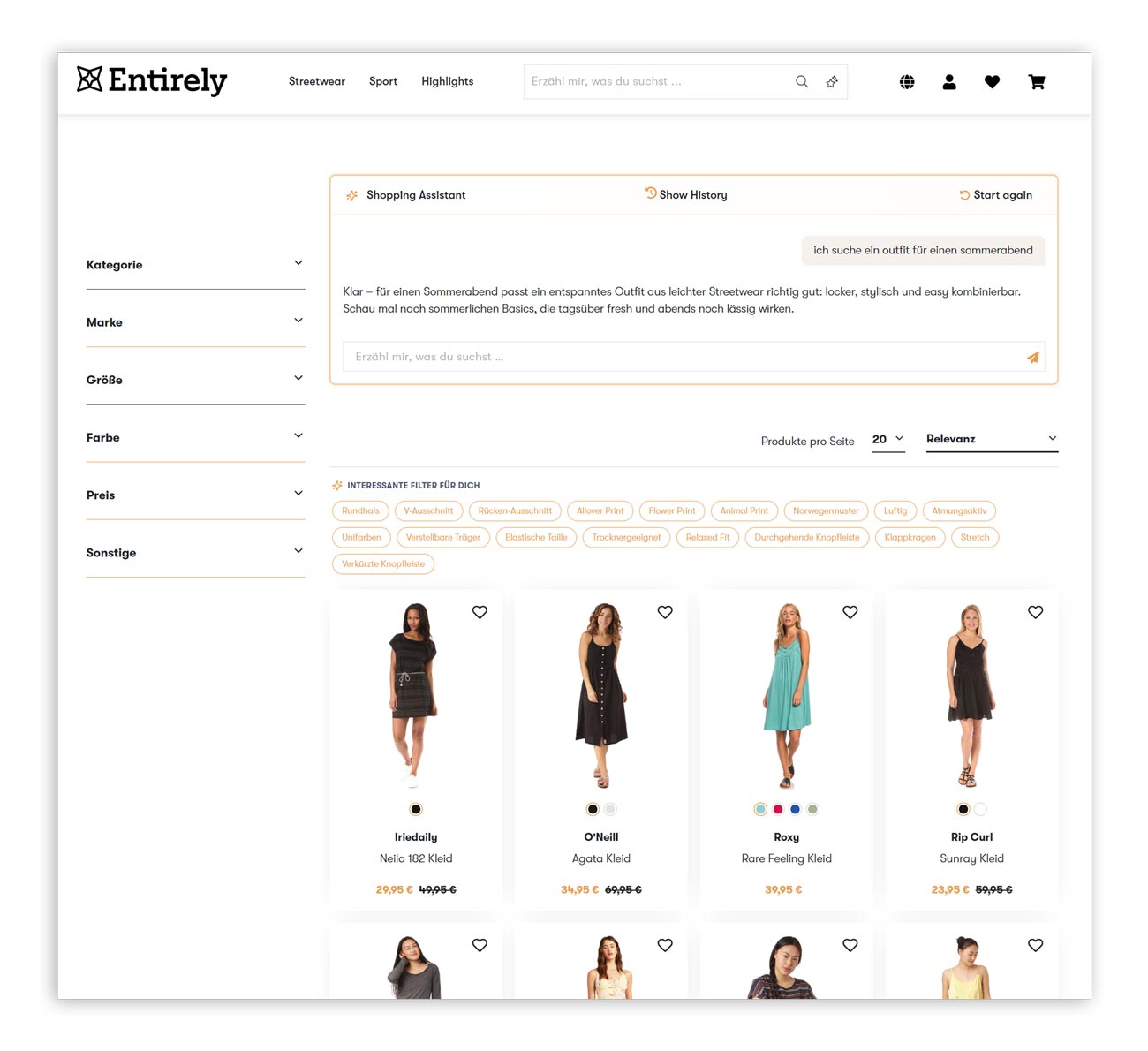
    • Train support staff and offer advice: If customer service representatives are familiar with their own product range, they can better advise customers and thus prevent errors. Digital product advice in the form of an AI shopping assistant is also particularly effective.

The AI Shopping Assistant helps customers choose the right product and can thus contribute to reducing the return rate
(Source: Own representation)

You can find more information on reducing return rates through personalized advice in our blog article Avoiding returns: The role of personalization in e-commerce consulting.

Conclusion: Pay close attention to return rates in online retail and take advantage of opportunities

Knowing your return rate enables you to make your online shop more profitable. It helps you identify problematic products or improve product presentation so that returns become less frequent. That's why few metrics are as important for online retail as the return rate.

Sources: ¹ Statista, ² Sendcloud (E-Commerce Delivery Compass), ³ Pressebox, ⁴ BEVH, ⁵ Sendcloud, ⁶ Die Wirtschaftszeitung, ⁷ Logistik-heute, ⁸ Statista

Want to reduce your return rate with the help of an AI shopping assistant?

Then schedule a web demo now!

Sarah, Junior Content Marketing Manager at epoq
Sarah Birk
Online Marketing Manager - Content & SEO
Sarah works as Online Marketing Manager – Content & SEO at Epoq and is responsible for the content area. Her responsibilities range from content planning and conception to analysis and optimization of various content formats, taking important SEO aspects into account.