
E-book – Personalization in E-commerce
In this e-book, you will learn why personalization is important in e-commerce and what the term personalization actually means.

On their journey through the online shop, customers go through different phases and come into contact with a wide variety of touchpoints. In order to create an unforgettable journey for your customers, it is important to familiarize yourself with the digital customer journey of your shop customers and its various phases, and ultimately to meet customer needs in each individual phase in the best possible way. We will now reveal how you can achieve this and what you need to know to do so.

Here's what you can expect to find in this blog article:
Get to know your customers' digital customer journey
Customer journey and touchpoints
Store customers with different requirements
The importance of the digital customer journey
Models and visualization of the digital customer journey
The phases of the digital customer journey
Different customer journey models
Needs-oriented customer journey model
Customer journey mapping
Harness the potential of the digital customer journey with personalization
Product research: Offer guidance
Product selection: Advise your customers
Willingness to buy: Provide inspiration
Customer trust: Connect with your store customers
Conclusion: Full personalization makes the digital customer journey unforgettable.
Frequently Asked Questions About the Digital Customer Journey
In order to design the best possible digital customer journey for your shop customers, we would first like to clarify what exactly the term "customer journey" means. Knowing the customer journey, its phases, and the needs of shop customers in each phase is the basis for a targeted and customer-oriented approach and the use of personalized measures.
Stay up to date on personalization: Sign up for the Epoq newsletter. Register now!
The customer journey represents the journey of potential customers from the initial idea of making a purchase, the first contact with a product, brand, or company, to a defined target action (e.g., completing a purchase). However, the customer journey does not end with the target action, which is why measures taken after the purchase (such as customer loyalty measures) are also important for the customer journey. The customer journey describes the path your customer takes and includes all touchpoints they encounter on their journey.
Touchpoints are all points of contact with a brand, product, or company. Before customers decide on a product and make a purchase, they usually come into contact with a product or brand several times. A touchpoint is any type of contact point, such as traditional advertising media in the form of advertisements, commercials, etc., online marketing measures such as banners or opinion forums, but also recommendations from acquaintances and friends.
Your customers' digital customer journeys can vary greatly in terms of duration, sequence, and touchpoints.
When it comes to designing the digital customer journey, one thing is particularly important to keep in mind: every shop customer comes to your online shop with different expectations, ideas, desires, and intentions. In addition, customers have different requirements at each stage of the customer journey, i.e., they search differently, have different information, and have different needs. It is therefore very important that you engage with your shop customers—regardless of which stage of the customer journey they are at when they enter your online shop or which stage they are currently in—and respond to their wishes and needs.
The digital customer journey helps you trigger desired actions from your online shoppers. To do this, it is crucial to get to know and understand your shop customers, their needs, preferences, and behavior so that you can address them in a targeted and customer-oriented manner—keyword: customer centricity.
In order to implement an ideal digital customer journey, it helps to visualize the customer journey. Various models and approaches are suitable for depicting the customer journey and its phases.
The digital customer journey can be divided into several phases. Each phase is important in its own right. This is because relevant experiences with the online shop are made in each phase, which ultimately determine whether the customer converts or not. Depending on the model, the number of possible phases may vary, or the individual phases may be designated differently. We will present a specific model with its phases in more detail below.
There are already numerous models that map the customer journey of shop customers. These are based on different approaches and divide the customer journey into different phases. But they all have one thing in common: a customer must first become aware of a product. Once their interest has been piqued, they gather further information and their desire to buy increases. A purchase decision is therefore usually not made immediately, but requires various steps of preparation, consideration, etc. In the best case scenario, the digital customer journey ends in a conversion. Depending on the objective, this can be a purchase, a newsletter subscription, or the download of a content format, for example.¹
Many customer journey models comprise at least five phases. However, the customer journey can also be broken down into smaller steps. Olaf Kopp presents a variety of models in his article "Customer Journey Simply Explained: Definition, Models & FAQ."
Below, we distinguish between four phases of the customer journey. This model of the digital customer journey is based on the customer journey in brick-and-mortar retail. This is because the needs that customers have there, such as orientation, advice, inspiration, and connection, can also be transferred to online retail. Let's take a closer look at how the needs-oriented customer journey model distinguishes between the individual phases in detail.
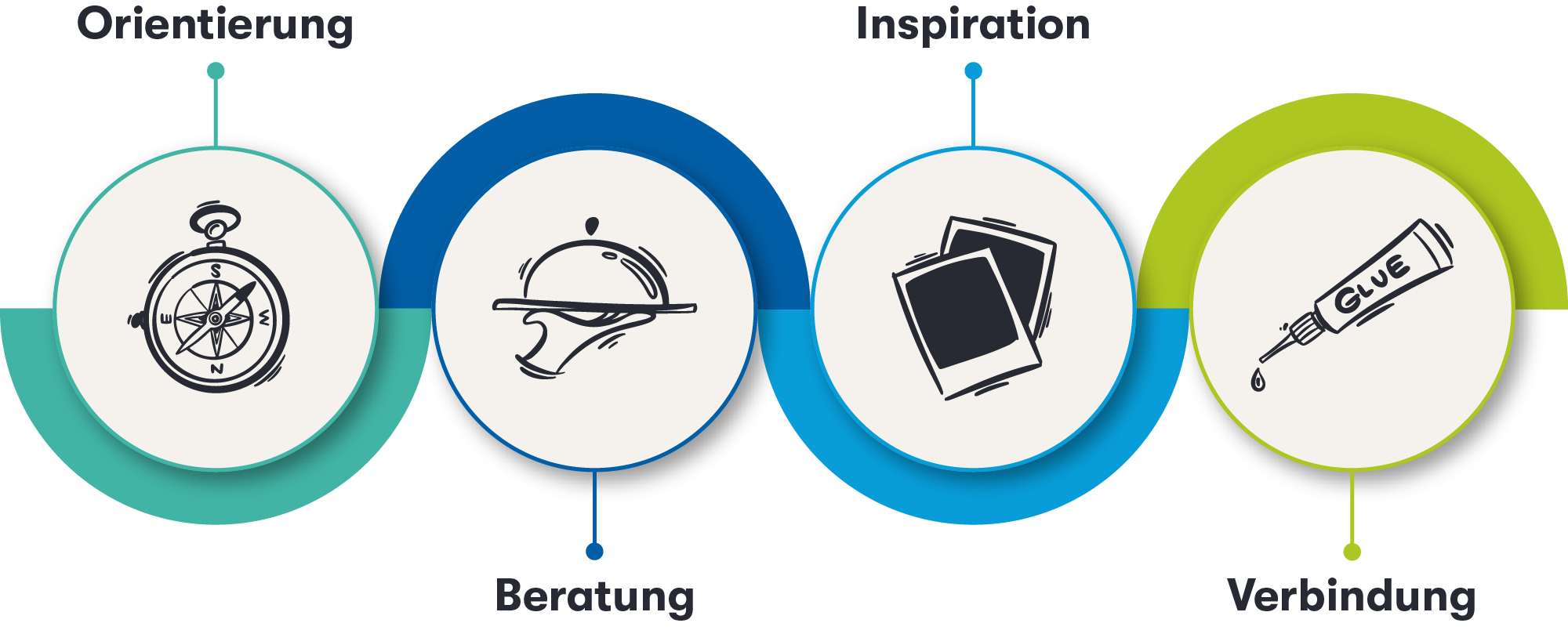
Needs-based customer journey model with four phases
Customer journey mapping is a helpful way to identify the touchpoints between shop customers and online shops. You can use it to determine the touchpoints and then derive optimization measures for the optimal design of the contact points. The aim here is to understand the customer and evoke positive emotions at every touchpoint with the shop or brand in order to ultimately achieve an inspiring customer experience.
We show you how this method can be used in detail to visualize the customer journey in our blog article Customer Journey Mapping for Identifying Touchpoints in E-Commerce.
Nowadays, shoppers have an enormous selection of stores and products to choose from. That's why it's even more important to create an optimal digital customer journey for your customers. This will prevent them from abandoning their journey from initial purchase idea to final purchase or switching to another provider. Important reasons for customizing the customer journey include:
Personalization comes into play to ensure an optimal customer journey. This is because it enables the entire digital customer journey to be customized using various measures. You should not miss out on the huge potential of the personalized shopping experiences that this creates. But now the question arises: How can the individual phases that a customer goes through be designed in the best possible way, what needs do shop customers have in the individual phases, and how can personalization ensure an unforgettable shopping experience? We'll show you now!
A customer has become aware of a product or brand and has subsequently visited an online shop. In order to engage the customer directly on the home page and convince them of the merits of your shop and you as a retailer, you should highlight your unique selling points at this point and convey both trust and security.
During the product research phase, interest in a specific product has already been piqued and the customer enters a store with a specific intention. They search for possible products that match their purchase requirements and want to find out which products can fulfill their purchase requirements.
Shop customers in this phase therefore need guidance. As in brick-and-mortar stores, they are greeted by a large number of products and a wide range of assortments in online shops and first need to find their way around. ecommerce search engine and a logically structured category structure play a crucial role in this research. Faceted navigation can also make it easier for your customers to narrow down the products they want. Personalized search results on product overview pages also help shop customers quickly navigate to the desired product detail page. By providing your customers with the best possible support in finding their way around your online shop, you can reduce your bounce rate.
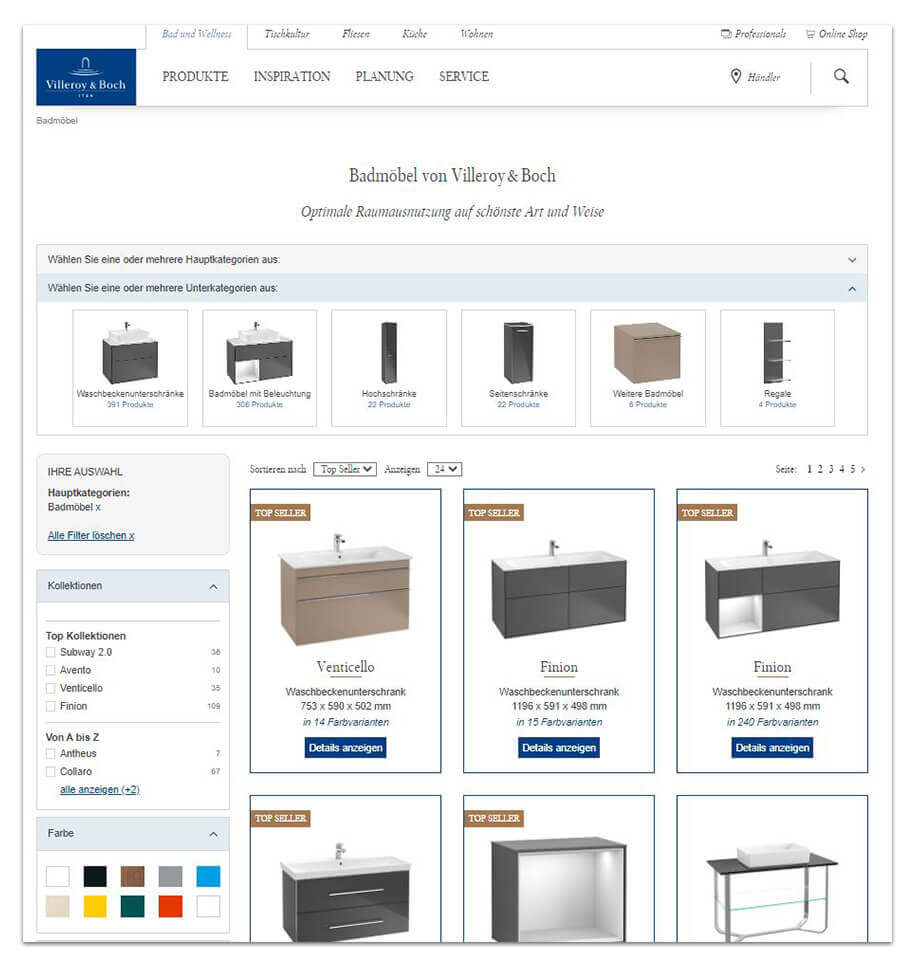
Example of faceted navigation in the Villeroy & Boch online shop to assist with orientation (source: screenshot from villeroy-boch.de)
The next phase is about product selection. The desire for a specific product increases and the shop customer wants to obtain more information, compare products, or seek advice in order to select the product that best suits their needs and requirements.
This highlights the need for advice. The product detail page is very important here. You should present all relevant information clearly and supplement it with elements that build trust. Furthermore, a digital advisor in the form of an AI shopping assistant can support your customers in determining their needs and selecting products – similar to a specialist salesperson in a brick-and-mortar store. This assistant processes natural text and voice inputs in the chat, records the needs of your online shoppers, and filters out the appropriate products from your range by combining current product data with the click and purchase behavior of online shoppers. This professional advice allows you to keep your return rate as low as possible.
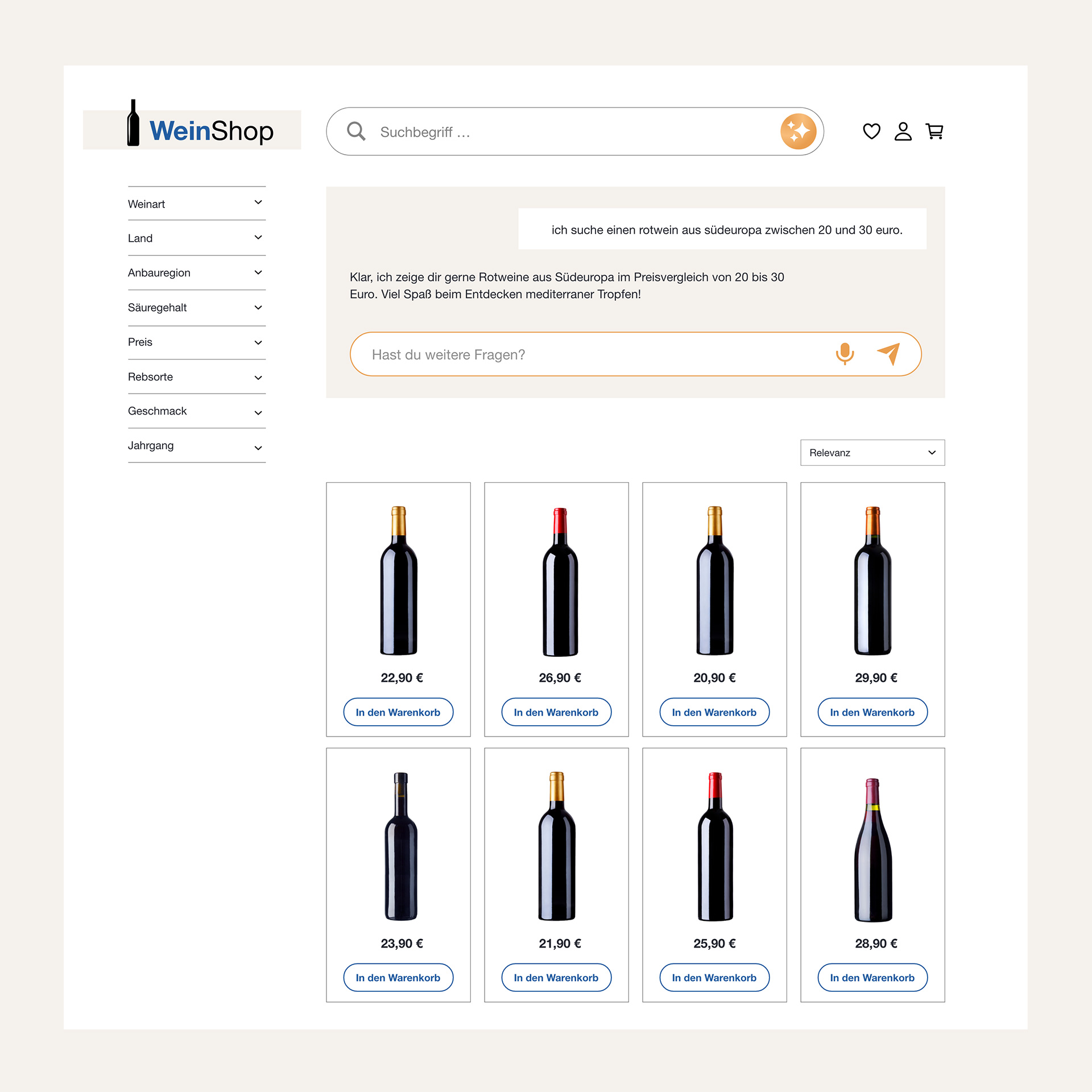
Example of a product advisor in a wine shop assisting with product selection (source: own illustration)
Once the shopper has gathered all the necessary information, sought advice if necessary, and compared products, they can finally make an informed decision. The shopper is now in the purchase readiness phase.
When a customer shows a willingness to buy, they are also open to inspiration. You can meet this need with personalized recommendations that take customer preferences into account. By complementing the selected item, product recommendations offer great added value for shop customers. There are various recommendation systems that use different types of personalization to calculate recommendations. If a customer has already decided on a product, cross-selling recommendations in the shopping cart or shopping cart layer are a good option. Relevant recommendations, positioned at various points in the online shop, provide inspiration and increase your shopping cart value.
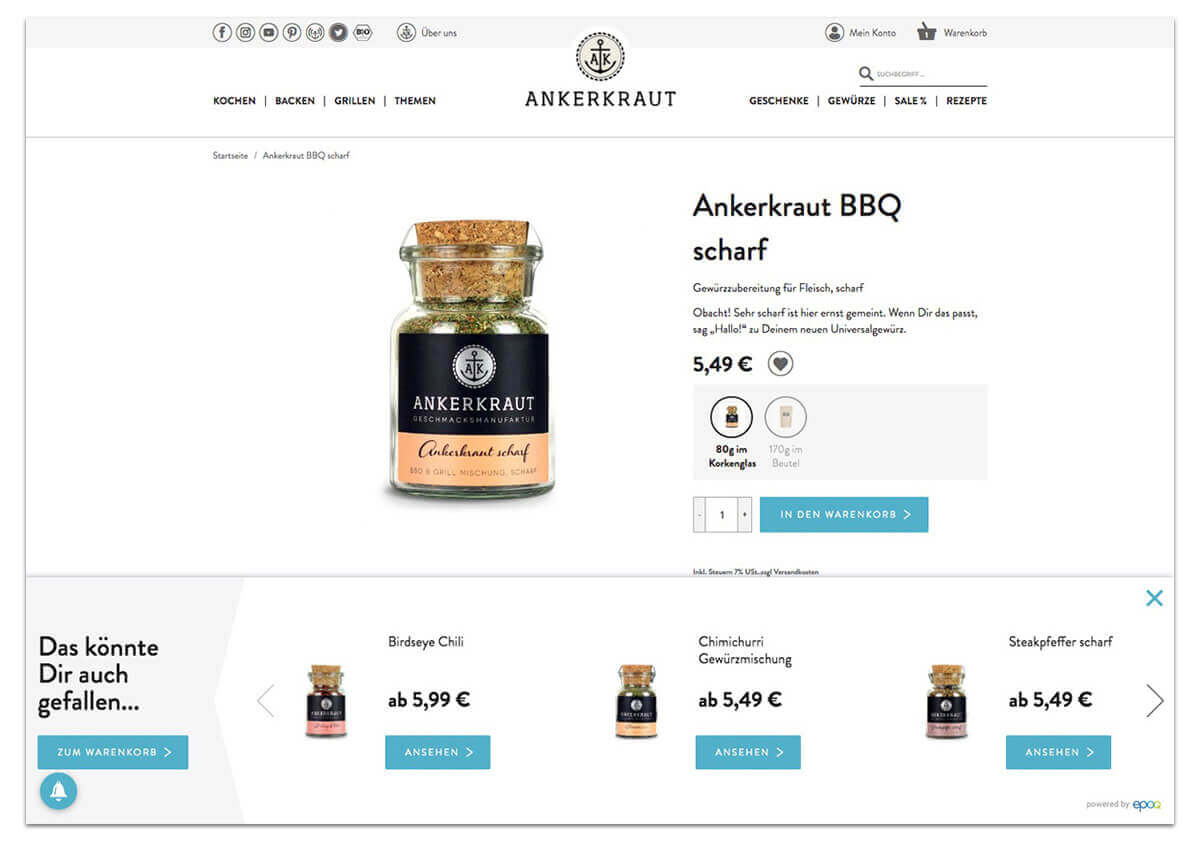
Example of cross-selling recommendations in the shopping cart layer in Ankerkraut's online shop
In our blog article Inspiration made easy: How to use product recommendations effectively in e-commerce, we reveal where recommendations can be placed effectively in e-commerce and what you need to bear in mind when doing so.
Stay up to date on personalization: Sign up for the Epoq newsletter. Register now!
In addition, it is crucial at this stage to ensure an intuitive and technically flawless ordering process to ensure that the customer does not abandon the purchase at the last minute. You can find more information and valuable tips on this topic in the blog article Effective Strategies for Shopping Cart Optimization.
Have you gained loyal customers who are happy to visit your store again? Great! Then get in touch and continue to build customer trust. Because in the final phase of the digital customer journey, your customers want to connect with you.
You can meet this need by sending personalized emails on various occasions, thereby staying in touch with your customers. If your customers trust your store, they will be happy to receive news and offers from you. Relevant product recommendations, which you can display in your emails in real time, are particularly useful for this purpose. This will encourage your customers to return to your online store. This will help you increase traffic to your online store.

Example of a personalized email from excellent HEMD (source: screenshot of email from excellent-hemd.de)
We have compiled further insights on the topic of after-sales measures in e-commerce for you in the blog article After the purchase is before the purchase: Successful after-sales measures in e-commerce.
Now you have learned a lot and know what needs shop customers have along their digital customer journey and how you can best meet these needs with the help of personalization measures. If you would now like to find out what an example of a customer journey in e-commerce might look like, we recommend our blog article This is what a customer journey in e-commerce looks like.
Competition and choice in e-commerce are fierce, and users can compare products and jump from one provider to the next with just a few clicks. To stand out from the crowd, an optimal digital customer journey is crucial. To design this in the best possible way, you first need to get to know and understand your customers' journey. You can then use various methods and models to illustrate your customers' customer journey. You can ultimately meet the needs your customers have in the individual phases of the digital customer journey by focusing on personalization measures throughout the entire customer journey. These enable you to take your customers by the hand in your online store, just like a good salesperson, and create unforgettable shopping experiences.
Sources: ¹ Ryte GmbH
The digital customer journey describes all the touchpoints a customer experiences from their first interaction with an online store through to the purchase and beyond—for example, search queries, store visits, product searches, the shopping cart, checkout, and after-sales communication.
Typically, a distinction is made between: Awareness, Consideration (information search), Purchase, and Retention (customer loyalty). Each phase requires different measures to provide customers with optimal support.
Personalization ensures that customers see relevant content and offers at every stage of the customer journey, tailored to their current behavior and interests. This shortens the path to a purchase decision and strengthens customer loyalty.
By analyzing user data, bounce rates, and conversion rates at individual touchpoints, you can identify areas for improvement. Tools such as heat maps, session recordings, and funnel analyses help you understand where customers drop off and why.
Emails are a key tool in the retention phase. Personalized newsletters, trigger emails (e.g., after a shopping cart abandonment), and reactivation emails help maintain customer relationships and bring customers back to the store.
In online shopping, the customer journey is often shorter, self-directed, and more anonymous. In brick-and-mortar retail, sensory experiences and personalized advice play a major role. The challenge in e-commerce is to replicate these experiences digitally.
Effective strategies include automated abandoned cart emails, retargeting ads, and personalized offers. It’s crucial to identify the reason for the abandonment—whether it’s price, shipping costs, or a lack of trust—and address it specifically.
Get even more tips and insights on personalization in e-commerce.
Check out the e-book on this topic now!

You are currently viewing placeholder content from HubSpot Embedded Content. To access the actual content, click the button below. Please note that doing so will result in data being shared with third-party providers.
More InformationYou are currently viewing placeholder content from HubSpot. To access the actual content, click the button below. Please note that doing so will result in data being shared with third-party providers.
More InformationYou are currently viewing placeholder content from HubSpot Meetings. To access the actual content, click the button below. Please note that doing so will result in data being shared with third-party providers.
More Information