Back to overview
  • Increase Traffic

After-sales examples: How Rose, TUI, and artegic bring customers back to the store

  • Published August 25, 2022
  • Jonathan Hermann
  • Reading time: 9 min.

When a customer buys something from your store, you have achieved your first goal. However, it is very important to continue to support the customer after the purchase. The cost of supporting regular customers is on average five times lower than acquiring new customers.¹ After-sales measures can therefore increase your repurchase rate and your sales, while even saving you money. The following article uses the two examples of ROSE and TUI to show you how you can take your after-sales management to a new level and create a closed loop in e-commerce. You will also receive useful tips from artegic on how to exploit the potential of transactional emails.

If you would like to learn the basics about after-sales, we recommend our blog article After the purchase is before the purchase: Successful after-sales measures for strong customer loyalty in e-commerce.

The role of personalization in after-sales

There is no question that after-sales service is extremely important in e-commerce. Nevertheless, many retailers miss the opportunity to use it properly. Personalization is key to successful post-purchase measures. This can take place not only before and during the purchase process, but can also be integrated into after-sales measures.

For example, you can use personalized emails to show your customers cross-selling and upselling products tailored to their individual needs in order to increase traffic and sales in your store. Personalized messages and relevant content also remind buyers of your store and have a positive impact on customer relations. Reminders can also help you bring back customers who left your website without making a purchase during their last visit. This works with a follow-up email. It allows your customers to continue browsing exactly where they left off last time.


Stay up to date on personalization: Sign up for the Epoq newsletter. Register now!


Personalized support between the time the order is placed and the goods arrive at the customer's premises also helps to build customer loyalty. Transaction emails containing information about your customers' orders are particularly suitable for this purpose.

The examples of ROSE and TUI show how this can work in practice.

ROSE – Newsletter distribution based on the online customer journey

One example of personalized email marketing is the newsletter from ROSE. Under the ROSE brand, the company sells premium lifestyle bicycles and also acts as a retailer for various bicycle-related products from different brands. Thanks to its wide-ranging portfolio, the online shop has a highly diverse customer base.

This raises the question of how ROSE can inspire individual customers after a purchase and bring them back to the platform.

1. Personalization in the newsletter

Newsletters provide customers with a constant stream of new, personalized ideas and inspiration. With a wide variety of customer groups, relevant topics can also be sent to smaller recipient groups and segmented according to purchasing behavior. For example, e-bike customers can receive information about new technology that would not be of interest to competitive road cyclists. Tailored seasonal topics can also be sent to specific customers.

The newsletter can also be further customized at the product level. Depending on the customer's behavior and history, newsletters can even be personalized on a one-to-one basis and include relevant products and individual offers. New ideas are constantly being generated and communication opportunities are being exploited, such as recommendations related to the previous session, tracking emails, matching accessories, etc.

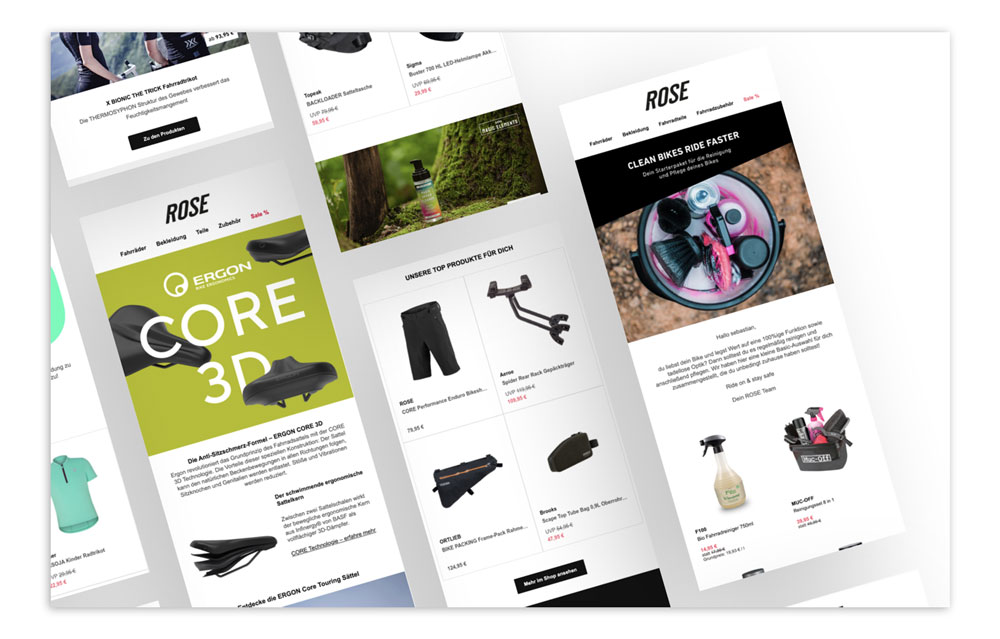
Personalized newsletters that strike the right chord with customers ensure a targeted approach. (Source: Screenshot example newsletter from rosebikes.de)

2. Delivery tracking as a source of potential for new or related inspiration

Communication immediately after the order and during the delivery period offers great potential for new or related inspiration in after-sales management. Since the customer is very excited after placing the order and a high level of engagement can be assumed, the open rates for such emails are particularly high at up to 80%.

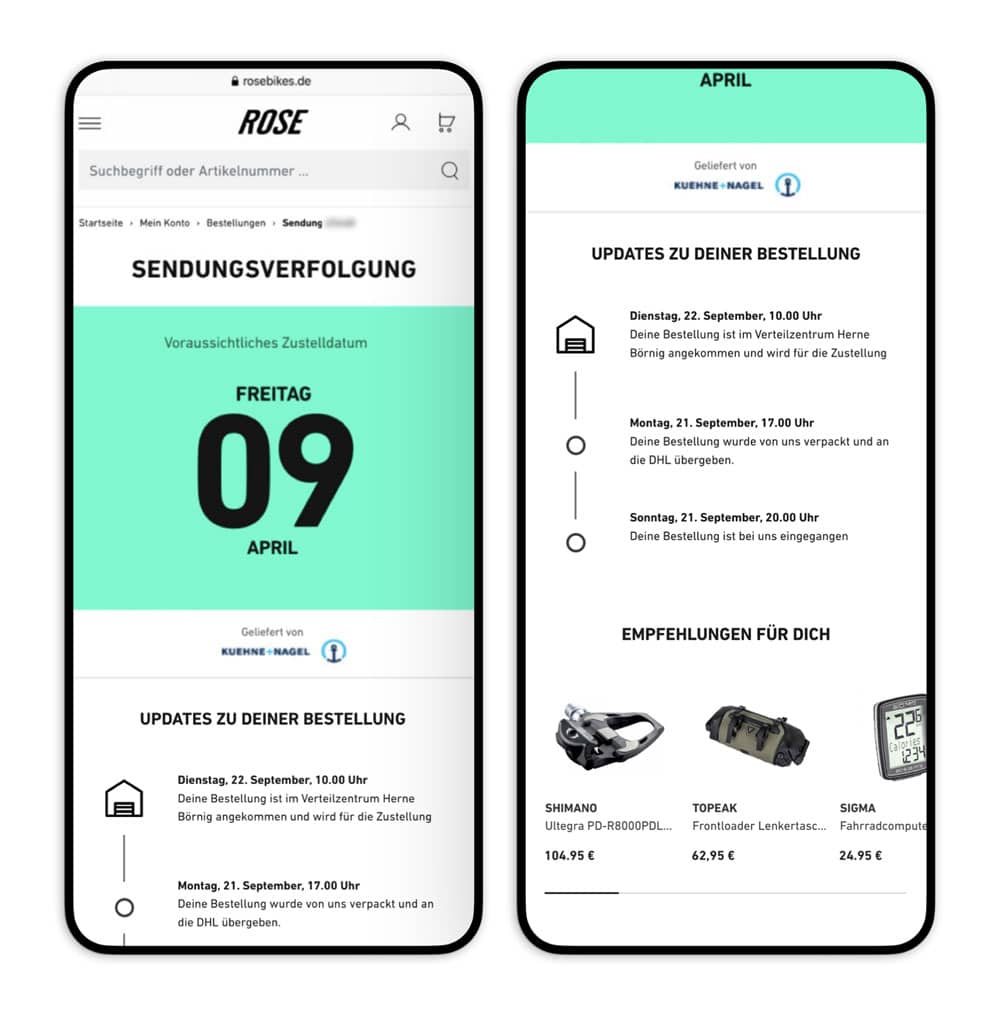
ROSE goes one step further here, beyond classic after-sales communication: by using the after-sales automation tool PAQATO, ROSE offers its own shipping tracking, which allows the company to reach a large number of customers' after-sales sessions, as they can track their package live. This touchpoint during shipping is otherwise often handled by third-party providers who offer their own tracking. Similar to the newsletter (as described in point 1), there are also a variety of personalization options here to offer customers relevant content and offers and enable cross-selling and upselling.

Customers can track their orders and view other offers from the shop using shipment tracking. (Source: Screenshot from rosebikes.de)

3. Personalization throughout the onsite journey

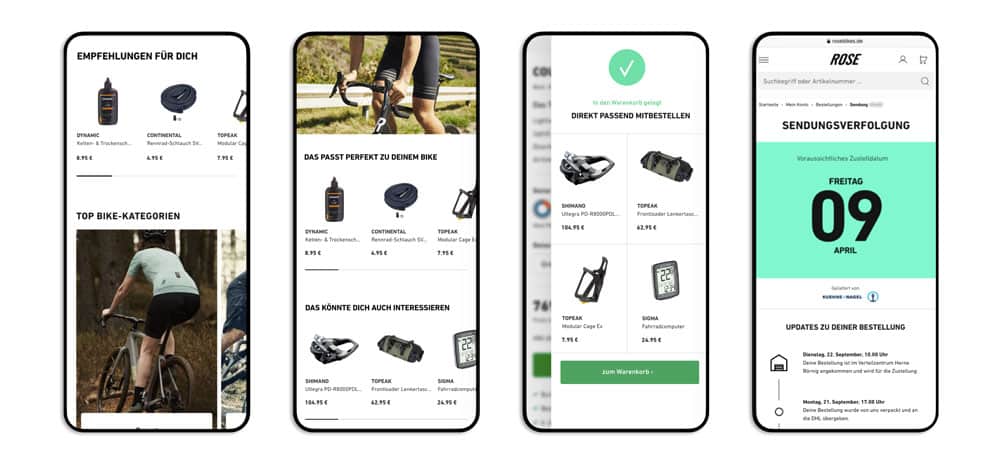
If the customer arrives at the shop via email or other channels, personalization can also be used to maintain relevance after the purchase. ROSE achieves this, for example, by

  • a customized home page where customers can resume their previous session,
  • displaying matching accessories on the product detail page,
  • Displaying "must-have accessories" in the shopping cart layer or
  • the onsite tracking page for shipment tracking.

This is how the examples for the home page, accessory suggestions, "must-haves," and shipment tracking are displayed. (Source: Screenshot from rosebikes.de)

TUI – Dynamic pricing in the newsletter

TUI is a German tour operator that is responsible not only for creating vacation packages, but also for marketing them.

In addition to follow-up emails with accompanying information on orders or bookings, newsletters are also an important part of email communication at TUI. Customers can therefore be targeted with content, products, recommendations, or offers in order to generate traffic for the website, among other things.

Adapting to the dynamic tourism market

It is very important for TUI to ensure that its newsletters are always up to date and relevant. This is because pricing in the travel industry is highly dynamic and sensitive. After all, prices are heavily dependent on capacity utilization and can fluctuate significantly within short periods of time.

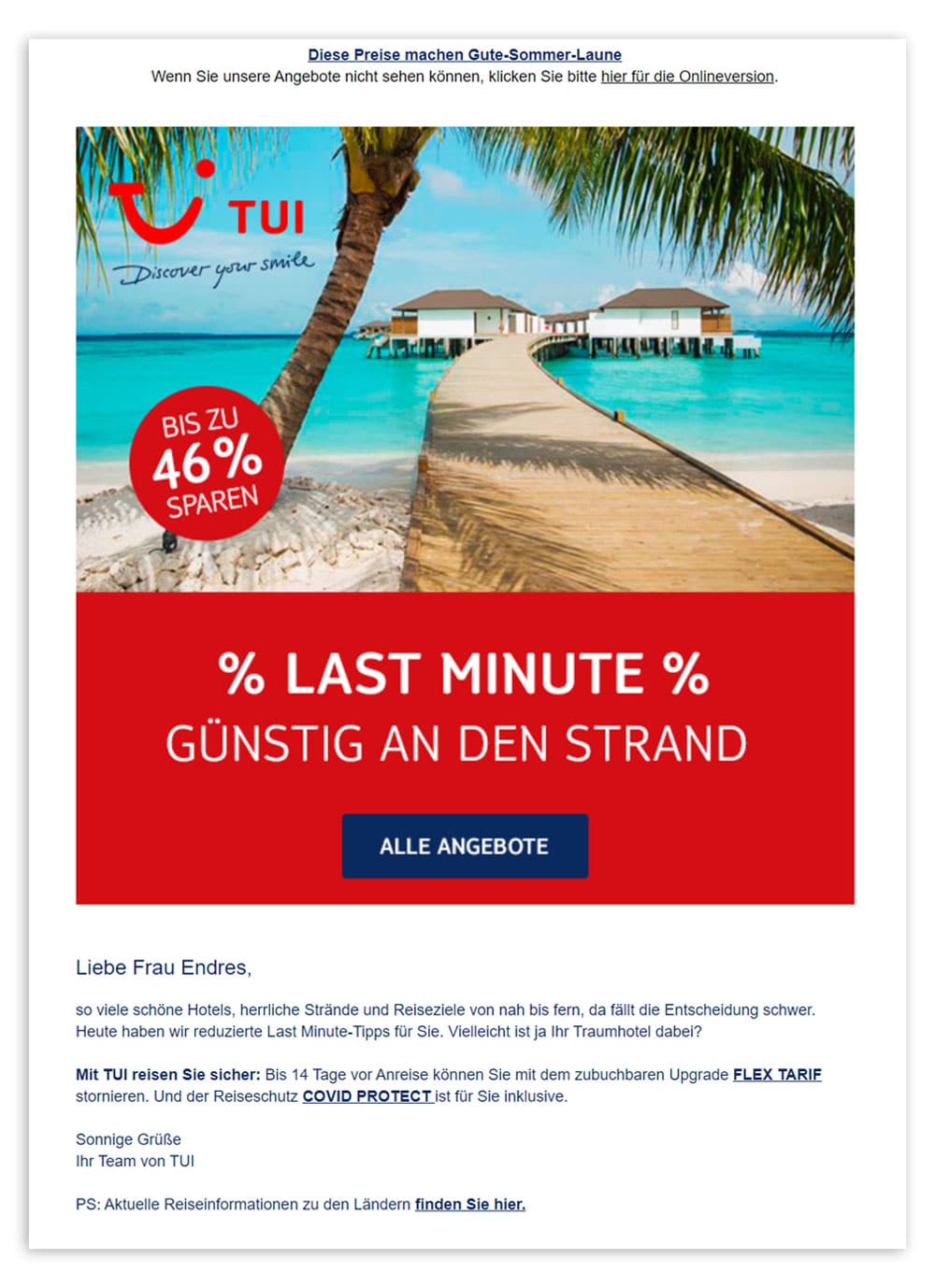
To ensure that prices are always up to date in emails as well as on the website, TUI uses dynamic pricing in its newsletter. On the one hand, this means that the latest prices are always displayed in the newsletter, even if it is not opened until days after it has been sent. On the other hand, offers that are no longer available can be hidden to avoid frustrating customers.


Stay up to date on personalization: Sign up for the Epoq newsletter. Register now!


Manual adjustments can also be made , e.g. for hotel or flight offers. This enables TUI to fill its newsletter for its customers with content that is relevant to the user and current prices from its system, even in the dynamic tourism market.

Dynamic newsletters ensure that customers always receive the latest offers. (Source: Screenshot of email from tui.com)

Presentation of offers

In addition to dynamic pricing, the presentation of offers in the newsletter is an important aspect. All important information alongside the call-to-action (CTA) ensures that users can see at a glance what it's all about and that their interest is piqued.

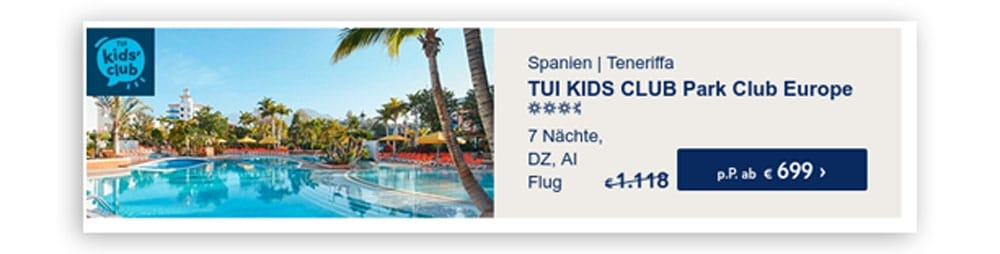
TUI, for example, uses "Save X%!" to show customers how much cheaper this offer is. In addition, "strikethrough prices"can be used to attract attention and convey important information about old and new prices.

With discounted prices and displays of the most important information, customers can see everything at a glance. (Source: Screenshot of email from tui.com)

artegic – Special features of transactional emails in email marketing

As already mentioned, transactional emails play an important role in email marketing. Transactional emails include, for example, order or shipping confirmations that customers receive after making a purchase. They are extremely relevant because they relate directly to the purchase made and are expected by the customer. It is therefore not surprising that these emails have an open rate of 60-80% —many times higher than that achieved with other marketing emails.

You shouldn't miss out on this potential. You can use transactional emails for the following purposes, among others:

  • Provide additional information,
  • Obtain confirmation of satisfaction,
  • Request a review,
  • Gain opt-ins by promoting your newsletter.
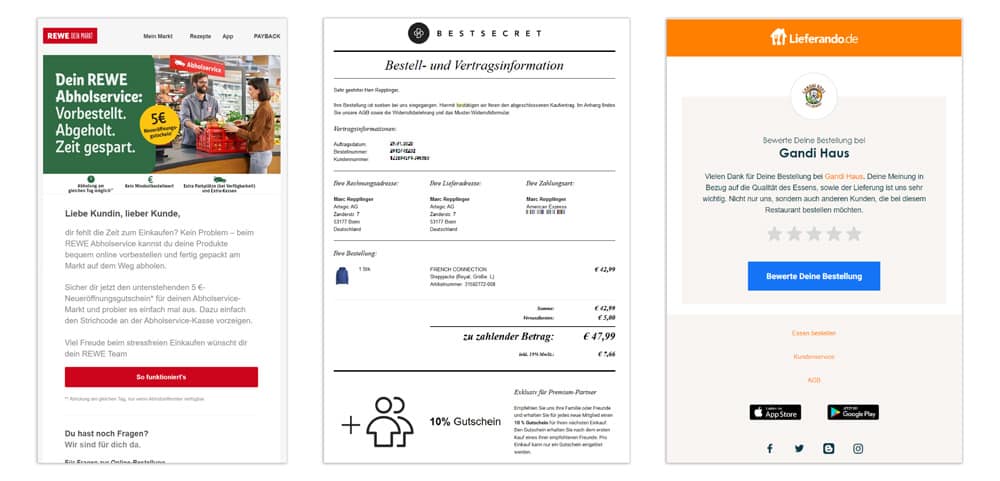
This is how transactional emails can be designed. (Source: Transactional emails from REWE, BESTSECRET, and Lieferando)

By timing the transaction moment, you can start an automated communication process —from order and shipping confirmation to recommendations to a "We miss you" email a certain amount of time after the purchase.

Finally, to fully leverage the potential of transactional communications, continuous optimization is crucial. Through multivariate testing, which combines different subject lines, button colors, calls to action, key visuals, etc., you can test which combination works best for which customer segment.


Conclusion: Long-term customer loyalty with the right after-sales measures

These after-sales examples show you what measures you can take to retain your customers in the long term. ROSE, TUI, and artegic demonstrate how important it is to continue communicating with customers even after the purchase. Personalized and dynamic emails can offer added value for customers and retailers, helping you to retain customers after a purchase and achieve 1:1 communication.

Sources: ¹ WuV, ² artegic

Presentation at the Personalization Experience Day 2021

As part of PXD 2021 (Personalization Experience Day), the following experts were guests at the "Close the Loop" webinar and reported on various after-sales measures to successfully bring customers back to the store. From left:Stefan von Lieven (CEO & Co-Founder at artegic), Sebastian Bomm (Director of UX & Customer Intelligence at ROSE Bikes), and Lydia Desch (Customer Relationship Manager at TUI).

Want to learn more about email personalization?

Check out our video clip!

Jonathan Hermann
Working student in marketing
Joni gained experience in personalization as a working student in marketing. His responsibilities included content creation, e.g., for our blog or our social media channels. He also took care of maintaining the English website. In addition to his work at Epoq, Joni studied marketing communication and advertising.