5.04% increase in sales per session thanks to new personalization strategy at Outletcity Metzingen
Outletcity Metzingen puts its personalization strategy to the test and increases revenue per session by 5.04%.

Discounts and promotions are real boosters that significantly increase your customers' shopping cart value. However, they only have a short-term effect. Other techniques, such as cross-selling, are time-consuming but bring long-term benefits and lead to a significant increase in sales. This article is your guide to cross-selling strategies, starting with the definition of cross-selling and ending with increasing the value of shopping carts through the targeted sale of complementary products.

Here's what you can expect to find in this blog article:
3 cross-selling examples you can learn from
1. Madewell
2. Lush
3. MeUndies
Personalization as the cherry on top of your cross-selling strategy
Relevant product recommendations
Examples of personalized cross-selling recommendations
5 practical tips for your cross-selling strategy
1. Bundle products
2. Offer discounted prices for bundled products
3. Use visual aids
4. Include complementary services
5. Convince customers with arguments in the shopping cart
When is the best time for cross-selling in the e-commerce customer journey?
Conclusion: Increase your e-commerce sales with a well-thought-out cross-selling strategy.
The cross-selling strategy is about persuading customers to buy a product that complements the goods they have already purchased.
Brick-and-mortar retailers traditionally use cross-selling in sales conversations when informing existing customers about complementary items. However, online retailers can also suggest suitable products to customers at various stages of the purchasing process. In doing so, they benefit from the possibilities offered by innovative personalization tools.
In cross-selling, a salesperson points out services or goods that complement services or products that the customer already wants to buy. Because the items are often relevant to the customer, shops can increase the value of the shopping cart. The implementation of this technique varies depending on the purchase motivation, the salesperson's capabilities, and the target group.
Thanks to the wealth of data available, e-commerce is ideally suited to finding out which services and products are a good fit for a particular purchase. Online retailers can also identify the perfect moment when customers are most receptive to an offer. For example, most online shops suggest additional products that complement the item in the buyer's shopping cart when they pay or continue browsing the shop before checkout.
Cross-selling and upselling have the same result: they increase the retailer's sales, albeit in different ways.
Upselling is about increasing sales by offering a higher-priced, higher-quality product, while cross-selling is simply offering additional goods in a similar price category for purchase.
Another difference between these two approaches lies in the customer's intention.
When customers are offered complementary products, they often had no intention of purchasing them beforehand. It is only when they are suggested to them that they will consider buying them.
Upselling, on the other hand, targets the consumer's desire to purchase a product that particularly well meets their needs or wishes. If the salesperson offers a higher-quality product and demonstrates how this product is even better suited to the customer's needs, they can increase the value of the shopping cart in this way.
Stay up to date on personalization: Sign up for the Epoq newsletter. Register now!
Below, we present three examples in which a specific cross-selling strategy is used in each case.
Madewell is a women's clothing brand that focuses on dresses, shoes, jeans, and T-shirts. One of the company's products is the "Linen-Blend Hilltop Shirt." Customers can get more information about the shirt by clicking on the top of the page, such as pictures, sizes, color options, etc.
As customers scroll down the page, they encounter a section titled "You may also like...", which leads to other items with complementary products that have been combined in shoppers' shopping carts in the past. This allows the clothing brand to easily recommend relevant items that a customer is likely to like without risking friction losses.
Lush is a brand of handmade cosmetics. One of its best-known products is a soap called "Honey I Washed the Kids," which is appropriately shaped like a honeycomb. Customers can find additional information on the product page itself, the FAQ page, the ingredients page, and the reviews page.
At the bottom of the page, under "Related Content," you will find other honey-based products that customers may also like, such as the "Scrubee" body lotion .
Here, too, the company is capitalizing on customer preferences and the trend toward honey-based products to recommend other relevant items. The company, in turn, benefits from lower acquisition costs.
The brand prides itself on having "the coziest men's underwear."On the website, customers will find many unusual designs, such as underwear printed with milk and cookies, perfect for Christmas. When customers want to purchase an item, it is added to their shopping cart. They are then taken to an overview page with details about the product before proceeding to checkout.
Below this overview page is the"Complete the Look"section with relevant items that customers might like and that complement the product they have purchased, including socks and bathrobes, for example.
Instead of relying on a generic "You might like," MeUndies is aware of the typical male weakness of not being able to put individual products into an overall context. The male target group naturally wants a complete look, and MeUndies helps with that.
This allows the company to use cross-selling to increase profits and raise the average order value (AOV) from its perspective, while at the same time making it easier for customers to find items they might never have come across otherwise.
This e-commerce feature means that different product recommendations are displayed, which vary depending on the profile and behavior of the individual buyer.
When selling items online, you need to constantly engage with your customers to keep them in your online store. Showing customers product recommendations via a recommendation system and personalizing these recommendations is an excellent solution for efficiently selling cross-selling and upselling goods.
Many shop systems already offer the option of displaying recommendations in various positions in the shop as standard. This feature is therefore often available, but usually offers only limited options in terms of the choice of items displayed. As a result, top sellers are often simply displayed. However, it is better to go one step further and provide personalized products as recommendations for each customer. Products that match personal preferences and are therefore particularly relevant. You can also achieve a high level of relevance if the products displayed are actually available (in the right size) and complement the items viewed or added to the shopping cart in a meaningful way, e.g., by ensuring technical compatibility.
You can use recommendation widgets to show your customers product recommendations on various shop pages that they would like to buy.
All these techniques lead to longer dwell times and thus increase the opportunities for sales.
Personalization is a particularly effective strategy for displaying recommendations. We have compiled some examples of personalized cross-selling for you below:
Product recommendations based on a cross-selling strategy are ideal for product detail pages. This allows you to display items that match the selected product and that the customer might not have discovered in the product range themselves. The relevance of the product recommendations displayed is particularly important here. You can ensure this by taking your customers' personal preferences into account, ensuring product availability, only offering products in the right size, and presenting items that are suitable in terms of content (e.g., a matching style for an outfit, compatible accessories for technical items, or harmonizing flavors for food).
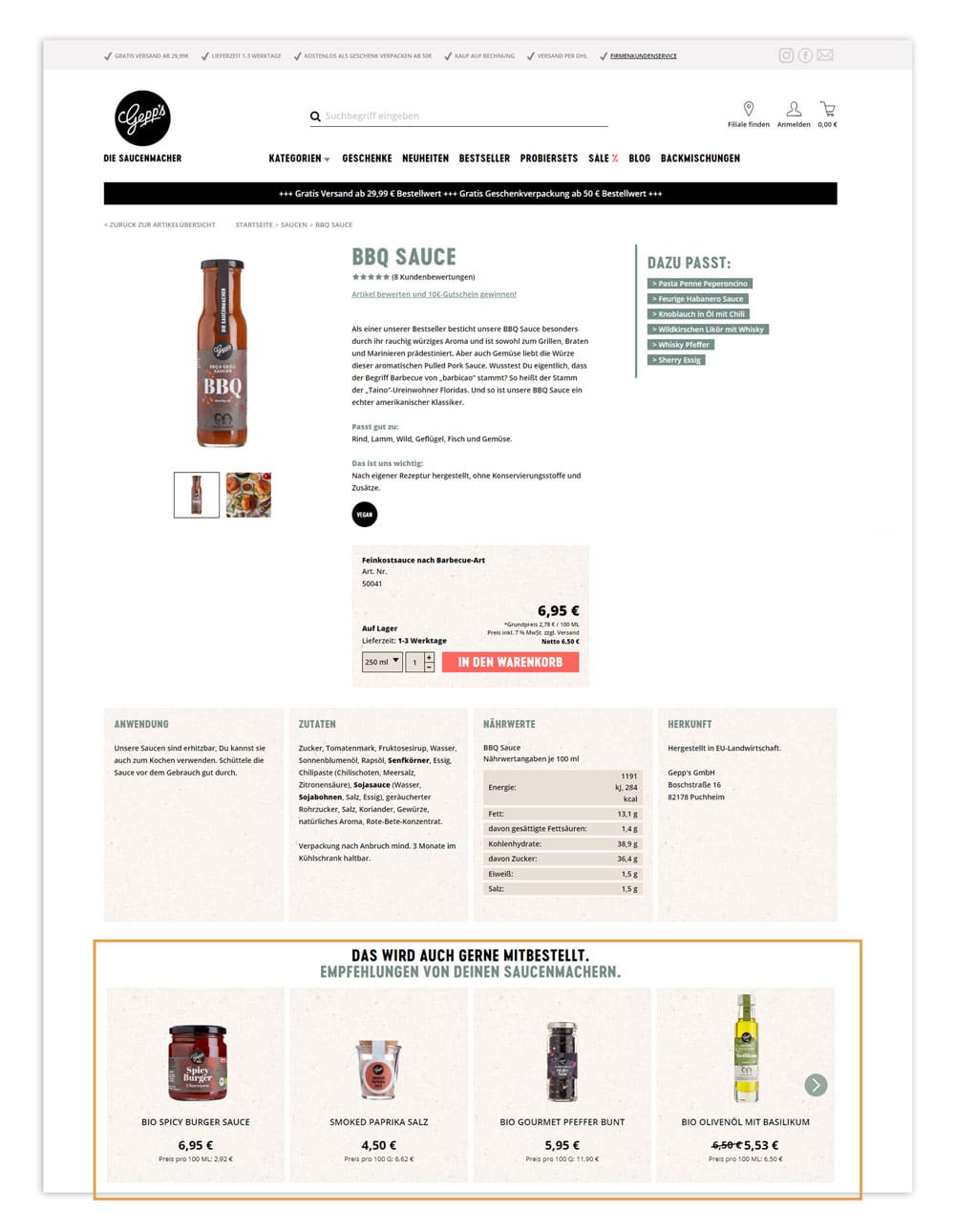
Product detail page on gepps.de with cross-selling recommendations (source: screenshot from gepps.de)
In addition, it is possible to offer customers a " like/dislike" function on the product detail page to give them the opportunity to indicate which suggested additional products are of interest to them. Shop customers can like or dislike recommended products with a single click. This information can then be used later on, and the liked products can be recommended in the shopping cart or shopping cart layer.
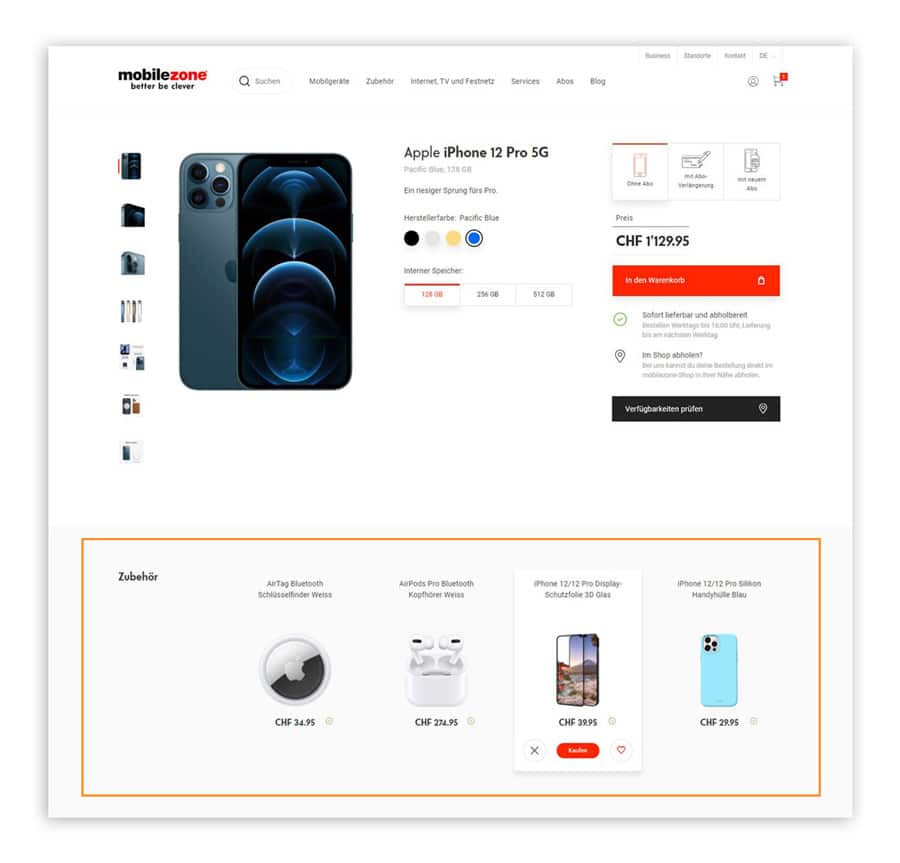
Product detail page on mobilezone.ch with cross-selling offers in the form of product recommendations that customers can like or dislike (source: screenshot from mobilezone.ch)
By offering entire product sets, customers can put together a complete outfit, for example, with just a few clicks. This saves your customer time and generates additional sales for you. Product sets also make sense in other areas outside of fashion. For example, a shop operator in the electronics sector can offer a matching case, protective film, or compatible headphones for a smartphone. Here, too, it is essential to ensure that the products are compatible, that customer preferences are reflected in the recommendations, and, as in this example, that the complementary products are the right size for the customer.
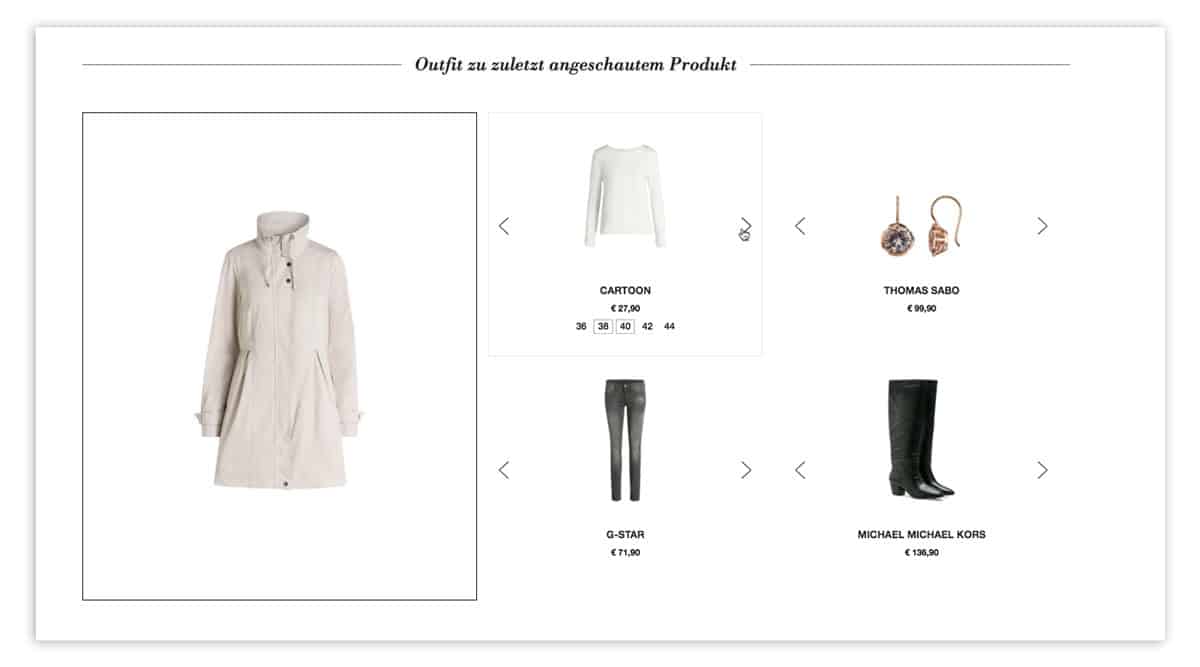
Cross-selling offer in the form of a complete outfit for women on outletcity.com (Source: Screenshot from outletcity.com)
By clicking on the "Add to cart" button, you can use a cart layer widget to calculate personalized recommendations in milliseconds and display them via a layer. If a customer is about to complete a purchase, as in this case, the use of a cross-selling strategy makes particular sense. By specifically displaying suitable products, you can create further purchasing impulses at this point and add relevant items to your customers' shopping carts. Here, too, it is important that the products displayed are available in the customer's preferred size, for example.
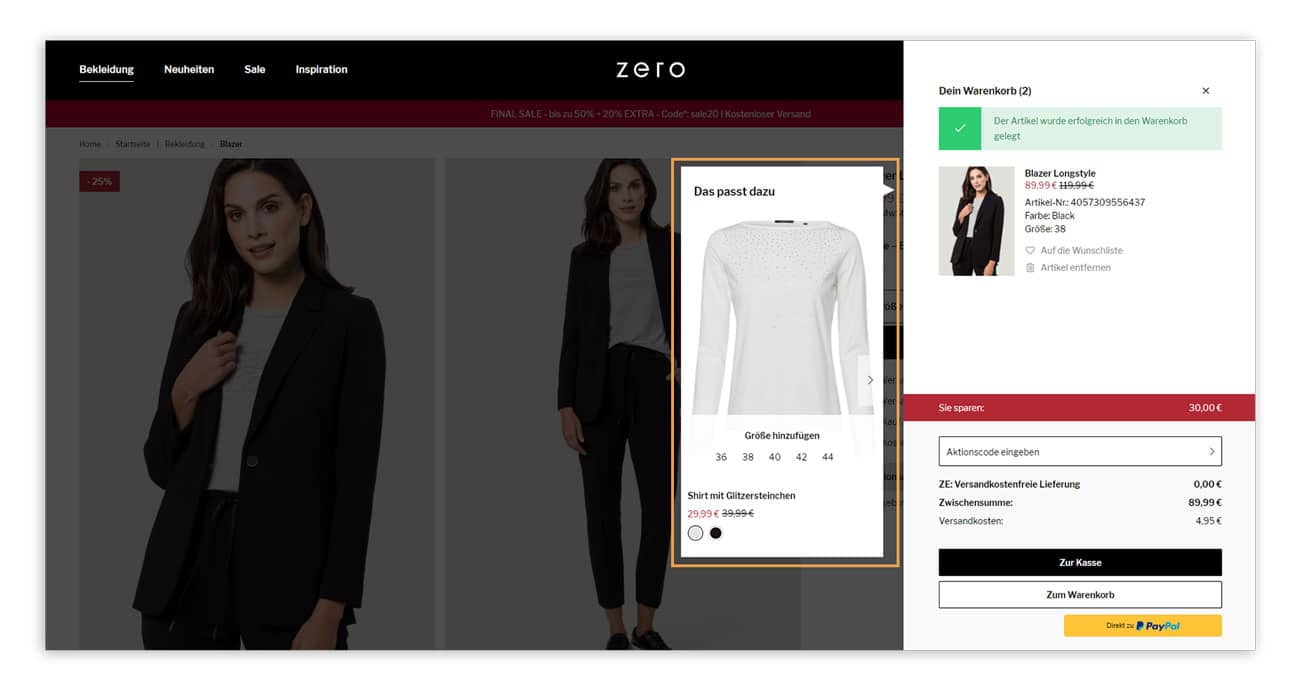
Cross-selling in Zero's shopping cart layer (source: screenshot from zero.de)
In the following sections, we will show you five helpful tips on how to successfully implement a cross-selling strategy in your online store.
You can bundle various individual services or products and sell them in a joint package. Conditioner and shampoo sets or beach kits with care products are typical examples of sensibly compiled product packages.
Some brands sell certain top products only as product bundles and not individually. This encourages their customers to try items that complement their top products.
This approach has two advantages:

On the Ex Libris product detail page, customers receive cross-selling recommendations in the form of a bundle, e.g., consisting of several books (source: screenshot from exlibris.ch).
Product bundles can be just as beneficial for your customers as they are for you. After all, when you offer a discount compared to individual sales, the customer also benefits financially.
A classic example of this type of cross-selling approach is game consoles sold together with games. Suppose a customer wants to buy the new game console and searches for it on Amazon: The console is available individually or as part of various bundles on Amazon. If a buyer wants to purchase the games included in a bundle anyway, or if they seem interesting enough given the total price, the customer will prefer the bundle over the individual purchase.
But be careful: you need to keep a close eye on your inventory to ensure that both bundle and individual product sales run smoothly.
Stay up to date on personalization: Sign up for the Epoq newsletter. Register now!
When visual aids are used, consumers are presented with a high-quality display in order to sell additional products.
An example:
If you want to buy a new pair of pants, a website might show you a picture of a model wearing the same jeans along with matching shoes, accessories, and a top. If you like the whole outfit, you might buy the entire set.
The same applies to furniture: you may be looking for a sofa, but end up buying a matching coffee table and TV stand as well.
Your goal is to show potential buyers an appealing picture and make it easy for them to turn that picture into reality in their lives.
There are many ways to implement this approach. For example, an e-commerce company that ships flat-pack furniture could offer an assembly service.
This saves the buyer a lot of time. It also minimizes the risk of damaging the item or becoming frustrated while attempting to assemble it without experience. The service is also excellent for physically impaired buyers and older people who are unable to assemble the furniture themselves.
You can also use this cross-selling strategy to offer services such as extended warranties or insurance.
Cross-selling other items is not limited to the product page. Offering a selection option on the shopping cart page can also be beneficial. This is especially true if you provide arguments in favor of adding additional items to the shopping cart.
Fackelmann has perfected this technique. When you click on the shopping cart, you will notice that shipping costs are usually charged. However, there is a note indicating the amount still needed to qualify for free shipping, as well as product recommendations to help you reach that threshold.
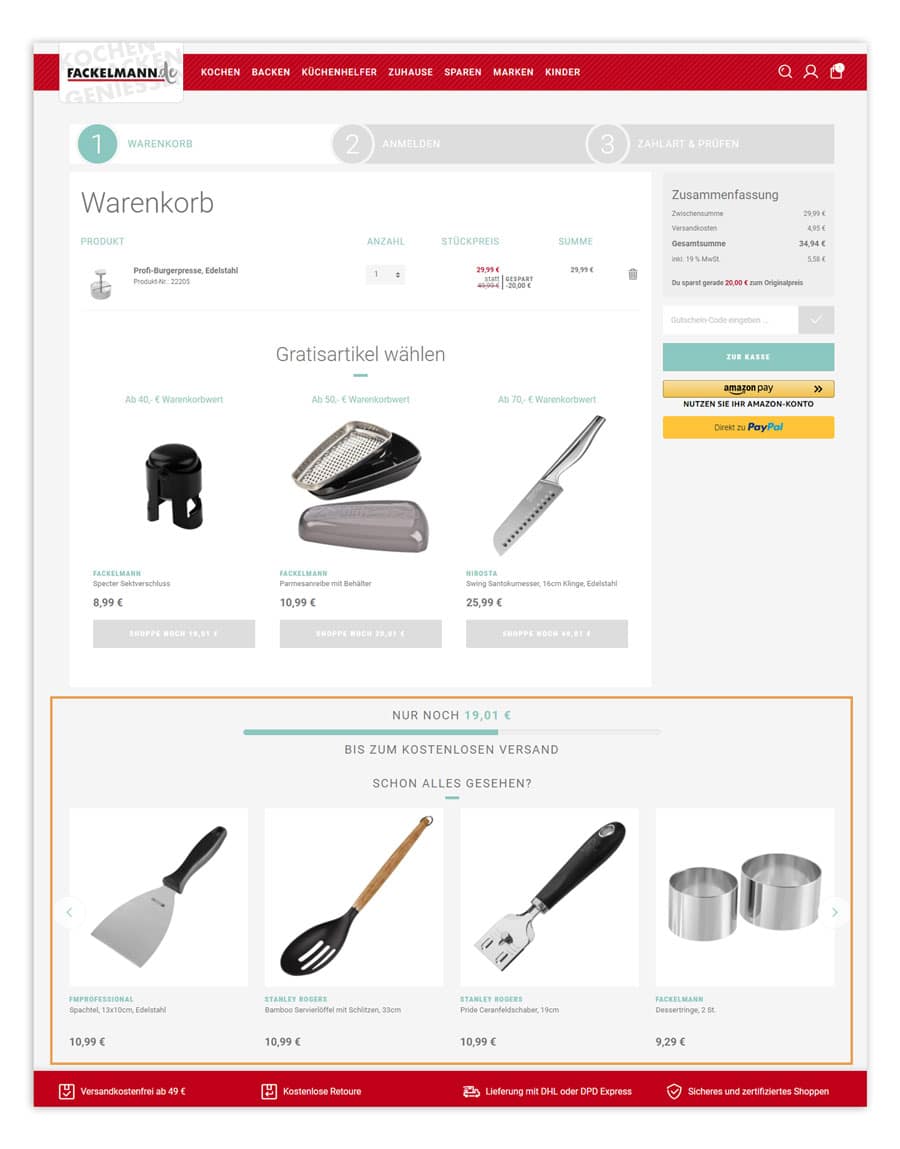
Cross-selling in the Fackelmann shopping cart to benefit from free shipping (source: screenshot from fackelmann.de)
The cross-selling strategy is most effective at the end of a sales cycle, when the customer is already interested in purchasing a product. In complex sales processes, however, it would be better to combine cross-selling and upselling with the entire shopping experience.
Successful cross-selling starts with a proper understanding of consumer needs. Train your sales staff to ask questions that will give them deeper insight into customer needs, and leverage data from your previous sales.
Have you already successfully implemented cross-selling strategies? What are your experiences? Feel free to leave a comment!
Don't be afraid to delve into cross-selling strategies and develop suitable scenarios for your shop. When used correctly, cross-selling not only increases your revenue, but also provides a helpful service for your customers.
Cross-selling involves recommending complementary products to customers based on the item they have selected. Upselling involves suggesting a higher-value alternative. Both strategies aim to increase the average order value.
The most effective placements are: the product detail page, the shopping cart, and post-purchase transactional emails. The closer to the moment of purchase, the higher the likelihood of conversion.
The most important KPIs are: average cart value, number of products per order, cross-selling click-through rate, and the additional revenue generated through cross-selling.
Yes, irrelevant or intrusive recommendations can disrupt the shopping experience. Cross-selling should always offer genuine added value. Too many recommendations at once can lead to decision overload.
Cross-selling recommends complementary products as separate purchase options. Bundle offers combine multiple products into a single package, often at a lower total price. Bundles increase perceived value and lower the barrier to purchase.
Yes, confirmation and shipping emails have extremely high open rates (often 50–80%) because customers want to be actively informed about the status of their order after making a purchase. This attention can be strategically leveraged to recommend complementary products or accessories.
Cross-selling remains one of the best strategies for online shops to increase sales. Would you like to learn how you can achieve 5.04% more revenue per session?
Check out this case study from OUTLETCITY METZINGEN.

You are currently viewing placeholder content from HubSpot Embedded Content. To access the actual content, click the button below. Please note that doing so will result in data being shared with third-party providers.
More InformationYou are currently viewing placeholder content from HubSpot. To access the actual content, click the button below. Please note that doing so will result in data being shared with third-party providers.
More InformationYou are currently viewing placeholder content from HubSpot Meetings. To access the actual content, click the button below. Please note that doing so will result in data being shared with third-party providers.
More Information