Back to overview
  • Increase Conversion Rate

Achieve greater success in e-commerce with content personalization

  • Published May 20, 2022
  • Sarah Birk
  • Reading time: 11 min.

More and more companies are engaging in content marketing. The volume of content is constantly increasing, and it is difficult for users to process and respond to all of it. This makes it all the more important to offer users added value with personalized content instead of flooding them with topics that are irrelevant to them. Below, you will learn what content personalization means, how it can benefit your online store, and how you can provide personalized content for your customers.

A person in front of a laptop displaying a content page about live shopping events.

What does content personalization mean?

Before we begin to explore the possibilities for displaying personalized content, you should first understand what content personalization actually means. With personalized content , the user, their interests, and their needs come first.

A lot of data is generally collected about a customer while they are browsing the internet. Based on this data, you can then provide them with personalized content. This can take the form of content adaptation or tailored content recommendations.

How successful content personalization works

To successfully implement content personalization in your marketing, you should ensure that it is carried out continuously. For example, if you only personalize the order confirmation page for your customers but fail to personalize the rest of the customer lifecycle, this will not result in a successful marketing strategy.

Personalized content should therefore be provided at every stage of the sales process and also in post-purchase communication. The content of your emails to customers and your online store itself offer you plenty of opportunities to implement personalized content. Your content personalization will be successful if you respond to your customers' needs and interests, thereby creating positive experiences for them.

Personalized content increases customer engagement

With personalized content, you not only offer your customers high added value, but also promote their engagement. With the abundance of content available, it is important to stand out and provide unique content, as well as to provide each customer with exactly the content that is actually relevant to them.


Stay up to date on personalization: Sign up for the epoq newsletter. Register now!


By addressing customers personally in email communications and personalizing the content within your online shop, you can spark their interest. In addition to boosting customer loyalty, you also enhance the user experience within your shop and can ultimately achieve higher conversion rates.

Learn more about how you can use content to improve your customers' shopping experience in our article on content commerce.

Targeting approaches for content personalization

When personalizing content, it is important to address the right target group. Various targeting approaches can be used to achieve this. We explain four common targeting approaches in more detail below.

#1 1:1 personalization

The goal of all measures should always be 1:1 personalization. To achieve this, you can record the individual click and purchase behavior of each customer and take this into account when displaying content. From the mass of content, you can use AI-supported 1:1 personalization to present each shop visitor with exactly the content, such as blog articles, topics, video shopping offers, etc., that is really interesting to them. In addition, you can offer customers customized content and display content such as salutations, texts, or banners individually. In this way , you can create a unique shopping experience tailored to each customer through 1:1 communication and intelligent e-commerce personalization.

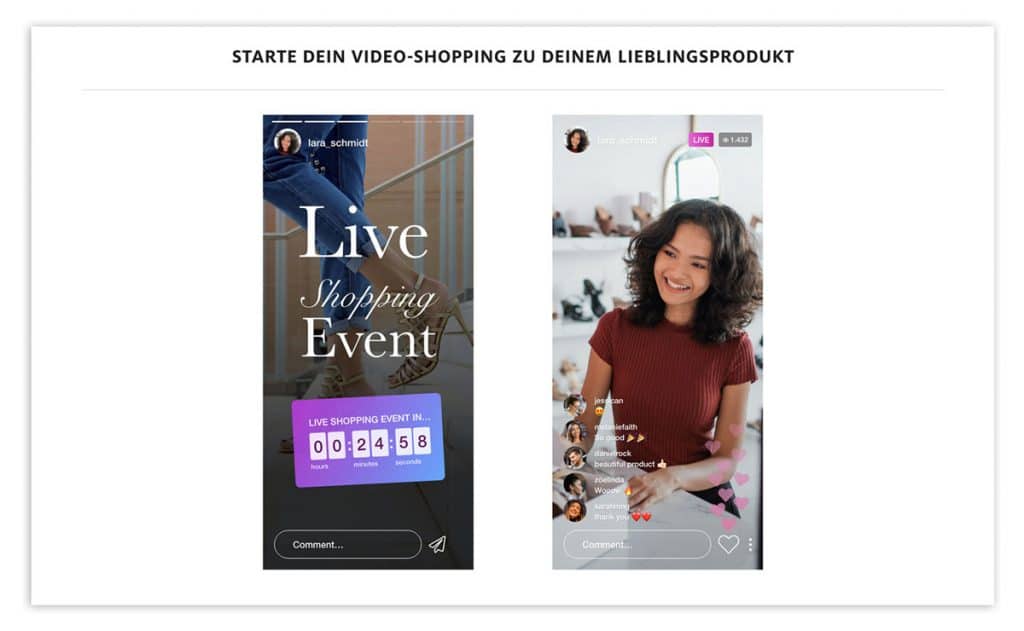
From a wide range of video shopping offerings such as event announcements or recordings, each customer can be recommended content that is relevant to them.
(Source: Own representation)

#2 Campaign-based content personalization

You can also work with personalized content at the campaign level. For example, if you launch a content campaign for specific occasions such as Easter or Christmas, you can serve your customers content tailored to these topics. Many technologies can be used to collect extensive data about users and their behavior. This allows you to group users with similar characteristics into customer segments. You can also use the collected data to create fictional representatives of a specific target group, known as personas.

When displaying content topics, you can now use 1:1 personalization in addition to the personas mentioned above. This allows you to provide users with exactly the content that suits their needs within the campaign.

Example: If your customer is interested in decorations, you can show them blog articles with decoration ideas as part of your Christmas campaign. If the user is more interested in outfit ideas, you can use personalization to ensure that they are shown suitable content with outfits for the cold season as inspiration.

#3 Content personalization along the customer journey

Another highly successful targeting approach within content personalization is the customer journey. This refers to your customer's journey – from initial contact to an action defined by you. You can therefore deliver personalized content depending on the phase your customer is currently in. Think carefully about what content your customer needs in each phase and provide it to them. For successful content personalization, you should make sure to tailor the content to your customers and their needs throughout the entire customer journey.

The importance of real-time personalization for the customer journey

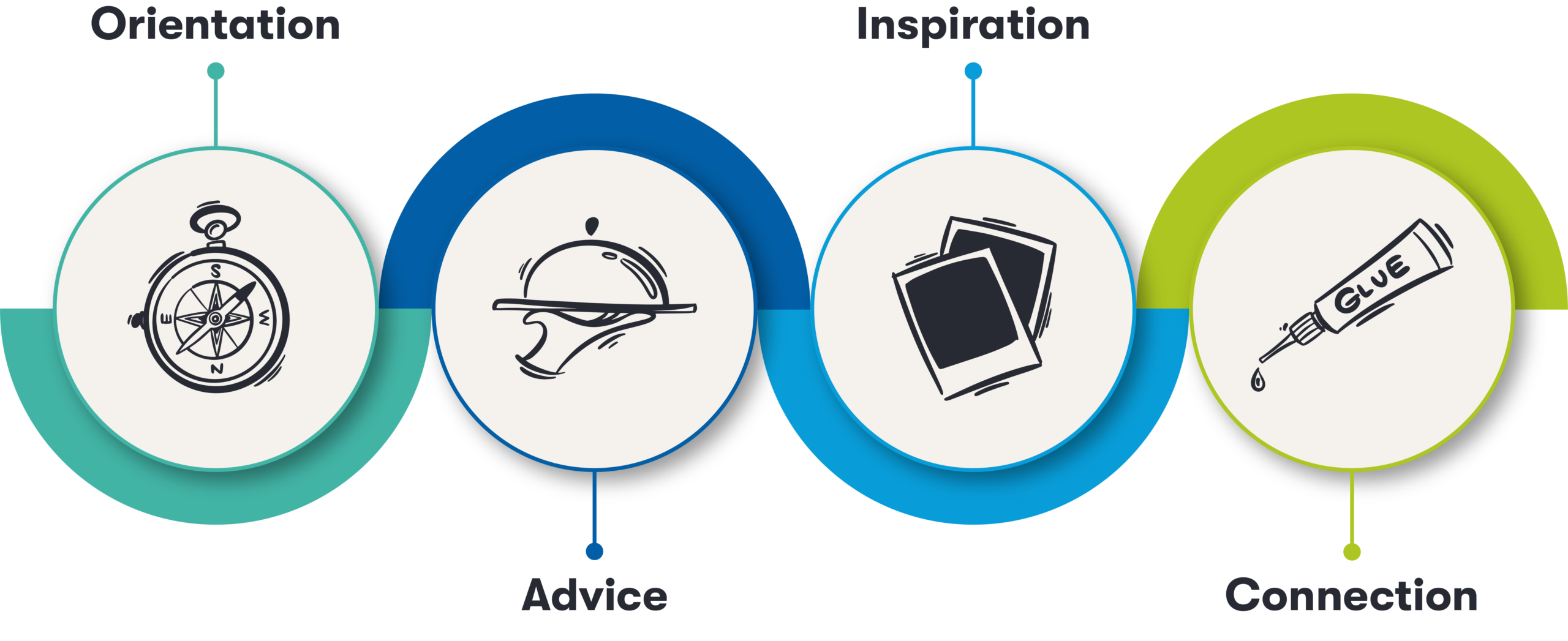
At each stage of the customer journey, customers have different needs that you can address specifically with content personalization.

#4 Personalization in relation to the referrer

As already explained, personalization can be based on characteristics and data that are available to you thanks to the latest technologies. In addition to the location of the shop visitor, for example, the characteristics also include the source—the so-called referrer.

The referrer provides information about the origin of a website or shop visitor. It therefore refers to the source through which a customer arrived at the shop. In most cases, this is a URL. With the help of the referrer, evaluations can be made about the origin of visitors, which plays an important role in online marketing in the field of web analysis, among other things.

The referrer can also be used for personalization. This allows the page accessed and its content to be customized depending on the source or origin of the customer, such as Google Shopping, social media, etc. For example, if a customer arrives directly at the corresponding product detail page via a Google ad for a specific product, you can customize the content. This page is therefore different from the product detail page that a customer sees when they are already on the site and access it from your shop.

It makes sense to take special measures here, as the display of Google ads is also associated with a high budget. You should therefore ensure that visitors do not immediately leave your shop after visiting it. Possible ways of personalizing your shop include displaying specific recommendations and integrating a search widget with tiles and filter options. This allows you to keep customers in your shop, as they can easily navigate further within the shop from this page.
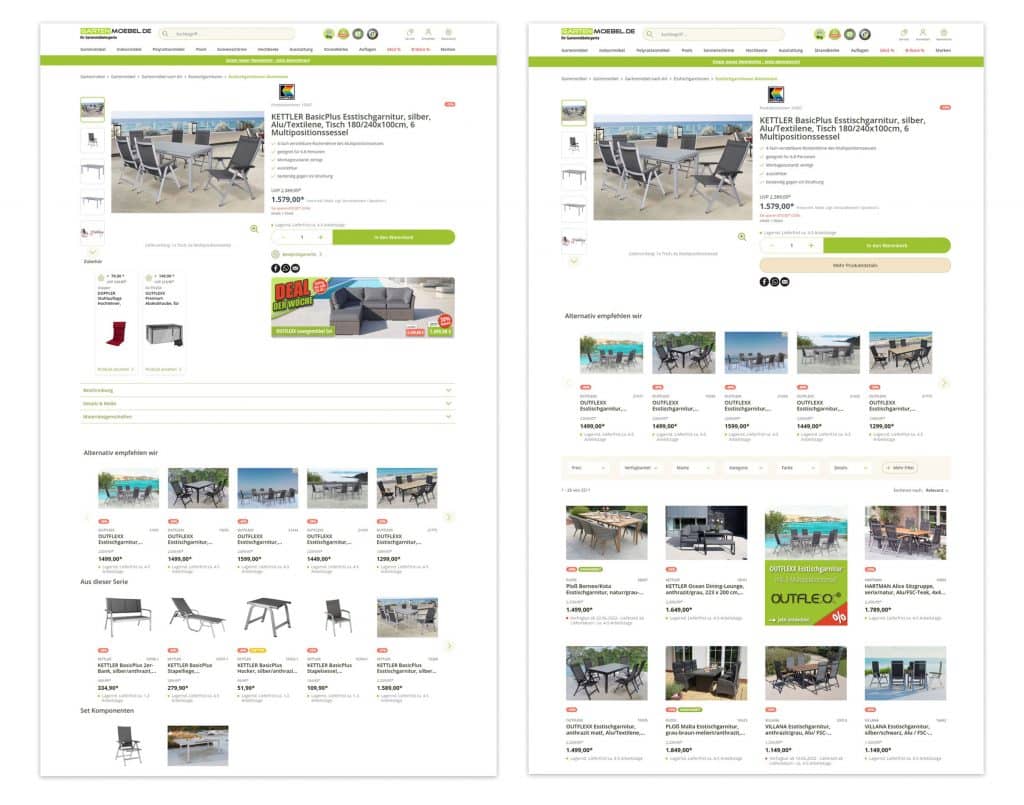
Compared to the product detail page accessed from the shop (left), GARTENMOEBEL.DE presents a customized version when customers arrive at the product detail page via a Google ad (right).
(Source: Screenshot from gartenmoebel.de)


Options for content personalization

As already mentioned, there are a variety of ways to provide personalized content. You can use content personalization in a wide range of places within your online store. A distinction must be made between the provision of personalized content and the adaptation of the content itself.

Content personalization

Firstly, you have the option of personalizing your content and thus responding individually to customer groups or each individual customer. One point that many people are familiar with is the personal greeting, which can be implemented using a tag. However, there are many other possibilities in the area of content personalization. For example, you can adapt texts and headlines to the respective customer. Even the color of the buttons or the entire layout can be customized to the user's needs. Images and banners can also be personalized. This allows you to create a unique user experience for your customers.

Content recommendations

On the other hand, you can also display content recommendations and present blog articles or topics that match the individual preferences of each customer. Using collected user data or personas you have defined, you can ensure that your customers are provided with the right content at the right time. This ensures that your customers are not overwhelmed by the mass of content, but that only topics relevant to them are brought into focus. In this way, you can attract more attention from your customers and offer them added value. At the same time, you also benefit in terms of SEO when you highlight content that is really interesting to your customers. You can display content recommendations in different places within your shop. For example, you can display individual content for your customers on the home page or category pages.

Real-time analytics as a basis

Individualized content that can be dynamically adapted is also referred to as smart content. With smart content, you can offer your customers a shopping experience that is perfectly tailored to them. Not only do you provide your customers with relevant content, but you also adapt it specifically to each individual customer.


Stay up to date on personalization: Sign up for the epoq newsletter. Register now!


These adjustments can affect many areas: personalized content can, for example, be individually tailored to the device used, the user's country, or the phase of the customer lifecycle. The goal is to personalize the content you provide even more to the individual customer. Smart content is characterized by the fact that it adapts dynamically and in real time to the respective user and their needs. Find out everything you need to know about creating a unique shopping experience for your customers with real-time personalization in our blog post.

Conclusion: Unique shopping experiences through personalized content

Content personalization allows you to create unforgettable shopping experiences for your customers and promote customer loyalty. Content tailored to individual customers and relevant content recommendations offer significant added value. It is important to remain relevant to customers by providing them with content that interests them from the vast amount of content available. Personalized content should not only be provided once, but throughout the entire customer lifecycle.

Frequently asked questions about content personalization

Learn everything you need to know about personalization in e-commerce in our e-book.

Request now!

Sarah, Junior Content Marketing Manager at epoq
Sarah Birk
Online Marketing Manager - Content & SEO
Sarah works as Online Marketing Manager – Content & SEO at Epoq and is responsible for the content area. Her responsibilities range from content planning and conception to analysis and optimization of various content formats, taking important SEO aspects into account.