
E-book – Personalization in B2B E-commerce
In this e-book, you will learn what B2B customers want from e-commerce and how you can meet their needs with personalization.

The world of e-commerce marketing is constantly changing. Real-time personalization in particular is developing at a rapid pace because the results it delivers are astonishing. Here you can find out how personalization works, how you can use it to significantly increase your conversion rate, and how to leverage it to create unique shopping experiences.

Here's what you can expect to find in this blog article:
What is real-time personalization?
How real-time personalization works technically
What role AI plays in this
How real-time personalization and the customer journey are connected
What can real-time personalization do in e-commerce?
4 well-known tactics as a basis for personalized recommendations
1. "Others also bought"
2. "This might go well with your product"
3. "Now reduced"
4. "You may also like"
Why is real-time personalization becoming increasingly important?
Conclusion: Real-time personalization offers shopping almost like in a store
If you don't know your shop visitors, you can't meet their specific wishes and needs. Real-time personalization exists to give customers exactly what they want. Its technologies are used to gain data-based insights into customers' wishes and purchasing habits from the moment they first click, and to personalize the shopping experience in real time.
To enable personalization, technology based on artificial intelligence is required. This so-called AI engine comprises a network of intelligent algorithms and uses artificial intelligence methods such as machine learning and reinforcement learning.
Machine learning is a process that generates knowledge from experience. Based on a corresponding database, the AI engine can recognize patterns and regularities and thus make predictions for the personalized display of products and content. The required database consists of the shop's product catalog, the click and purchase behavior of shop customers, and the expert knowledge of the shop operator and personalization provider. This data is combined in a so-called knowledge base. The AI system processes it into knowledge and ultimately uses it to make predictions about the purchasing behavior of shop customers.
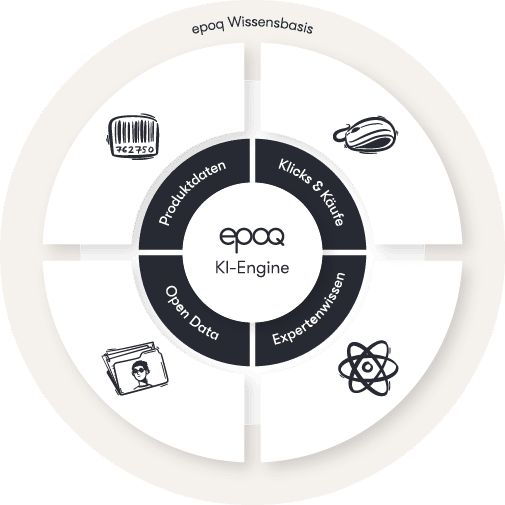
Real-time personalization requires a knowledge base consisting of four data categories: product data, clicks and purchases, open data, and expert knowledge.
Reinforcement learning is an artificial intelligence method in which a so-called agent learns to interact with its environment as effectively as possible. Real-time analytics is required to ensure that this happens in real time. The incoming data is analyzed and processed directly.
Automated decisions can be made within seconds or milliseconds using real-time analytics. This could be a decision about which content or products to display to a customer who is currently visiting a store. By making automated decisions in real time, the agent can provide this store customer with suitable recommendations within milliseconds.
When the page is accessed, a request is sent to the server, which interprets the request and creates a numerical vector containing information about the request for the agent. Based on this vector, the agent can decide on one or more actions. These decisions influence the rule chain used to determine the products that are actually recommended. These products are then returned to the user's browser.
The AI engine develops through self-learning with every click and purchase, allowing personalized real-time communication to be continuously refined. By using real-time personalization, you can deliver personalized content to each individual shopper at various touchpoints along the customer journey.
Stay up to date on personalization: Sign up for the Epoq newsletter. Register now!
You can find out more about real time and how to collect, enrich, and interpret as much data as possible in order to extract the truly meaningful information from the mass of data in our blog article Reinforcement Learning Process: How to Increase the Probability of Purchase with Real-Time Analytics (Part 2).
Real-time personalization therefore goes hand in hand with AI. Only systems with artificial intelligence are capable of analyzing large amounts of customer data in real time, creating a profile while the shop visitor is browsing, and using this information to display personalized content and products.
The profile generated in this way can be taken into account, for example, by using an ecommerce search engine function for search queries. If your customer enters "parka" in the search field, for example, the AI automatically adjusts the order of the jackets displayed to suit their taste. Is elegance and quality more important to the user than a low price? Then high-quality brand-name products will appear on their screen first, followed by the less expensive parkas.
The genius of it: with every click, more data is generated that can be used immediately. With every interaction, the AI system learns more about what works and what doesn't for your shop visitors and adjusts the products or content accordingly.
This allows you to create a personalized customer experience that significantly improves customer loyalty and conversion rates. AI is therefore the "driving force" behind real-time personalization—without it, nothing works.
To take full advantage of real-time personalization and create tailored shopping experiences, you need to understand your customers' journey. You track and analyze all of a user's touchpoints until they perform a specific action, such as making a purchase or signing up for a newsletter. This provides a 360-degree view of customer engagement in your store.
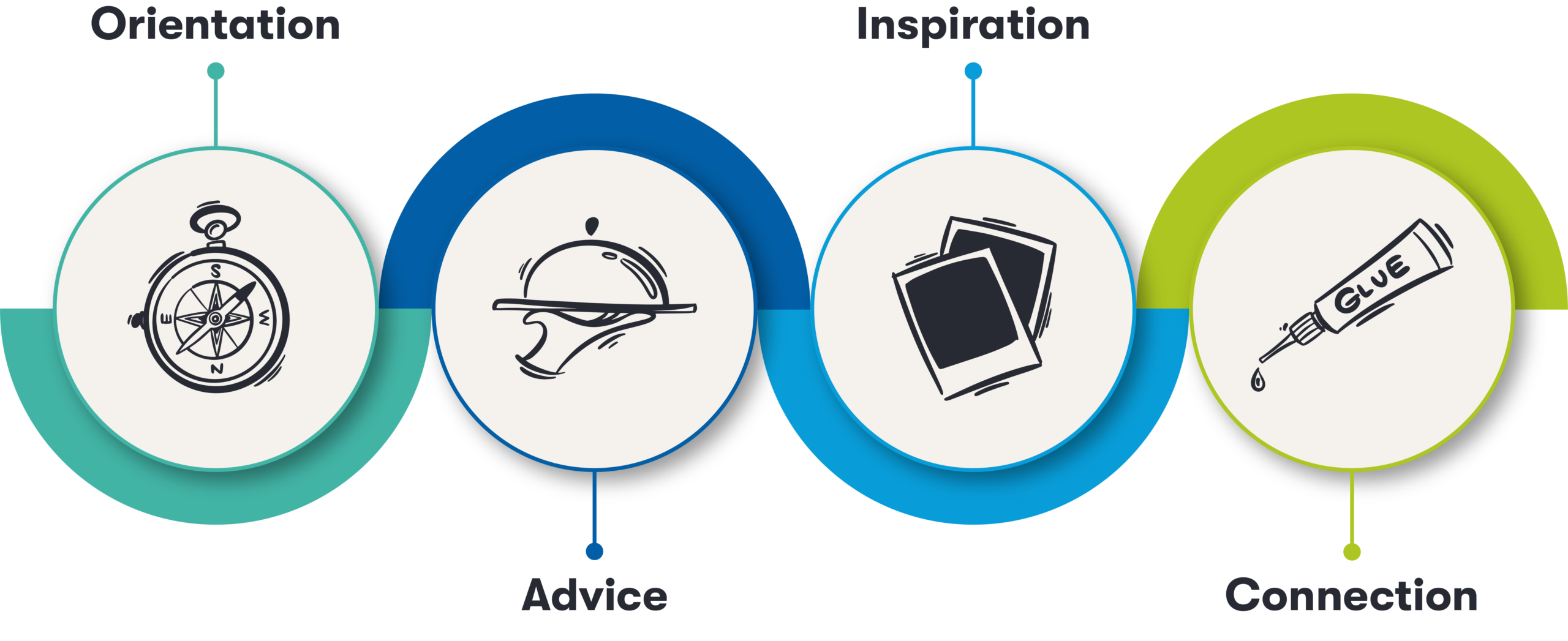
Shop operators can use real-time personalization to optimize the entire customer journey for their customers.
You analyze your customers' customer journey by using detailed web tracking and evaluating the individual click behavior of each customer. This gives you in-depth information about their purchasing behavior. Ideally, the system gets to know the customer so well based on data that it can even predict what they expect from certain touchpoints. You can then use this knowledge to optimize the customer journey by displaying positive, personalized interactions in real time at each of their touchpoints.
These include, for example
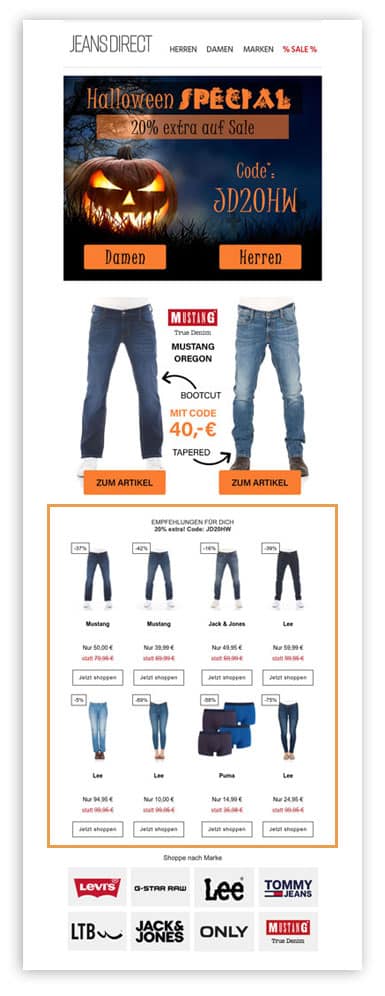
Jeans-direct.de offers every customer a personalized shopping experience in the form of personalized emails using real-time personalization.
(Source: Screenshot of email from jeans-direct.de)
If you coordinate real-time personalization and the customer journey well, customers will get the impression when visiting your online shop that you know their wishes, value them, and care about them. We bet that won't be the last time they shop with you!
Real-time personalization enables 1:1 communication with customers in e-commerce. If you succeed in stringing together personalized interactions at five or ten touchpoints along the customer journey, the customer will ideally feel as if they are being guided through the online shop and receiving individual advice from a friendly, attentive salesperson.
The user enjoys the presentation of products tailored to their tastes until they reach their desired destination and finally make a purchase.
The goal of real-time personalization in e-commerce is to create an individualized user experience. The aim is to replicate the personal experience of browsing through a store as authentically as possible. It's like when you go to your favorite store and the salesperson says, "Hi Nils, I've got something new in from your favorite brand."
Below, we would like to present four initial tactics for recommendations that are frequently used and show how these examples can be made even more successful through e-commerce personalization. You are sure to recognize one or two of them.
As already mentioned, real-time personalization can of course also be used at many other touchpoints along the customer journey.
Actually, we humans are quite simple creatures: we always want what others have. Or at least we are interested in what "others" think is great. The "others also bought" product recommendations take advantage of this habit. To make the whole thing even more effective, it is important to match these recommendations with the individual interests of each customer and only recommend products that the shop customer might potentially like and that are also available in their size, for example.
Your customer has added a set of nails to their shopping cart. Now you have the opportunity to offer them matching additional items, e.g. , in the form of a shopping cart layer with products that go well with them: hammers, picture frames, DIY sets. How likely is it that your customer will suddenly remember that they still need this and that? Right—quite high. Here, too, the relevance of the products displayed is crucial. The product recommendations must be consistent, i.e., they must be compatible with each other in terms of content or technology. If you also take into account the personal preferences of each shop customer, you can make even more targeted recommendations that suit their individual tastes.
Your customer is browsing around their favorite store, not really looking for anything in particular. However , during one of their last visits, your customer took a closer look at some great clothes but didn't buy them, perhaps because the price was too high. If some of these items are currently on sale, you can follow up with personalized recommendations in the style of "Now reduced." If a customer has already had their eye on certain products that interest them, they may now decide to buy them at a lower price.
Based on the click and purchase behavior of your shop customers, you can act asa "digital sales assistant"and make targeted, personalized product recommendations that your customers will like. By tailoring further product suggestions to the individual online shopper (favorite brand, preferred color, correct size, etc.), you can draw their attention to products that might also suit their taste. This allows you to offer good service and, in the best case scenario, benefit from increased shopping cart values at the same time.
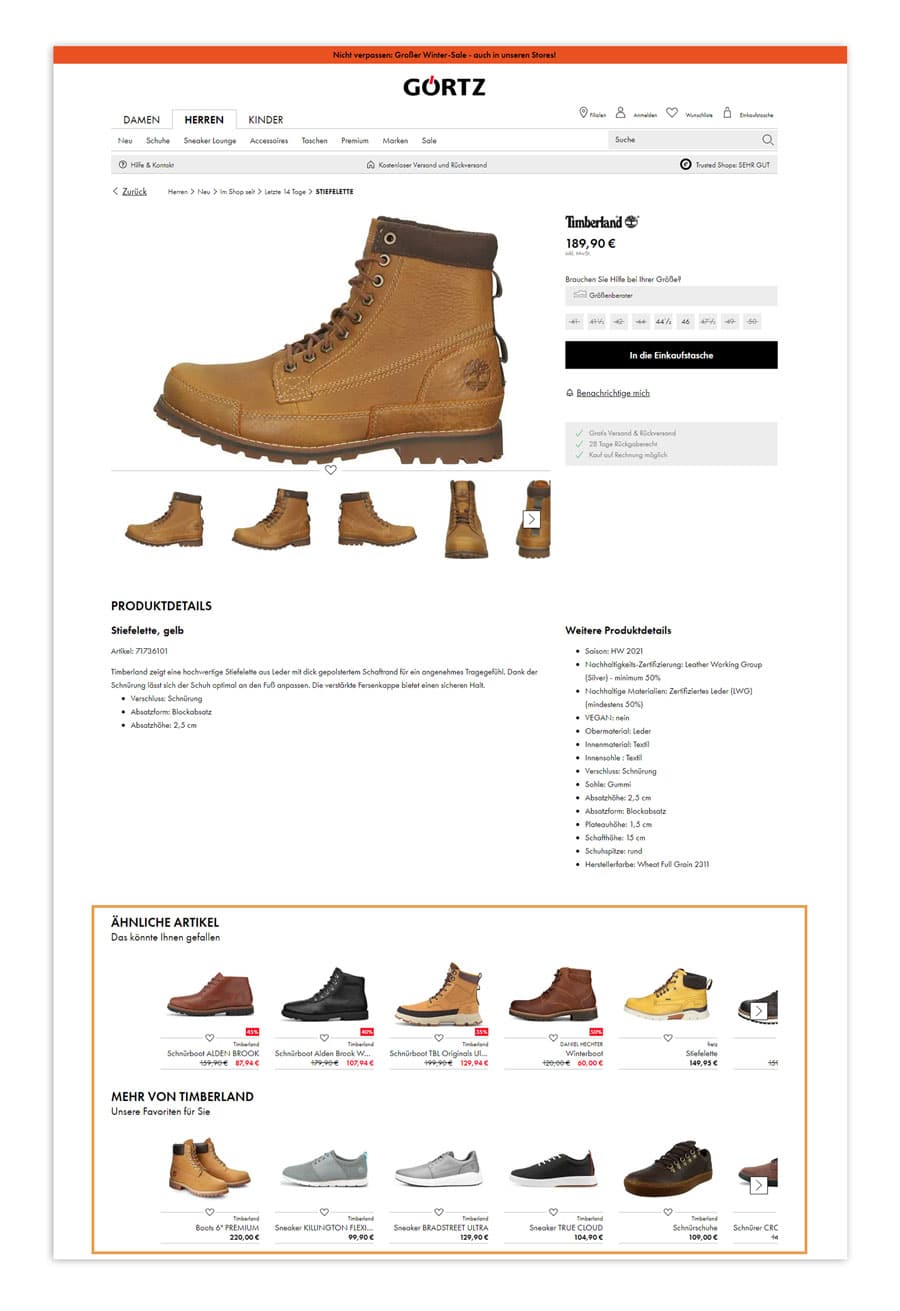
In the Görtz online shop, customers receive product suggestions in the form of similar items that they might also like.
(Source: Screenshot from goertz.de)
So, did you have déjà vu? Only when you learn more about real-time personalization in e-commerce do you realize how ingenious its mechanisms are and how much they influence you. Find out how well-known online shops use personalization effectively in different ways in our blog article 5 examples of successful personalization.
Stay up to date on personalization: Sign up for the Epoq newsletter. Register now!
It's high time to start using real-time personalization for your customers too! Because even better than its mechanisms are its results: strong customer loyalty, high conversion rates, and unique shopping experiences.
Customers love online shops that combine speed and functionality with individualized product presentation. In the long term, only those who continuously optimize their digital business will be able to hold their own in the e-commerce market—especially in terms of time savings, convenience, and personalization.
Most consumers already consider a tailor-made shop layout to be a normal part of their online customer experience. They want to feel "understood" by only seeing the most relevant products that they immediately like.
In short, real-time personalization technologies are essential for remaining competitive in crowded and increasingly complex e-commerce markets.
Real-time personalization in e-commerce can create a holistic feel-good experience based on AI. Shop visitors enjoy advice and inspiration that rivals that of a brick-and-mortar store. Want to offer customers a contemporary shopping experience and take your conversion rate to the next level? Then you should definitely take a closer look at the possibilities in this area.
Real-time personalization means that content, product recommendations, and offers are calculated and displayed individually at the exact moment a user visits the store, based on the user’s current behavior. Traditional personalization, on the other hand, relies on predefined segments and static rules.
The data is primarily based on the user’s click and purchase behavior in the online store: which products they viewed, which categories they visited, and what they added to their cart or purchased. These signals are analyzed in real time to ensure that relevant content is always displayed.
Customers no longer view the store as a generic catalog, but as a personalized shopping environment that understands their preferences. This not only increases satisfaction but also loyalty, because customers prefer to return to stores where they feel well taken care of.
Yes, reputable personalization platforms rely on pseudonymized behavioral data and do not use personally identifiable information without explicit consent. Click and purchase behavior is collected but processed in such a way that it can no longer be linked to a specific individual—in accordance with the GDPR principle of data minimization.
A cookie consent solution and a transparent privacy policy are prerequisites for operating in compliance with EU law.
Which metrics indicate whether real-time personalization is successful?
The most important KPIs are: increasing the conversion rate, raising the average cart value, improving the click-through rate on personalized recommendations, reducing the bounce rate, lowering the return rate, and increasing traffic.
The relevant KPIs vary depending on the touchpoint:
Conversion Rate: Applies across all touchpoints
Bounce Rate: Search
Return Rate: Consultation
Cart Total: Recommendations
Traffic: Email Personalization
An A/B test comparing a personalized version with a non-personalized version yields the clearest results.
Want to boost your conversion rate with real-time personalization?
Our e-book is just right for you!

You are currently viewing placeholder content from HubSpot Embedded Content. To access the actual content, click the button below. Please note that doing so will result in data being shared with third-party providers.
More InformationYou are currently viewing placeholder content from HubSpot. To access the actual content, click the button below. Please note that doing so will result in data being shared with third-party providers.
More InformationYou are currently viewing placeholder content from HubSpot Meetings. To access the actual content, click the button below. Please note that doing so will result in data being shared with third-party providers.
More Information