
E-book – Personalization in E-commerce
In this e-book, you will learn why personalization is important in e-commerce and what the term personalization actually means.

Data-driven commerce is more than just a short-lived trend. The magic word in e-commerce is personalization—and that is not possible without collecting and analyzing large amounts of data. In this article, you will learn how you can use data-driven commerce and data-driven marketing to get to know your customers and significantly boost your conversion rate.

Here'swhatyou can expect to find in this blog article:
Data-driven marketing: Analyzing and inspiring customers
Definition: What lies behind data-driven commerce
What are the application scenarios for data-driven commerce?
What role do customer journey and AI play in data-driven marketing?
Getting started: Small steps instead of jumping in at the deep end
Is data-driven marketing right for my business?
What are the first steps?
What are some useful tools to get started?
Conclusion: Data-driven commerce is the key to an optimal customer experience.
Data-driven marketing means using data to get as close as possible to the user and learn about their needs as accurately as possible. We have summarized how this works and what you can achieve with it in e-commerce below.
People are using more and more digital devices, services, and channels—and in doing so, they are leaving behind many traces and clues. Whether through entering information in forms or apps, their clicking behavior, or automatically generated data such as location information, the more data that is collected, the clearer their identity and shopping preferences become.
Collecting and analyzing this information and tailoring online marketing strategies accordingly will be a prerequisite for a successful e-commerce business in the future. And that is precisely what data-driven commerce is all about: the systematic and holistic use of customer data to continuously optimize customer loyalty and conversion rates.
Stay up to date on personalization: Sign up for the Epoq newsletter. Register now!
Artificial intelligence is an important foundation for data-driven commerce because it is capable of collecting, independently organizing, and analyzing structured data. The conclusions drawn using AI help with decision-making, simplify processes, and thus bring enormous competitive advantages.
The analysis and evaluation of user data has long been established in e-commerce. Here you can see where data-driven commerce is frequently used and what it offers:
Until now, data has tended to be used to optimize specific sections of the customer journey. But every online marketer's dream is a consistently personalized customer journey. This is where the full potential of data-driven commerce lies.
The reason: the ability to personalize the entire customer journey opens up a huge opportunity for customer loyalty. If you have enough data from the customer's previous visits to your store, you can eventually accompany them throughout their entire journey through the store with personalized communication and tailored offers – from the first click to checkout and after-sales. In short: pure personalization!
This perfectly matches today's customer expectations: your shop visitors want to be noticed and receive personalized advice. They want their digital tour of your product range to give them the same pleasant feeling they get in a brick-and-mortar store, where a salesperson values them as a regular customer and provides them with detailed advice. Customers who feel this way will visit your shop again and again. Thus, the personalized customer journey brings the vision of the perfect digital customer experience with a feel-good atmosphere within reach.
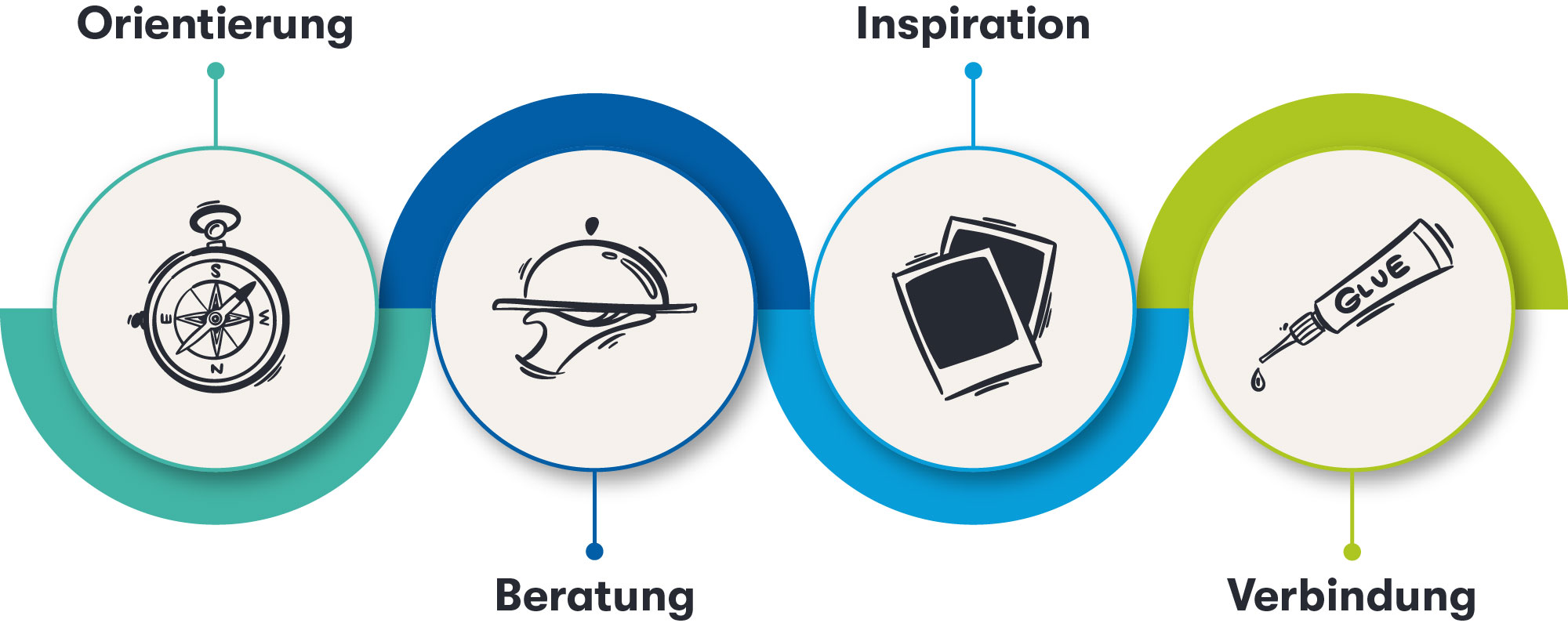
Personalization throughout the entire customer journey creates a comprehensive experience and improves customer satisfaction.
But in order to really take care of potential buyers in this way, you naturally need a lot of data from them. And even that data does not initially provide any truly useful information. The trick is to analyze these data sets— also known as big data — in such a way that patterns and correlations can be identified and smart measures can be derived from them.
This is where artificial intelligence (AI) and machine learning come into play. AI tools and algorithms are used to analyze the available data and, based on this, carry out individualized actions in the online store. In addition to individual product recommendations, these can include the selection of relevant payment methods. Discount logic can also be developed and applied—again, fully automatically and in real time.
The advantages of AI tools and personalized customer journeys are obvious: user communication becomes more individualized and offers can be tailored and presented in such an attractive way that the result is both strong customer loyalty and excellent conversion rates. It cannot be said often enough: the future of e-commerce lies in a customer experience that puts a big smile on customers' faces as they browse an online store – and save the URL to their favorites.
In data-driven commerce, continuous optimization in small steps is the path to success. You need a little patience, but it's definitely fun to work with the right tools.
We have good news for you: even smaller online shops can significantly improve their performance with data-driven marketing. It is no longer a large budget that is decisive, but rather the intelligent use of data with the help of the right tools. Even if you only have a small marketing budget, data-driven commerce can help you reduce wastage, increase your ROI (return on investment), and ultimately save costs.
It doesn't have to be a sophisticated data-driven marketing strategy spanning several quarters. Even small steps can bring about amazing improvements. One useful tool, for example, is the so-called ecommerce search engine function. This collects and analyzes search entries and draws conclusions about the preferences and needs of the user.
At the same time, future search results are automatically optimized. Even this small feature significantly improves the customer experience and has an impact on the conversion rate. So, just get started!
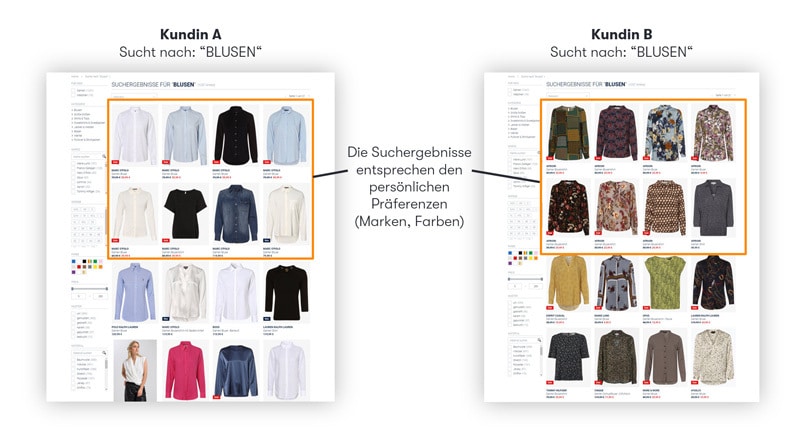
With the help of an ecommerce search engine, search results can be customized according to personal preferences.
Below you will find the most important steps for getting started with data-driven commerce. Artificial intelligence (AI) forms the basis, as it offers a wide range of possibilities for better understanding your customers' needs, making predictions about their behavior, and providing personalized content across all channels and devices and throughout the entire customer journey.
What is the current situation? What data can I already access, and which key figures should be analyzed? At which points in the customer journey can I obtain reliable data? Which tools are right for me? What are my goals?
These are all questions you should ask yourself first. Then implement the necessary tools for data collection and select the metrics and data sets that are relevant to your goals.
Where could personalized content be displayed, and where do all shop visitors currently see the same thing? If there is a range of possible content, AI can optimize the selection. An A/B test ensures that the optimization is based on the status quo. This is because A/B tests allow you to test content or strategies against each other. The resulting conversion rates then provide information about the relevance of the content or offer for the corresponding user segment.
Stay up to date on personalization: Sign up for the Epoq newsletter. Register now!
The most important basis is, of course, your data collection. It's like a garden: you have to be patient and keep weeding until it bears fruit. Applied to the online shop, this means that you adopt the more successful version of the A/B test and monitor it over the next few weeks. Collect data over a longer period of time and observe the figures and measurements that the tools display. It is best to define reporting periods in which the metrics are viewed and exported.
After a certain amount of time, you will be able to recognize patterns, valleys, and peaks (such as seasonal fluctuations, trends, and currents) in the data analysis. With each cycle, each data analysis, and each optimization, a clearer strategy emerges.
At this stage, it is essential to continuously adjust goals and KPIs in order to identify weaknesses in the strategy and improve them. Ultimately, the strategy can then be implemented across multiple channels, such as email marketing, personalized newsletters, and banner ads.
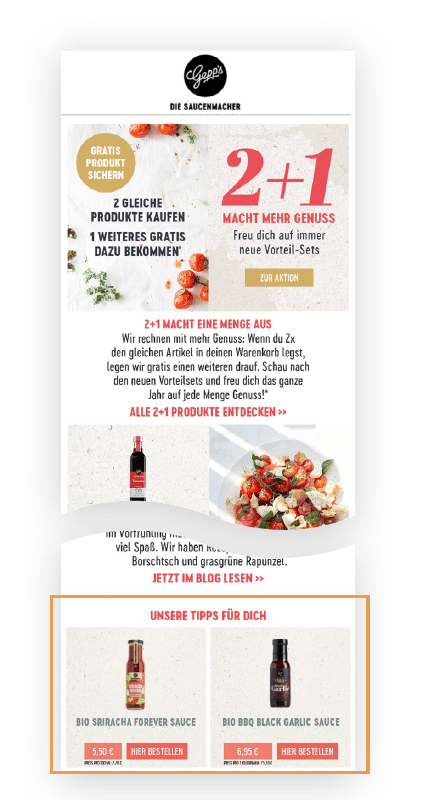
Personalization can be used, for example, in the form of relevant product recommendations in emails.
(Source: Screenshot email from gepps.de)
There are many tools that can help you with data-driven commerce. Here is a small selection:
Data collection and analysis in data-driven commerce never stops. Analytical methods and models are constantly optimized and evaluated to improve data quality and update the strategy accordingly. Staying on top of things is everything!
Admittedly, data-driven commerce requires patience. But it's worth it, because digital-driven marketing gives you and your online shop a decisive competitive advantage. You get to know your customers really well and can accompany them more attentively on their customer journey. This strengthens your brand, continuously increases your conversion rate, and makes your users happy!
The most important goal is to use customer data analysis to get to know buyers and their preferences better, thereby providing them with seamless, personalized offers throughout their digital shopping experience—right through to personalized after-sales and returns management.
Enormous amounts of customer data are quickly accumulated, which can only be evaluated using artificial intelligence. Algorithms then display the appropriate offers on the presentation area in real time.
The end-to-end digitization of the customer journey—that is, collecting data on how customers behave at each touchpoint—opens up entirely new opportunities for customer loyalty. By getting to know users and their preferences as well as possible, it is also possible to better respond to their individual preferences.
During their tour of the online shop, users feel that they are being treated as individuals and receiving personalized advice, because at every stage they are presented with offers that are tailored to their tastes. This naturally strengthens their loyalty to the shop and the brand.
The most important thing in data-driven marketing is consistency: collecting and evaluating data over the long term, continually adapting measures to the results, and staying on the ball.
Learn more about AI-powered personalization and how you can use it throughout the customer journey.
Read the e-book now!

You are currently viewing placeholder content from HubSpot Embedded Content. To access the actual content, click the button below. Please note that doing so will result in data being shared with third-party providers.
More InformationYou are currently viewing placeholder content from HubSpot. To access the actual content, click the button below. Please note that doing so will result in data being shared with third-party providers.
More InformationYou are currently viewing placeholder content from HubSpot Meetings. To access the actual content, click the button below. Please note that doing so will result in data being shared with third-party providers.
More Information