
How-To | Data Enrichment – Make Informed Decisions (#EpoqPXD22)
In this slot, the speakers will present various solutions for data management.

To be successful as an online retailer, it is important that all employees have access to the necessary data and that this data is easily accessible. Data silos often lead to problems in this regard. Breaking down these silos can increase the success of your e-commerce business and, in particular, optimize personalization. In the following article, we explain what data silos are and how they arise. We also highlight the problems that data silos cause in general and in relation to personalization, as well as ways to break down these silos.

Here'swhatyou can expect to find in this blog article:
Why decentralized data storage is problematic for e-commerce companies
Data silos and personalization
Identify and break down silos
Identify data silos in your e-commerce
Break down data silos and leverage the potential of your data
Conclusion: Breaking down data silos for greater efficiency in e-commerce
The term "data silo" is based on the "silo" we know from agriculture. Different departments within an organization tend to store their respective data and information in different locations. A collection of data that is not easily accessible to everyone within a company and is stored in different locations is referred to as a data silo.
Data silos develop over time in almost every company. Each department within a company collects its own data and often stores it in different locations. In doing so, they usually fail to consider that the data collected could also be of great benefit to other departments. The most common causes of information silos are:
Stay up to date on personalization: Sign up for the Epoq newsletter.Sign up now!
Data silos, whether created unintentionally or deliberately, pose problems for online retailers in many areas. To make the best use of all your data, you should fix them.
As already indicated, data silos pose a major problem, especially in relation to 1:1 personalization in e-commerce. This is because you can only achieve holistic personalization and thus 1:1 communication with your customer if all information from the various touchpoints is used consistently. For technical and organizational reasons, it is often the case that only individual touchpoints are personalized rather than the entire customer journey. Depending on the size of the company, individual project managers or entire departments collect and manage the data from the individual touchpoints separately, resulting in silos. If the individual touchpoints are also personalized separately, it is not possible to respond fully to the customer.
Example: A customer is looking for a T-shirt. To do this, they use faceted navigation, select their size, and filter by their favorite color. They then click on a suitable result. If suitable alternatives are now suggested on the product detail page, you should also take the information obtained from the search into account for the recommendations. This allows you to achieve the highest possible relevance. However, if the two services (search and recommendations) are not aware of each other, product recommendations may be made that appear relevant but are not precise enough to ultimately trigger a purchase. In addition, disappointment may arise if, for example, T-shirt alternatives are suggested that the customer likes but are not available in the size they previously filtered for.
Stay up to date on personalization: Sign up for the Epoq newsletter. Register now!
Communication between the individual touchpoints and the various teams is therefore crucial here. The knowledge base forms the foundation for holistic personalization. This is where all information about customer behavior is collected so that it can be used at all touchpoints within the customer journey.
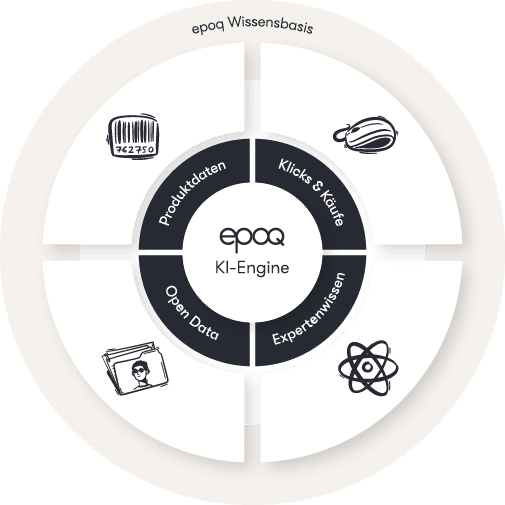
All collected data and information converge in the knowledge base. (Source: Own representation)
In most cases, shop operators are unaware that data silos exist within their organization. This makes it all the more important to identify and break them down.
You can tell whether decentralized data storage is taking place in your company by the following points:
Centralized data management offers many advantages that can benefit your e-commerce business. If you have identified decentralized data storage in your company, you should eliminate it.
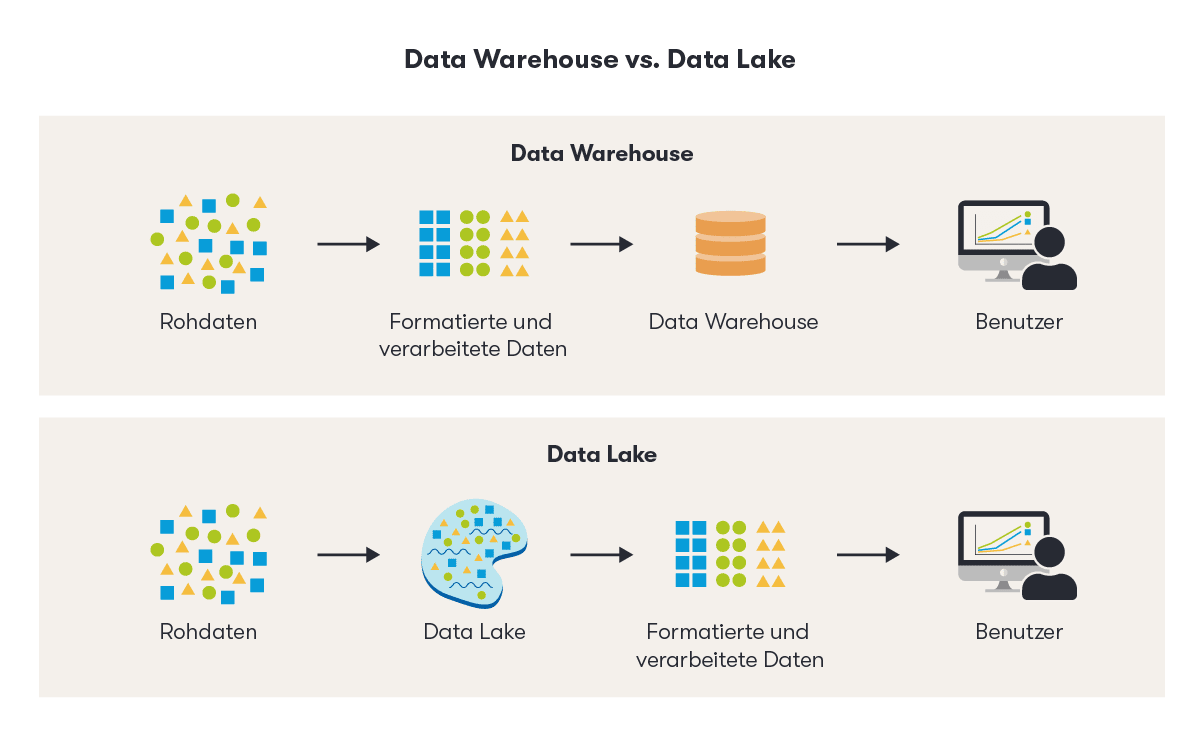
While formatted data is stored in a data warehouse, a data lake contains raw data that has not yet been processed.
(Source: Own representation based on SAP¹)
Data silos can quickly creep into a company. In the area of personalization in particular, online retailers depend on a uniform knowledge base and communication between the individual touchpoints. Otherwise, data silos will prevent you from fully responding to customers and their purchasing intentions. Centralized data management allows you to leverage the full potential of your data and increase the success of your company.
Source: ¹ SAP
A data silo is a collection of data stored in different locations, resulting in restricted access.
Common causes of data silos are:
– Departments store data in different locations.
– When several companies merge, different systems are used.
– Lack of communication.
– Storage of data in external tools.
Data silos cause the following problems:
– Incorrect assessment of data.
– Incomplete analyses.
– Incomplete or incorrect data.
– Additional administrative work.
– Higher resource consumption for data storage.
– No comprehensive personalization.
You can recognize data silos by the following factors:
– Employees need a lot of time to compile data from different systems.
– Data is collected and stored multiple times.
– Data is incomplete.
– Data from different systems differs from one another.
You can break down data silos using these measures:
– Change your processes and habits with the help of change management.
– Develop a strategy for centralizing your data.
– Use data integration to bring all data together in one central location.
– Establish supported self-service access.
Learn more about data enrichment.
Watch the webinar recording!

You are currently viewing placeholder content from HubSpot Embedded Content. To access the actual content, click the button below. Please note that doing so will result in data being shared with third-party providers.
More InformationYou are currently viewing placeholder content from HubSpot. To access the actual content, click the button below. Please note that doing so will result in data being shared with third-party providers.
More InformationYou are currently viewing placeholder content from HubSpot Meetings. To access the actual content, click the button below. Please note that doing so will result in data being shared with third-party providers.
More Information