
How-To | Data Enrichment – Make Informed Decisions (#EpoqPXD22)
In this slot, the speakers will present various solutions for data management.

"Knowledge is power," as the saying goes. But how is knowledge created? And how can you use it in your online store? The knowledge pyramid provides an explanation: in conjunction with artificial intelligence, the data you collect in your online store can be turned into information and ultimately knowledge. This knowledge forms the basis for various promising measures for customer acquisition and retention, such as personalization. Here you can learn more about the knowledge pyramid and its relationship to artificial intelligence.

Here'swhatyou can expect to find in this blog article:
What is the knowledge pyramid?
Knowledge staircase – an alternative model
Data, information, and knowledge – what these terms mean
How relevant is the knowledge pyramid for companies?
How are the knowledge pyramid and artificial intelligence related?
How knowledge is created with the help of artificial intelligence – examples
Knowledge pyramid and AI – the basis for personalization
Conclusion: Targeted knowledge management is essential for online shops
The knowledge pyramid is a model that describes the creation of knowledge. It has its origins in data management and highlights the difference between data, information, and knowledge.
Data forms the bottom level of the pyramid. Taken on its own, however, it is not particularly meaningful. Only when data is linked together does it become information. This information consists of situation-specific definitions, descriptions, and perspectives—what, where, when, and who. Combining different pieces of information allows us to identify patterns and structures which, together with context and experience, lead to knowledge. This knowledge then serves as a basis for decisions on specific actions – the fourth level.
An example:
Data: Measurements from all measuring stations of the German Weather Service.
Information: It's 35°C here today.
Knowledge: The heat can be dangerous to health, protective measures must be taken.
Action: Drink plenty of fluids, stay indoors if possible, wear sunscreen when outside.
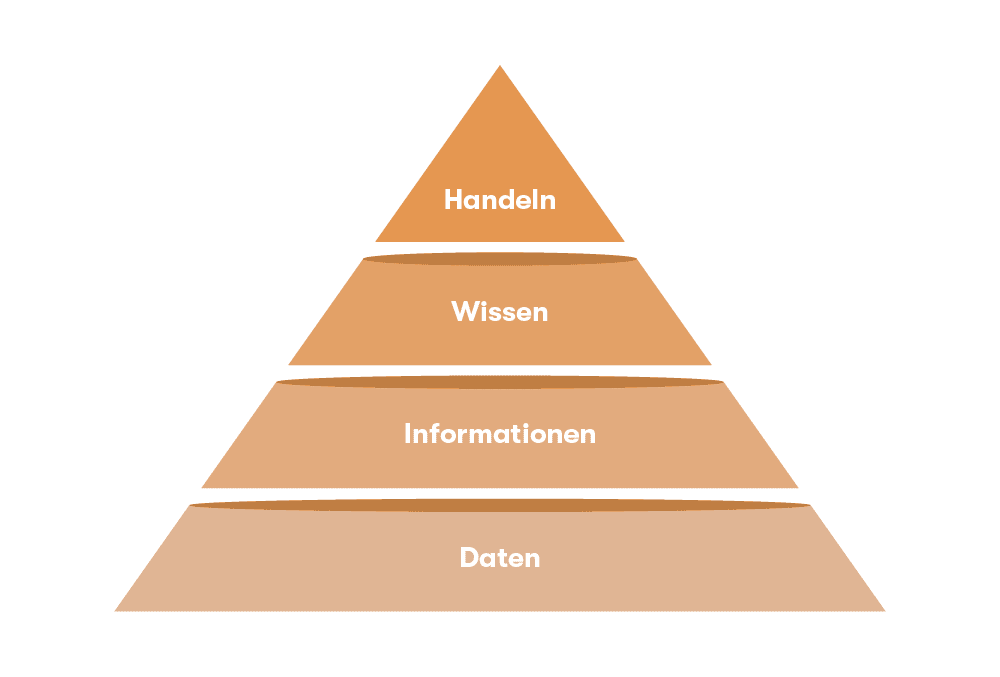
The knowledge pyramid with its four levels: data, information, knowledge, and action. (Source: Own representation)
The knowledge staircase is an extension of the knowledge pyramid. It focuses specifically on the needs of companies and the analysis of big data. The individual levels correspond to those of the knowledge pyramid, supplemented by a fifth: skills. However, instead of levels, this model is based on steps. The goal is to systematically create value from data: the company successfully implements the recommendations for action and thus achieves its business objectives.
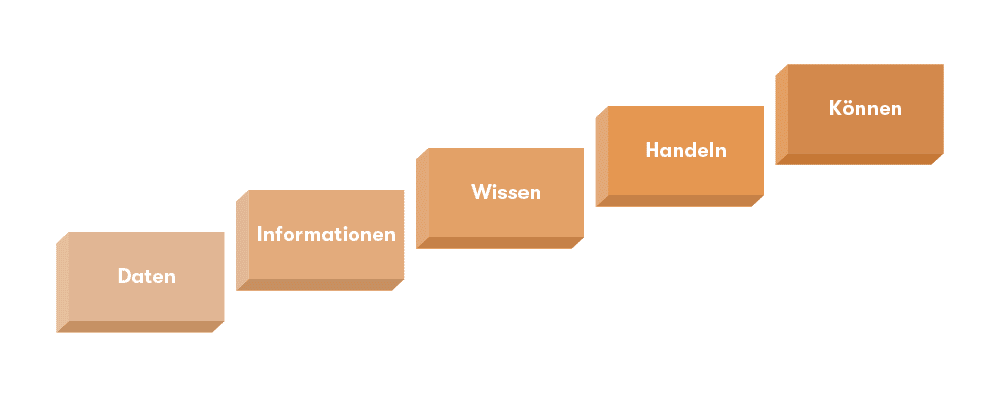
The knowledge ladder consists of five steps: data, information, knowledge, action, and skill. (Source: Own representation)
Within the knowledge pyramid, data describes measurable quantities that are stored digitally, such as a specific sequence of numbers. On its own, this does not initially provide any information about its meaning. However, when the data is supplemented with additional attributes or metadata, information is created: for example, the sequence of numbers is the item number of a product that customer X has purchased. Linking this information with context and empirical values ultimately creates knowledge.
Stay up to date on personalization: Sign up for the Epoq newsletter.Sign up now!
If the purchased product is, for example, a soccer ball, the item number of the purchased product can provide an indication of the customer's preferences. With this knowledge, you as a shop operator can display personalized product recommendations in the form of matching items (soccer shoes, jersey, ball pump) that are of interest to this particular customer.
Many companies collect data, but only those who know how to use it can benefit from it. Data without interpretation and integration into a context is worthless for e-commerce companies. Structured and systematic data analysis, on the other hand, provides ideas for innovative business models that ultimately lead to higher sales. Big data must become smart data—and this is where the knowledge pyramid helps.
Among other things, the knowledge pyramid forms the basis for AI engines, i.e., computer algorithms that make decisions using artificial intelligence. In e-commerce, AI is used in various areas, such as personalized product recommendations, sales forecasting, filtering out fake reviews, and customer targeting. AI engines use methods such as machine learning and reinforcement learning to do this. This enables them to make very complex connections. In addition, the extensive data analyses are fully automated, leaving you more time for other tasks.
The results of AI provide a better basis for decision-making than supposed knowledge —i.e., knowledge based on limited information that is supported by even less real data. In this case, the knowledge pyramid is turned upside down: business decisions are made "on gut instinct." This can work, but it doesn't have to.
There are two types of artificial intelligence (AI): knowledge-based AI or expert systems, and data-based AI.
Knowledge-based AI, also known as expert systems, supports human experts in their decision-making. To do this, the experts first capture the necessary knowledge and make it understandable for the computer. Based on this, the system develops solutions to problems, which are then presented to the human user in an understandable form. These expert systems are less intelligent than data-based AI.
Instead, decision-making here takes place via fixed "if... then..." rules, which the programmer uses to communicate their knowledge base to the machine. This makes the machine less flexible and independent in its decision-making. One disadvantage of expert systems is therefore that the knowledge transmitted can become outdated.
Example of an expert system: With top seller recommendations, you as the shop operator specify exactly which products you want and tell the system clearly, "Give me the products with the most purchases in the last x days." As an expert, you believe that frequently purchased products are a good choice for your recommendations.
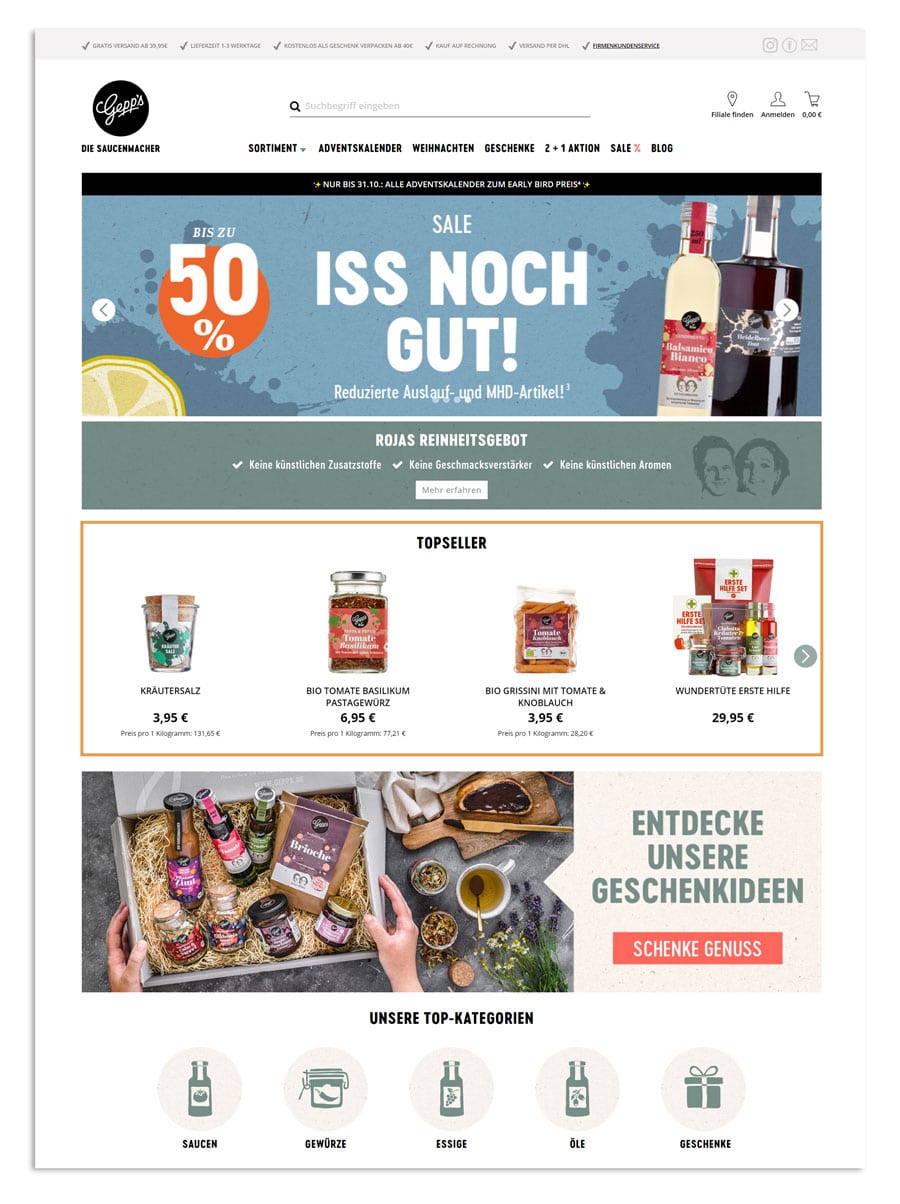
Top seller recommendations are an example of the use of an expert system.
(Source: Screenshot from gepps.de)
In this case, the AI must be trained using algorithms and statistical models in order to draw relevant conclusions from a set of data. There are various approaches to this training process, such as supervised learning, unsupervised learning, and reinforcement learning. Once the AI has recognized the patterns and dependencies between the data, it can make decisions independently. However, the AI's decision-making process is difficult to understand. It is also heavily dependent on data quality and is not suitable for every task. For example, aesthetic features, which play a major role in product recommendations, are difficult to convey to AI.
Example of data-based AI: If you, as a shop operator, want "good alternative recommendations," you can submit a request to the AI and tell it what you want. The artificial intelligence decides which recommendations to make based on the data. So you just give the AI a little help by specifying which strategy (in our example, "alternatives") should be used. This also involves a little bit of expert knowledge.
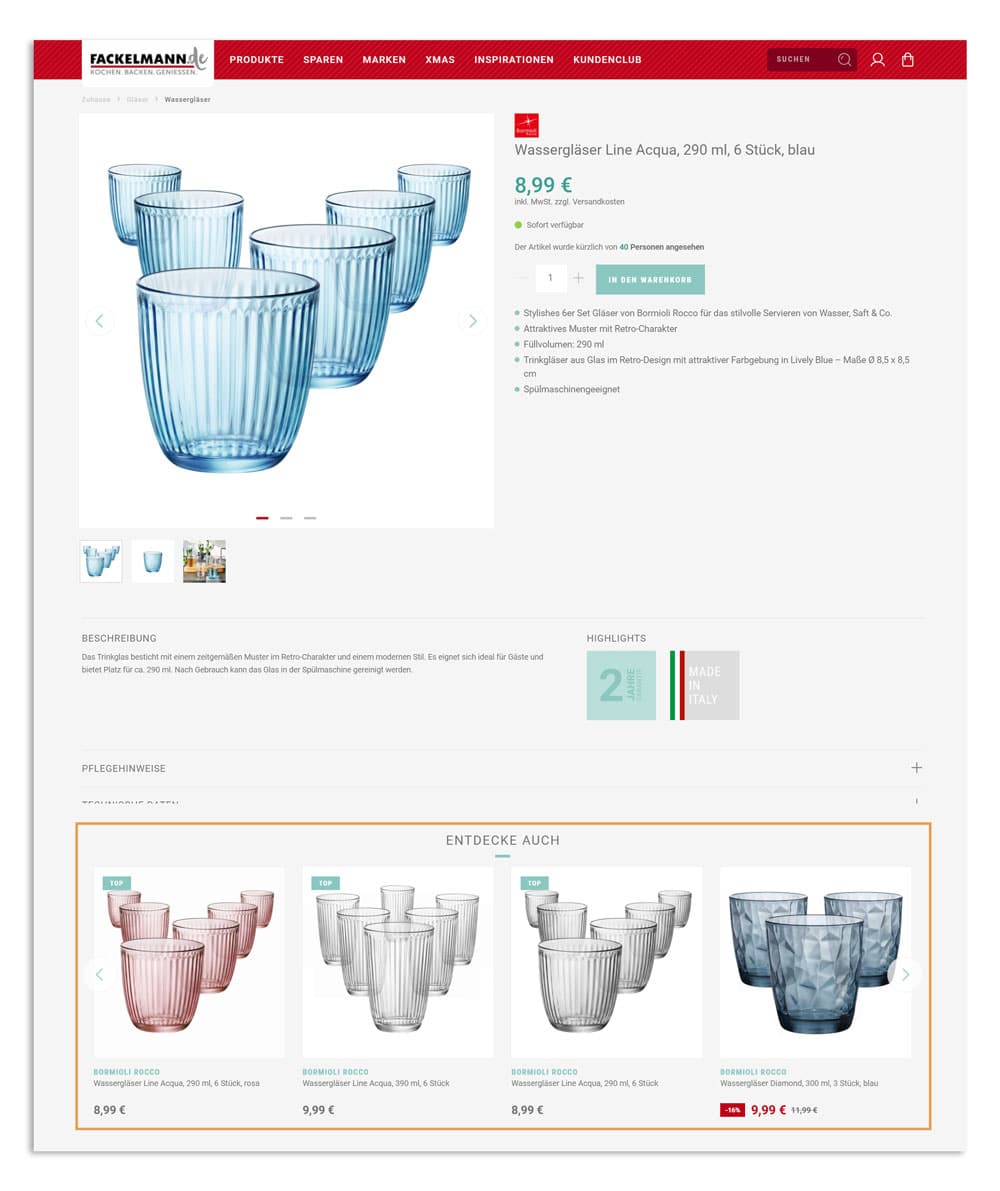
Product recommendations in the form of alternatives are an example of the use of data-based AI.
(Source: Screenshot from fackelmann.de)
As the basis for AI engines, the knowledge pyramid also plays a crucial role in personalization in e-commerce. As already explained, the process of making data-driven decisions is divided into three parts. In the following, we will apply this process once again to AI-supported personalization in e-commerce.
Stay up to date on personalization: Sign up for the Epoq newsletter.Sign up now!
When we talk about big data in e-commerce, we mean all data collected in the context of online shopping. This includes click and purchase behavior, which can be enriched with data from the shop system or merchandise management system.
Information is now the data that is crucial for selecting personalized customer recommendations. The art of recognizing patterns and correlations in data in order to extract useful information for the online store is called data mining. Its use results in smart data, which has a significantly higher information density than the previous big data mass.
Knowledge is now the ability to make decisions based on information and experience. This experience can be gathered not only by humans, but also by machines. For example, reinforcement learning can be used to make decisions about personalization based on given information.
The knowledge pyramid not only makes the creation of knowledge easier to understand, but the model also provides a roadmap for training artificial intelligence. AI engines offer e-commerce companies enormous potential: in addition to automating processes, they also enable greater customer focus. Thanks to AI, you can deliver personalized content to your customers throughout the entire customer journey and address them at exactly the right time.
The knowledge pyramid is a model from data management that explains the creation of knowledge. It consists of four levels: data, information, knowledge, and actions. Data alone is not particularly valuable. Only when data is linked together does it become information, which, with the help of experience and context, leads to knowledge. This knowledge, in turn, serves as the basis for targeted actions.
Many companies today collect various types of data on their internal processes, their customers, and their user behavior. By linking and analyzing this data, they can not only develop ideas for innovative business models, but also obtain a basis for promising business decisions, such as necessary improvements in customer service or an optimized customer journey.
The knowledge pyramid defines how data is transformed into knowledge. Artificial intelligence must first be fed with data and trained so that it can form information from it and make independent decisions based on its acquired knowledge.
AI engines enable online shops to optimize various processes and respond more effectively to their customers' needs. For example, they can display personalized product recommendations, target customers with advertisements, or make predictions about when they will make their next purchase.
Artificial intelligence delivers results based either on data or on knowledge. The data-based approach includes, for example, the automated creation of personas—customer groups with similar master data and behavioral data. Knowledge-based AI can filter spam or make statements about a customer's expected next purchase date.
Want to learn how to organize data from your online store correctly to maximize its potential?
Discover our webinar recording on this topic.

You are currently viewing placeholder content from HubSpot Embedded Content. To access the actual content, click the button below. Please note that doing so will result in data being shared with third-party providers.
More InformationYou are currently viewing placeholder content from HubSpot. To access the actual content, click the button below. Please note that doing so will result in data being shared with third-party providers.
More InformationYou are currently viewing placeholder content from HubSpot Meetings. To access the actual content, click the button below. Please note that doing so will result in data being shared with third-party providers.
More Information