
E-book – Personalization in E-commerce
In this e-book, you will learn why personalization is important in e-commerce and what the term personalization actually means.

On the one hand, there are many competitors and interchangeable products; on the other hand, there are customers who are willing to switch and who want personalized content and an experiential shopping experience. Are you wondering how you can get customers excited about your online store in the face of these challenges? With customer experience management! Because here, your customers are the focus of all activities. Find out why this is so important in e-commerce and how you can set up an optimal customer experience strategy.

Here'swhatyou can expect to find in this blog article:
Customer experience management – a brief definition
The importance of CXM in e-commerce
Tasks of customer experience management
CRM and CXM – internal and external focus on customer needs
Two examples of successful customer experience management
ABOUT YOU: Automated personalized website
Ralph Lauren: The Snapchat avatar as a model
Tips for a successful customer experience strategy
Create target group-specific buyer personas
Define a clear vision of the customer experience
Build a strong team to improve the customer experience
Invest in the right system and tools
Use artificial intelligence (AI) for a better customer experience
Track customer experience metrics
Integrate customer feedback into the continuous improvement process
Conclusion: Customer experience management makes all the difference
Frequently asked questions about customer experience management
Customer experience management (CXM or CEM) can be translated as customer experience management. It is a systematic, holistic approach that places customers at the center of all business processes. It aims to create a perfect customer experience in order to achieve higher customer satisfaction and long-term customer loyalty.
The combination of technologies and marketing strategies allows interactions with customers to be monitored, supported, and organized. The entire customer journey is controlled and personalized in real time across all touchpoints.
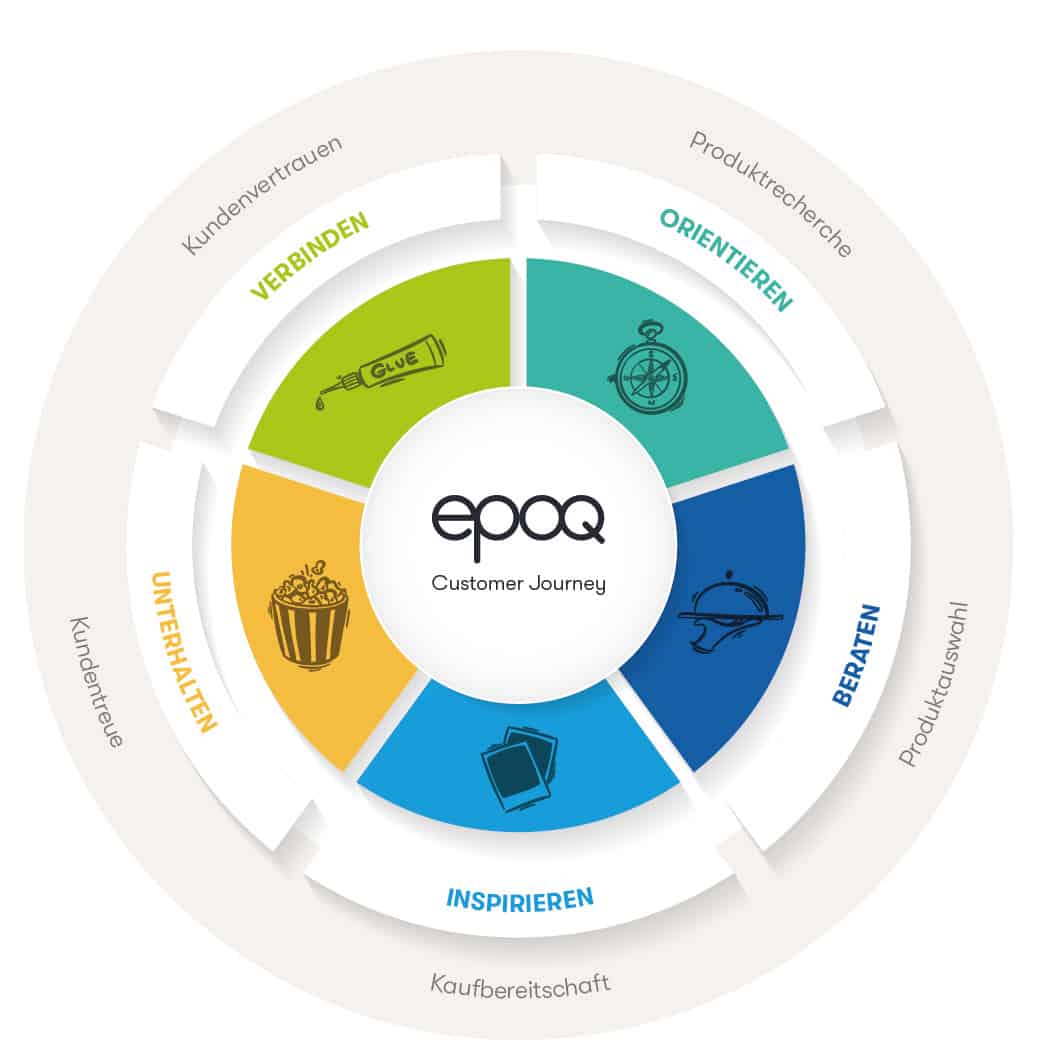
Customer experience management allows you to focus on the customer at every stage of the customer journey.
(Source: Own representation)
Successful CXM improves lead generation, conversion rates, and brand loyalty. To achieve this, you need to understand your customers better. It's not just about meeting their expectations and needs, but exceeding them.
At every touchpoint and across all channels, you offer an optimal UX and thus a customer-oriented experience—whether in the online shop, on social networks, via email, push notifications, or when contacting customer service. These individual experiences reflect the customers, ideally creating a positive customer experience.
Positive experiences promote customer loyalty and strengthen their connection to your brand. Loyal customers not only generate regular sales, they also recommend your shop to others, providing you with free advertising.
For long-term success, customer experience management also includes regularly analyzing and measuring your CX initiatives. Have you achieved your goals? If so, what is the next step? If not, why not? What else can you improve? In this context, customer feedback is very important, as it should always be incorporated into strategies for improving the customer experience.
In a highly competitive market such as e-commerce, customer experience management is becoming increasingly important. This is because products and services have become interchangeable. CXM offers you the opportunity to set yourself apart from your competitors in the long term. If you manage to create an emotional connection between your products and your customers, this will be difficult for others to imitate.
Stay up to date on personalization: Sign up for the Epoq newsletter. Register now!
CXM also responds to society's focus on experiences, which is reflected in consumer behavior. Today's customers expect an emotional, lively approach. They want to receive personalized offers and be able to contact a company flexibly in terms of time and location.
Customer relationship management, or CRM for short , focuses on optimizing internal processes: the aim is to improve customer service and customer relations. Customer experience management, on the other hand, is more externally focused on customers. It centers on their expectations and an outstanding customer experience.
Traditional customer relationship management provides quantitative insights such as anonymized data, statistics, and trends. With CXM, on the other hand, you work with qualitative data across the entire customer lifecycle of individual customers. With the help of artificial intelligence and collected CRM data, you can respond more quickly to customer requests and thus adapt the CX in real time.
Below, we present two examples where customer experience management is already being used successfully.
When customers log in to the ABOUT YOU online store, they are shown a personalized website. This is created automatically based on their previous orders and search behavior. Features include a personal logo (e.g., ABOUT MARIA), personalized product recommendations, and links to relevant blog articles.
Snapchat users can try on the latest outfits from Ralph Lauren on their avatar and purchase them directly through the app. The fashion company has thus managed to connect two contrasting worlds. The innovative concept alone attracts new Snapchat users, which increases brand awareness and ultimately leads to more conversions.
You can use the following tips to develop your own customer experience strategy.
Each target group of your online store has different expectations. To optimally align their respective customer journeys, it is worth creating buyer personas. Here , you create fictional personalities that characterize your best customers within a specific target group. All the information you have about them, as well as the way they use your products, serves as a basis for this. The better you know your customers, the more likely you are to create a customer experience that exceeds their expectations. You can find out more about buyer personas and how to create them in the HubSpot article "What is the difference between buyer personas & target groups?".
A concrete vision of the customer experience is an ambitious statement about how your company wants to address, support, and treat its customers. It provides all employees with guidelines that guide their actions, especially when it comes to customer-related decisions. This vision should be simple and clear, known throughout the company, and supported by management. It should also be linked to concrete goals, a roadmap, and significant milestones.¹ You can find more on this topic in the article "Building a customer experience vision" by Qualtrics.
In many companies, CXM is primarily located in marketing. However, this holistic approach requires cross-departmental cooperation. The authors of the Gartner Customer Experience Management Study 2019 write: "Collaboration on CX assets and efforts improves the quality of CX outcomes. It promotes greater customer focus and increases the likelihood of successful cross-departmental CX execution."
The different perspectives, for example in product development, service, sales, and marketing, can be used to jointly develop new ideas and strategies to create exceptional experiences for the customers of your online store.
Since customer experience management is a systematic approach, there are special CXM platforms where data from all departments can be consolidated, centrally stored, and utilized. Choose from the wide range of providers the one that has all the features and tools you need to successfully implement your CXM strategy.
Personalized content also plays an important role in creating exceptional customer experiences. And artificial intelligence is the basis for successful personalization. With the help of an AI shopping assistant, you can provide your shop visitors with optimal advice. Chatbots also offer the opportunity to contact your shop outside of your customer service opening hours. A recommendation system can also automatically display individual product recommendations that are tailored to the needs of your customers. In addition, you can use customer targeting to address your customers individually.
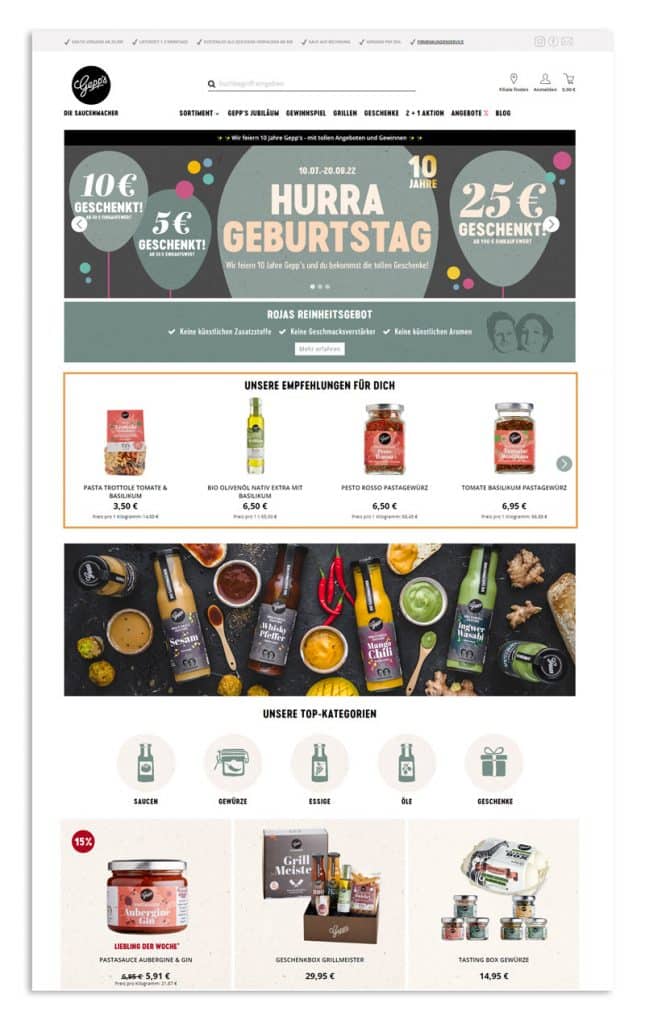
With the help of artificial intelligence, personal product recommendations can be displayed, such as here in Gepp's online shop.
(Source: Screenshot from gepps.de)
As a holistic approach, customer experience management is designed for the long term. This should also be reflected in the key performance indicators you define for your CXM. Think about your KPIs from the customer's perspective: How do they define success?
Short-term goals such as awareness, increased traffic, and conversions are only one side of the coin. In the long term, the focus is on:
With the help of these key figures, you can substantiate the value of successful customer experience management for your company and justify the necessary budgets.
Stay up to date on personalization: Sign up for the Epoq newsletter. Register now!
This brings us full circle: customers are the focus of customer experience management. That's why their feedback is essential for continuously improving the customer experience. Regularly ask your customers about their experiences with your brand at various touchpoints. You can do this through online surveys, personal conversations, or feedback on social media, for example. Be happy about praise and work on any points of criticism to further optimize the customer experience for your customers.
In times when customers are highly likely to switch between online stores and loyalty is declining, you need a strategy to make your brand stand out from the crowd. This is the only way to survive in the highly competitive e-commerce market in the long term, retain customers, and increase your sales. Take the time with your team to define a holistic customer experience strategy with clear goals and make adjustments along the way to ensure your customers have an outstanding experience.
Customer experience management is a holistic approach that places customers at the center of all business activities. The goal is to provide them with outstanding customer experiences that increase their satisfaction with products and services and their loyalty to the company.
Traditional customer relationship management (CRM) focuses on internal improvement processes. The primary focus is on customer relationships. Customer experience management (CXM), on the other hand, deals with customer expectations and attempts not only to meet them, but to exceed them.
When you successfully implement CXM in your online shop, you not only increase awareness, traffic, and conversions, but also strengthen customer loyalty to your brand in the long term. Loyal regular customers ensure regular sales and also recommend your shop to family and friends free of charge. CXM therefore clearly sets you apart from your competitors.
Since CXM is a holistic concept, you need a concrete vision and a strategy with clearly defined goals and milestones. You should also try to involve all internal departments in customer experience management in order to optimize the customer experience at all touchpoints.
There are specialized CXM platforms where you can centrally store and access all information about your customers. Individual tools, such as chatbots or virtual assistants, also support customers at each touchpoint, thereby ensuring an engaging customer experience.
Want to learn more about personalization in e-commerce?
Then get our guide!

You are currently viewing placeholder content from HubSpot Embedded Content. To access the actual content, click the button below. Please note that doing so will result in data being shared with third-party providers.
More InformationYou are currently viewing placeholder content from HubSpot. To access the actual content, click the button below. Please note that doing so will result in data being shared with third-party providers.
More InformationYou are currently viewing placeholder content from HubSpot Meetings. To access the actual content, click the button below. Please note that doing so will result in data being shared with third-party providers.
More Information