
E-book – Personalization in E-commerce
In this e-book, you will learn why personalization is important in e-commerce and what the term personalization actually means.

E-commerce technologies are increasingly adapting to rising customer demands. This is where cloud-based and hyper-flexible headless commerce systems come into play. With "headless" IT architecture for professional e-commerce, unlimited customization options are possible on the front end—and all without any hassle or need to intervene in the back end. This opens up new possibilities for creating personalized shopping experiences – on all devices and channels. In this article, we'll show you exactly what the headless approach entails and why this topic is only now becoming so prominent in e-commerce.
Here'swhatyou can expect to find in this blog article:
The flexible world of limitless user experience
What is headless commerce?
How does headless commerce work?
How does it differ from traditional platforms?
Impact of constantly changing requirements and developments on e-commerce
How does headless commerce help meet rising customer expectations?
Why is this topic only now becoming so prominent?
What are the advantages of headless commerce?
Are there any disadvantages?
For whom does this approach make sense?
Conclusion: Customers want to enjoy online shopping at all touchpoints
The exciting thing about headless commerce is the endless variety of functional modules that can be used on the presentation area of an online shop. And that without having to make time-consuming adjustments to the backend. This means that tools for a better customer experience can also be easily tested.
"Headless" is a term from IT architecture and means that the front end of a portal is decoupled from its back end. The presentation area of the online shop is therefore completely independent of the business processes in the background. This independence allows you, as an e-commerce professional, to add plug-ins, services, and marketing tools from a wide variety of providers to the user interface without having to customize the backend or worry about negative effects on the rest of the system.
Stay up to date on personalization: Sign up for the Epoq newsletter. Register now!
With a headless CMS, you can expand the user interface of your online shop as you wish and enrich it with new surprises for users. This opens up enormous flexibility: with a minimum of cost-intensive backend development, you can try out functional modules and thus react quickly to market trends and the preferences of your customers. There are practically no limits to your desire to experiment.
The core elements of a headless CMS are cloud-based programming interfaces called APIs (application program interfaces). You can think of them as the studs on Lego bricks. They effortlessly connect a wide variety of customer experience modules and are endlessly compatible with old, new, and future touchpoints and channels. Changes can be made quickly and easily on the user interface without having to adjust the database or change the checkout process for a small change, such as adding a new form field to the user account.
What's more, APIs are extremely lightweight, meaning that headless commerce architecture is not only exceptionally agile, but also fast and powerful. This makes APIs the driving force behind outstanding store performance. Your customers surf through a consistent brand and shopping experience across different channels, with components provided by various third-party platforms—and you benefit from increased conversion rates and sales!
5 examples of headless commerce platforms are:
Classic CMS platforms are monolithic systems (i.e., an inseparable unit) that are equipped with relatively fixed content, components, and features. In these systems, the front end is closely linked to the backend code and infrastructure. For example, if data is changed in the backend, it can be displayed immediately in the front end. With this approach, the same software is responsible for storing, processing, and displaying data.
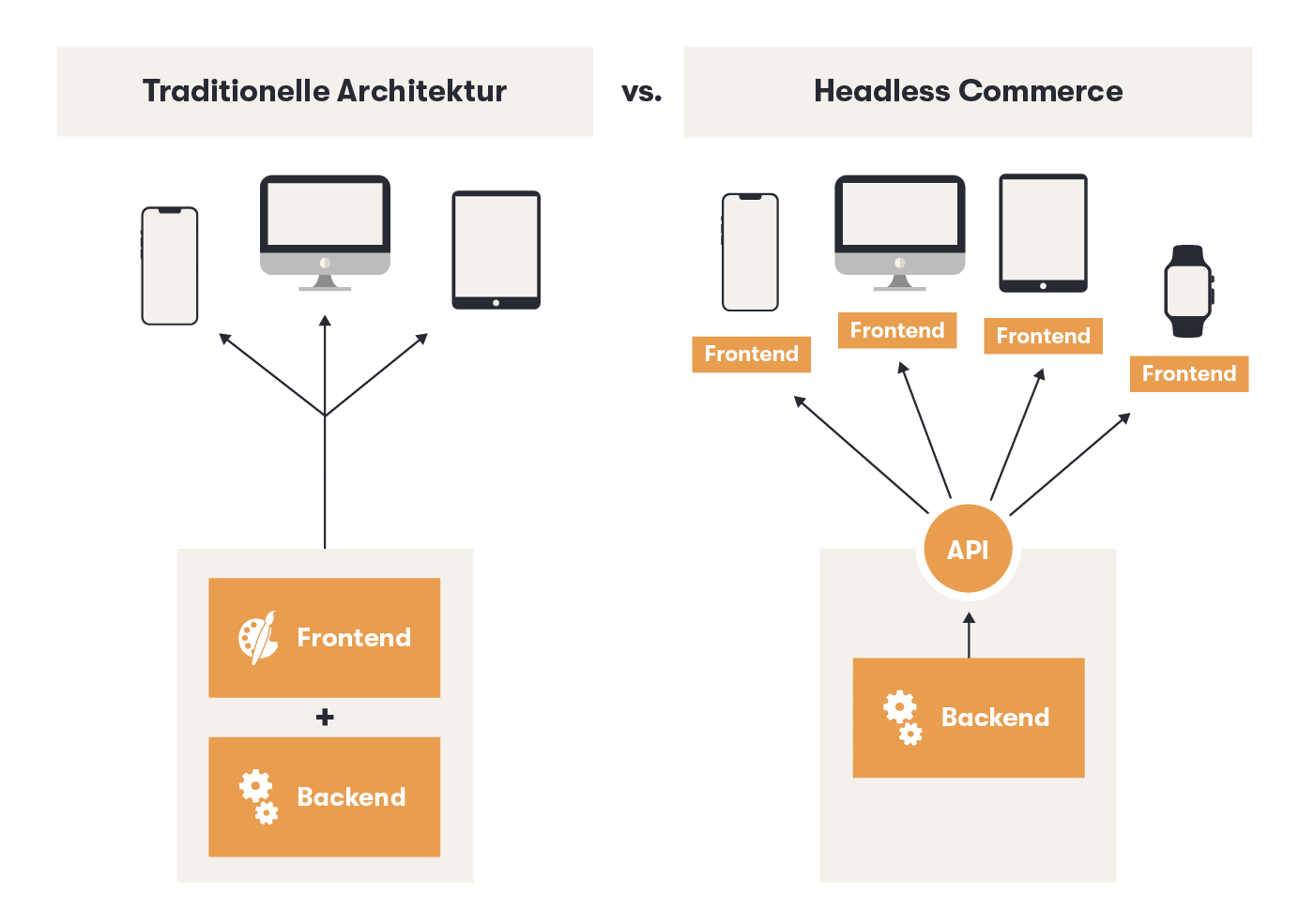
Compared to headless commerce, traditional architecture closely links the front end with the back-end code and infrastructure. (Source: Own representation)
While this is convenient, this "one size fits all" approach also comes with many limitations: every functional enhancement involves time-consuming restructuring throughout the entire system. A change in one place must also be laboriously made individually for all other touchpoints if you want to ensure a consistent shopping experience. Not to mention the usual technical problems and frequent difficulties when installing updates. So, with a traditional e-commerce system, you only have limited scope for customization.
With headless commerce, on the other hand, the CMS is much more flexible. You are no longer tied to a limited number of applications, but can choose exactly the functional modules you need at any given time to best address your target groups from a large repertoire of APIs – and replace them again without much effort. Search functions, product visualization, and checkout, for example, can come from different providers. This enables a kind of best-of-breed approach. The complexity and bulkiness of headless CMS are significantly reduced compared to the traditional model.
But be careful! When it comes to personalization, a best-of-breed approach is not necessarily recommended. Instead, personalization from a single source is more advantageous, as it allows the individual touchpoints along the customer journey to be personalized in a consistent manner and based on the same database. This prevents personalization breaks and eliminates the need for coordination between providers regarding the database and personalization strategy. You can find out more about this in our blog article Best of Breed in the Context of Personalization in E-Commerce.
At the heart of today’s e-commerce are constantly evolving, relevant interactions that promise truly unique shopping and service experiences—such as AI-powered, personalized shopping experiences that go far beyond the typical “customers who bought X also bought Y” approach. Headless commerce is ideal for responding flexibly to rising customer expectations and continually surprising users.
Headless commerce is the perfect answer to the biggest challenge currently facing e-commerce: the rising demands of a clientele that quickly becomes bored. Customers want to feel courted and personally addressed. This means that the user experience must be continuously individualized in order to increase brand loyalty and repurchase rates.
In addition, it is becoming increasingly important to cover all touchpoints and sales channels where customers can be found as seamlessly as possible. Multi-channel sales have rapidly gained in importance. This is because users are more likely to buy a product if they see it more often in different places. It has therefore become normal to expand reach by connecting online shops to social media platforms or large e-commerce portals such as Amazon, Etsy, or eBay. Addressing customers via voice commerce, smartwatches, and augmented reality is also becoming increasingly common.
Here, too, headless commerce can show what it can do. In the form of microservices, new sales channels can be quickly set up and tested. Product photos, videos, or blog posts can be transferred to any channel—even refrigerators with screens. And real-time personalization is not only fueled in online shops, but also in mobile apps and on social channels.
The question now arises as to why the headless approach is so prevalent in e-commerce right now. After all, the technical approach of separating the backend from the frontend is not really a new one. However, more and more e-commerce retailers and shop operators are discovering the associated advantages and opportunities for their businesses. But why only now? One reason for this is that many e-commerce platforms were developed in the desktop screen era with web browsers. The idea that desktop browsers would be the focus for e-commerce was virtually built into the architecture of the sites. This view is more than outdated, and we now have "mobile first" or use Google Home or Amazon Echo. Today, we shop directly on social networks such as Instagram, and more and more digitally enabled and connected devices are certainly being added. This is an important reason for e-commerce retailers to increasingly rely on the headless commerce platform model.
As you can see, headless commerce is a wonderful playground for those who want to stay ahead of the competition and not only take advantage of relevant developments in e-commerce, but also help shape them.
Instead of a rigid system architecture, headless commerce promises much greater flexibility in tailoring individual customer communications and simplifying the rollout of digital sales processes across all channels. This results in a number of advantages in an increasingly competitive market.
To summarize the advantages once again:
All this makes headless commerce a powerful, agile system that can be used to successfully increase conversion rates and brand awareness. Never before has there been a CMS that has allowed new channels, markets, regions, and even countries to be tapped into so quickly and efficiently.
So far, this sounds like a lot of fun. But to be completely honest: where there is so much light, there is of course also shadow. Headless commerce, for example, lacks a feature that e-commerce professionals greatly appreciate in traditional CMS: the preview of content, which allows them to see at a glance how it will look on the end user's device or screen.
This is not possible in a headless CMS. Since the components are completely separate, the backend does not know how the content should be presented in the frontend. Want to quickly add content and photos yourself in the do-it-yourself editor? Not possible. With headless CMS, developers create frontends that are tailored to each device and channel.
Which brings us to the next major disadvantage of headless systems: when adding new content, you are much more dependent on the support of an IT team. And that can be quite costly.
Headless commerce offers many opportunities to try out new customer experience technologies and make e-commerce more exciting. The fact is that headless systems are becoming increasingly popular among e-commerce experts and large online retailers.
However, if you don't have the budget to continuously try out brand-new multi-touchpoint strategies and don't need highly flexible front-end processes, you may be better off with classic shop software. The headless approach is more suitable for successful shops that want to climb to the next level of e-commerce and make a real leap forward.
Stay up to date on personalization: Sign up for the Epoq newsletter. Register now!
If you run a small shop and are happy with it, keep up to date with what's happening in the market and what suits your target group. Staying unique is more important than chasing new trends and possibly losing your head in the process.
Headless commerce is up to the task, as it offers customers a consistent brand and shopping experience across all channels. That's why many companies will undoubtedly jump on the headless bandwagon soon. If you have big plans and want to build a strong business with a stable customer base and good sales, headless commerce is probably the way to go.
The defining feature of headless systems is the decoupling of the front end and back end.
You can try out new function modules for the user interface without having to readjust the backend at the same time.
The customer experience, because a headless CMS makes it easier to experiment with tools for personalization and improved usability. These can also be easily deployed on all devices and channels, so that the customer can be reached consistently at all touchpoints. Since headless systems are lightweight, shop performance is also improved.
Headless systems are becoming increasingly popular with e-commerce retailers who want to make the shopping experience more exciting, thereby positioning themselves ahead of the competition and helping to shape relevant developments in e-commerce.
With a headless CMS, the front ends are edited by developers. It is not possible to preview them from the back end. If you want to work with a do-it-yourself editor and remain independent of an IT team, you may be better off with classic shop software.
Learn more about the hidden secrets of personalization in e-commerce in our e-book.

You are currently viewing placeholder content from HubSpot Embedded Content. To access the actual content, click the button below. Please note that doing so will result in data being shared with third-party providers.
More InformationYou are currently viewing placeholder content from HubSpot. To access the actual content, click the button below. Please note that doing so will result in data being shared with third-party providers.
More InformationYou are currently viewing placeholder content from HubSpot Meetings. To access the actual content, click the button below. Please note that doing so will result in data being shared with third-party providers.
More Information